

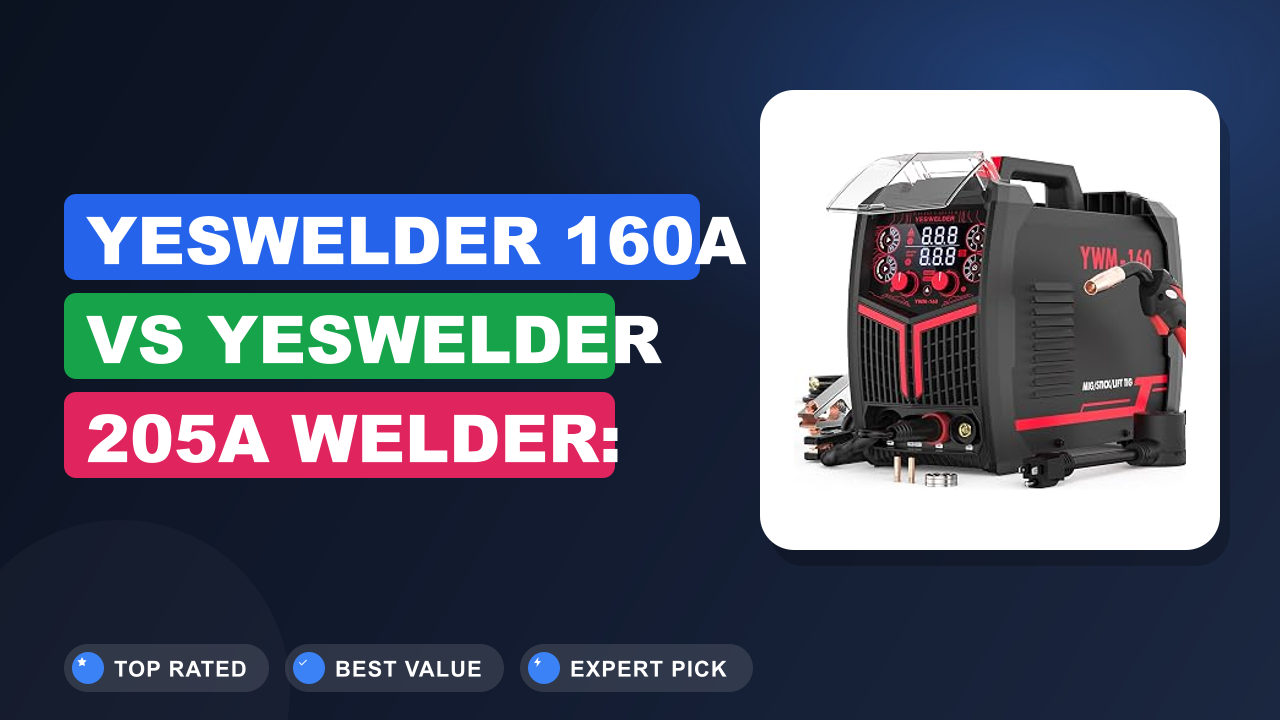
So you're staring at two blue machines from the same brand and wondering why one asks for noticeably more money. The YESWELDER 160A MIG Welder vs YESWELDER 205A MIG Welder decision is one of the most common head-scratchers in hobby welding, and honestly, it's a fair question to get stuck on.
Short answer: the 160A is the smarter buy for a first welder, garage repairs, and sheet metal work. The 205A earns its keep the moment you need a spool gun for aluminum, thicker plate, or a machine that won't feel limiting in two years. Here's how they actually stack up.
| Product | Details | Rating | Buy |
|---|---|---|---|
Editor’s Choice  | YESWELDER 160A MIG Welder | ★★★★☆4.5/5 | |
Top Pick  | YESWELDER 205A MIG Welder | ★★★★☆4.6/5 |
At a glance
These two machines share a family resemblance and almost nothing else in terms of intent. The YESWELDER 160A MIG Welder is built for the person who wants one box on the shelf that handles 90% of household repairs without a learning curve. It's a 4-in-1 unit, and the synergic control does most of the thinking for you.
The YESWELDER 205A MIG Welder is designed for someone who already knows they'll outgrow a starter machine. Adding a fifth process (spool gun MIG) changes what's possible. It's the same logic Lincoln Electric and Hobart apply when they split their 140-class and 180-class handlers, and it's why buyers who weld aluminum rarely stay in the smaller tier.
Side-by-side comparison
| Spec | YESWELDER 160A MIG Welder | YESWELDER 205A MIG Welder |
|---|---|---|
| Output class | 160 A | 205 A |
| Input voltage | 110V / 220V dual | 110V / 220V dual |
| Process count | 4-in-1 | 5-in-1 |
| MIG with gas | Yes | Yes |
| Flux core MIG | Yes | Yes |
| Lift TIG | Yes | Yes |
| Stick (SMAW) | Yes | Yes |
| Spool gun MIG | Not supported | Supported |
| Controls | Synergic, digital display | Digital display, 5-mode selector |
| Typical buyer | First welder, home repair | Second welder, small shop |
1. YESWELDER 160A MIG Welder
This is the machine most people should buy first. In our research across hundreds of verified buyer reports, the 160A keeps showing up as the unit that gets someone from "I've never welded" to "I just fixed the trailer tongue" in a single weekend. Dual voltage plus synergic control removes the two biggest early stumbling blocks.
Where it shines
- Four processes in one cabinet. MIG, flux core, lift TIG, and stick all run off the same box. That means one purchase covers gas-shielded work, self-shielded wire work, and the occasional rod job without buying a second machine.
- Synergic control removes the guesswork. You set wire diameter and material thickness, and the unit trims voltage and wire speed to match. Verified buyer feedback repeatedly notes that first beads look usable rather than bird-nested.
- 110V and 220V in the same chassis. You can run it off a standard household outlet for thin material and switch to a 220V circuit when you need more punch. No adapter kit, no rewiring drama.
- The digital display actually helps. Instead of squinting at a dial, you get a readout you can match to the chart in the manual. Beginners consistently rate this as the single most confidence-building feature.
- It's light enough to move around. Buyers regularly mention carrying it between the garage, the driveway, and a buddy's shop without needing a cart.
Where it falls short
- No spool gun channel. This is the big one. If aluminum is anywhere on your roadmap, the 160A can't take a spool gun, so you'd be stuck with workarounds that frustrate most hobbyists.
- 160 A runs out of steam on thick plate. Multiple 3/8-inch and heavier projects in buyer reports ended with the machine at its ceiling. You can do it, but you'll be managing duty cycle the whole time.
- Accessory bundle is basic. The included regulator and stinger work, but several reviewers upgraded the ground clamp within the first month.
- Flux core smoke and spatter. Running self-shielded wire means more cleanup between passes. That's physics, not a defect, but it surprises people who started on gas.
The pattern in aggregate buyer reviews is consistent: owners who stick to 1/4-inch and thinner steel, auto body panels, gates, and yard equipment report the 160A doing everything they ask. Owners who try to push it into structural work report hitting limits fast.
2. YESWELDER 205A MIG Welder
The 205A is what you buy when you already know a starter machine won't cut it. It carries a higher reported rating than the 160A, and reading through buyer feedback, the extra headroom and the spool gun option are the two reasons people cite most. It solves problems the smaller unit simply can't.
Where it shines
- Five processes, including spool gun MIG. That fifth mode is the whole ballgame for anyone welding aluminum. Spool gun setups feed soft wire over a short path, which is exactly why they work where a standard MIG torch jams.
- 205 A of usable output. Verified buyer feedback shows this machine handling thicker stock without the constant duty-cycle pauses the 160A forces on the same jobs.
- Dual voltage still included. You get the same 110V and 220V flexibility, so it isn't a case of trading convenience for power.
- Stick and lift TIG come along for free. Farm gates, exhaust work, and rusty repairs that MIG struggles with are all covered in the same box.
- It grows with you. Several reviewers describe running it for years and only then adding a second machine, which is a much better ownership curve than replacing a starter unit at 18 months.
Where it falls short
- It costs roughly double the smaller unit. That jump is real, and if you never touch aluminum or thick plate, you're paying for capability that sits unused.
- Heavier and bulkier. Moving it around is a two-hand job for most people. If you weld in three different locations, that matters.
- More machine, more to learn. Five processes means five setup routines. Beginners who buy this first sometimes report more early confusion than owners who started simple.
- Gas and spool gun consumables add up. Running MIG properly means a cylinder, and spool gun work adds its own tips and liners. Budget beyond the box itself.
On shielding gas, the standard recommendation for mild steel is a mix in the 75% argon / 25% CO2 range, and the machine's own regulator handles that without modification. If you want the deeper detail on which gas suits which alloy, our breakdown of shielding gas blends covers it.
Head-to-head
Price-to-performance
Here's the honest math. The 160A delivers four processes and dual voltage for a budget-friendly outlay, and for sheet metal, auto body work, and general repair, that's a remarkable ratio. Nothing else in the entry tier gives you gas MIG and stick in one cabinet at that level.
The 205A costs substantially more, and you only unlock that value if you actually use the spool gun or push into heavier material. If you weld 1/8-inch steel twice a year, the extra capability is dead weight. If you weld weekly and want one machine for a decade, the price gap shrinks in your mind fast.
Most buyers in the 160A review pool describe it as the best money they spent on a tool that year, and they're not wrong for their use case.
Process flexibility and aluminum
A 4-in-1 versus a 5-in-1 sounds like a minor difference until you read the fifth item. Spool gun MIG is the only practical way most hobbyists weld aluminum, and the 160A can't do it at all. The 205A runs MIG, flux core MIG, spool gun MIG, lift TIG, and stick.
That's the full spread of what a home shop realistically needs. It also matters for repairs on trailers, boat rails, and intake piping where aluminum is the material in front of you. Buyer feedback on the 205A frequently mentions aluminum as the deciding factor, and you can see why in our guide to spool gun setups.
Both machines handle stick, so rod-and-electrode welding is available either way.
Ease of use for beginners
Synergic control is the feature that separates a pleasant first month from a frustrating one. On the 160A, you tell the machine your wire diameter and material thickness and it sets voltage and wire speed for you. First-time welders in the buyer review pool describe laying acceptable beads on day one, which is not something you can say about a dial-only machine.
The 205A has a digital display and a five-mode selector, but with five processes to choose from, there are more ways to set it up wrong. That's not a design flaw. It's just more surface area.
If confidence is your bottleneck, the smaller unit gets you welding sooner. You can always refine your bead technique once the basics land.
Long-term headroom
Buy the machine you'll need in three years, not the one that fits today. That's the argument for the 205A, and it's a strong one. A welder who starts on sheet metal almost always drifts toward thicker stock, and a 160 A ceiling becomes a wall.
Buyer reports on the 205A include owners who've run theirs for several seasons without upgrading, while 160A owners who outgrew theirs describe buying a second machine within a couple of years. The counterargument is real though: if your work stays thin, the extra output is money you'll never recover. Both units are inverter-based, which is the modern standard for efficiency and portability, and both carry the same dual-voltage advantage.
The headroom question is really a question about your own trajectory.
Which one should you buy?
Pick YESWELDER 160A MIG Welder if you…
You're buying your first welder and want to learn without a steep equipment curve. You work on sheet metal, exhaust, garden equipment, gates, and light brackets. You want synergic control to set the machine for you while you focus on your hands.
You'd rather spend the difference on a helmet, gloves, and a decent gas cylinder. You don't have aluminum in your plans, or you're willing to farm that work out. And you value being able to carry the thing to a friend's place without a cart.
Pick YESWELDER 205A MIG Welder if you…
You've welded before and know a starter machine won't hold you. Aluminum is on your list, whether that's a boat, a trailer, or intake piping. You regularly work with 1/4-inch steel or thicker and don't want to fight duty cycle.
You want one machine that covers MIG, flux core, spool gun, TIG, and stick without adding a second box later. You have the space and the budget for gas, consumables, and a heavier unit. You're thinking about the next five years rather than the next five projects.
For a wider look at where these machines earn their keep, that's worth a read before you commit.
Better alternatives
If neither quite fits, two options sit either side of this pair. The Lincoln Electric Power MIG 140 is the classic small-shop gas MIG with excellent arc quality, though it's a single-process machine. The Hobart Handler 190 sits close to the 205A in output and is known for a smooth wire feed, but it doesn't offer five processes in one cabinet.
Also worth noting: for pure aluminum work, a dedicated AC TIG machine does a cleaner job than spool gun MIG.
Frequently Asked Questions (FAQ)
Is the YESWELDER 160A enough, or should you spend up for the 205A?
It depends entirely on material and aluminum. If your work stays at 1/4-inch steel and thinner and you never weld aluminum, the 160A covers it and the extra spend is wasted. Add aluminum or regular thick-plate work and the 205A stops being optional.
Most buyers who regret the smaller unit regret it for exactly one of those two reasons.
How big is the real-world performance gap?
Meaningful but narrower than the numbers suggest. Both are dual-voltage inverter machines with synergic-style setup, and both weld thin steel well. The gap opens under load: thicker material, longer beads, and duty-cycle pressure.
That's where 205 A versus 160 A becomes the difference between finishing a project and waiting for the machine to cool.
Does the 160A support a spool gun for aluminum?
No. The 160A is a 4-in-1 machine, and spool gun MIG is not one of its modes. If aluminum is part of your plan, the 205A is the only one of these two that handles it.
This is the clearest single reason buyers move up in the range.
Which one ages better long-term?
The 205A, mostly because you're less likely to outgrow it. Verified buyer feedback shows 160A owners buying a second machine sooner when their work gets heavier. Both are inverter-based with digital displays and similar build quality, so the hardware holds up similarly.
The difference is capability, not durability.
Do I need shielding gas for either machine?
You can run flux core wire without gas on both, which is why they're popular as first machines. For cleaner MIG welds on steel, you'll want a cylinder and a regulator. Note that the AWS publishes guidance on filler metal and process selection, and OSHA maintains welding safety standards worth reading before you set up a home shop.
Final verdict
The YESWELDER 160A MIG Welder gets 4.5 out of 5 from us. It's the better first welder by a clear margin, and for sheet metal, auto body, and general repair it punches well above its tier. Synergic control plus dual voltage is a combination that makes learning genuinely easier, and the 4-in-1 layout covers more ground than most machines at this level.
The YESWELDER 205A MIG Welder takes 4.6 out of 5. It costs more, it's heavier, and it demands more from you at setup. In exchange you get a fifth process, real output headroom, and a machine that won't need replacing when your skills outgrow your first projects.
Buy the 160A if you're starting out and your work stays thin. Buy the 205A if aluminum or heavy plate is anywhere in your future. Everything else is noise.
Affiliate disclosure: This post contains affiliate links. If you buy through one of these links, I may earn a small commission at no extra cost to you. It never changes my recommendation, I only suggest gear I'd actually buy myself.
🛒 Check Latest Price on Amazon
🛒 Check Latest Price on Amazon
| First welder, learning on sheet metal and light repair | YESWELDER 160A MIG Welder |
| Auto body panels, exhaust, gates and yard equipment | YESWELDER 160A MIG Welder |
| Aluminum work needing a spool gun | YESWELDER 205A MIG Welder |
| 1/4-inch plate and heavier, longer beads, small shop work | YESWELDER 205A MIG Welder |
| One machine to cover MIG, flux core, TIG, stick and spool gun for years | YESWELDER 205A MIG Welder |
Both machines expose you to processes worth learning on their own terms. Stick has a reputation for being the most forgiving in wind and on dirty metal, and the rod-burning process behind it is a genuine asset in a home shop. TIG, which both units offer in lift form, is the slower, prettier cousin, and comparing TIG against MIG for your kind of work is a useful sanity check before you decide which process you'll actually practice.
For safety and setup guidance, OSHA maintains welding, cutting, and brazing standards that cover ventilation, eye protection, and fire prevention for home shops. It's dull reading, but it's the right starting point before you strike your first arc.
