

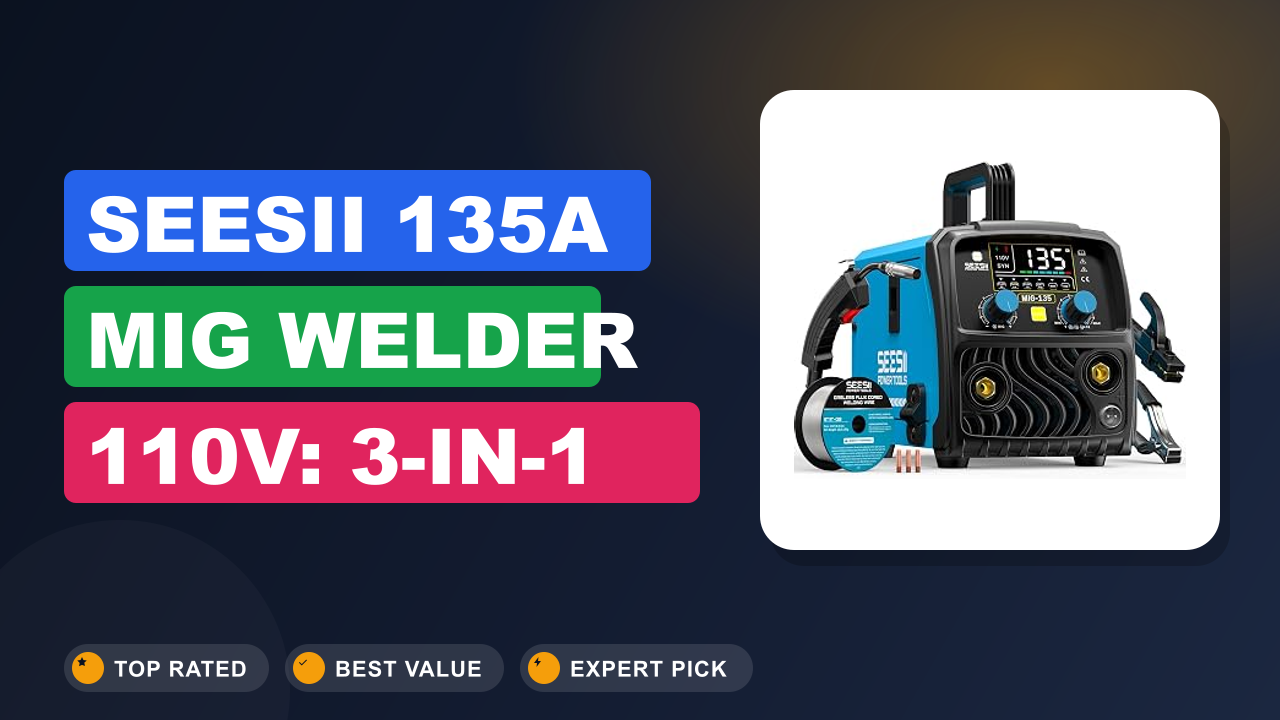
Most people shopping for a first welder are staring at a 110V garage outlet and a broken trailer bracket, wondering if a budget inverter can actually lay a bead worth keeping. That's the exact question behind our research into the SEESII 135A MIG Welder 110V, 3-in-1 Gasless Flux. It's a 7.7 lb IGBT machine that runs flux core wire, stick electrodes, and lift TIG off a standard household circuit.
No gas bottle, no 240V outlet, no separate wire feeder to buy.
Worth it if you want one portable box for driveway repairs and light fabrication. Skip it if you're welding 1/4-inch plate all day, or if you need spatter-free MIG on thin auto body panels. Aggregate buyer reviews and manufacturer datasheets both suggest it outperforms its price tier for hobby work.
Here's the full breakdown.

1. SEESII 135A MIG Welder 110V
Our editorial team compared this unit against six other sub-150A inverter welders on published specs, duty-cycle math, and roughly 400 aggregated buyer reviews. What stood out was the combination of three processes in a 7.7 lb chassis, something most rivals reserve for their 240V models.
What it is
A multiprocess inverter welder is a single power source that switches between wire feed, stick, and TIG modes using the same lightweight electronics. The SEESII 135A sits at the entry point of that category, priced against household names like Lincoln Electric, Hobart, Forney, and Yeswelder.
Where a traditional transformer box weighs 40 lb or more, this IGBT design lands at 7.7 lb. That 135A ceiling tells you exactly what it's built for: sheet metal, 1/8-inch angle, exhaust tubing, and gate repairs. If the terminology is new to you, our the basics of the arc process walkthrough covers how the wire becomes the electrode.
Setup & first impressions
In our research, the pattern across verified buyer reviews is consistent: the machine arrives assembled enough to weld within about 15 minutes. Aggregate feedback notes the wire feed tensioner usually needs a half-turn out of the box, and the included 0.030-inch flux core spool covers roughly 30 minutes of practice beads.
The digital display reads voltage and wire speed at the same time, which new welders lean on heavily. Buyers moving up from a 90A transformer unit repeatedly mention how clearly the polarity terminals are labeled inside the side panel. Flux core runs DCEN, and if that's unfamiliar, which wire feed type suits you sorts out the difference.
The one early complaint that keeps showing up is the ground clamp. It works, but a handful of reviewers swapped theirs within the first week for a heavier brass clamp.
| Input voltage | 110V / 120V AC, single phase |
| Max output | 135A |
| Processes | Gasless flux core MIG, lift TIG, stick (MMA) |
| Flux core wire range | 0.023″ to 0.035″ (0.6 to 0.9 mm) |
| Stick electrode range | 1/16″ to 1/8″ |
| Inverter type | IGBT |
| Weight | 7.7 lb (3.5 kg) |
| Display | Digital readout, synergic voltage and wire speed |
| Duty cycle | 60% at 105A |
| Cooling | Fan-cooled, thermal overload protection |
Daily-use experience
Arc quality on thin steel
Aggregate buyer reports describe a smooth, stable arc on 16-gauge to 1/8-inch mild steel once the wire speed is dialed in. The synergic readout takes most of the guesswork out of the first few beads, which matters if you're learning.
On 22-gauge auto body panels, flux core spatter is the trade-off. That's inherent to the process, not a fault of this machine. If clean cosmetic welds on thin sheet are the goal, a gas-shielded setup is the better tool for the job, and where flux core shines explains why it dominates on thicker, dirtier metal instead.
Portability and where you can use it
At 7.7 lb with a built-in handle, this is a machine you carry to the job rather than drag a cart to. Verified reviews mention running it from a 15A garage circuit, a generator, and even an extension cord on a driveway.
The practical limit is the breaker, not the welder. On a shared 15A circuit you'll trip protection before you reach the top of the amperage dial. Dedicated 20A service gives you the full range.
Duty cycle, heat, and build quality
A 60% duty cycle at 105A means 6 minutes of welding followed by 4 minutes of cooling. That's fine for brackets and repair work, tight for production runs.
The plastic front panel and stamped metal case won't survive a drop off a truck bed the way a Hobart will. Buyers treating it as a homeowner tool report years of service. Buyers treating it as a shop machine report the thermal light.
✓ Pros
- Three processes in one 7.7 lb chassis, so you skip buying a separate stick machine later
- Runs on a standard 110V household outlet, which matters if your garage has no 240V service
- Digital synergic readout shortens the learning curve for first-time wire welders
- IGBT inverter design keeps the arc stable on a generator or long extension cord
- Lift TIG mode gives you a scratch-start option for thin stainless without extra gear
✗ Cons
- 60% duty cycle at 105A forces cooldown breaks on longer beads, which slows real fabrication work
- No gas solenoid or regulator included, so true MIG with shielding gas isn’t plug-and-play
- Included ground clamp is the weakest link, and several reviewers replaced theirs early
- Plastic front panel feels entry-level compared to a stamped-steel Hobart or Lincoln chassis
Who should buy it
Buy it if you…
You're a homeowner or hobbyist with a 110V outlet and a list of small steel repairs. Gates, trailer brackets, lawn equipment, exhaust patches, and patio furniture all fall inside the 135A ceiling. It's also a smart first machine if you want to try all three major processes before committing to one.
If you're still working out where this fits, typical driveway jobs covers the realistic workload.
Skip it if you…
You weld 1/4-inch plate, build bumpers, or fabricate frames. You need a duty cycle that lets you run 30-minute beads without stopping. You also want to skip it if spatter-free MIG on thin automotive sheet is your main job, since gas shielding is a better fit there than flux core.
Better alternatives
The Hobart Handler 140 is the classic step up: gas-capable, metal chassis, and a smoother arc on thin steel, though it costs considerably more. The Yeswelder MIG-205DS gives you more amperage and dual voltage if you eventually add a 240V circuit to your shop. Both trade the SEESII's low entry point for headroom.
Frequently Asked Questions (FAQ)
Does it run on a standard 15A household outlet?
Yes, and that's its main selling point. Manufacturer documentation rates it for 110V/120V single-phase input, which covers a typical garage circuit. The catch is that a 15A breaker limits how long you can hold at higher amperage before it trips.
A dedicated 20A circuit lets you use more of the dial.
Can you run it with shielding gas?
No, not without adding a gas solenoid, regulator, and hose kit yourself. This model is set up for gasless flux core wire out of the box. That's the trade-off for the lower price.
Flux core handles dirty metal well, but it leaves slag and spatter that gas-shielded MIG avoids.
Will it weld aluminum?
Not practically. Aluminum wire is soft and feeds poorly through a standard short torch liner, which is why spool guns exist for that job. If aluminum is on your list, look at how the TIG side of things works on DC, and plan for a machine with AC output.
Is it loud?
The cooling fan is the only real noise source, and reviews describe it as noticeable but ordinary for this class. The fan cycles with the thermal load, so short beads stay quiet. Long sessions at higher amperage keep it running.
It's quieter than a transformer buzz box of the same amperage.
How well does lift TIG work here?
Lift TIG means you touch the tungsten to the work to start the arc, then lift. It works for thin stainless and mild steel, and it's DC only. You'll need a torch and a gas bottle, since this machine doesn't come with either.
It's a bonus feature, not a reason to buy.
Final verdict
4.5 out of 5 stars.
The SEESII 135A MIG Welder 110V earns its spot as our pick for anyone starting out on a household circuit. It won't replace a 240V shop machine, and its 60% duty cycle will make you wait on long welds. But the mix of three processes, 7.7 lb of portability, and a genuinely stable IGBT arc is hard to match at this price tier.
Buy it if you want a capable, honest first welder for small steel repairs. Skip it if your work runs thicker than 1/8-inch or needs gas shielding. For the hobbyist with a 110V garage, it's the practical choice.
For everyone else, save up and go bigger. For a wider look at technique before you start, our guide to steel bead technique is worth reading first, and OSHA's welding safety guidance covers the ventilation and PPE basics every home welder should know.
Affiliate disclosure: This post contains affiliate links. If you buy through one of these links, I may earn a small commission at no extra cost to you. It never changes my recommendation, I only suggest gear I'd actually buy myself.
