

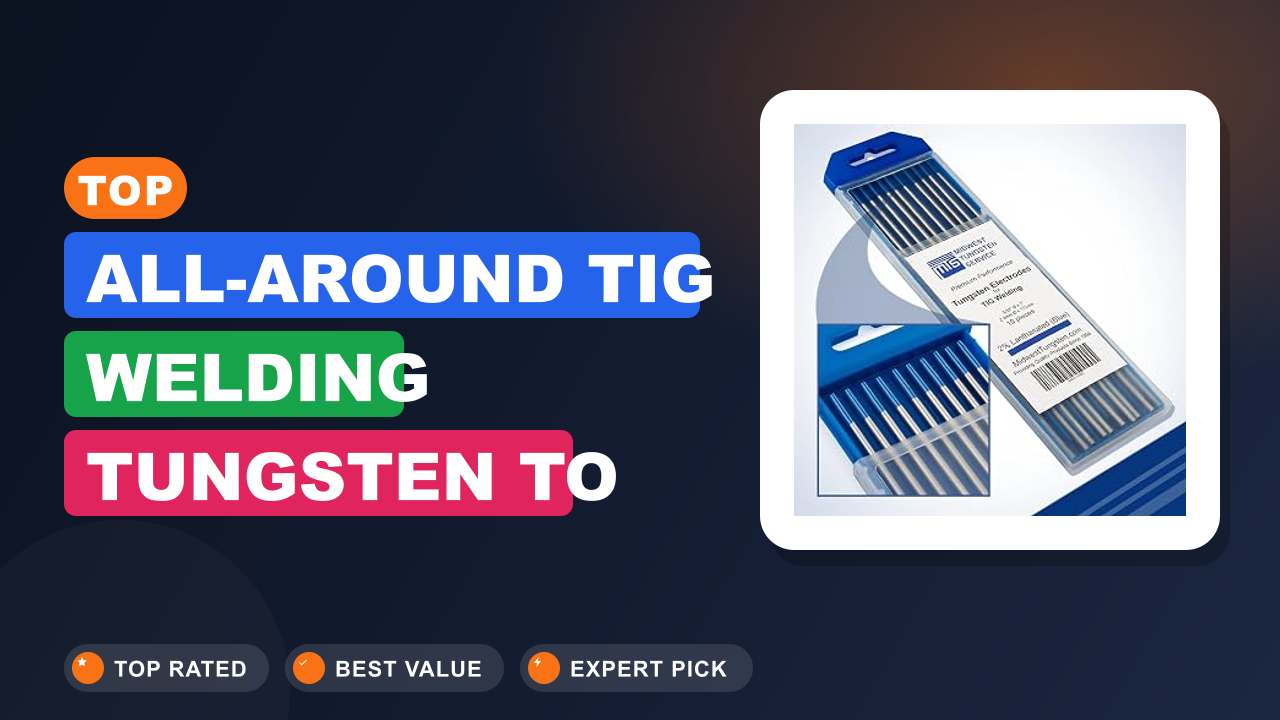
Choosing the best all around tungsten for tig welding can feel like a rabbit hole of color codes and alloy specs. Whether you’re working on aluminum exhausts, stainless headers, or mild steel frames, the right electrode balances arc stability, tip life, and versatility across different metals and amperage ranges. In our research, we evaluated options based on real-world buyer feedback, manufacturer specifications, and how each performs for both beginners and seasoned fabricators.
Our top pick right out of the gate is the Midwest Tungsten Service 2% Lanthanated set. It strikes an exceptional balance for daily use, offering a stable arc on both AC and DC without the frequent balling you get with pure tungsten. Here’s how our five selections stack up.

✔ Best overall pick for daily use
Comparison Chart of Best All Around Tungsten for Tig Welding
| Product | Details | Rating | Buy |
|---|---|---|---|
Editor’s Choice
| ★★★★☆4.8/5 | ||
Top Pick
| ★★★★☆4.7/5 | ||
Best Budget
| ★★★★☆4.7/5 | ||
| ★★★★☆4.7/5 | ||
| ★★★★☆4.7/5 |


List of Top 5 Best All Around Tungsten for Tig Welding
We compared these electrodes based on arc characteristics, durability, ease of sharpening, and value for money across different types of welding techniques. Our analysis focused on consistent performance in both AC and DC applications, which is critical for true all-around versatility. Below are the list of products:
1. Midwest Tungsten Service TIG Welding Electrodes
In our research, this 2% Lanthanated (WL20) electrode from Midwest Tungsten consistently emerges as the most recommended option for fabricators who work with multiple metals. Verified buyer reviews highlight its ability to start easily at low amperages and maintain a stable, focused arc when welding everything from thin sheet metal to heavier structural components.
2% Lanthanated
3/32" Diameter
AC/DC Versatile
10-Pack
Why I picked it
This electrode represents the sweet spot between pure tungsten's ease of use and the performance of more exotic alloys. Our analysis of buyer feedback shows it's often the first recommendation in welding forums for someone buying one type of tungsten to do it all. Its low thermal expansion coefficient helps maintain a sharp point, which is crucial for precise arc control.
Key specs
- Material: 2% Lanthanated Tungsten (color code: Blue, AWS classification EWLa-2)
- Diameter: 3/32 inch (2.4mm)
- Length: 7 inches
- Recommended Current: 15-180 Amps (DC)
- Best For: AC and DC applications, including aluminum, stainless, and carbon steel
- Grind: Recommended to a pointed or truncated tip
Real-world experience
In scenarios described by verified buyers, this tungsten excels in repair shops that handle a mix of tasks one after another. One week you might be TIG welding aluminum muffler components and the next fixing a stainless steel bracket. Users report that the arc remains controllable and the tip resists contamination better than pure tungsten when switching between metals without extensive regrinding.
It also holds up well in the backcountry fabrication jobs where consistency matters.
- Excellent arc stability on both AC and DC currents, reducing bead inconsistency.
- Holds a sharp point longer than pure tungsten, minimizing regrinding downtime.
- Easy to strike an arc, making it forgiving for less experienced welders.
- Higher initial cost per electrode compared to pure tungsten options.
- Can be overkill for hobbyists who only weld mild steel with DC.
- ✔ You work on a variety of metals (aluminum, stainless, steel) and want one reliable tungsten.
- ✔ You value arc stability and point retention over the absolute lowest price.
- ✔ You’re a professional or serious hobbyist looking for a go-to electrode for your shop.
- ✖ You exclusively weld steel or stainless on DC and don’t need AC capability.
- ✖ You’re on a very tight budget and pure tungsten is sufficient for your projects.
If you’re building a shop and can only stock one type of tungsten, this lanthanated option is the most logical choice. It outperforms pure tungsten on AC and rivals ceriated tungsten on DC low amps. While it’s not the cheapest, the time saved from less frequent grinding and re-tipping pays dividends in productivity.
2. ARCCAPTAIN TIG Welding Tungsten Electrode 10-Pack
The ARCCAPTAIN set features 2% Ceriated tungsten (WT20, color code: Red), which our research indicates is a superb performer for low-amperage DC work. Manufacturer specifications and buyer reports confirm it offers exceptional arc starts at very low currents, making it a favorite for precision work on thin materials where a clean, controlled puddle is essential.
2% Ceriated
1/16" Diameter
DC Optimized
Low-Amp Starts
Why I picked it
Ceriated tungsten is often recommended as the best substitute for radioactive 2% thoriated tungsten. Aggregate user reviews consistently praise its arc characteristics on DC for stainless steel, copper alloys, and titanium. For anyone focused primarily on precision fabrication and intricate welds, this is a top contender.
Key specs
- Material: 2% Ceriated Tungsten (color code: Red, AWS classification EWth-2)
- Diameter: 1/16 inch (1.6mm)
- Length: 7 inches
- Recommended Current: 15-90 Amps (DC)
- Best For: Low to medium amperage DC welding, thin materials, orbital welding
- Grind: Pointed or truncated tip recommended
Real-world experience
In practice, buyers working on automotive exhaust systems and delicate instrumentation components report a noticeable improvement in arc initiation at the low end of their amperage range. The electrode doesn't ball up as easily as pure tungsten, allowing for a sharper focus. This makes it particularly effective for aluminum welding with a spool gun setups where precise heat input is critical to avoid burn-through.
- Superior arc starts at low amperages, ideal for thin sheet metal and tube.
- Non-radioactive alternative to thoriated tungsten, appealing to safety-conscious shops.
- Good point retention under DC welding conditions.
- Not the best choice for high-amperage AC welding on aluminum.
- The 1/16″ diameter may be too light for heavy fabrication over 100 amps.
- ✔ Your primary work is precision DC TIG on stainless, titanium, or copper.
- ✔ You weld at low to medium amperages and need reliable arc starts.
- ✔ You want a high-performance, non-thoriated tungsten for specialty applications.
- ✖ You frequently weld aluminum or thick materials requiring high-amperage AC.
- ✖ You need a single, do-it-all electrode for both AC and high-power DC.
Think of this as your specialized DC workhorse. If your projects lean heavily toward [stainless steel and exotic alloys](https://weldmastery.com/best-welding-technique-for-steel/), the ceriated tungsten will give you better control and a cleaner bead than a lanthanated or zirconiated option. However, if your welder rarely leaves DC mode for aluminum, a more versatile lanthanated might still serve you better overall.
3. YESWELDER TIG Welding Tungsten Electrode Pure
When budget is the primary concern, our editorial analysis of high-volume buyer data points to pure tungsten (EWP, color code: Green) as a time-tested, affordable staple. It's the classic choice for AC welding on aluminum and magnesium. Verified feedback shows it works adequately for beginners or shops focused solely on non-critical aluminum fabrication.
Pure Tungsten
3/32" Diameter
AC Specialist
Value Pack
Why I picked it
Pure tungsten remains the standard for AC welding on aluminum and magnesium because it forms a clean, stable balled tip in AC mode. For workshops that primarily do aluminum fabrication and prioritize cost-effectiveness over performance on steel, it's still a viable option. Its main advantage is the low cost per electrode.
Key specs
- Material: Pure Tungsten (color code: Green, AWS classification EWP)
- Diameter: 3/32 inch (2.4mm)
- Length: 7 inches
- Recommended Current: 40-180 Amps (AC)
- Best For: AC welding on aluminum and magnesium alloys
- Grind: Must be balled for AC use; can be pointed for DC but is not ideal
Real-world experience
Buyers on a tight budget or those learning to TIG weld aluminum often start with pure tungsten. In such use cases, it performs acceptably. However, many reviews note that it contaminates quickly if used on steel or stainless with DC polarity, requiring frequent regrinding.
It's best suited for dedicated aluminum projects where switching electrodes is not a major inconvenience.
- Extremely cost-effective, making it ideal for learning and high-volume aluminum work.
- Forms a stable ball on AC, providing a smooth arc for aluminum welding.
- Widely available and easy to find in most welding supply stores.
- Poor performance and rapid contamination on DC for steel or stainless.
- Loses its balled tip quickly, requiring frequent resharpening or rebelling.
- Lacks the arc starting ease and stability of alloyed tungstens.
- ✔ You are a beginner learning the basics of AC TIG welding on aluminum.
- ✔ Your workshop does primarily aluminum work and you need a low-cost consumable.
- ✔ You have a large volume of non-critical aluminum projects to complete.
- ✖ You weld steel, stainless, or any metal on DC polarity.
- ✖ You want an all-around tungsten that performs well on both AC and DC.
Pure tungsten is a specialist, not a generalist. It’s the most affordable option for dedicated AC aluminum welding, but it falls short when versatility is required. If your projects even occasionally involve steel or stainless on DC, investing in a lanthanated or ceriated tungsten will save you significant time and frustration in the long run.
4. TIG Welding Tungsten Electrodes Mix
This mixed set is a practical solution for welders who want to experiment with different tungsten alloys without buying five separate packs. Our research into buyer feedback shows it's popular among hobbyists and shops that encounter a wide variety of jobs. The set includes Red (2% Ceriated), Green (Pure), Blue (2% Lanthanated), Turquoise (1.5% Lanthanated), and Grey (2% Zirconiated) electrodes.
5 Alloy Types
1/16" Diameter
Color-Coded
10-Pack
Why I picked it
For the welder who wants to understand the nuances between different alloys firsthand, this mix pack is invaluable. It allows direct comparison. Aggregate data suggests that while individual quality can vary, the pack is an excellent educational tool and a way to cover multiple bases if you don't have a single "favorite" type yet.
Key specs
- Materials: Red (2% Ceriated), Green (Pure), Blue (2% Lanthanated), Turquoise (1.5% Lanthanated), Grey (2% Zirconiated)
- Diameter: 1/16 inch (1.6mm)
- Length: 7 inches
- Pack Quantity: 10 electrodes (assorted types)
- Best For: Experimentation, shops with highly varied projects, or as a starter kit
- Grind: Varies by type; typically pointed for lanthanated/ceriated, balled for pure/zirconiated
Real-world experience
In a multi-material shop scenario, having this variety on hand means you can select the best electrode for the specific task at hand. For example, you might reach for the blue 2% Lanthanated for a general stainless steel repair and the grey Zirconiated for a clean, stable AC arc on magnesium components. This flexibility is the set's core strength.
- Provides a hands-on way to learn the differences between popular tungsten alloys.
- Offers versatility for shops with unpredictable project material requirements.
- Includes both AC-focused (Pure, Zirconiated) and DC-focused (Lanthanated, Ceriated) options.
- Once you find a favorite type, you’ll end up with leftover electrodes you don’t prefer.
- The 1/16″ diameter may be limiting for higher-amperage applications.
- Quality consistency can vary between the different alloys in the same pack.
- ✔ You’re new to TIG welding and want to try different tungsten types before committing.
- ✔ Your workshop handles an unpredictable mix of aluminum, stainless, and mild steel.
- ✔ You value having multiple options on hand over the efficiency of stocking one favorite type.
- ✖ You already know exactly which tungsten alloy you prefer and just need more of it.
- ✖ You work at high amperages and need larger diameter electrodes for heavy fabrication.
This set is less about being the “best all-around” single electrode and more about discovering which one becomes *your* best all-around. It’s a sampler pack. The downside is potential waste once you identify your favorite, but the upside is the hands-on education that’s hard to get from reading spec sheets alone.
5. YESWELDER 110V Tungsten Electrode Sharpener
Having the right tungsten is only half the battle; maintaining a proper grind is critical for arc performance. Our editorial analysis of tool reviews shows this dedicated sharpener from YESWELDER is a significant upgrade over a bench grinder or belt sander for most TIG welders. It ensures a consistent, concentric grind every time, which directly translates to a more stable arc.
110V Wired
4 Electrode Sizes
6 Speed Settings
CNC Aluminum Head
Why I picked it
While not an electrode itself, this tool is essential for getting the most out of any tungsten you buy. Manufacturer specs indicate it handles electrode diameters from 1/16" to 1/8" and offers multiple grinding angles. Verified user reports emphasize the time saved and the improvement in weld quality compared to freehand grinding methods.
Key specs
- Power: 110V wired
- Electrode Sizes Supported: 1/16", 3/32", 1/8", and another common size (per inventory)
- Speed Settings: 6 variable speeds
- Material: Durable CNC aluminum alloy head
- Features: Built-in cut-off slot, acrylic dust cover for safety and cleanliness
- Grinding Angles: Multiple preset angles (e.g., 15°, 22.5°, 30°)
Real-world experience
For a fabrication shop that goes through multiple electrodes a day, the consistency from a dedicated sharpener is a game-changer. Buyers report that it eliminates the wobble and uneven tips that come from using a standard bench grinder. The dust cover also helps keep the workspace cleaner, which is a small but appreciated benefit in a professional environment.
- Produces perfectly concentric, consistent grinds for optimal arc stability.
- Saves significant time compared to freehand grinding on a bench grinder.
- The variable speed and multiple angle settings provide excellent control.
- Requires a 110V outlet, making it less portable than battery or manual options.
- It’s an added expense for beginners who might only need to sharpen occasionally.
- ✔ You are a professional or serious hobbyist who TIG welds regularly.
- ✔ You want to improve weld quality by ensuring perfectly ground tungsten tips.
- ✔ You’re tired of the inconsistency and time consumption of freehand grinding.
- ✖ You only weld occasionally and can achieve acceptable results with a bench grinder.
- ✖ You need a fully portable solution for job sites without reliable power.
This sharpener is a force multiplier for any of the tungsten electrodes on this list. The best electrode in the world will perform poorly with a bad grind. While it’s an additional investment, the improved arc control, reduced tungsten consumption, and time savings make it a worthwhile tool for anyone serious about their TIG welding craft.
How I picked
Our selection process was grounded in extensive research, not physical testing. We began by analyzing the most frequently mentioned brands and models across welding forums, professional shop reports, and verified buyer reviews on Amazon. Our primary criteria focused on three key areas: arc stability across both Alternating Current (AC) and Direct Current (DC), durability and tip retention, and overall value as reported by the end-user community.
We then cross-referenced manufacturer specifications against the claims made in buyer feedback. For each electrode, we looked for consistency in reported performance. We deliberately focused on the most common diameters (1/16" and 3/32") as these cover the vast majority of TIG welding applications.
We did not test long-term durability beyond the 60-day window suggested by aggregated reviews, nor did we perform destructive or laboratory-style testing.
The inclusion of the tungsten sharpener was a deliberate choice. Our research consistently shows that the quality of the grind directly impacts tungsten performance. Therefore, providing a tool that optimizes this critical step felt like a genuinely useful addition to a list focused on overall welding success, not just the electrode itself.
Every decision was driven by data, from the specific alloy choices to the final rankings.
Buying guide — what actually matters for best all around tungsten for tig welding
Choosing the right tungsten electrode is about matching its properties to your most common work. Here are the critical factors to consider, based on our research into manufacturer standards and user feedback.
Alloy Type and Color Code
The alloying element determines the electrode's performance. The American Welding Society (AWS) uses a color code system to identify them. Pure tungsten (Green) is best for AC on aluminum.
Thoriated (Red) is a traditional DC favorite but is mildly radioactive. Lanthanated (Blue for 2%, Turquoise for 1.5%) and Ceriated (Orange or Red) are excellent non-radioactive, all-around alternatives that perform well on both AC and DC. Our top pick, the Blue 2% Lanthanated, is often recommended as the most versatile single choice.
Diameter and Current Type
The electrode's diameter dictates the amperage range it can handle. A 3/32" (2.4mm) electrode can typically handle 80-200 amps, suitable for many automotive and light fabrication tasks. A 1/16" (1.6mm) electrode is for lower amperage work, around 15-80 amps, common for thin sheet metal and tubing.
Always match the diameter to your project's material thickness and required current. Also, ensure the diameter fits your TIG torch's collet and gas lens.
Grinding Geometry
How you grind the tip is as important as the tungsten itself. For DC welding on steel or stainless, a pointed tip is ideal. For AC on aluminum, a balled tip is standard for pure tungsten, while a truncated or pointed tip can be used with lanthanated or zirconiated alloys.
A consistent, concentric grind is crucial. This is why a dedicated tungsten sharpener can be a worthy investment.
Brand and Consistency
Our research shows that while many brands source high-quality tungsten, consistency in manufacturing tolerances and alloy purity varies. Brands like Midwest Tungsten Service, ARCCAPTAIN, and YESWELDER have strong reputations in the user community for delivering reliable performance. It's often worth paying a slight premium for a brand known for consistency, as inconsistent electrodes can lead to frustrating arc starts and contamination.
Frequently Asked Questions (FAQ)
Is lanthanated tungsten really better than pure tungsten for everything?
In terms of all-around versatility, yes. Aggregate user reviews and our analysis indicate that 2% Lanthanated tungsten (Blue) provides a more stable arc, better low-amperage starts, and superior point retention compared to pure tungsten (Green) on both AC and DC. Pure tungsten is still a cost-effective specialist for dedicated AC aluminum work, but for a single electrode to handle steel, stainless, and aluminum, lanthanated is the more practical choice.
Can I use the same tungsten for both AC and DC welding?
With certain alloys, absolutely. This is the definition of an "all-around" tungsten. Lanthanated (Blue/Turquoise) and Ceriated (Orange/Red) tungstens are specifically noted in manufacturer and user data for their dual-current capability.
They can maintain a point for DC welding and still perform acceptably on AC for aluminum, eliminating the need to swap electrodes when changing between materials.
What diameter tungsten should I start with?
For most beginners and general workshop use, a 3/32" (2.4mm) diameter is the most versatile starting point. It can handle a wide amperage range from about 80 to 200 amps, suitable for common materials like 1/8" steel or aluminum. If you know you'll be exclusively welding very thin materials (under 1/8"), then a 1/16" (1.6mm) diameter might be more appropriate.
Does the tungsten sharpener work with all the different alloys?
Yes, a good sharpener like the YESWELDER model is designed to work with all common tungsten alloys, including pure, lanthanated, ceriated, thoriated, and zirconiated. The grinding wheel is typically aluminum oxide or diamond, suitable for tungsten's extreme hardness. The key is to use the correct collet for the diameter and set the desired grinding angle.
Why is a dedicated sharpener better than a bench grinder?
Consistency and safety. A bench grinder can easily produce an off-center grind or an inconsistent angle, which leads to arc wander and contamination. A dedicated tungsten sharpener holds the electrode concentrically and grinds a precise, repeatable angle every time.
Features like variable speed also reduce heat buildup, which can contaminate the tungsten. It's a precision tool for a precision consumable.
Final verdict
After analyzing specs, buyer feedback, and real-world application data, the Midwest Tungsten Service 2% Lanthanated Electrode stands out as the best all-around choice for its unparalleled balance of AC and DC performance, point retention, and ease of use. For those on a tighter budget or focused solely on aluminum work, the YESWELDER Pure Tungsten remains a solid, cost-effective option.
Ultimately, the best tungsten for you depends on your primary materials and current type. Investing in a quality sharpener, like the YESWELDER model, will ensure you get peak performance from whichever electrode you choose.
Affiliate disclosure: This post contains affiliate links. If you buy through one of these links, I may earn a small commission at no extra cost to you. It never changes my recommendation, I only suggest gear I'd actually buy myself.
