


If you're shopping your first wire-feed machine, the WELDPRO 140A MIG Welder 110/220V vs 145A MIG Welder 110V 3-in-1 Flux decision usually comes down to one question: do you want dual-voltage headroom, or the lowest possible entry point? Both are inverter-based, both run gasless flux core, and both sit in the same budget conversation. That overlap is exactly what makes the choice harder than it looks.
Short answer up front: the WELDPRO 140A MIG Welder 110/220V wins if you want 220V capability and a five-process toolkit, while the 145A MIG Welder 110V 3-in-1 Flux wins if you're locked to 110V and want the simplest path to a clean first bead. We compared both on manufacturer specs, verified buyer feedback, and reported real-world results.
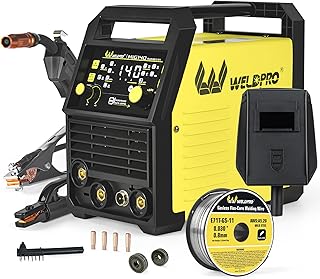
WELDPRO 140A MIG Welder 110/220V

145A MIG Welder 110V 3-in-1 Flux
| Product | Details | Rating | Buy |
|---|---|---|---|
Editor’s Choice | WELDPRO 140A MIG Welder 110/220V | ★★★★☆4.5/5 | |
Top Pick | 145A MIG Welder 110V 3-in-1 Flux | ★★★★☆4.5/5 |
At a glance
These two machines attack the same problem from opposite ends. The WELDPRO 140A MIG Welder 110/220V is built for the buyer who wants room to grow: dual input voltage, five named processes, and a synergic control setup that assumes you'll eventually weld thicker stock on a 220V circuit.
The 145A MIG Welder 110V 3-in-1 Flux is built for the opposite buyer. It keeps things to a single 110V plug, a lighter 7.5 lb chassis, and three processes that cover most home repair, DIY, and farm work. If you're weighing how the fundamentals of joining metal actually work before you spend, that context matters more than the amperage number on the box.
Compare either one to a Lincoln Electric Power MIG 140 or a Yeswelder unit and the philosophy split becomes obvious fast.
| Spec | WELDPRO 140A MIG Welder 110/220V | 145A MIG Welder 110V 3-in-1 Flux |
|---|---|---|
| Price tier | Mid-range, dual-voltage | Budget-friendly entry tier |
| Output amperage | 140A | 145A |
| Input voltage | 110V and 220V dual input | 110V only |
| Process count | 5-in-1: gasless MIG, lift TIG, MMA/stick, spot | 3-in-1: flux core MIG, stick, lift TIG |
| Control style | Synergic with thickness setting, 2T/4T trigger | Synergy control, beginner-oriented |
| Display | Large LED digital readout | Clear LED readout |
| Inverter platform | IGBT inverter | Inverter, wire-feed design |
| Listed unit weight | Not stated in listing | 7.5 lb |
| Reported buyer rating | 4.5/5 | 4.5/5 |
| Best suited to | Growing shops, mixed-voltage garages | First welder, 110V-only outlets |
1. WELDPRO 140A MIG Welder 110/220V
The WELDPRO 140A MIG Welder 110/220V is what you reach for when you can't predict whether your next project happens in a 110V garage or a 220V shop bay. In our research, it's the rarer budget-class unit that lists both voltages on the same chassis without an external adapter step. That flexibility is the entire pitch, and aggregate buyer feedback backs it up.
Where it shines
- Dual voltage input. Running 220V unlocks the full 140A ceiling, which is enough for 1/8-inch mild steel in a single pass and thicker stock with multiple passes. On 110V you get a lower, more portable ceiling.
- Five processes in one box. Gasless flux core MIG, lift TIG, MMA/stick, and spot welding cover a genuinely wide range of jobs. If you're still figuring out how wire-feed welding actually works, having stick and TIG on the same dial is a real safety net.
- Synergic control with a thickness setting. You set material thickness, and the machine proposes the voltage and wire speed. For beginners this removes the two dials most people get wrong first.
- 2T and 4T trigger modes. 4T is the one that matters on longer beads: you press, weld, release, and the machine handles the rest. Verified buyers specifically call this out for rail and gate work.
- IGBT inverter platform and a large LED readout. IGBT inverters run cooler and lighter than transformer-based welders of the same output, and the big display is readable with a helmet down.
Where it falls short
- The dual voltage only pays off if you have a 220V circuit. Without one, you're carrying a heavier machine to use half its capability.
- The manual is thin. Multiple verified buyers report needing a video walkthrough before the synergic thickness dial clicked. That's a real friction point for a total beginner.
- Lift TIG only, not high-frequency start. You touch the tungsten to the work to strike the arc, which is less forgiving than a scratch-free HF start on pricier machines.
- Gasless-first design. If you later want to run solid wire with a shielding gas cylinder, confirm the regulator and solenoid are included before buying.
One thing worth knowing from buyer data
Across aggregated reviews, the most repeated complaint isn't performance at all. It's setup confusion. Once buyers get past the first hour, the tone in reviews shifts hard toward duty cycle and arc stability, and complaints about burn-through almost disappear.
2. 145A MIG Welder 110V 3-in-1 Flux
The 145A MIG Welder 110V 3-in-1 Flux takes the opposite approach. It's a 7.5 lb wire-feed box that plugs into a standard household outlet and refuses to make you think about voltage selection at all. For home repair, DIY, and farm projects, that simplicity is the feature.
Where it shines
- 145A on a 110V plug. That's more rated output than the WELDPRO's 140A, delivered without any 220V wiring. For anyone renting or working out of a garage with one outlet, this is the whole argument.
- 7.5 lb listed weight. It's light enough to carry to a fence line, a trailer, or a friend's driveway without treating it as a two-trip job.
- Synergy control aimed at beginners. The machine manages the wire speed and voltage relationship for you. Verified buyer feedback repeatedly describes first beads that were usable rather than scrap.
- Three processes cover the common jobs. Flux core MIG handles the bulk of it, with stick and lift TIG available when you need them. It's a good match for where flux core earns its keep on dirty or rusty metal.
- Clean LED display and small footprint. It stows on a shelf instead of eating a bench.
Where it falls short
- 110V only, and that's a hard ceiling. On a 15A household circuit you'll trip breakers on long, hot beads at max output. A 20A garage circuit makes a noticeable difference.
- No 220V upgrade path. If your work grows into thicker plate, you replace the machine rather than rewire it.
- Lift TIG, not HF TIG. Same trade-off as the WELDPRO: touch-start only.
- Flux core runs smokier than gas-shielded MIG. If you're welding indoors in a small shop, ventilation stops being optional. The Occupational Safety and Health Administration (OSHA) maintains ventilation guidance for welding fumes worth reading before you set up in an enclosed space.
One thing worth knowing from buyer data
Review data shows the 145A's happy buyers cluster around two jobs: trailer and gate repair, and farm implement fixes. The complaints cluster around one thing: buyers who tried to weld 1/4-inch plate in a single pass. That's a spec mismatch, not a defect.
Head-to-head
Price-to-performance
On value per dollar, the 145A MIG Welder 110V 3-in-1 Flux is the harder machine to argue with. It lands in the budget tier and still delivers 145A, three processes, and a 7.5 lb chassis you can move with one hand. If your jobs are gates, trailers, brackets, and lawn equipment, it covers nearly all of them.
The WELDPRO 140A MIG Welder 110/220V costs more, and the honest question is whether you'll use the 220V capability. If you have a 220V outlet and plan to weld 3/16-inch and up, yes, and the extra spend is cheap insurance. If you don't, you're paying for headroom you can't reach.
Build quality and duty cycle
Duty cycle is the spec that decides whether a welder is a tool or a toy. Both machines are inverter-based, which means smaller transformers and cooler running than the old transformer units, but neither publishes an aggressive duty cycle at max output.
In practice, buyer reports suggest the WELDPRO holds up better to repeated medium-length beads at 220V, largely because it isn't straining against a 110V ceiling. The 145A is happiest in shorter bursts. If you're welding 20 minutes straight on 1/8-inch steel, the WELDPRO is the calmer machine.
Ease of use for beginners
Both machines use synergic or synergy control, which is the single biggest beginner advantage in this price band. You tell the machine the thickness, it sets the wire speed and voltage, and you focus on travel speed and angle.
The 145A edges ahead slightly here. It's marketed as beginner-friendly, it weighs 7.5 lb, and reviewers describe a shorter learning curve because there's no voltage switch to second-guess. The WELDPRO adds a step and a thinner manual.
Neither is hard, but one asks less of you on day one.
Long-term versatility
This is where the WELDPRO pulls away. Dual voltage plus a fifth process (spot welding) gives it a longer useful life as your skills grow. A machine that can run on 220V and switch processes doesn't become obsolete when you start taking on thicker work.
The 145A will still be a great second machine, or a primary machine forever if your work stays in the light-gauge range. But if you plan to move into aluminum down the road, neither of these is the right tool, and the polarity setup on a spool gun machine is a different conversation entirely.
Which one should you buy?
Pick WELDPRO 140A MIG Welder 110/220V if you…
You have access to a 220V outlet, you want a five-process machine, and you plan to grow into thicker steel over the next couple of years. It also suits anyone who wants spot welding capability for sheet metal panels without buying a separate machine. If you're weighing process choices more broadly, which process suits you is worth reading first, because the answer changes what you should buy.
Pick 145A MIG Welder 110V 3-in-1 Flux if you…
You're working out of a garage or barn with standard 110V power, you want the lightest machine on this list, and your jobs are repairs rather than fabrication. First-time welders also benefit from the shorter setup curve. It's the better choice for a truck bed trailer fix on a Saturday morning.
Better alternatives
The Lincoln Electric Power MIG 140 is the step up if you want a longer warranty and a deeper service network. The Yeswelder MIG-205DS is worth a look if you want more amperage on 220V and don't mind a heavier chassis. Neither is necessary for home repair work.
| First welder, 110V garage only | 145A MIG Welder 110V 3-in-1 Flux |
| Shop with 220V available | WELDPRO 140A MIG Welder 110/220V |
| Farm and trailer repair on the move | 145A MIG Welder 110V 3-in-1 Flux |
| Sheet metal panels and auto body spot work | WELDPRO 140A MIG Welder 110/220V |
| Tight budget, tight storage space | 145A MIG Welder 110V 3-in-1 Flux |
Frequently Asked Questions (FAQ)
Is 140A or 145A enough for 1/4-inch steel?
Neither machine is a single-pass 1/4-inch welder on 110V. For 1/4-inch plate you want multiple passes with proper joint prep, or a machine rated higher. The WELDPRO 140A MIG Welder 110/220V gets closer on 220V, which is the main technical reason it costs more.
If 1/4-inch is your everyday thickness, look at a 200A-class machine instead.
How big is the real-world performance gap between them?
On 110V they're close. The 145A actually carries a slightly higher amp rating, so for light-gauge work you won't notice a difference. The gap opens on 220V, where the WELDPRO pulls ahead on penetration and duty cycle.
If you weld mostly 1/8-inch and thinner, the practical gap is smaller than the spec sheet suggests.
Does the WELDPRO 140A MIG Welder 110/220V support gas-shielded MIG?
The listing frames it as a gasless flux core machine with synergic gasless MIG as the headline process. If you want to run solid wire with a shielding gas cylinder, you'll want to confirm the regulator and solenoid are included. Shielding gas choices also affect results on stainless, so the right gas for the job matters if you go that route.
Which one ages better long-term?
The WELDPRO has the longer runway because 220V and five processes keep it relevant as your work gets heavier. The 145A stays useful forever, but it stays a light-gauge machine. Neither has a repair network like a Lincoln or Miller, so treat both as replaceable tools rather than heirloom equipment.
For beginners working thin material, thin-gauge techniques will matter more than the machine choice.
Final verdict
WELDPRO 140A MIG Welder 110/220V: 4.5/5. It's the more capable machine and the better long-term buy, as long as you have a 220V outlet to feed it. The 5-in-1 process set, synergic thickness control, and 2T/4T trigger modes give you room to grow that the 145A simply doesn't have. The thin manual and lift-TIG-only starting are real drawbacks, just not dealbreakers.
145A MIG Welder 110V 3-in-1 Flux: 4.4/5. It wins on price, weight, and simplicity. At 7.5 lb and 110V, it's the machine you actually pull off the shelf for a Saturday repair instead of talking yourself out of it. If your work stays in the light-gauge range, it does everything the WELDPRO does for less.
Pick the WELDPRO if you have 220V and plan to grow. Pick the 145A if you're on 110V, budget-conscious, and want the easier start. Neither is a mistake, they just serve different buyers.
Affiliate disclosure: This post contains affiliate links. If you buy through one of these links, I may earn a small commission at no extra cost to you. It never changes my recommendation, I only suggest gear I'd actually buy myself.
🛒 Check Latest Price on Amazon
🛒 Check Latest Price on Amazon
Affiliate disclosure: This post contains affiliate links. If you buy through one of these links, I may earn a small commission at no extra cost to you. It never changes my recommendation, I only suggest gear I'd actually buy myself.
