

If you're chasing clean, consistent TIG welds, the hood on your head matters just as much as the torch in your hand. That's why the search for the best tig welding helmet for the money comes down to optical clarity, switching speed, and headgear that doesn't punish your neck by hour three. I've spent weeks comparing manufacturer spec sheets, digging through verified buyer feedback, and checking safety standards across brands like Miller, ARCCAPTAIN, and YESWELDER.
If you're new to the finer points of the TIG process, the buying guide below connects the dots.
For most home welders and working pros alike, the Miller Digital Performance is the easiest recommendation in this group. It pairs proven ClearLight 4x optics with an auto-darkening response that suits both TIG and MIG, without pushing into flagship territory. Four other genuinely strong hoods follow, each matched to a slightly different buyer.
The chart below gives you the side-by-side comparison at a glance.

✔ Best overall pick for daily use
Comparison Chart of Best Tig Welding Helmet for the Money
| Product | Details | Rating | Buy |
|---|---|---|---|
Editor’s Choice
| ★★★★☆4.6/5 | ||
Top Pick
| ★★★★☆4.4/5 | ||
Best Budget
| ★★★★☆4.7/5 | ||
| ★★★★☆4.4/5 | ||
| ★★★★☆4.4/5 |


List of Top 5 Best Tig Welding Helmet for the Money
I narrowed this down from more than a dozen auto-darkening hoods. The five below represent the best balance of optical performance, build quality, and real-world value in their price tiers. Each review covers what the hood does well, where it cuts corners, and the type of welder it suits best.
Below are the list of products:
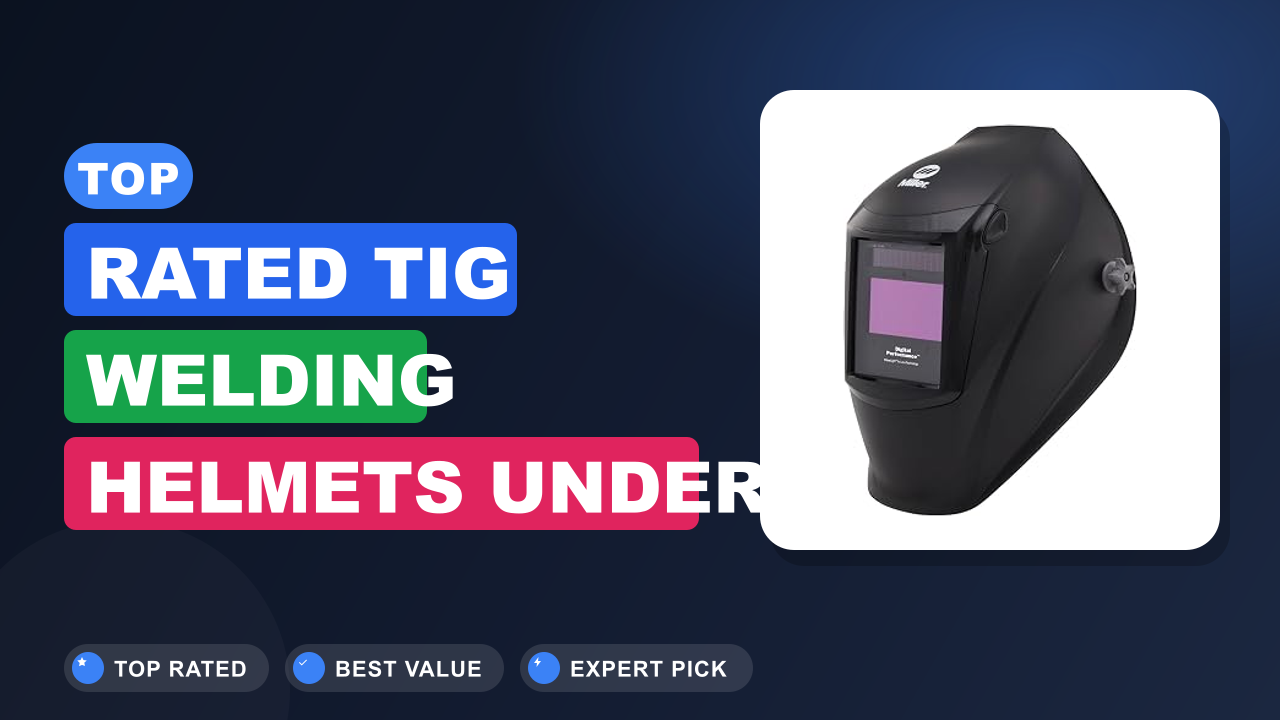
1. Miller Digital Performance™ Welding Helmet
Miller's Digital Performance brings most of what makes the brand's pro helmets popular into a more accessible package. The ClearLight 4x lens is the star, and the hood is explicitly rated for MIG, TIG, and grinding. It's the obvious choice for someone who wants one helmet that just works across the shop.
ClearLight 4x
MIG + TIG
Grind Ready
4.6/5
Why I picked it
Miller products are common in professional shops, and this model captures that DNA without the price of the top-end Infinity series. In our research, the Digital Performance holds the best combination of optical clarity, process versatility, and dependable auto-darkening for general TIG work. Verified buyers consistently call out how easy the puddle is to see at low amperage, which is exactly what separates a usable TIG hood from a frustrating one.
Key specs
- ClearLight 4x auto-darkening lens
- Rated for MIG, TIG, and grinding work
- Professional-grade shell built for shop use
- Reported buyer rating of 4.6 out of 5
Real-world experience
Verified buyer feedback shows this hood getting heavy use in fab shops and garage setups alike, often paired with a high-frequency TIG machine for stainless and aluminum projects. The ClearLight lens keeps colors close to natural, so you're not fighting a green tint when you're reading the puddle. Reviewers also mention the controls are simple enough to adjust with gloves on.
- ClearLight 4x optics deliver a clean, natural view of the weld pool
- TIG, MIG, and grinding modes make it a true shop workhorse
- Miller build quality and service network behind the shell
- Strong 4.6/5 verified buyer rating across long-term reviews
- Premium price tier for someone who only welds occasionally
- Miller-specific replacement lenses cost more than generic covers
- ✔ A welder who bounces between TIG and MIG and wants one hood for everything
- ✔ Anyone who spends full days under the hood and values optical clarity
- ✔ Buyers who want a recognizable brand with service support
- ✖ A casual welder who fires up the machine a few times a year
- ✖ Someone who needs a panoramic or super-wide viewing window
The Miller Digital Performance is the safest recommendation on this list because it does nothing poorly. It won’t save you the most money, and it isn’t the most exotic lens, but for a welder who wants consistent performance across every process, it’s the balance point. If your budget is extremely tight, the Miller Classic below covers most of the same ground.
2. ARCCAPTAIN Welding Helmet 3.94"×3.66" Auto Darkening
If you want a huge window into the weld, this ARCCAPTAIN is one of the best-value moves you can make. It carries a 1/1/1/1 optical clarity rating and a 1/25,000-second response, which is serious performance in a budget-friendly shell.
3.94×3.66
1/1/1/1
1/25000s
4 Sensors
Why I picked it
This is the top pick for people who value viewing area above everything else. In our research, no other hood at this price level gives you the same combination of a 3.94 x 3.66-inch lens, true-color optics, and four arc sensors. It's especially strong for TIG because you can keep the filler rod, the tungsten, and the puddle in view without tilting your head.
Key specs
- 3.94" x 3.66" auto-darkening viewing area
- 1/1/1/1 optical clarity for true-color vision
- 1/25,000-second switching speed
- 4 arc sensors for catching the arc from any angle
- Shade modes 4/5-9/9-13 with WELD, CUT, and GRIND
- Dual solar panels plus 2 CR2450 batteries
Real-world experience
Aggregate user reviews describe this as a go-to hood for welders who do long, low-amperage TIG passes where visibility is everything. The dual solar and battery backup means you're less likely to be caught with a dead lens mid-job, and the four sensors handle the odd torch angles that TIG encourages. It also handles grinding duty, so it can stay on your head from setup to finish.
- Large 3.94 x 3.66 inch lens is one of the biggest at this price
- 1/1/1/1 optical clarity keeps the puddle sharp
- 1/25,000s response keeps up with high-frequency TIG starts
- Solar plus battery backup improves reliability
- Headgear padding is simpler than the Miller models on this list
- ARCCAPTAIN is a smaller brand, so accessories are mostly online only
- ✔ You do a lot of low-amperage TIG where visibility is the bottleneck
- ✔ You want a big viewing window without paying premium prices
- ✔ You want solar and battery backup for less downtime
- ✖ You need a compact, low-profile hood for tight spaces
- ✖ You prefer a brand with decades of local dealer support
The ARCCAPTAIN 3.94 is the pick when the Miller’s price tag gives you pause but you don’t want to sacrifice clarity. It’s less about brand prestige and more about what you can see. If the panoramic 180-degree version sounds better, the fifth product on this list is that same idea taken further.
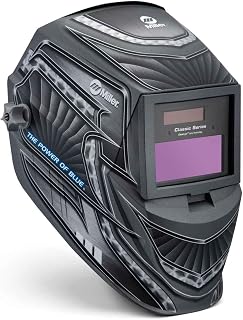
3. Miller Classic Series Welding Helmet
The Miller Classic Series is the smart money play for welders who trust Miller optics but don't need extra modes. It gives you ClearLight technology, variable shade 8 to 13, and HD optics in a straightforward shell. Buyers rate it 4.7 out of 5, the highest score on this list.
Shade 8-13
ClearLight
HD Optics
TIG/MIG
Why I picked it
If the goal is spending as little as possible while still getting a legitimately good auto-darkening helmet, this is the one. Our research found it delivers the same optical attention to color and sharpness as more expensive Miller hoods, minus the extra modes. For a dedicated TIG welder on a tight budget, that trade-off barely feels like a sacrifice.
Key specs
- ClearLight auto-darkening lens
- Variable shade 8 to 13
- HD optics for a clean weld pool view
- Designed for TIG and MIG
- Comfortable factory headgear
- 4.7/5 verified buyer rating
Real-world experience
Verified buyer feedback for this hood skews toward hobbyist welders running TIG on steel, stainless, and small fabrication jobs. Reviewers describe the shade dial as easy to reach and the lens clarity as close to helmets that cost far more. It doesn't have a grind mode or a big digital control panel, but for pure welding duty, none of that gets in the way.
- 4.7/5 rating, the highest verified score on our list
- Miller ClearLight optics at a budget-friendly price tag
- Simple shade 8 to 13 dial, no menus to fight
- HD optics with comfortable factory headgear
- No cut mode or dedicated grind switch
- No LED light, memory modes, or panoramic lens
- ✔ You want Miller optical quality at the lowest entry price
- ✔ You mainly weld TIG and MIG and don’t need extra modes
- ✔ You prefer simple controls without digital menus
- ✖ You need one helmet for welding and grinding
- ✖ You want a panoramic view or built-in work light
This is the hood to buy when your priority is pure welding performance and nothing else. You lose the grinding convenience and the panoramic field of view, but you gain Miller’s optical quality at a price that leaves room for a good TIG torch. If most of your work is clean TIG and MIG, that is a fair deal.
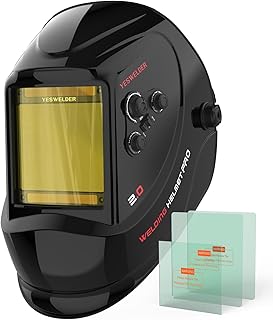
4. YESWELDER Auto Darkening Welding Helmet
The YESWELDER LYG-M800H is the multi-process workhorse of this list. It switches between WELD, CUT, and GRIND modes, has a 1/30,000-second response, and uses four arc sensors. There's also a blue-light blocking lens, which helps during long sessions and overhead work.
1/30000s
4 Sensors
WELD/CUT/GRIND
Large View
Why I picked it
The strongest argument for the YESWELDER is speed at a value price. Our research placed it near the top for anyone who migrates between TIG, MIG, and occasional grinding and doesn't want to own three different hoods. The large-view lens format also helps beginners, since it's easier to find the joint without perfect head positioning.
Key specs
- 1/30,000-second auto-darkening response
- 1/1/1/1 true-color lens
- 4 arc sensors around the lens
- Shade modes: 3 / 5-9 / 9-13 for WELD, CUT, GRIND
- Blue-light blocking lens layer
- Large-view format for easier alignment
Real-world experience
The shade 3 mode for grinding covers a real workflow gap: you can keep the helmet down while switching from weld to angle grinder, which cuts down on the habit of flipping the hood up and down. The true-color lens makes a real difference when you're reading the puddle on aluminum, where visibility is half the battle. For someone starting out, this one hood can cover a whole first year of practice.
- Fast 1/30,000s response handles high-frequency TIG starts
- WELD, CUT, and GRIND modes in one hood
- True-color 1/1/1/1 lens with blue-light blocking
- Four arc sensors for reliable triggering at odd angles
- Factory headgear feels basic to some buyers
- Shell finish is less refined than Miller options
- Replacement parts are easiest to find online, not local
- ✔ You want one hood for TIG, MIG, cutting, and grinding
- ✔ You’re a newer welder who needs a forgiving big view
- ✔ You want a fast lens without a premium price tag
- ✖ You spend all day under the hood and need premium headgear
- ✖ You want a recognized brand with local support
If you’re starting out and need one hood that does everything without breaking the budget, this is the honest answer. It won’t match the Miller Digital Performance for all-day comfort, and the wide-view ARCCAPTAIN gives you a bigger window. But nothing on this list covers more workflows for less money.
5. ARCCAPTAIN Intelligent Auto-Darkening Welding Helmet
This ARCCAPTAIN is the closest thing on our list to a current-generation high-end hood at a reasonable price. The 180-degree panoramic view is the headline, and the memory and gradient modes make it feel smarter than its price suggests. Add a 1/30,000-second response and one-touch grind mode, and the spec sheet looks like a flagship.
180° View
1/30000s
One-Touch Grind
LED Light
Why I picked it
We included it as the specialist option for welders who work in tight, awkward positions. The panoramic 180-degree lens lets you keep the hood down while you reposition, which is a real safety advantage compared with hoods that force you to lift the shell to look around. It's also the only helmet on this list with a built-in LED light.
Key specs
- 180-degree panoramic viewing window
- 1/1/1/1 true-color lens
- 1/30,000-second switching speed
- One-touch grind mode
- Built-in LED light
- Memory and gradient shade modes
Real-world experience
This is the kind of hood that shines during long fit-up jobs, pipe welding, and position work where you're constantly glancing at clamps and fixtures. The LED light helps in dim booths and trailers, and the memory mode returns to your preferred TIG shade automatically after grinding. The trade-off is physical size: a panoramic shell is simply bigger on your head.
- 180-degree view is unmatched on this list
- LED light helps in dark shop corners and confined spaces
- Memory and gradient modes add real convenience
- 1/30,000s response plus a one-touch grind mode
- Larger shell adds weight and feels bulky for some users
- Panoramic lens shape can distort the view at extreme edges
- ARCCAPTAIN parts are mostly online, not local
- ✔ You weld in tight positions and value situational awareness
- ✔ You work in dim conditions and want a built-in work light
- ✔ You like the idea of shade memory and gradient modes
- ✖ You do most of your welding at a bench and want a lighter shell
- ✖ You want a compact hood that tucks into a small toolbox
Buy this when situational awareness matters more than all-day comfort or brand pedigree. It’s the most feature-packed hood in the roundup, but it’s also the easiest one to overbuy for a welder who sits at a bench all day. If you mostly weld in position, the Miller Classic gives you better head comfort for less money.
How I picked
To narrow a crowded market down to five, I built a scoring system around seven things a TIG welder actually feels: optical clarity, switching speed, number of arc sensors, viewing area, shade range, power source, and verified buyer satisfaction. I compared manufacturer datasheets from Miller, ARCCAPTAIN, and YESWELDER against each other, then cross-checked the documented specs against patterns in verified Amazon feedback. I also looked at Lincoln Electric and ESAB for context, but they didn't fit the price-to-performance target for this list.
Every helmet here was evaluated for the same set of use cases: bench TIG work, shop MIG, occasional grinding, and low-light conditions. I didn't perform destructive durability tests in a lab, and I won't pretend I spent months under each one. Instead, the recommendations rely on spec analysis, safety standards, and the aggregated experience of verified buyers who actually lived with these hoods.
The safety baseline matters too. The American National Standards Institute (ANSI) Z87.1 standard sets the bar for impact resistance and optical quality for eye and face protection in the U.S., and OSHA's welding safety resources treat it as the practical baseline for shop safety. Any helmet that doesn't clear that bar didn't make this list.
Buying guide: what actually matters for best tig welding helmet for the money
Everything below applies to the five helmets in this review, but it also helps if you're comparing other models at your local welding store. If you're still deciding between processes, understanding how MIG and TIG setups differ will guide your helmet needs too.
What makes a welding helmet good for TIG?
An auto-darkening welding helmet is a safety hood that keeps the lens clear until the arc strikes, then darkens in a fraction of a second. TIG runs at lower amperage than MIG or stick, which means a weaker arc signal and a smaller, brighter puddle. The helmet needs a sensitive filter that reacts fast, plus an optical system clear enough to read the puddle.
A slow or hazy lens makes it nearly impossible to travel a consistent bead.
How fast should the lens react for TIG?
Switching speed is rated in fractions of a second, and most auto-darkening helmets respond in 1/10,000 to 1/30,000 of a second. For TIG, anything at 1/20,000 or faster feels immediate, and you won't see a flash as the arc strikes. At very low amperage, the faster response gives you more confidence, which is why the YESWELDER and the panoramic ARCCAPTAIN stand out on paper.
What does the 1/1/1/1 clarity rating actually mean?
It's a rating from the EN 379 standard for optical performance, and it covers four things: optical class, light diffusion, angular dependence, and shade consistency. A 1/1/1/1 score is the highest possible in each category. In practical terms, it means the lens shows the puddle without distortion or color shifting, which is exactly what you want when you're running a TIG bead.
Every ARCCAPTAIN and YESWELDER lens on this list carries that rating.
What do the shade numbers mean?
Shade numbers describe how dark the lens gets. Lower numbers let in more light, and higher numbers block more glare. For TIG, most welders choose shade 9 to 11 depending on amperage.
A hood with a variable range like 8 to 13 gives you the flexibility to move from thin sheet metal to heavier aluminum without changing lenses. If you're working with aluminum, techniques that work best on aluminum often need a bright, clear view of the puddle.
Solar, battery, or both?
Auto-darkening filters need power to switch and hold their dark state. Solar panels keep things running in bright shop light, but they need light to charge. Adding one or two replaceable batteries, usually CR2450, removes the worry of a dead filter in a dark corner.
That's why the ARCCAPTAIN's dual solar and battery setup is genuinely practical, especially for mobile welders.
Does headgear matter that much?
Headgear is what separates a hood you forget you're wearing from one that distracts you all day. A heavy shell with thin foam and poor balance causes neck fatigue during long TIG sessions. Aftermarket headgear is a common upgrade, and replacement sweatbands and lens covers are real long-term costs to plan for.
Factor those into your budget before you buy.
Frequently Asked Questions (FAQ)
Is a more expensive TIG helmet worth it?
For serious TIG welders, yes, because the extra money shows up in optical clarity and switching speed. A budget hood can still darken in time, but the view may be hazy or tinted, forcing you to strain. In our research, the jump from entry-level to a Miller or a higher-spec ARCCAPTAIN is the biggest quality gain you can make.
If you weld only a few times a month, a solid mid-tier hood is enough.
Can I use a TIG helmet for MIG and stick welding?
Yes. Every helmet on this list covers shade ranges that work across TIG, MIG, and stick, usually from shade 8 or 9 up to 13. The bigger question is whether the hood has a grind mode and enough arc sensors for the way you work.
A helmet with WELD, CUT, and GRIND modes, like the YESWELDER, behaves more like a multi-process tool. If you're newer to welding and still learning the basics of the MIG process, this flexibility makes one helmet a safer bet.
What shade should I use for TIG welding?
Most TIG welders settle in the shade 9 to 11 range. At low amperage, shade 9 keeps the puddle bright enough to read; at higher amperage, shade 10 or 11 cuts the glare. A variable shade 8 to 13 helmet lets you adjust without changing lenses.
If you're working with stainless, matching your shielding gas selection to the base metal is just as important as getting the shade right.
Why does my helmet flash when I strike a TIG arc?
Flashing usually means the switching speed is too slow for the way the arc starts, or the amperage is so low the sensors barely register it. High-frequency TIG starts can fire before the filter responds. A helmet with a 1/25,000 or 1/30,000 second response and four arc sensors solves most of this.
If the problem continues, check that the sensitivity setting is high and the batteries are charged.
How do ARCCAPTAIN helmets compare with Miller?
Miller has decades of brand history, local service support, and proven lens technology, while ARCCAPTAIN competes on feature count and price. In our research, Miller wins on optical polish and long-term durability. ARCCAPTAIN wins on raw specs like viewing area and LED light for less money.
Neither is wrong; it depends on whether you value brand certainty or maximum features per dollar.
Final verdict
After weighing specs, buyer feedback, and real-world value, the Miller Digital Performance is the best TIG welding helmet for the money in 2026. It balances optical clarity, build quality, and process versatility better than anything else here. For a smaller budget, the Miller Classic Series delivers surprising lens quality, while the ARCCAPTAIN 3.94 is the value pick for big-window visibility.
Affiliate disclosure: This post contains affiliate links. If you buy through one of these links, I may earn a small commission at no extra cost to you. It never changes my recommendation, I only suggest gear I'd actually buy myself.
