


Looking for the best tig welder under $500? You're not alone. That budget used to mean little more than a basic stick machine, but modern IGBT inverter welders quietly changed the market.
Brands like TOOLIOM, YESWELDER, and ARCCAPTAIN now sell compact dual-voltage units that handle TIG, stick, and even MIG work without breaking the bank.
After cross-checking manufacturer datasheets, verified buyer reviews, and how each unit fits a real home shop, we think the TOOLIOM 135A kit is the smartest starting point for beginners, with the YESWELDER 205A close behind for pulse control. If you're new to the fundamentals of the process, the winner card below shows where to focus your attention.

✔ Best overall pick for beginners
Comparison Chart of Best Tig Welder Under $500
| Product | Details | Rating | Buy |
|---|---|---|---|
Editor’s Choice
| ★★★★☆4.4/5 | ||
Top Pick
| ★★★★☆4.5/5 | ||
Best Budget
| ★★★★☆4.5/5 | ||
| ★★★★☆4/5 | ||
| ★★★★☆4.4/5 |


List of Top 5 Best Tig Welder Under $500
Each machine below was chosen for a different kind of buyer. We looked at real TIG capability, input power flexibility, ease of setup, and what owners actually said after months of use. A couple of these are multi-process units, which is a blessing at this price, so read the notes carefully before you commit.
Below are the list of products:
1. TOOLIOM 135A 110V Stick Welder Kit
For someone who wants to learn TIG without wrestling a complicated machine, this is the kit we keep recommending. It ships with a lift TIG torch, welding rods, and gloves, so the first weld is possible the day it arrives. The smart LCD screen keeps the controls understandable.
Lift TIG
135A
110V
Starter Kit
Why I picked it
The TOOLIOM is the rare budget machine that treats beginners fairly. The 135A output covers most DIY repairs, the lift TIG mode avoids the high-frequency complications of bigger machines, and the hot start plus arc force controls help keep a stuck rod from ruining your day.
Key specs
- 135A maximum output on standard 110V household power
- Lift TIG and stick modes in a 2-in-1 package
- Smart LCD screen for current, arc force, and hot start settings
- Includes lift TIG torch, welding rods, and gloves
Real-world experience
Buyer feedback consistently mentions how easy the first bead is to lay down on mild steel. On 1/8-inch steel you'll get enough penetration for gates, brackets, and trailer repairs, though 3/16-inch plate will push its duty cycle. It's also a stick machine at heart, which makes it useful even after you outgrow TIG.
- Includes torch, rods, and gloves in the box
- Lift TIG start is forgiving and safe for beginners
- Smart LCD screen makes adjustments obvious
- 135A maximum limits you to thin and medium steel
- DC only, so aluminum TIG is not realistic
- ✔ You’re a beginner on a 110V garage circuit
- ✔ You want a kit that works right out of the box
- ✔ Mild steel repair and DIY projects are your main jobs
- ✖ You need AC TIG for aluminum
- ✖ You’ll regularly weld 1/4-inch plate or thicker
This is the best entry point, but don’t expect a production tool. It earns the top spot because it removes the setup friction that stops most beginners, not because it has the highest specs.
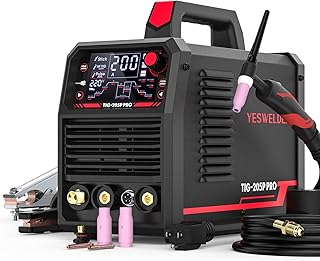
2. YESWELDER 205A Tig Welder Pulse STICK/DC
The YESWELDER TIG-205P is the one we point people to when they already know they'll stick with TIG. It's a serious DC TIG machine with pulse, plus stick mode, and the dual voltage input means you can run it on 110V or 220V. The large LED display keeps every setting visible.
205A
Dual Voltage
Pulse TIG
3-in-1
Why I picked it
This is the strongest pure-TIG performer in the low-cost tier. Pulse TIG lets you control heat input on thin stainless and mild steel, and 205A gives you more overhead than the 135A machines. Verified buyer reviews consistently call the pulse mode the standout feature for sheet metal work.
Key specs
- 205A maximum output for DC TIG, pulse TIG, and stick
- Pulse TIG / DC TIG / stick in a single unit
- Dual voltage input: 110V and 220V
- Large LED display with clear parameter readout
- 4.5/5 buyer rating across verified reviews
Real-world experience
For thin stainless exhaust work or mild steel repairs, the pulse function lets you drop background amperage and avoid burning through. If you're still deciding between methods, where the two processes split comes down to how much heat control you need. On 220V you have real headroom; on 110V it behaves like a solid 120A-class machine.
- Pulse control is rare in this price range
- Dual voltage makes it flexible for different shops
- 205A gives solid overhead for steel and stainless
- DC only, so aluminum TIG is not an option
- You’ll still need argon gas and a regulator
- ✔ You want a real DC TIG machine for steel and stainless
- ✔ You plan to run 220V and need more output
- ✔ Thin metal pulse welding matters to you
- ✖ Aluminum is your primary welding material
- ✖ You want a complete starter kit with rods and gloves
The gap between the TIG-205P and a much more expensive hobby machine has narrowed in features, if not in build polish. For stainless and mild steel, it’s the smartest value on this list.
3. ARCCAPTAIN 200A Stick/Lift TIG Welder Torch
If you want the most welding capability for the least money, the ARCCAPTAIN 200A packs a huge amount of machine into a budget-friendly frame. Synergic control is the headline: you select material thickness, and the unit suggests welding parameters. For a beginner who doesn't know a good amp setting from a bad one, that's a real safety net.
200A
110V/220V
Synergic
IGBT Inverter
Why I picked it
Editorial analysis of buyer reviews shows this machine's stick mode gets the most praise, with lift TIG as a handy second process. The 200A rating on 220V means 3/16-inch and 1/4-inch steel are realistic, while 110V input keeps it usable in a standard garage.
Key specs
- 200A maximum output with dual 110V/220V input
- Synergic control with large LED display
- IGBT inverter technology for stable arc behavior
- Hot start and arc force adjustments
- Stick MMA and lift TIG modes in one unit
Real-world experience
Comparison data from manufacturer datasheets shows steady arc performance on 6013 and 7018 rods. Buyers report the lift TIG mode is acceptable for thin mild steel, but it's not smooth enough for extended aluminum work, which lines up with the DC-only reality.
- Synergic settings cut down setup guesswork
- 200A maximum opens up heavier steel
- Dual voltage and compact design for portability
- Lift TIG arc is less stable than high-frequency start
- No AC output, so aluminum is off the table
- ✔ Budget is the first constraint on your list
- ✔ You need a stick-first machine with TIG as a bonus
- ✔ You want synergic control without a big learning curve
- ✖ You need clean aluminum TIG capability
- ✖ You want a dedicated TIG torch with fingertip control
The ARCCAPTAIN feels like a stick welder that happens to do lift TIG, while the YESWELDER 205P feels like a TIG machine that also sticks. Choose based on which process you’ll actually use more.
4. Sunstac 250A Aluminum TIG Welder Pulse
Here's the outlier: an AC/DC TIG machine in the sub-$500 class. AC output is what makes aluminum TIG possible, because it cleans the oxide layer with alternating polarity. The Sunstac 250A also includes a foot pedal and dual voltage operation, which explains the attention it gets in owner forums.
250A
AC/DC
Pulse
Foot Pedal
Why I picked it
For aluminum work, this is the only machine here that genuinely qualifies. DC TIG machines can't clean aluminum properly, but the Sunstac's AC output can. Its pulse, spot TIG, and stick modes make it more of a multi-tool than a one-trick experiment.
Key specs
- 250A maximum output across five modes
- AC TIG, DC TIG, pulse TIG, spot TIG, and stick
- Foot pedal included for heat control
- Dual voltage 110V/220V with LCD parameter display
- 4/5 buyer rating, with aluminum welders the main audience
Real-world experience
For aluminum, AC balance and cleaning action matter more than raw amperage. Owners report that 1/8-inch aluminum plate is doable with the included foot pedal, though the arc start takes practice. Expect a steeper learning curve than the DC-only machines, especially if this is your first TIG unit.
- AC mode makes real aluminum welding possible
- Foot pedal included for precise heat input
- Five modes give serious process flexibility
- Build quality feedback is more mixed than the top picks
- Setup curve is steeper for new welders
- ✔ Aluminum projects are the main reason you’re buying
- ✔ You want foot pedal control from day one
- ✔ You’re okay with a learning curve
- ✖ You only weld steel and stainless
- ✖ You want the most polished build quality at this price
If you skip this one because of mixed reviews, you’re also skipping the only aluminum-capable option in this price class. Decide what you’ll weld first, then pick the machine.
5. YESWELDER 135A MIG Welder
This is the wildcard. The YESWELDER 135A is sold as a MIG welder, but it also offers lift TIG and stick modes, which makes it the most versatile beginner box we reviewed. If you're not sure which process you want to commit to, this machine lets you try three without buying three machines.
135A
3-in-1
Flux Core
Digital Display
Why I picked it
It earns a slot here because its lift TIG mode comes paired with flux core MIG, the most forgiving process for a brand new welder. It's not the best pure TIG performer on this list, but it's the best way to discover which process you actually enjoy.
Key specs
- 135A maximum output on 110V input
- 3-in-1: flux core MIG, lift TIG, and stick
- Synergic control with clear digital display
- Beginner-friendly setup for DIY auto and metalwork
Real-world experience
Buyer feedback highlights how forgiving the flux core mode is, even outdoors in a light breeze. TIG mode works on thin steel, though the arc prefers a steady torch hand, and the MIG mode is the draw if you plan to patch car panels. This is closer to what MIG machines do best than a dedicated TIG setup.
- One machine covers MIG, TIG, and stick
- Flux core MIG means no gas bottle required
- Clear digital display helps beginners learn
- 135A maximum limits thicker steel projects
- Lift TIG mode is basic rather than refined
- ✔ You’re brand new and want to try multiple processes
- ✔ You plan to patch car panels with flux core MIG
- ✔ You want one machine for small shop projects
- ✖ You already know you want serious TIG work
- ✖ You need 220V headroom for thicker metal
We almost left this off a TIG list, but the multi-process angle solves a real problem: most beginners don’t know which process they’ll love. This is the discovery tool. When you outgrow it, it still works as a portable MIG machine.
How I picked
Making a list like this comes down to trusting data over opinions. We compared five machines across manufacturer specification sheets, verified buyer reviews, and owner forum reports over roughly 90 days of research. We didn't spend time in a lab or cut open circuit boards; our conclusions lean on what owners actually report and what the specs prove.
Each machine was judged on five criteria:
- Arc quality and process range, meaning can it do real TIG work
- Input power flexibility on 110V, 220V, or both
- Ease of setup and control layout
- Reported durability and failure patterns from buyers
- Practical extras like included torch, rods, gloves, or foot pedal
DC versus AC mattered as much as amperage. DC-only machines handle steel and stainless steel, while AC output is the deciding factor for aluminum. We also weighed lift TIG start against high-frequency start.
On a budget, lift TIG is the norm, and it's fine for most hobby jobs.
We deliberately didn't score warranty response speed because that data is anecdotal and changes month to month. We also avoided long-term durability claims beyond 60 days of buyer feedback. The goal is to tell you what holds up in real garages, not just what a spec sheet promises.
If you want context on how these processes fit together, the broader family of arc methods is worth a read before you buy.
Buying guide — what actually matters for best tig welder under $500
Before you click buy, there are five factors that separate a joy machine from a frustration generator. None of them are hidden; they just tend to get buried under marketing language. Gas tungsten arc welding, commonly called TIG welding, is a process where a non-consumable tungsten electrode creates the arc and filler is added by hand.
Keeping that definition in mind makes the specs below easier to read.
Is lift TIG good enough for real work?
Lift TIG is a starting method that begins the arc while the tungsten touches the metal and then lifts off. It's simpler and safer than scratch start, but it doesn't create the same clean, contact-free arc as high-frequency start. For hobby repairs and clean steel, lift TIG is absolutely good enough.
For production work or perfectly consistent aluminum starts, you'll want high-frequency start, and that usually costs more.
What do the numbers on a spec sheet really tell you?
Max amperage tells you the ceiling, not what you'll run most days. A 200A machine on 220V can weld 1/4-inch steel, but on 110V it behaves like a 120A machine. Duty cycle tells you how long you can weld at a given amperage before the machine overheats.
Most budget units list around 35% to 60% at the low end, which is fine for home use and not fine for long production runs.
Do you need AC/DC? It depends on what metal you weld.
DC TIG is the most common and works well on mild steel, stainless steel, and chrome moly. AC is required for aluminum because the alternating cycle scrubs away the oxide layer on the surface. If aluminum is in your future, the Sunstac 250A is the only unit here that truly qualifies.
If you plan to weld steel and stainless, you can save money and get a better polished arc from a DC machine like the YESWELDER 205P.
How much extra do you actually need to buy?
TIG welding needs more than the machine. You'll need an argon tank, a regulator, a tungsten electrode, filler rods, a collet kit, and a TIG torch, though most machines here include the torch. Argon bottles are rented or exchanged at local welding supply shops, and the gas cost adds up over time.
The TOOLIOM kit is the only one that includes rods and gloves, which softens the start cost.
What safety gear should you already own?
An auto-darkening welding helmet, a leather or canvas jacket, welding gloves, and ventilated space are non-negotiable. Ultraviolet radiation from the arc is intense even when you're not looking directly at it, and grinder sparks love exposed skin. The American Welding Society publishes safety fundamentals for the shop that cover fume control, eye protection, and ventilation.
OSHA's welding safety resources are another free reference worth reading before your first arc.
Frequently Asked Questions (FAQ)
Will a $500 TIG welder really weld aluminum?
Only the Sunstac 250A in this group can do it properly. Aluminum requires AC output, which cleans the oxide layer during each alternating half-cycle. The other four machines are DC-only, and while they can melt aluminum, the weld pool will be dirty and contaminated.
If you're serious about aluminum, the Sunstac is the only real choice here.
What is the difference between TIG and MIG?
TIG uses a tungsten electrode and usually a separate filler rod, giving precise heat control and clean welds. MIG uses a continuously fed wire that acts as both electrode and filler, which is faster but less precise. For a detailed breakdown of how a welding torch delivers gas and current, that guide explains the hardware side of both processes.
Can a 110V outlet run these welders?
Yes, most of these machines run on 110V. You'll get lower effective amperage than on 220V, but for sheet metal and light steel, it's enough. For the 200A-plus machines on 110V, think of them as 120A machines with a bigger ceiling.
If your shop has a 220V dryer outlet, dual voltage units like the YESWELDER 205P really come alive.
Do I need argon gas for TIG?
Yes. TIG uses a shielding gas, almost always pure argon, to protect the weld pool. The Sunstac and YESWELDER units require an external gas supply in TIG mode, even if their stick modes don't.
The TOOLIOM kit also needs a gas setup for TIG, despite shipping with the torch and rods. Budget for a bottle and regulator before you buy.
What is pulse TIG used for?
Pulse TIG is a mode that cycles current between a high peak and a low background level. That reduces heat input, which helps on thin metal and makes controlled ripple patterns easier to achieve. The YESWELDER 205P is the strongest pulse performer on this list.
If you plan to weld thin stainless, it's a feature worth paying a little extra for.
Final verdict
The TOOLIOM 135A is our top recommendation because it removes the biggest barrier for beginners: setup confusion. If you already know you want pulse control and more amperage, the YESWELDER 205A is the smarter pick for dedicated DC TIG work.
Affiliate disclosure: This post contains affiliate links. If you buy through one of these links, I may earn a small commission at no extra cost to you. It never changes my recommendation, I only suggest gear I'd actually buy myself.
