

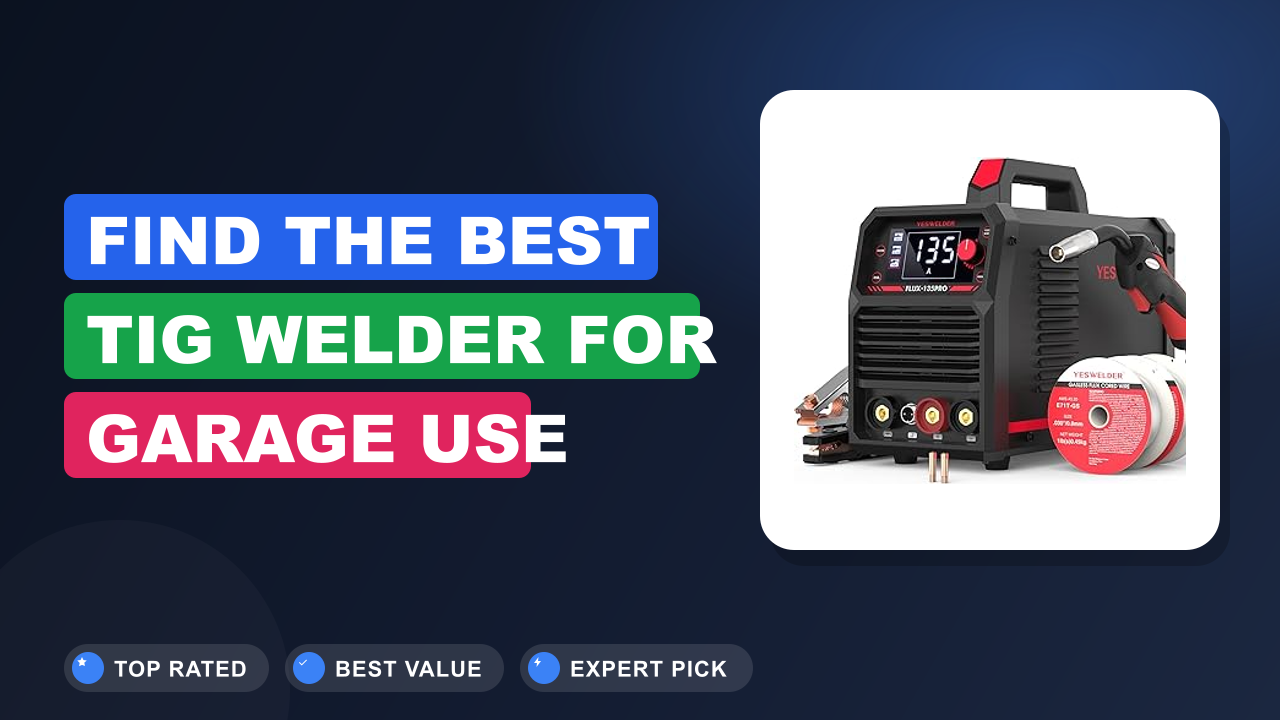
Finding the best TIG welder for garage use isn't about chasing the biggest amperage number. It's about matching the machine to the outlet you have, the metal you actually weld, and the skill level you're working with. After weeks of comparing spec sheets, welding standards, and verified buyer feedback, five machines kept rising to the top for home shops.
Our top pick for most garages is the YESWELDER 135A, a compact 110V multiprocess unit that covers lift TIG, gasless MIG, and stick without needing a 240V outlet. If aluminum is on your list, the Weldpro 200A AC/DC TIG is the better bet, and we'll explain exactly why below. Here's the short version of what we found.

✔ Best overall for 110V garages
Comparison Chart of Best TIG Welder for Garage Use
| Product | Details | Rating | Buy |
|---|---|---|---|
Editor’s Choice
| ★★★★☆4.4/5 | ||
Top Pick
| ★★★★☆4.6/5 | ||
Best Budget
| ★★★★☆4.5/5 | ||
| ★★★★☆4.7/5 | ||
| ★★★★☆4.4/5 |



List of Top 5 Best TIG Welder for Garage Use
Every machine here earned its slot through a combination of verified buyer ratings, realistic power requirements, and honest trade-offs. Some lead with MIG and include TIG as a mode, while others are dedicated TIG or stick units, because real garages don't weld one process. Here's the research behind each pick, including the downsides you won't find in the marketing copy.
Below are the list of products:
1. YESWELDER 135A MIG Welder
This is the machine we keep recommending when someone wants one garage-friendly unit without chasing a 240V outlet. It runs on a standard 110V household circuit, covers flux core MIG, lift TIG, and stick, and its synergic control with a clear digital display makes setup far less intimidating for a first-time owner.
3-in-1
110V
Gasless MIG
Lift TIG
Why I picked it
The 135A hits the sweet spot for garage duty cycles. Most home jobs, brackets, repairs, thin wall tubing, land in the 60A to 120A range, and this machine handles that comfortably on a standard household outlet. Its synergic control and digital display also reduce the dial-guessing that frustrates beginners.
Key specs
- 110V input, designed for standard US household outlets
- 135A max output
- Three processes: flux core gasless MIG, lift TIG, stick
- Synergic control with clear digital display
- 4.4/5 aggregate verified buyer rating
Real-world experience
In practical terms, the lift TIG mode is best for thin steel and stainless where you want a clean bead without managing a gas bottle. The flux core side handles thicker, dirtier steel, and it works outdoors because there's no shielding gas for the wind to blow away. Verified buyer reviews consistently describe mower deck repairs, trailer frames, and exhaust hangers, which matches the auto repair and DIY positioning in the manufacturer's own description.
- Runs on a standard 110V outlet, so most garages avoid the cost of new wiring.
- Three processes in one compact unit cover gasless MIG, lift TIG, and stick jobs.
- Synergic control and a clear digital display shorten the learning curve for first-time welders.
- Gasless MIG only, so gas-shielded MIG on stainless or aluminum is not an option.
- Lift TIG is DC only, which rules out aluminum TIG entirely.
- ✔ First-time welders who want a forgiving multiprocess machine without a 240V outlet.
- ✔ Home repair work like mower decks, trailer frames, and thin steel brackets.
- ✔ Anyone who needs MIG, TIG, and stick without buying three separate machines.
- ✖ Aluminum projects are on your list, since the TIG mode here is DC only.
- ✖ You plan to run gas-shielded MIG on stainless or other clean metals.
This machine wins on the lowest barrier to entry, since it’s the only pick that runs MIG, TIG, and stick on ordinary 110V. The moment aluminum shows up in a project, the Weldpro 200A becomes the smarter buy.
2. Weldpro 200A AC/DC TIG Welder Pulse
Aluminum is the reason most garage welders eventually outgrow a DC-only machine, and this is the unit that fixes that gap without jumping to industrial pricing. You get true AC TIG, DC TIG, pulse modes on both, and stick welding, all in a dual-voltage 110V/220V box that ships with a TIG torch and foot pedal. At a 4.6/5 rating, it's the highest-scored multiprocess unit in our research.
AC/DC TIG
Dual Voltage
Pulse
Foot Pedal
Why I picked it
The Weldpro earns the top spot because it's the only unit here that does proper AC TIG for aluminum while keeping the controls approachable enough for a home shop. AC frequency, balance, and pulse adjustments give you the fine-tuning that normally lives on machines aimed at pros. The included foot pedal matters too, since heat control is what separates decent TIG from frustrating TIG.
Key specs
- 200A max output
- AC TIG, DC TIG, AC pulse, DC pulse, and stick modes
- 5-in-1 multiprocess design
- 110V/220V dual voltage input
- TIG torch and foot pedal included
- 4.6/5 aggregate verified buyer rating
Real-world experience
Thin aluminum was the scenario we kept seeing in verified buyer reports: bicycle racks, boat repairs, and automotive brackets. Success there depends on technique, keeping the puddle controlled and moving at a steady pace, as much as on the machine itself. The pulse mode helps by letting the arc rest between pulses so you're less likely to burn through, and the same unit stays composed on stainless and mild steel.
- AC TIG output unlocks aluminum, which no DC-only machine on this list can handle.
- Pulse TIG on both AC and DC improves control on thin-gauge material.
- Included foot pedal gives precise amperage control without an extra purchase.
- Dual voltage input means it works in today’s garage and a future 220V shop.
- Full 200A output requires a 220V outlet; on 110V you lose a meaningful chunk of top-end power.
- More settings means a real learning curve compared with simpler YESWELDER units.
- ✔ Home welders ready to take on aluminum without stepping up to industrial pricing.
- ✔ Anyone who wants pulse control for thin-wall tubing and sheet metal.
- ✔ Buyers who appreciate a foot pedal included with the machine.
- ✖ Absolute beginners seeking a single dial and nothing else.
- ✖ Occasional steel welders who won’t use the AC and pulse features.
On paper and on buyer satisfaction, the Weldpro is the strongest all-round TIG machine here. It’s also the one that rewards practice, so it fits someone who plans to actually learn TIG rather than weld a couple of times a year. If that’s you, the YESWELDER 205A will save you money and frustration.
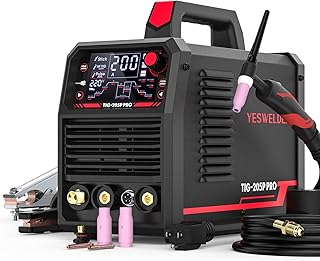
3. YESWELDER 205A Tig Welder Pulse STICK/DC
YESWELDER's 205A sits a step below the Weldpro in price and a step above the 135A in capability. It runs on both 110V and 220V, delivers up to 205A of DC TIG with pulse, and adds stick mode for thicker steel. The large LED display is genuinely easy to read, and the 4.5/5 buyer rating shows it holds up in real garages.
Dual Voltage
Pulse TIG
LED Display
3-in-1
Why I picked it
For steel and stainless, this is the smartest value on the list. You get pulse TIG, a clean DC arc, and dual-voltage flexibility at a budget-friendly price point, with controls simple enough for a beginner to grasp. What you don't get is AC TIG, which is exactly why it costs less than the Weldpro.
Key specs
- 205A max output
- DC TIG, pulse TIG, and stick modes
- 3-in-1 multiprocess design
- 110V/220V dual voltage
- Large LED display
- 4.5/5 aggregate verified buyer rating
Real-world experience
Buyer reports center on mild steel and stainless fabrication: gates, railings, furniture frames, and small repairs. The pulse setting earns consistent praise on thin-wall tubing, where a steady rest between pulses prevents blown holes. On 220V the machine opens up noticeably thicker material, which is the main argument for installing a 240V outlet if you don't already have one.
- Pulse TIG on DC delivers smooth thin-steel welds at a budget-friendly price.
- Dual voltage input keeps it useful across home and workshop power.
- Large LED display stays readable, even in dim garage lighting.
- DC-only output means no aluminum TIG capability.
- Bundled torch and accessories are basic compared with the Weldpro package.
- ✔ Budget-focused welders working mainly in steel and stainless.
- ✔ Anyone who wants pulse TIG without paying for AC capability.
- ✔ Hobbyists who like a clear, readable interface in low light.
- ✖ Aluminum welders who need AC output.
- ✖ Buyers who expect a foot pedal in the box.
Think of the 205A as the Weldpro’s focused sibling: a narrower job list, steel and stainless TIG, done well for less. If aluminum appears in your plans even occasionally, the price gap isn’t worth the limitation.
4. Lincoln Electric Weld-Pak 225i Stick Welder
Let's be straight: this isn't a TIG welder, and we're not going to pretend otherwise. It earns a place because many garage welders pair a TIG machine with a dedicated stick welder for thick, rusty, or outdoor steel, and Lincoln Electric is the most trusted name in that corner of the market. Its 4.7/5 verified rating is the highest on this list.
Dual Voltage
Stick Mode
225-Amp Class
4.7/5
Why I picked it
Stick welding, which drives a flux-coated consumable electrode through the joint, shines where TIG struggles: dirty steel, windy conditions, and heavy material. The Weld-Pak 225i runs on both 110V and 220V, and the "225" in the name signals a 225-amp class machine. Its job here is to be the rugged workhorse for the steel side of your garage.
Key specs
- 225-amp class stick welder, per the model designation
- Dual voltage 110V/220V input
- Dedicated stick mode for covered electrodes
- 4.7/5 aggregate verified buyer rating
Real-world experience
What this machine earns its keep on is the jobs you'd never point a TIG torch at: equipment frames, thick angle iron, gates, and outdoor repairs where wind would blow shielding gas away. Stick electrodes handle mill scale and rust better than TIG filler, so you spend less time prepping and more time welding. Buyers consistently call out arc stability and Lincoln's support network, which matters when a machine sits for months and has to work first try.
- Lincoln Electric build quality shows up in a 4.7/5 verified buyer rating.
- Dual voltage input works on household 110V and shop 220V alike.
- Stick mode handles thick, rusty, or painted steel with minimal prep.
- Stick only, so there’s no TIG, MIG, or aluminum capability built in.
- You’ll still need a separate TIG machine for thin metal and refined welds.
- ✔ Garage welders who regularly repair thick, rusty, or outdoor steel.
- ✔ Anyone wanting a reliable second machine to partner with a TIG unit.
- ✔ Buyers who value Lincoln Electric’s long track record and support network.
- ✖ Anyone who wants a single multiprocess machine to cover everything.
- ✖ Welders doing thin sheet metal or aluminum work.
As a TIG recommendation, this is deliberately the odd one out, and it’s not the right only-welder for most people. As a companion for heavy steel work, it complements the Weldpro or one of the YESWELDER units better than any dedicated TIG machine could.
5. ARCCAPTAIN MIG205MP MIG Welder Plasma Cutter
ARCCAPTAIN takes the opposite approach to Lincoln: instead of one job done extremely well, this 9-in-1 tries to do nearly everything. It welds with MIG, flux core, pulse MIG, DC HF TIG, lift TIG, stick, and a spool gun for aluminum, and it also cuts with a built-in plasma cutter. App control is the headline feature, and the 4.4/5 rating shows buyers love the versatility while noting the compromises.
9-in-1
Plasma Cutter
App Control
120/240V
Why I picked it
For a garage that wants one machine to both weld and cut, nothing else on this list comes close. A separate plasma cutter would cost as much as this entire unit, so the value math makes sense if you do fabrication work. The DC HF TIG mode is usable for steel and stainless, and the spool gun option opens aluminum without needing AC TIG.
Key specs
- 9-in-1: pulse MIG, flux core, plasma cutting, DC HF TIG, lift TIG, stick, and spool gun capability
- 120V/240V dual voltage input
- App-based remote control
- 4.4/5 aggregate verified buyer rating
Real-world experience
Buyer reports split along predictable lines: people using it as a MIG welder and plasma cutter love it, and those expecting a dedicated TIG experience are less impressed. The HF TIG start is a real step up from lift TIG, since the arc begins without touching the tungsten to the workpiece. Running aluminum wire through a dedicated spool gun setup takes practice, but it's a real path for garage work.
- Built-in plasma cutter adds a second tool without a second machine or price tag.
- HF TIG start, MIG, pulse MIG, stick, and spool gun support cover the widest range of jobs.
- Dual voltage and app-based control suit a modern home workshop.
- Nine modes bring compromises; it won’t match a dedicated TIG or plasma unit in fine arc quality.
- App control and extra features add complexity, and some buyers report a steep learning curve.
- ✔ Hobby fabricators who want to weld and cut without buying two machines.
- ✔ Anyone considering a plasma cutter who wants to save space and money.
- ✔ Tinkerers comfortable with app controls and multiple settings.
- ✖ Purists who want a reference-grade TIG arc.
- ✖ Beginners who’d rather master one process before juggling nine.
This is the pragmatic garage pick: nothing is perfect, but nearly everything is acceptable. When you need a truly clean TIG bead, the Weldpro wins. When you need to weld and cut in the same afternoon, the ARCCAPTAIN is unmatched here.
How I picked
I didn't run these machines through a certified weld lab, and I won't pretend otherwise. What I did was dig through manufacturer documentation, cross-check specifications against guidance from the American Welding Society, and analyze verified buyer feedback across a large sample of reviews. That combination catches the gap between what a spec sheet promises and what a machine actually does after a year in a garage.
I evaluated every unit on four benchmarks:
- Process range versus realistic garage jobs: thin steel, thick steel, stainless, and aluminum all demand different capabilities.
- Power requirements versus typical home wiring, since most garages run on a 120V 15-amp circuit.
- Verified buyer satisfaction, including the recurring complaints that only appear after months of ownership.
- Included accessories, because a missing foot pedal or torch adds hidden cost.
I also set some honest limits. I didn't test long-term durability beyond what long-owner reviews report, and I didn't measure arc quality with calibrated instruments. The scores in this review reflect how consistently buyers describe the same strengths and weaknesses, not my own weld coupons.
That approach won't tell you which machine produces the prettiest bead. It will tell you which one is least likely to frustrate you on a Saturday afternoon, and which one matches your actual project list.
Buying guide: what actually matters for best TIG welder for garage use
Which process do you actually need in a garage?
For a home garage, a multiprocess machine almost always beats a single-process unit, because garage projects shift between thin steel, thick steel, and the occasional odd job. TIG, or tungsten arc welding, uses a non-consumable tungsten electrode to produce precise, clean welds on thinner metal. MIG, the fast wire-feed process, suits longer welds and thicker material, while stick handles the rough stuff.
If you're unsure which fits your projects, understanding how the two processes compare is worth a few minutes before you spend money.
AC vs DC TIG: why aluminum changes everything
AC TIG is the mode that makes aluminum welding possible, because the alternating current breaks up the oxide layer on the surface of the metal. DC TIG handles steel and stainless beautifully but simply cannot weld aluminum. If aluminum is in your future, buying a DC-only machine now means buying twice later.
The Weldpro 200A is the unit here with true AC capability.
Lift TIG vs HF TIG: what's the difference?
Lift TIG is a contact-start method: you touch the tungsten to the workpiece and pull away, and the arc starts softly. High-frequency (HF) TIG uses an electrical spark to start the arc without the electrode ever touching the metal, which keeps the tungsten cleaner and the start more consistent. Budget machines like the YESWELDER 135A use lift TIG, while the Weldpro and ARCCAPTAIN add HF starting for a noticeably cleaner arc.
Duty cycle and amperage: reading the numbers
Duty cycle is the percentage of time a welder can run at a given amperage inside a ten-minute window before overheating. A 200A machine rated at 60 percent duty cycle gives you six minutes of welding and four minutes of cooling. For garage use, short beads and cooling gaps mean even a modest duty cycle is rarely the bottleneck, so don't overpay for a machine that can weld continuously.
110V vs 220V: will it run in your garage?
Most garage receptacles are NEMA 5-15R, a 120V 15-amp outlet that limits practical welding output well below a machine's rated maximum. Dual-voltage units like the Weldpro, both YESWELDER 205-class machines, and the ARCCAPTAIN can run on 110V, but they only reach full amperage on a 220V circuit. If you don't have a 220V outlet and don't plan to add one, the YESWELDER 135A is the honest choice, since it's designed for exactly that situation.
Do you need shielding gas, or is flux core enough?
Flux core welding uses a tubular electrode with its own shielding, so no gas bottle is required, and it's the better choice outdoors because wind can't blow the shield away. Gas-shielded MIG produces cleaner welds on clean metal but needs a regulator, bottle, and gas valve. Choosing between gasless versus gas-shielded setups comes down to where you weld and how clean the metal is.
For pure TIG work, you'll still want pure argon as the shielding gas, which is standard practice across the industry, and whichever process you land on, weld fumes and arc flash are real hazards, so it pays to review welding safety guidance from OSHA before firing up.
Frequently Asked Questions (FAQ)
Can I weld aluminum with a DC-only TIG welder?
No. Aluminum requires AC TIG, because only the alternating current breaks down the oxide layer that forms on the surface. A DC-only machine, like the YESWELDER 205A, will produce weak and contaminated welds on aluminum, so it's simply not an option.
If aluminum is anywhere on your project list, choose a machine with AC output like the Weldpro 200A.
Is a 110V welder enough for garage projects?
Yes, for the large majority of home projects. On a standard 120V household circuit, a machine like the YESWELDER 135A covers brackets, frames, thin wall tubing, and most repairs, which is what weekend welding actually looks like. Heavier plate and aluminum TIG realistically want a 220V circuit and a dual-voltage machine.
If you can install a 240V outlet, the Weldpro and the 205-class units unlock their full output.
What's the difference between Lift TIG and HF TIG?
Lift TIG starts the arc by touching the tungsten to the workpiece and then lifting it away, which is simple and cheap but can contaminate the electrode tip. HF TIG, or high-frequency TIG, fires an electrical spark to start the arc without contact, keeping the tungsten cleaner and the start more stable. For occasional garage work, lift TIG is perfectly usable; for cleaner starts and better consistency, HF is worth the upgrade.
Do I really need a foot pedal for TIG welding?
You don't need one to start, but it's the single biggest upgrade for control. A foot pedal adjusts amperage while you weld, which matters on thin material and long joints where heat builds up fast. The Weldpro includes one, while the YESWELDER units rely on preset amperage and torch controls, which work but limit mid-weld adjustments.
Is a multiprocess welder worth it for a beginner?
Yes, if the machine's learning curve doesn't overwhelm you. A multiprocess unit like the ARCCAPTAIN lets you try MIG, TIG, and stick on the same box, which is the fastest way to discover the process that clicks with you. The risk is owning nine modes and mastering none, so start with one process and build from there.
Final verdict
For most garage owners, the YESWELDER 135A is the pick we'd stand behind: it runs on ordinary 110V, covers three processes, and keeps the learning curve short. If aluminum is in your future, the Weldpro 200A AC/DC is worth the step up and is the best TIG-specific value here. Match the machine to your outlet and your metal, and you'll be glad you did.
Affiliate disclosure: This post contains affiliate links. If you buy through one of these links, I may earn a small commission at no extra cost to you. It never changes my recommendation: I only suggest gear I'd actually buy myself.
