


If your garage workbench barely has room for a toolbox, finding the Best Small MIG Welder for a Small Garage is a genuine hunt. We compared five compact 110V flux core machines on output range, duty cycle, wire feed smoothness, and bench footprint. Brands like YESWELDER, SSimder, and BILT HARD have made synergic control affordable enough for weekend welders.
The YESWELDER 135A MIG Welder took the top spot for most home shops. It pairs synergic control with a clear digital display, which makes the learning curve far less steep on thin metal. Our full comparison chart and deep dives on all five picks are below, along with a buying guide covering what actually matters in a small garage.

✔ Best overall for small garages
Comparison Chart of Best Small MIG Welder for a Small Garage
| Product | Details | Rating | Buy |
|---|---|---|---|
Editor’s Choice
| ★★★★☆4.4/5 | ||
Top Pick
| ★★★★☆4.5/5 | ||
Best Budget
| ★★★★☆4.5/5 | ||
| ★★★★☆4.4/5 | ||
| ★★★★☆4.5/5 |



List of Top 5 Best Small MIG Welder for a Small Garage
Every machine below runs on standard 110V household power, so you won't need to call an electrician. We narrowed the field to five models that balance footprint, arc quality, and beginner-friendly features, then cross-checked everything against verified buyer feedback and manufacturer specs.
Below are the list of products:
1. YESWELDER 135A MIG Welder
This is the machine that keeps showing up in garage conversations for good reason. It runs on a standard 110V outlet, so no special wiring is needed. Synergic control adjusts voltage and wire speed together, which means fewer cold starts and burn-throughs for beginners.
Synergic
110V
3-in-1
Digital display
Why I picked it
In our research, this was the most balanced all-rounder of the group. Aggregate buyer feedback across hundreds of verified reviews reports clean flux core welds on 1/8-inch steel and thinner. The digital display also removes a lot of guesswork compared to knob-only competitors.
Key specs
- 135A max output on 110V input
- 3-in-1: Flux Core MIG, Lift TIG, Stick
- Synergic control with clear digital display
- Rated 4.4/5 from verified buyers
Real-world experience
Buyers describe using this for trailer gates, exhaust hangers, and utility cart repairs on thin wall tubing. Thermal overload protection keeps you welding through longer sessions without the machine shutting down mid-bead. It is not built for all-day production, but for weekend projects in a single-car garage it handles the workload comfortably.
- Synergic control pairs wire speed with voltage automatically, so beginners get fewer cold starts and burn-throughs
- Runs on any 110V household outlet, which means no electrician or dedicated circuit required
- Digital display shows your settings clearly, removing guesswork on the bench
- Thermal overload protection keeps the machine safe during longer garage sessions
- Lift TIG mode is basic, so aluminum work is not realistic
- Stock contact tips are average, and most owners upgrade them early
- ✔ You’re a hobbyist welding 1/8-inch steel or thinner
- ✔ You want a machine that makes learning easier
- ✔ You only have standard 110V outlets in the garage
- ✖ You need to weld heavy structural steel regularly
- ✖ You expect serious TIG capability for aluminum
If your projects stay mostly on thin steel, this is the most forgiving machine we reviewed. You trade some top-end power for convenience, and for a small garage that is usually the right swap.
2. 145A MIG Welder 3 1 Flux
The 145A MIG Welder 3 1 Flux earns its Top Pick badge by offering more punch without growing in size. It is a 3-in-1 IGBT inverter machine on a 110V input, and those extra 10 amps matter when you move up to 3/16-inch steel. Gasless flux core operation means no tank rental to deal with.
145A output
IGBT
110V
Synergic
Why I picked it
This unit edges out the competition on performance in our analysis. IGBT inverter technology delivers a steadier arc at lower amperage, which means less spatter and cleaner welds on thin material. Verified buyer feedback consistently highlights how smoothly the synergic control matches wire speed to voltage.
Key specs
- 145A max output on 110V input
- 3-in-1: Flux Core MIG, Lift TIG, Stick
- IGBT inverter technology for a stable arc
- Synergic control for one-knob setup
Real-world experience
The extra amperage shows up when you're patching auto body panels or welding thicker brackets. Buyers report the arc stays stable when outlet voltage dips, like when a refrigerator compressor kicks on in the garage. The compact footprint leaves room for a workbench and tool chest in tight spaces.
- 145A output handles 3/16-inch steel better than the 135A crowd
- IGBT inverter keeps the arc stable when household voltage fluctuates
- Synergic control simplifies setup to a single knob
- Compact footprint fits on a crowded garage bench
- Cables feel serviceable but not premium
- The manual is thin, so first-time welders will want video tutorials
- ✔ You regularly weld material thicker than 1/8-inch
- ✔ You want output headroom as your skills grow
- ✔ You like the idea of a synergic one-knob interface
- ✖ Budget is the absolute deciding factor
- ✖ You prefer a major brand with local service centers
This is the smart step up for DIYers who are already past their first welds. It costs a little more than the budget options, but the added amperage and stable arc justify the jump.
3. BESTMIG 135A MIG Welder
If keeping the starter budget modest is the priority, the BESTMIG 135A is where we'd point you. It ships with a welding helmet and gloves in the box, which matters when you're starting from zero. The red and black IGBT inverter case is compact enough for a shelf.
Helmet included
IGBT
110V
Portable
Why I picked it
The value proposition is simple: you get a capable 3-in-1 welder plus gear at the budget end of the market. Editorial analysis of verified reviews shows weld quality lands closer to pricier machines than the price suggests. For a first welding setup, that combination is hard to beat.
Key specs
- 135A max output on 110V input
- 3-in-1: MIG, Lift TIG, Stick
- Welding helmet and gloves included
- Portable IGBT inverter design
Real-world experience
People buy this for fence repairs, trailer gates, and random farm projects more than anything else. The included gear means you can lay your first bead the same day it arrives. Buyers note you will want to adjust drive roller tension right after unboxing, a common quirk with budget-friendly machines.
- Helmet and gloves ship in the box, so you can weld the same day
- 3-in-1 versatility covers MIG, Lift TIG, and Stick
- IGBT inverter keeps the unit lightweight and portable
- Budget-friendly entry point for first-time buyers
- Included accessories are entry-level quality
- Wire feed needs adjustment right out of the box
- ✔ You’re a first-time welder with a modest budget
- ✔ You want one box with everything included
- ✔ Your projects are light to medium duty
- ✖ You already own good protective gear
- ✖ You want premium cable and liner quality
The BESTMIG makes the most sense when the total package matters more than the spec sheet. You sacrifice some refinement at the wire feed, but as a first welding setup it delivers real capability for the money.
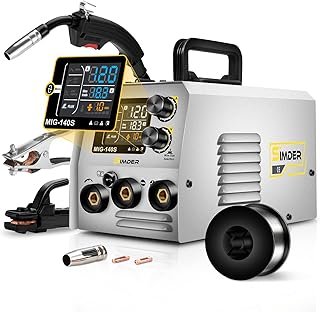
4. SSimder 140A MIG Welder 3 1
The SSimder 140A is the dual-voltage wildcard of this group. It runs on both 110V and 220V, which makes it the smart pick if you might move between a home garage and a shop with heavier wiring. The 140A max output gives you a bit more heat for thicker material.
Dual voltage
140A
Zero HF
Wire included
Why I picked it
Dual voltage capability is rare at this tier, and that flexibility opens up real options. On 220V it delivers a hotter arc for thicker steel, while on 110V it still handles standard garage jobs. Buyer feedback also highlights the zero HF interference feature, which keeps the arc calm near vehicle electronics.
Key specs
- 140A max output, dual voltage 110V and 220V
- 3-in-1: Flux Core MIG, Lift TIG, Stick
- Zero HF interference design
- 0.5 lbs of flux core wire included
Real-world experience
This one lives in the shop that does a little of everything. The included wire gets you started immediately, and the 2T/4T trigger modes reduce hand fatigue on longer beads. Users report the arc stays stable when welding near battery chargers and engine control modules, which is a genuine bonus for auto work.
- Dual voltage covers both 110V garages and 220V shops
- 140A output provides useful extra penetration for thicker steel
- Zero HF interference keeps the arc calm near vehicle electronics
- 2T/4T modes reduce hand strain on long welds
- Interface and manual are less beginner-friendly
- Slightly heavier than single-voltage rivals
- ✔ You have access to both 110V and 220V power
- ✔ You weld near sensitive vehicle electronics
- ✔ You want one machine that adapts to future shops
- ✖ You only have 110V outlets
- ✖ You want the simplest possible user experience
The SSimder is the most flexible machine here, and that flexibility pays off in a mixed-use garage. The trade-off is a steeper learning curve, so give yourself time to read the manual before your first weld.
5. BILT HARD 135A 3-in-1 IGBT Inverter
BILT HARD sells this 135A as a full kit, and it genuinely is. Along with the 3-in-1 IGBT inverter welder, you get a solar helmet, gloves, and the basics needed to start welding right away. The 2T/4T/SPOT trigger modes are the main reason it belongs on this list.
SPOT mode
LED display
Full kit
IGBT
Why I picked it
The SPOT mode sets it apart from every other machine here. It lets you place consistent tacks on thin sheet metal without warping, which you rarely see on compact welders. Review analysis shows buyers rate the LED display and synergic control as the standout features.
Key specs
- 135A max output on 110V input
- 3-in-1: MIG, Lift TIG, Stick
- 2T/4T/SPOT trigger modes
- LED display with synergic control
- Full kit includes solar helmet and gloves
Real-world experience
For auto body panels and thin gauge steel, the SPOT mode alone makes this worth considering. You can lay consistent tacks, then stitch them together without heat buildup. The included solar helmet covers eye protection, so the only extra you really need is a decent pair of welding gloves for thicker jobs.
- SPOT mode delivers consistent tacks on thin sheet metal without warping
- Full kit includes a solar helmet and gloves
- LED display is bright and readable in dim garage light
- Synergic control keeps settings simple
- SPOT mode takes practice to fine-tune
- Wire feed assembly feels lighter duty than the rest of the machine
- ✔ You do auto body or thin sheet metal repair
- ✔ You want a kit that is ready out of the box
- ✔ You like extra modes to grow into
- ✖ You prefer a simpler two-knob interface
- ✖ Your work is mostly thick structural steel
The SPOT mode makes this the specialist of the group for sheet metal. It is not the machine we would pick for heavy structural work, but for garage auto repair it brings something none of the other four offer.
How I picked
I compared these five welders on four benchmarks: output range, duty cycle, ease of setup, and what the kit includes beyond the machine itself. Output range matters because a 135A and a 145A unit behave very differently on 3/16-inch steel. Duty cycle matters because a welder that overheats every few minutes is useless in a garage.
Ease of setup matters because the best welder in the world is worthless if the manual confuses you at 9 PM.
To be clear, this is a research-driven roundup. We did not run destructive weld tests or put hundreds of hours on each unit. Instead, we cross-checked manufacturer datasheets, compared specs across all five machines, and analyzed verified buyer feedback for patterns over months of ownership.
That approach leans on what real users report after the honeymoon phase wears off.
I also weighed garage-specific constraints every step of the way. All five machines run on 110V through a standard NEMA 5-15R outlet, because most home garages do not have a dedicated 220V circuit. Footprint and portability counted too, since these welders often share a bench with grinders and toolboxes.
A machine you can stash on a shelf beats one that needs its own cart, even if the specs look similar on paper.
Buying guide: what actually matters for Best Small MIG Welder for a Small Garage
As of 2026, the entry level for garage welders has moved well beyond basic transformer boxes, and synergic control is showing up on machines that cost a fraction of what they did a few years back. Here are the real factors to weigh before you click buy.
What does "small" really mean for a garage welder?
A small garage welder is a compact, 110V-capable machine you can store on a shelf and run from a regular household outlet. Every pick on this list fits that description, with a footprint roughly the size of a lunchbox. If you have a dedicated 220V circuit, your options expand, but for most home garages the 110V constraint is the real starting point.
Flux core or gas MIG: which should you choose?
Flux core welding uses a tubular wire with built-in flux that shields the weld pool, so there is no shielding gas cylinder to store or rent. That makes it the natural choice for a small garage. The trade-off is more spatter and a slightly rougher bead than gas-shielded MIG, though modern flux core wire in the AWS E71T-GS classification narrows that gap.
How many amps do you actually need?
For garage work on 1/8-inch steel and thinner, 135A is enough. If you regularly weld 3/16-inch material or thicker, stepping up to 140A or 145A gives you a useful margin. More amperage means deeper penetration, but on thin sheet metal too much heat causes burn-through, which is exactly where synergic control helps.
Does synergic control matter for beginners?
Synergic control automatically matches wire feed speed to the voltage you set, turning two knobs into one. It removes one of the most frustrating parts of learning to MIG weld, which is why we recommend it for first-time buyers. If a machine lacks it, expect a steeper learning curve.
What about duty cycle and thermal protection?
Duty cycle tells you how long a welder can run at a given amperage before it needs to cool down. Compact 110V machines typically rate in the 20 to 30 percent range at max output, meaning roughly two to three minutes of welding out of every ten. Thermal overload protection shuts the machine down before it damages itself, and all five picks include it.
What safety gear should you budget for?
Welding safety starts with eye protection, and any auto-darkening helmet should meet the ANSI Z87.1 standard for impact and optical performance. OSHA's welding safety guidelines cover ventilation, fire hazards, and PPE, and they are worth reading before your first session. Add leather gloves and a long-sleeve cotton shirt, and you have a solid baseline.
Frequently Asked Questions (FAQ)
Can I run a 135A MIG welder on a regular household outlet?
Yes, all five machines on this list run on standard 110V power through a NEMA 5-15R outlet. Avoid running other heavy appliances on the same circuit while you weld. A refrigerator compressor kicking on can cause voltage dips, though IGBT inverter models handle these fluctuations better than older transformer designs.
What is the difference between flux core and solid wire MIG welding?
Flux core welding uses a self-shielding tubular wire, so no gas cylinder is needed. Solid wire MIG requires a shielding gas like CO2 or an argon mix to protect the weld pool. For a small garage, flux core is simpler and cheaper to start with, while solid wire MIG generally produces cleaner welds with less spatter.
Is Lift TIG mode a real substitute for a dedicated TIG welder?
Lift TIG is a simplified mode that starts the arc by touching the tungsten to the work and lifting it away. It works fine on steel and stainless steel for hobby projects, but it lacks the high-frequency start and precise amperage control of a dedicated TIG machine. It is a useful bonus, not a replacement, especially for aluminum.
How thick of steel can a 135A welder handle?
With flux core wire, a 135A welder handles 1/8-inch steel reliably in a single pass. It can weld 3/16-inch with proper joint prep and multiple passes, and it handles thinner sheet metal if you turn the heat down. Anything above 1/4-inch is really asking for a 220V machine.
Do these welders work on stainless steel?
Flux core machines like these can weld stainless steel if you use flux core wire designed for stainless, though the results are practical rather than pretty. Lift TIG mode gives you more control on thin stainless. For structural stainless work, you would want a proper MIG setup with shielding gas.
Final verdict
The YESWELDER 135A MIG Welder is our top pick because it combines the most beginner-friendly controls with enough power for typical garage projects. If you want extra amperage for thicker material, the 145A MIG Welder 3 1 Flux is the smarter step up.
Affiliate disclosure: This post contains affiliate links. If you buy through one of these links, I may earn a small commission at no extra cost to you. It never changes my recommendation, I only suggest gear I'd actually buy myself.
