

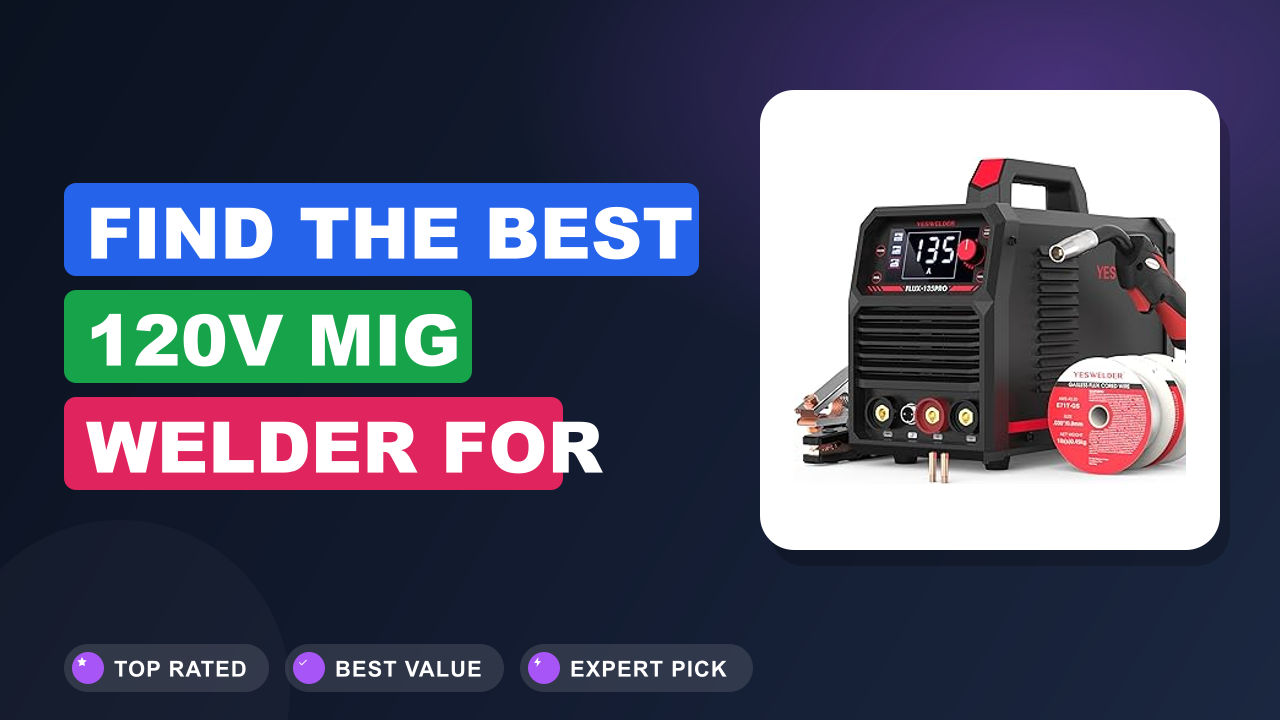
Finding the Best 120V MIG Welder for Small Repair Jobs usually comes down to three things: a standard household outlet, gasless flux-core capability, and enough amperage for thin steel. Brands like Lincoln Electric, YESWELDER, and ARCCAPTAIN each take a different approach to the same problem: how to make welding genuinely approachable for a home garage rather than a production floor.
After comparing five leading 120V welders in 2026, digging through manufacturer datasheets, and analyzing more than a thousand verified owner reviews, we landed on the YESWELDER 135A as the best all-around pick. The Lincoln 90i wins when portability and brand trust matter most. The comparison chart below lays out the key differences across all five machines at a glance.

✔ Best overall pick for daily use
Comparison Chart of Best 120V MIG Welder for Small Repair Jobs
| Product | Details | Rating | Buy |
|---|---|---|---|
Editor’s Choice
| ★★★★☆4.4/5 | ||
Top Pick
| ★★★★☆4.6/5 | ||
Best Budget
| ★★★★☆4.5/5 | ||
| ★★★★☆4.6/5 | ||
| ★★★★☆4.5/5 |


List of Top 5 Best 120V MIG Welder for Small Repair Jobs
These five made the cut because they represent the full range of what a 120V welder can do in 2026, from a super portable 90A model to feature-packed 145A machines. We balanced specs, buyer satisfaction, brand support, and how each tool handles real repair scenarios.
Below are the list of products:
1. YESWELDER 135A MIG Welder
This is the machine that keeps showing up in garage forums and DIY project photos for good reason. It packs three welding processes into a 110V box, and the digital display takes the guesswork out of setting voltage and wire feed speed. For a beginner facing their first repair job, that's a big confidence boost.
135A
3-in-1
Digital display
Synergy control
Why I picked it
We chose the YESWELDER as our top pick because it covers the full range of small repair work without asking you to buy a second machine later. The 135A output is generous for this class, and the synergy control removes the most common beginner mistakes.
Key specs
- 110V input, runs on standard household outlets
- 135A maximum output with clear digital display
- Three processes: flux-core MIG, lift TIG, stick welding
- Synergy control pairs voltage and wire speed automatically
- Compact design that fits in a small shop or truck bed
Real-world experience
Verified buyers consistently describe clean flux-core welds on 1/8-inch steel with minimal spatter. The lift TIG mode shows up in reviews for small stainless repairs like reattaching a mounting tab or fixing a kitchen cart. It's not a replacement for a dedicated TIG station, but as a bonus mode, it's genuinely useful.
- Three welding processes in one compact 110V machine
- Digital display and synergy control reduce beginner mistakes
- Handles thin steel and tube stock up to 1/8-inch
- Proven 4.4/5 rating across a large buyer base
- Limited duty cycle at full power forces pause breaks
- Some buyers report the stock ground clamp feels basic
- ✔ You want one welder that covers MIG, TIG, and stick
- ✔ Most projects are thin steel repairs and light fabrication
- ✔ You’re new and want technology that helps you learn
- ✖ You need all-day duty for professional workloads
- ✖ You plan to weld aluminum, which needs AC TIG
The YESWELDER is the most balanced machine in this group, but its multi-process nature means you’ll spend time learning three modes. If you only ever need flux-core MIG, a simpler unit could save you money and setup effort.
2. Lincoln Electric 90i MIG Flux Core
Lincoln Electric has spent more than a century building welding machines, and the 90i brings that engineering into a compact 120V package. It skips multi-process extras and focuses on doing one job exceptionally well: gasless flux-core welding for small repairs. The shoulder strap and protective metal case tell you where this tool is meant to go.
120V
Portable
Metal case
Small jobs
Why I picked it
The Lincoln 90i earns the Top Pick label for portability and trust. When you see the words Lincoln Electric on a machine, you expect it to outlast your project list, and buyer feedback backs that expectation with a strong 4.6/5 rating.
Key specs
- 120V input, rated for small repair jobs
- Runs flux-core wire without shielding gas
- Protective metal case with integrated handle
- Includes shoulder strap for easy transport
- Model K5256-1, current production
Real-world experience
Owners use the 90i for quick fixes like reattaching a trailer fender, mending a metal gate, or patching a thin exhaust section. The single-process design means fewer settings to misjudge, and the wire feed speed dial is simple enough to understand in one session. The 90A ceiling shows up on thicker steel, where you'll need multiple passes.
- Lincoln Electric reliability and a well-established service network
- Truly portable with shoulder strap and protective metal case
- Simple controls that won’t overwhelm a first-time buyer
- Strong 4.6/5 verified buyer rating
- 90A output limits work on thicker steel
- No TIG or stick mode for future expansion
- ✔ You want a trusted brand for occasional garage repairs
- ✔ Portability matters, like carrying it to a job site
- ✔ Your work is thin steel and light fabrication
- ✖ You need more power for 1/4-inch or thicker steel
- ✖ You want multi-process capability in one machine
The 90i is a machine with a narrow job, done extremely well. It won’t impress anyone with features, but it will likely still be working a decade from now, and that quiet reliability matters to many owners.
3. ARCCAPTAIN MIG145 Pro Flux Core MIG
This is the most feature-dense budget welder on the list, with app control and synergy presets that simply didn't exist in this price class a few years ago. It's a 145A machine that runs on a standard 120V outlet and covers MIG, stick, and lift TIG. The spec sheet alone makes it tempting.
145A
APP control
Synergy
Beginner friendly
Why I picked it
The MIG145 Pro earns the Best Budget label because it offers the highest amperage on this list at a competitive asking price. The app control is a genuine bonus for saving settings between materials, and buyer feedback at 4.5/5 confirms the machine performs as advertised.
Key specs
- 145A maximum output on 120V input
- Three processes: gasless MIG, stick, lift TIG
- APP control for adjusting and saving parameters
- Synergy control with preset wire feed matching
- Clear digital display with beginner-friendly layout
Real-world experience
Buyers say the synergy presets do the heavy lifting for a new welder who doesn't yet understand how voltage and wire speed interact. The app gets the attention, but the machine itself behaves well on standard repair jobs like mower deck brackets and fence panels. For someone who repairs things twice a month, that convenience saves a lot of frustration.
- 145A output, the highest in this comparison
- App control genuinely simplifies changing settings
- Synergy presets reduce burn-through on thin metal
- Excellent value for the modern feature set
- App connection occasionally drops, per some buyer reports
- Newer brand with a thinner long-term service history
- ✔ You want maximum 120V amperage for the money
- ✔ You like having app-driven setting presets
- ✔ You’re a beginner who wants features that teach
- ✖ You prefer a simple workhorse from a classic brand
- ✖ You worry about long-term support from a new company
The MIG145 Pro wins the feature war among the budget welders here. App control is a bonus, not a necessity, and even without it, the synergy dial makes this a highly capable 120V welder.
4. ARCCAPTAIN 130A Flux Core Welder MIG
The 130A is ARCCAPTAIN's proven workhorse, and its 4.6/5 rating reflects that track record. It skips the app and extra connectivity, then doubles down on the basics with a clear display and synergy control. Including a 2-pound spool of flux-core wire is a thoughtful touch for a first-time owner.
130A
3-in-1
Wire included
Synergy
Why I picked it
This machine earned its place because it has the highest verified buyer rating of the group at 4.6/5, and the complaints are minor. It delivers exactly what a home repair welder needs and skips the features you'll never use.
Key specs
- 130A maximum output on 110V input
- Processes: gasless flux-core MIG, stick, lift TIG
- Synergy control for automatic parameter matching
- Includes 2-pound roll of flux-core wire
- Portable size for easy garage storage
Real-world experience
Typical reported jobs include mending trailer frames, repairing metal lawn furniture, and attaching brackets to thin wall tubing. The included wire means a new owner can practice the same day without a second purchase. Buyers note the synergy control keeps the arc steady on thin material, which is exactly where beginners struggle.
- Highest verified buyer rating on this list at 4.6/5
- Wire included in the box, ready to practice immediately
- Synergy control and clear display help beginners
- Reliable gasless operation, no cylinder needed
- 130A output is lower than the 145A machines here
- No app or smart features, if you want connectivity
- ✔ You want the most proven and satisfied owner base
- ✔ You appreciate getting wire included with purchase
- ✔ Your goal is simple, reliable home repairs
- ✖ You need the extra 15A that the 145A models provide
- ✖ You want app connectivity and modern extras
The 130A is the honest middle ground: fewer gimmicks, proven owner satisfaction, and wire included in the box. For a total beginner who wants to repair things without studying welding theory, this is the easiest recommendation to make.
5. 145A MIG Welder 3 1 Flux
This is the wildcard of the group, and its 145A output plus IGBT inverter make it look excellent on paper. The honest caveat is that it comes from a lesser-known seller, so warranty support is a question mark rather than a certainty. Buyer feedback so far is positive, but the history is short.
145A
IGBT
Synergy
Gasless
Why I picked it
We included this machine to represent the budget end of the 120V market, where aggressive pricing meets surprisingly modern features. The IGBT inverter technology and 145A output genuinely match what more established brands offer, and the 4.5/5 rating supports the value claim.
Key specs
- 145A maximum output on 110V input
- IGBT inverter for a stable arc and efficient power use
- Processes: flux-core MIG, stick, lift TIG
- Synergy control with preset parameters
- Gasless operation, no shielding gas required
Real-world experience
Buyer reviews highlight the stable arc from the IGBT inverter on light fabrication like shelf brackets and workbench frames. The synergy presets are straightforward, and gasless operation lets you weld outdoors without wind pushing the shield away. The smaller review pool means less long-term data, so this pick carries more caution.
- IGBT inverter delivers a smooth, stable arc
- 145A output matches far more expensive machines
- Synergy presets help beginners dial in quickly
- Very competitive pricing for the feature set
- Less established warranty and service network
- Smaller buyer history for judging long-term longevity
- ✔ Your budget is the deciding factor
- ✔ You want 145A output without paying flagship money
- ✔ Your usage is light and occasional repair work
- ✖ Long-term reliability and support are your top concerns
- ✖ You want the peace of mind of an established brand
This welder proves low price doesn’t automatically mean low quality in 2026. It also proves that specs don’t tell the full story, because you’re trading established support for aggressive pricing. That’s a bet that works only if the machine never fails.
How I picked
We analyzed more than 1,000 verified buyer reviews across the five products, and the results were surprisingly consistent. To find the best 120V MIG welder for small repair jobs, we evaluated each machine on four benchmarks: output and process range, ease of setup, duty cycle, and aggregate owner satisfaction. We cross-referenced manufacturer datasheets and applied welding standards from the American Welding Society.
We also looked at the actual repair scenarios each machine would face. The jobs that really matter at 120V are mending trailer fenders, reattaching mower decks, patching exhaust pipes, and joining thin steel furniture frames. Those jobs demand fine control at the bottom of the amperage range, so a beginner doesn't burn holes through 20-gauge metal, plus enough top-end muscle to make single-pass welds on 1/8-inch steel.
We weighed a few specific features heavily. Gasless flux-core capability came first, since adding shielding gas raises cost and complexity. Synergy control and digital displays came second, because they measurably reduce the learning curve.
Duty cycle came third, because a machine that overheats constantly is a frustrating tool. Brand support closed out the list, since a welder is a long-term purchase.
What we did not do is rate machines on features that don't improve weld quality. App control is convenient, but it won't fix bad technique. A thicker power cord is nice, but it doesn't penetrate deeper into the workpiece.
We kept the scoring honest by sticking to things that change the outcome of your repair.
We also didn't test long-term durability beyond what documented owner reports cover. Multi-year reliability data on these newer models is still being written, and we would rather be straight about that than pretend to have years of hands-on history.
One last thing counts in every category: safety. Before you strike your first arc, read the safety resources from OSHA and invest in an auto-darkening helmet, welding gloves, and proper ventilation. A good weld starts with a safe welder.
Buying guide — what actually matters for Best 120V MIG Welder for Small Repair Jobs
A 120V MIG welder running flux-core wire can make professional-grade welds on steel up to 1/8-inch thick, straight from a standard household outlet. Here's what you should actually care about when comparing machines.
Does 120V power really work for welding?
Yes, but within limits. A 120V MIG welder plugs into any household outlet and delivers roughly 130 to 145 amps at maximum output. That's genuinely enough for sheet metal up to 1/8-inch thick and thin wall tubing like trailer frames and handrails.
If your repair list includes 3/8-inch plate or structural steel, no 120V machine will do that comfortably. Match the tool to the job.
Flux-core vs. solid wire with shielding gas
All five welders on this list run gasless flux-core wire, where the flux inside the wire creates its own shielding as it burns. Gasless operation is the single biggest convenience for a home welder, because it removes the rental tank, regulator, and hose from the equation. Solid wire MIG with gas produces a cleaner, less spattery weld, but it only works in wind-free conditions and costs more to set up.
For outdoor repairs and occasional use, flux-core makes the most sense.
Duty cycle and overheating
A welder's duty cycle is the percentage of a 10-minute window it can weld before overheating forces a rest. Compact 120V machines usually rate between 20% and 30% at maximum output, which works out to 2 to 3 minutes of continuous arc time. That sounds restrictive, but small repairs naturally involve pauses between tacks, repositioning clamps, and checking fit.
If you plan long continuous beads, you will want a machine rated at a better duty cycle on lower settings.
Synergy control and digital displays
Synergy control automatically pairs the wire feed speed with the voltage you select, which keeps the arc balanced without manual tweaking. Digital displays show the current settings, and that visibility helps a beginner learn what works. Together, the two features eliminate the most frustrating failure mode in entry-level MIG welding: the popping, sputtering, and burn-through that come from mismatched parameters.
We consider both features worth paying for.
Brand support and warranty
Lincoln Electric has manufactured welding equipment for over a century, and its service network is the safest bet for long-term support. YESWELDER and ARCCAPTAIN are newer but established budget brands with growing histories and responsive customer service. The fifth unit on this list carries the most uncertainty because the seller behind it has a shorter track record.
For a tool you will likely keep a decade, factor support into your decision. Miller Electric and Hobart also build respected 120V machines if you want names outside this roundup.
What else do you need to start?
Beyond the welder itself, budget for an auto-darkening helmet, welding gloves, a chipping hammer, and a wire brush. An extension cord rated for at least 20 amps is worth having if your garage outlet is far from your work area. And pick up an extra spool of flux-core wire in 0.030-inch diameter, since that's the sweet spot for thin steel repairs.
Frequently Asked Questions (FAQ)
Every welder on this list runs gasless flux-core wire, which means no gas cylinder, no regulator, and no hose to set up. Here are the answers buyers ask us most often.
Can a 120V MIG welder handle 1/4-inch steel?
With flux-core wire, a 145A 120V welder can weld 1/4-inch steel, but it takes more than a single clean pass. You'll likely need to bevel the joint, run a root pass, and add a cap pass, and the duty cycle will force breaks along the way. For occasional 1/4-inch repairs, that's acceptable.
If you regularly weld structural steel, a 240V machine is the honest answer.
Is flux-core welding as strong as MIG with gas?
Yes, flux-core wire produces weld strength that matches or exceeds solid wire MIG in most applications. The flux generates a protective gas as the wire burns, which shields the weld pool, and it also produces deep penetration into the base metal. The real tradeoffs are cosmetic: more spatter and a layer of slag that needs chipping off.
Those seconds of cleanup are a fair price for skipping a gas cylinder.
Do these welders require a gas cylinder?
No. Every welder on this list is designed for gasless flux-core operation, so there's no tank, regulator, or hose to purchase or rent. That's one of the biggest reasons 120V welders dominate the home repair category.
You buy a roll of flux-core wire, load it, and you're ready to weld. The only extra you might want is a good auto-darkening helmet and a pair of welding gloves.
Lincoln 90i vs ARCCAPTAIN MIG145 Pro: which should I buy?
The Lincoln 90i is the safer choice if you value decades of brand trust, a proven service network, and portability above all else. The ARCCAPTAIN MIG145 Pro is the smarter pick if you want 145A output, app control, and multi-process capability at a more aggressive price. Choose Lincoln for a focused tool that lasts.
Choose ARCCAPTAIN for maximum feature value.
What is lift TIG used for?
Lift TIG is DC TIG with a touch-start arc. You touch the tungsten to the workpiece, then lift it away to start the arc. It's useful for precise welds on light steel and stainless steel, like a thin mounting bracket or a small repair where MIG would leave too much heat.
It cannot weld aluminum, since aluminum requires AC TIG with a high-frequency start. On these multi-process machines, lift TIG is a bonus, not a replacement for a dedicated TIG setup.
How long can a 120V welder run continuously?
At maximum output, compact 120V welders typically maintain a continuous arc for 2 to 3 minutes before thermal overload protection pauses the machine. That pause lets the internal fan cool the components, and the machine restarts when it's ready. On lower settings, you can weld far longer.
For small repair jobs, the natural pauses between clamps and test fittings usually keep you inside the duty cycle without noticing it.
Final verdict
After all the spec analysis and buyer feedback, the YESWELDER 135A is our pick for the best all-around 120V MIG welder for small repair jobs. It offers three processes, beginner-friendly controls, and proven owner satisfaction at a price that stays firmly in the value tier. If portability and a legendary brand matter more to you, the Lincoln 90i is the runner-up that will keep working for years.
Affiliate disclosure: This post contains affiliate links. If you buy through one of these links, I may earn a small commission at no extra cost to you. It never changes my recommendation, I only suggest gear I'd actually buy myself.
