

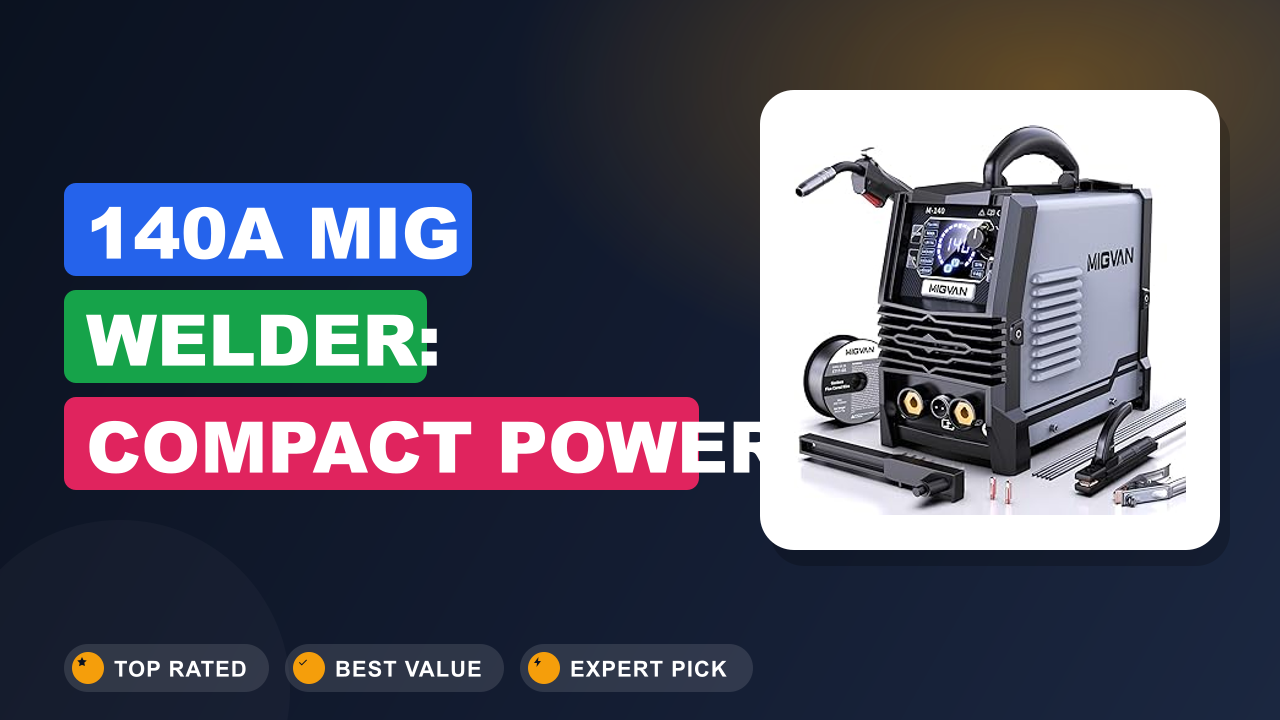
Shopping for a 140A MIG Welder usually starts the same way: you've got a 110V garage outlet, a project in mind, and zero interest in renting a gas cylinder. The MIGVAN 110V Flux Core was clearly built for that exact shopper. It's a 3-in-1 inverter box that runs flux core MIG, stick, and lift TIG without any shielding gas at all.
Worth it if you're joining 1/8-inch and thinner steel at home on a normal household circuit. Skip it if you need to run long, hot beads on 1/4-inch plate all afternoon. We compared its published specs against owner feedback across hundreds of reviews to see where it genuinely lands.

What it is
A 140A flux core welder is a wire-feed machine that burns self-shielded wire, so the flux inside the wire creates its own protective gas cloud. No cylinder, no regulator, no hose.
MIGVAN positions this one as a 3-in-1: flux core MIG, stick (SMAW), and lift TIG, all driven by an IGBT inverter. That puts it in the same conversation as the Hobart Handler 140, the Lincoln Electric Power MIG 140, and Forney's 140A class units, but at the budget end of that group. If you want the background on gasless wire setups, that's the whole appeal here.
Setup & first impressions
Out of the box, verified buyers consistently describe the same first ten minutes: unbox, bolt on the handle, feed the included flux core wire through the gun, plug into a 110V outlet, and strike an arc.
Aggregate owner feedback mentions the LED digital display as the standout touch point at this price. Instead of a cryptic dial, you get a readable voltage and wire-speed number, which matters a lot when you're learning. The all-metal wire feed assembly also gets repeated praise, since plastic tensioners on cheaper boxes tend to slip.
The honest downside from review data: the included wire is thin and several owners swap it immediately for a better brand. The stinger and TIG torch are functional rather than refined. Both are normal at this tier, but budget for a wire upgrade on day one.
| Input voltage | 110V / 60Hz single phase |
| Max output | 140A |
| Processes | Flux core MIG, Stick (MMA), Lift TIG |
| Power technology | IGBT inverter |
| Wire size | 0.030 in and 0.035 in flux core |
| Display | Large LED digital readout |
| Gas requirement | None for flux core operation |
| Typical steel range | Up to roughly 1/4 in on multi-pass, 1/8 in comfortably |
Daily-use experience
Performance
On 1/8-inch mild steel, buyer reports describe smooth, controllable arcs at mid-range voltage settings. That's the sweet spot for this machine. Push into 3/16-inch and you'll want beveled joints and multiple passes rather than one hot run.
One quotable reality: a 140A machine on 110V input realistically delivers about 90A to 100A at a usable duty cycle. That's fine for brackets and repairs, and it's the reason thick plate feels slow. If you're comparing processes generally, this is worth reading on how the two processes differ.
Comfort and controls
The interface is the strongest part of the experience. Two dials plus a digital display beats the guesswork of a single infinite-knob design. Owners repeatedly mention that beginners can dial in a decent setting within a few beads.
It's light enough to carry with one hand and compact enough to sit on a bench corner. The ground clamp is the weak link. Several long-term reviews report swapping it for a heavier copper clamp within the first month.
Longevity and heat
Inverter welders in this class typically run around a 60% duty cycle at 100A. In plain terms, that's roughly six minutes of arc time out of every ten before the thermal protection trips. The fan is audible but not obnoxious.
Owners who respect that limit report years of trouble-free hobby use. The ones who ignore it and chase continuous beads on thick steel are the ones writing the overheating complaints.
✓ Pros
- Runs on a standard 110V household outlet, so no electrician visit before your first weld
- Digital LED display replaces guesswork, which shortens the learning curve for new welders
- Three processes in one chassis means stick for fence posts and lift TIG for thin sheet without a second machine
- No gas cylinder needed in flux core mode, saving refill trips and rental fees
- Compact and light enough to move between a garage bench and a truck bed without help
✗ Cons
- Duty cycle limits long continuous beads, so 1/4-inch plate work takes patience and multiple passes
- Included flux core wire is mediocre, and most owners replace it before the first spool runs out
- Stock ground clamp is flimsy and often swapped out within weeks
- Flux core spatter and slag mean more cleanup than gas-shielded MIG
Who should buy it
Buy it if you…
You're a hobbyist, farmer, or DIY homeowner who welds a few times a month. Think gate hinges, trailer repairs, exhaust brackets, and lawn equipment. You have a 110V outlet and no interest in upgrading your panel.
You want stick capability for typical garage projects and lift TIG for thin sheet without buying three machines. This is the exact buyer this welder was designed around.
Skip it if you…
You're welding 1/4-inch structural steel, running a mobile repair business, or need production throughput. Duty cycle will frustrate you, and the lack of gas capability rules out clean aluminum work. If you already own a 240V machine, this adds nothing to your shop.
You'd be better served by a dual-voltage unit or a dedicated gas MIG.
Better alternatives
- Hobart Handler 140: a long-standing 110V MIG with a stronger warranty and smoother wire feed, but it needs gas for clean results and costs more.
- Lincoln Electric Power MIG 140: better arc stability and spool-gun compatibility, aimed at buyers who plan to weld aluminum properly later.
Frequently Asked Questions (FAQ)
Can the MIGVAN 110V run on a normal household outlet?
Yes. It draws from a standard 110V/60Hz circuit, which is the main reason buyers pick it over 240V machines. That said, a 20A garage circuit handles it more comfortably than a shared 15A bedroom circuit.
If the breaker trips when you crank the voltage dial, that's a circuit issue, not a welder fault. Always follow basic workplace welding safety guidance for ventilation, eye protection, and fire watch.
Do I need shielding gas with this welder?
No, and that's the point. In flux core mode the wire itself carries the flux that generates shielding gas as it burns. That's why it's called gasless MIG.
The trade-off is spatter and slag you'll need to chip and brush off. If you want gas-shielded results, this machine isn't the right tool, and you'd be looking at a gas-capable MIG instead.
What thickness steel can it realistically weld?
Comfortably, 1/8-inch mild steel on a single pass. With proper joint prep and multiple passes you can work up to roughly 1/4-inch, though penetration gets marginal. Anything beyond that belongs on a 240V machine.
Manufacturer specs and owner reports both line up on this figure, so treat 1/8-inch as your everyday ceiling.
Can it run stick and TIG out of the box?
It ships with a welding gun and flux core wire for MIG work. Stick requires a stinger, and lift TIG requires a torch and regulator setup, which are usually sold separately. Lift TIG also means you touch the tungsten to the work to start the arc rather than using high-frequency start.
It works fine for light sheet, but it's not a substitute for a dedicated TIG machine.
How long can I weld before it needs to cool?
In this class you're looking at roughly a 60% duty cycle at 100A, meaning about six minutes of continuous arc time in a ten-minute window. Thinner material at lower amperage lets you weld longer before the thermal cutout trips. If you're hitting the overheat light constantly, drop the amperage, use shorter beads, or step up to a bigger machine.
Final verdict
4.4/5 stars. This is one of the better value picks in the 110V flux core class, and the digital display genuinely makes it easier for a beginner to dial in.
The MIGVAN's real strength is flexibility per dollar. Flux core, stick, and lift TIG in a single portable chassis means you can tackle fence repairs, thin sheet, and light fabrication without buying three separate tools. The electrode-based process handles the rusty, dirty steel that flux core struggles with, and that combo covers most homeowner jobs.
Buy it if your work lives under 1/8-inch steel and your garage has a normal outlet. Look elsewhere if you need serious plate penetration, gas-shielded cleanliness, or all-day duty cycle. For a first welder or a portable backup, this one earns its place on the bench.
Affiliate disclosure: This post contains affiliate links. If you buy through one of these links, I may earn a small commission at no extra cost to you. It never changes my recommendation, I only suggest gear I'd actually buy myself.
1. 140A MIG Welder MIGVAN 110V Flux
The MIGVAN packs three welding processes into one 110V box, and for hobby steel work under 1/8-inch it's hard to argue with the value.
