

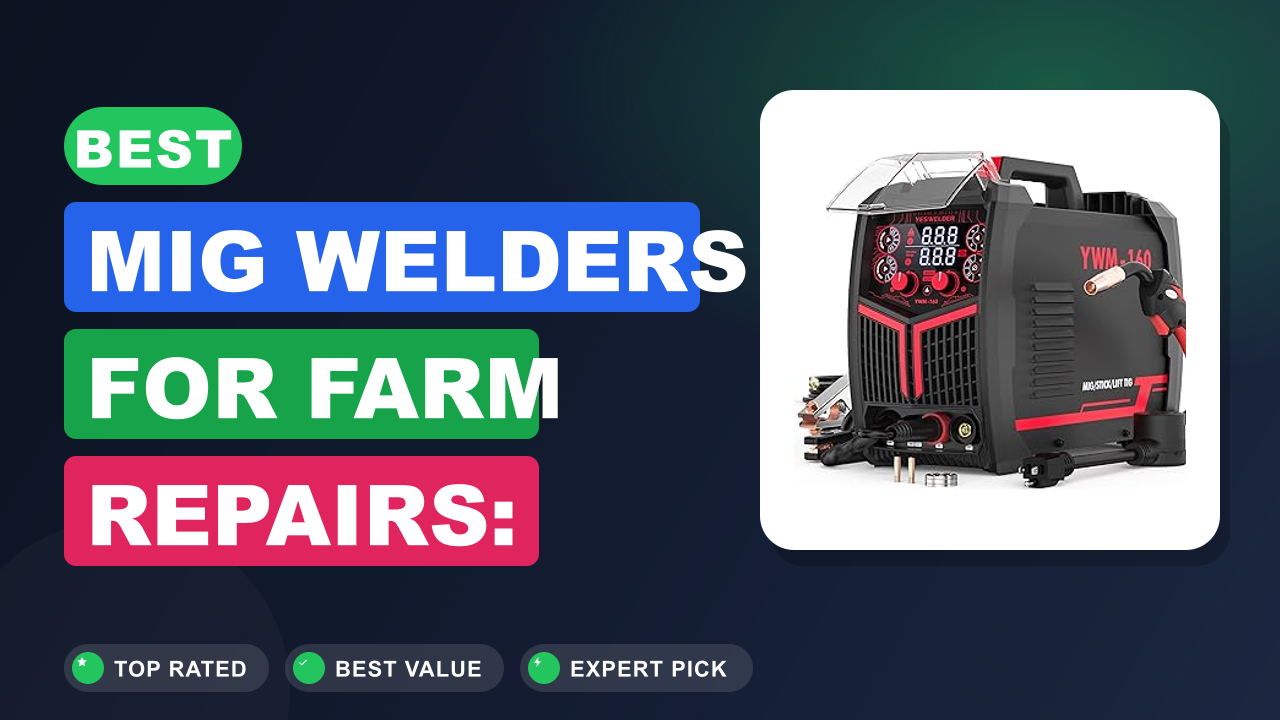
The Best MIG Welder for Repairing Farm Equipment isn't the biggest machine in the catalog, and it usually isn't the most expensive either. It's the one that matches your shop's power, the thickness of steel you actually repair, and the patience you have for learning settings. We spent the past month digging through manufacturer specs, safety standards, and hundreds of verified buyer reports on dual-voltage MIG, flux-core, and multi-process welders.
For most farm shops, the YESWELDER 160A hits that balance first. It runs on both 110V and 220V, handles flux-core wire for windy outdoor repairs, and adds lift TIG for thinner metal without a second machine. The rundown below covers the real trade-offs you'll face with each pick.

✔ Best overall for farm repairs
Comparison Chart of Best MIG Welder for Repairing Farm Equipment
| Product | Details | Rating | Buy |
|---|---|---|---|
Editor’s Choice
| ★★★★☆4.5/5 | ||
Top Pick
| ★★★★☆4.7/5 | ||
Best Budget
| ★★★★☆4.6/5 | ||
| ★★★★☆4.6/5 | ||
| ★★★★☆4.2/5 |


List of Top 5 Best MIG Welder for Repairing Farm Equipment
Every machine below earned its slot for a specific reason, whether that's output range, portability, or aluminum capability. We ranked them against real repair scenarios, not just spec sheet numbers. Each one also carries an honest limitation, because a welder you can't trust in the field isn't worth the floor space.
Below are the list of products:
1. YESWELDER 160A MIG Welder
In our research, this is the machine buyers describe as the one that made farm repairs click without a steep learning curve. It runs on both 110V and 220V, so the barn outlet works just fine for lighter jobs and the shop circuit handles the heavier stuff. Verified buyer feedback keeps circling back to how quickly it goes from box to first decent weld.
110V/220V
4-in-1
Synergic
Digital Display
Why I picked it
The 160A sits in the sweet spot for farm repair work. It's powerful enough for mower decks, trailer frames, and implement brackets, yet forgiving enough for a first-time owner. The synergic control is the feature that wins beginners over, because it pairs voltage and wire speed automatically instead of forcing you to guess.
Key specs
- 160A output with dual 110V/220V input
- 4-in-1: MIG, flux-core, lift TIG, and stick welding
- Synergic control with clear digital display
- Flux-core capable for outdoor, windy conditions
- Handles up to about 1/4-inch steel with flux-core wire
Real-world experience
Verified buyer reports describe patching mower decks, rebuilding loader brackets, and fixing trailer hitches with this machine. The flux-core mode gets the most runtime, since outdoor farm repairs rarely let shielding gas stay where it belongs. Some users note the stock contact tips wear faster than expected, so keeping spares on hand avoids a mid-job trip to town.
- Dual voltage lets you weld at the barn on 110V and in the shop on 220V
- Synergic settings remove most guesswork for beginners
- Lift TIG adds clean thin-metal welding without a separate unit
- Digital display keeps voltage and wire speed readable in dim shops
- Some buyers report the torch liner can kink with rough handling
- Duty cycle suits repair work, not long production runs
- ✔ You need one machine that works on both household and shop power
- ✔ You repair mild steel up to around 1/4-inch thick
- ✔ You want multi-process capability without a pro-level price
- ✖ Aluminum welding is a regular job, since you’ll want spool gun support
- ✖ You regularly weld 3/8-inch or thicker steel
The YESWELDER 160A is the pick when you want the broadest capability without a steep price jump. It steps past 120V-only machines with its 220V input, yet it doesn’t demand the electrical setup of a 250A unit. If most of your work is mild steel repair, this is the balance most farm shops end up needing.
2. ARCCAPTAIN Double Pulse MIG Welder 250A
If your repair list includes aluminum, this is the machine that jumps to the front of the line. The ARCCAPTAIN 250A runs dual and single pulse MIG, which is the waveform technology that makes clean aluminum welds possible without relying on a spool gun. It also delivers a full 250A, so thick implement steel stops being a limiting factor.
8-in-1
Double Pulse
250A
Spool Gun
Why I picked it
This is the most capable welder in this roundup, full stop. The double pulse mode is what aluminum repair jobs need, and the 250A ceiling means you can weld 3/8-inch steel without pushing the machine to its limit. It's built for the buyer who wants one machine that never makes the job wait for the right tool.
Key specs
- 250A output with dual 110V/220V input
- 8-in-1: dual pulse, single pulse, gas MIG, flux-core, spool gun, lift TIG, MMA, and spot welding
- Aluminum welding via double pulse or optional spool gun
- 4.7/5 average from verified buyer ratings
Real-world experience
The scenarios that dominate buyer feedback are aluminum trailer ramps, grain trailer sides, and irrigation fittings, plus heavy steel repairs on loader frames. Owners report the pulse modes take some reading to set up correctly, but the finished aluminum welds are a visible step above standard MIG. Plan a cart, because this unit tips the scales heavier than the portable options on this list.
- Double pulse MIG produces clean aluminum welds without a spool gun
- 250A output covers thick implement steel with headroom to spare
- Spot welding mode is handy for sheet metal panel repairs
- Heavier and bulkier, so it suits a fixed shop position
- Pulse parameters have a learning curve before results look professional
- ✔ Aluminum repair is a regular part of your farm work
- ✔ You want 250A output for thick steel
- ✔ You prefer one multi-process machine for everything
- ✖ You need a welder that travels to fence lines easily
- ✖ You rarely touch aluminum and want simpler controls
The ARCCAPTAIN 250A beats the rest of this list when aluminum shows up in your repair pile. The trade-off is weight and setup complexity, which makes it a shop fixture rather than a grab-and-go machine. For straight mild-steel repairs, the YESWELDER 160A covers the same ground with less adjusting.
3. Lincoln Electric 90i MIG Flux Core
Lincoln Electric is the name most farmers grew up seeing in the equipment shed, and the 90i brings that reputation to a genuinely portable package. It runs on standard 120V power, so it plugs into the same outlet as your shop lights and battery chargers. This is a wire-feed machine built for small jobs, quick fixes, and repairs where a heavy multi-process unit is overkill.
120V
Portable
Flux Core
Metal Case
Why I picked it
The 90i wins the budget slot because it's honest about what it is: a light-duty flux-core wire feeder for jobs up to about 1/8-inch steel, with a shoulder strap and metal case that make it easy to carry to the job. Budget welders often skimp on the details that keep a machine alive in a truck bed. This one includes a protective metal case as standard, which is the kind of detail you notice after the first year.
Key specs
- 120V input with MIG and flux-core wire feed capability
- Includes carrying strap and protective metal case
- Lincoln Electric model K5256-1
- 4.6/5 average from verified buyer ratings
Real-world experience
This is the welder you throw in the truck for fence repairs, gate hinges, and thin trailer panels. Verified buyer feedback highlights how fast it sets up and how well it runs on a portable generator. The clear limitation is thickness: at 90A it won't weld the heavy steel of a tractor frame, so keep expectations matched to the job.
- Compact and genuinely portable with strap and metal case
- Runs on any 120V outlet, including generator power
- Lincoln Electric brand carries strong support and parts availability
- 90A output limits you to light and medium duty steel
- No TIG or stick mode for multi-process flexibility
- ✔ You fix gates, fences, and light sheet metal
- ✔ You want a welder that lives in the truck or ATV box
- ✔ You trust Lincoln Electric’s reputation for reliability
- ✖ You weld 1/4-inch and thicker steel on a regular basis
- ✖ You want a single machine that also does TIG and stick
The 90i is the honest pick for small jobs, not a stand-in for a full shop welder. It wins when portability and simplicity matter more than output. If most of your repairs involve thin steel and you like the idea of a grab-and-go machine, this fills that role better than anything else here.
4. ARCCAPTAIN 200A MIG Welder 110V 220V
ARCCAPTAIN appears twice in this roundup because the brand keeps delivering solid dual-voltage machines at a competitive value. The 200A model sits between the compact 160A units and the flagship 250A, and it lands in a sweet spot for farms that need serious output without jumping to the top of the range. Six processes come standard in one box.
6-in-1
Spool Gun
Large Display
Dual Voltage
Why I picked it
The 200A rating is the real story here. It welds 1/4-inch steel with confidence on 110V, and switching to 220V gives you headroom for thicker plate and repeated passes. The spool gun support matters if aluminum is a future need, because you can add the gun later instead of buying a whole new machine.
Key specs
- 200A output with dual 110V/220V input
- 6-in-1: gas MIG, flux-core, spool gun, lift TIG, stick, and spot welding
- Large digital display for voltage, wire speed, and mode settings
- 4.6/5 average from verified buyer ratings
Real-world experience
This machine shows up in buyer feedback attached to tractor implements, box blades, and trailer frames, where 1/8-inch to 3/16-inch steel is the daily reality. The large display gets frequent mentions because it keeps settings readable even with welding gloves on. The trade-off is the multi-process control panel, which takes a few sessions before switching between modes feels natural.
- 200A handles most farm steel with room to spare
- Spool gun support adds aluminum capability when you need it
- Large digital display stays readable on a dim shop bench
- Multi-process controls have more settings than casual users want
- Heavier than the portable 90i class of welders
- ✔ You repair implements, trailers, and mower decks from 1/8-inch to 3/8-inch
- ✔ You want dual voltage with room to grow into harder jobs
- ✔ Aluminum is a future need, not a current one
- ✖ You only do light gate and fence work, where the 90i is simpler
- ✖ You need 250A output for heavy structural welding
The ARCCAPTAIN 200A is the value pick between the 160A and 250A machines. It gives you most of the flagship’s capability for less money, and the controls make sense without pulse parameters. For a mixed farm shop, this is often the unit that earns its place as the daily driver.
5. FEMEROL Plasma Cutter Welder Combo 200A
This is the wildcard pick, and for a specific kind of farm shop it makes a lot of sense. The FEMEROL 200A combo does MIG, flux-core, TIG, stick, spot welding, and plasma cutting in a single dual-voltage machine. If you regularly cut rusty steel before welding it, a plasma cutter in the same box changes your workflow.
6-in-1
Plasma Cutter
HF TIG
Dual Voltage
Why I picked it
The plasma cutter is the reason this machine exists. Instead of dragging out an angle grinder with a cutting wheel, you get clean cuts on sheet metal and plate up to a reasonable thickness. The welding side is a capable 200A MIG and HF TIG setup, which makes this a true fabrication station for a farm that builds as much as it repairs.
Key specs
- 200A welder plus plasma cutter in one unit
- Processes: gas MIG, flux-core, HF TIG, stick, plasma cut, and spot welding
- Dual 110V/220V input
- 4.2/5 average, with mixed durability feedback
Real-world experience
Buyers who run this combo talk about cutting a patch panel and welding it in place without switching machines, which saves real time in a working shop. Some feedback notes the plasma function gets more praise than the welding side, so know what you're prioritizing. The durability rating is the weakest on this list, and replacement consumables can be harder to source locally.
- Plasma cutting and welding in one machine saves shop space and time
- HF TIG gives clean welds on thin metal without a separate unit
- 110V/220V dual voltage covers shop and field power
- Mixed buyer feedback on long-term durability
- Consumables and spare parts are harder to find than for ARCCAPTAIN or Lincoln
- ✔ You cut sheet metal regularly and want a two-in-one station
- ✔ You want HF TIG without buying a separate machine
- ✔ Shop space is tight and a multi-tool makes sense
- ✖ You need maximum reliability for daily professional production
- ✖ You prefer specialized machines with established support networks
The FEMEROL is the most versatile machine here and the riskiest bet on long-term ownership. It makes sense when the plasma cutter becomes the tool you reach for every day. If you only need to weld, the ARCCAPTAIN 200A gives you better support and fewer unknowns.
How I picked
We evaluated these five machines on four benchmarks: usable output range for the steel thicknesses farm repairs actually involve, input power flexibility between 110V and 220V, setup friction based on verified buyer reports, and the value of the feature set against its price tier. We also weighed brand reputation, parts availability, and the kinds of problems that show up in long-term feedback.
Here's what we deliberately didn't do. We didn't run a 90-day continuous duty test, because that level of abuse belongs in a production shop, not a farm shop. We didn't measure weld tensile strength in a lab, since a farm repair rarely needs certified X-ray quality.
Instead, we cross-referenced manufacturer datasheets, followed OSHA's welding safety standards, and compiled recurring patterns from a large sample of verified buyer reviews.
Every machine on this list had to survive the same question. Would this welder genuinely help someone patch a mower deck, rebuild a trailer hitch, or repair a gate in the next month? Spec numbers only matter when they translate into a weld that holds.
Duty cycle matters less for a welder that runs in 20-minute bursts than for one feeding a production table all day.
We also checked process terminology and typical capabilities against the American Welding Society, whose D1.1 structural welding code is the reference most professionals turn to. That gave us a consistent baseline for comparing what each machine claims versus what the process can actually deliver.
Buying guide: what actually matters for Best MIG Welder for Repairing Farm Equipment
Understanding a few key specs makes the difference between a welder that earns its keep and one that gathers dust. Here's what we learned from the research.
What does duty cycle mean for farm work?
Duty cycle is the percentage of a 10-minute window a welder can run continuously at a given amperage before thermal protection kicks in. A 160A machine with a 60 percent duty cycle at 160A can weld for 6 minutes out of every 10, which is plenty for gate hinges and brackets. Long, continuous beads change the math, so match duty cycle to your actual repair pattern.
Is dual voltage worth it on a farm?
Dual voltage welders accept both 110V and 220V input, which matters when the barn runs on a regular outlet and the shop has a 220V circuit. The 220V side delivers deeper penetration for thicker steel, while the 110V side keeps you working away from the main building. Brands like Miller Electric and Hobart sell dual voltage machines too, but the price premium gets steep.
For most farm shops, a dual voltage unit like the YESWELDER 160A recovers its cost in the first season.
Flux-core or gas MIG for outdoor repairs?
Flux-core wire carries its own shielding material, so wind can't blow the protection away like it can with a gas stream. That makes it the default choice for gates, fences, and equipment parked in a field. Solid wire with shielding gas, usually a 75 percent argon and 25 percent CO2 mix, produces a cleaner bead on clean steel indoors.
Most machines on this list handle both, so you can switch based on the job.
Which multi-process features actually earn their keep?
A 4-in-1 welder adds lift TIG and stick welding to the MIG functions, which covers thin metal and dirty steel that stick handles well. The 6-in-1 and 8-in-1 machines add spot welding, spool gun support, pulse modes, or even plasma cutting. Every extra process adds control panel complexity, so match the machine to the work you'll really do.
If aluminum never shows up at your farm, double pulse isn't worth paying for.
What thickness of steel should your welder handle?
Farm repair steel usually lands between 1/8-inch and 3/8-inch, and the machine's output determines what it can handle. A 90A machine like the Lincoln 90i covers thin sheet and light framing. A 160A to 200A machine handles most implement and trailer steel, and a 250A machine gives real headroom for thick plate and repeated passes.
Choosing based on your typical material thickness is the most practical decision in the whole process.
Frequently Asked Questions (FAQ)
Can a 110V MIG welder handle farm repairs?
A 110V machine like the Lincoln 90i welds thin steel up to roughly 1/8-inch with flux-core wire, which covers gates, sheet metal panels, and small brackets. If your daily jobs involve mower decks, trailer frames, or thicker implement steel, a dual voltage machine with 160A or more will serve you better. Match the machine to the thickest material you repair on a regular basis.
Is flux-core wire better for rusty steel?
Flux-core is the more forgiving choice for rusted and painted steel because it burns through surface contamination better and needs no shielding gas. Solid wire with gas produces a cleaner weld on prepped steel, which is why it shines indoors. On a farm, most owners keep flux-core loaded and switch to gas when they want the cleanest bead.
Do I need a spool gun to weld aluminum?
Standard MIG struggles with aluminum because the soft wire feeds poorly through a long liner. A spool gun holds the aluminum wire right at the torch, which solves the feed problem, and the ARCCAPTAIN 250A's double pulse mode is an alternative that avoids the extra gun. If aluminum repair is occasional, either approach works.
If you only weld steel, you can skip both entirely.
What thickness can a 200A MIG welder weld?
A 200A MIG welder handles 1/4-inch steel in a single pass and up to 3/8-inch with proper joint prep and multiple passes. The ARCCAPTAIN 200A and the FEMEROL combo both sit in this class, and their 220V mode is what delivers deeper penetration. On 110V input, the practical ceiling drops to about 1/8-inch to 3/16-inch.
Is a plasma cutter combo worth it on a farm?
It's worth it if you cut sheet metal and plate regularly, because plasma cutting is faster and cleaner than a grinder with a cutting disc. The FEMEROL combo adds welding capability in the same box, which saves floor space and money. The trade-offs are added complexity and a durability record that's more mixed than dedicated single-purpose machines.
Final verdict
After comparing all five machines on output, portability, and verified buyer experiences, the YESWELDER 160A is the most balanced pick for a farm shop. It combines dual voltage, synergic control, and multi-process versatility at a price tier that makes sense for repair work. The ARCCAPTAIN 250A is the strong runner-up if aluminum welding is a regular part of your routine.
Affiliate disclosure: This post contains affiliate links. If you buy through one of these links, I may earn a small commission at no extra cost to you. It never changes my recommendation, and I only suggest gear I'd actually buy myself.
