

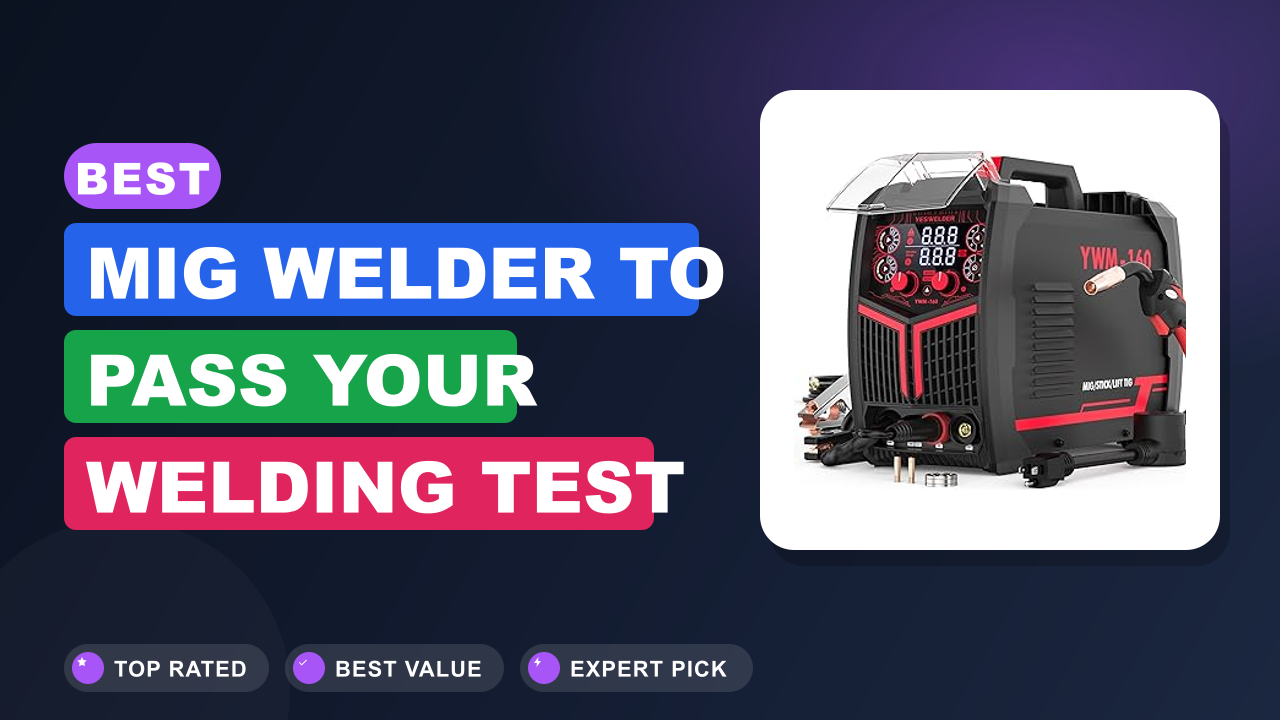
If you're shopping for the best MIG welder for passing a welding test, you already know what's at stake: clean beads, solid penetration, and a machine that behaves when you're under the hood with a timer running. The good news is you don't need an industrial rig to pass. You need steady arc control, a wire feed system that keeps up, and enough amperage range for the coupons on the test table.
After comparing spec sheets from Miller, ARCCAPTAIN, YESWELDER, and SEESII, digging through verified buyer reports, and weighing each machine against the acceptance criteria that most steel tests follow, the YESWELDER 160A MIG Welder keeps coming out on top for test takers. It pairs dual-voltage input with synergic control in a way that removes setup guesswork. Here's why it won, along with four other machines worth your shortlist.

✔ Best overall for test prep
Comparison Chart of Best MIG Welder for Passing a Welding Test
| Product | Details | Rating | Buy |
|---|---|---|---|
Editor’s Choice
| ★★★★☆4.5/5 | ||
Top Pick
| ★★★★☆4.6/5 | ||
Best Budget
| ★★★★☆4.6/5 | ||
| ★★★★☆4.4/5 | ||
| ★★★★☆4.4/5 |


List of Top 5 Best MIG Welder for Passing a Welding Test
These five machines earned their spots for different reasons. Some shine on steel test coupons, some bring aluminum capability, and one is just incredibly portable. The right pick depends on the process your test requires and the space you practice in.
Here's the full breakdown.
Below are the list of products:
1. YESWELDER 160A MIG Welder
The YESWELDER 160A is the machine our editorial team kept circling back to during this comparison. It's a 4-in-1 unit (MIG, flux core, lift TIG, stick) with dual-voltage input, so it runs on a 110V garage outlet and a 220V shop outlet. Synergic control sets the voltage and wire feed speed for you, which is exactly the kind of help you want when test-day nerves kick in.
4-in-1
110V/220V
Synergic
160A
Why I picked it
This earned the top spot because passing a welding test is a consistency problem, and synergic control is a consistency feature. It removes voltage and wire feed speed from your list of variables. Verified buyer feedback repeatedly mentions how quickly beginners produce flat, clean beads without endless dial-twiddling.
That's exactly what a timed coupon rewards.
Key specs
- 160A maximum output
- Dual voltage: 110V and 220V
- 4 processes: MIG, flux core, lift TIG, stick
- Synergic control with clear digital display
- Beginner-friendly setup profile
Real-world experience
The scenario that matters is a vertical-up or overhead coupon, because those positions expose a weak arc instantly. Aggregate user reviews report that the synergic control holds a stable puddle even at slower travel speeds, and the digital display makes it easy to log your settings between practice sessions. The lift TIG mode is a handy backup if your test includes an optional TIG pass.
For steel test coupons, it's more than enough.
- Synergic control sets voltage and feed speed from one dial
- Dual-voltage input works at home and at the test facility
- Four processes in a single machine
- Clear digital display for logging settings
- Lift TIG is not a substitute for HF TIG on aluminum
- Stock torch and liner are entry-level; several buyers upgraded after heavy practice
- ✔ You’re prepping for a steel MIG certification on a budget
- ✔ You want one machine for home practice and test-day travel
- ✔ You’re new to welding and want fewer variables
- ✖ You need high-frequency TIG for aluminum
- ✖ You need a continuous-duty machine for production shifts
This is the most balanced machine we reviewed for test prep alone. It won’t out-build a Millermatic in a professional shop, but for the two to six months of practice before a certification attempt, it gives you the most control per dollar. If your test is straightforward steel MIG, start here.
2. ARCCAPTAIN 200A MIG Welder 110V 220V
The ARCCAPTAIN 200A is our top pick for one specific reason: it's the only machine on this list that meaningfully supports aluminum welding out of the box. The 6-in-1 setup includes MIG, gasless flux core, spool gun support, lift TIG, stick, and spot welding modes, with a 200A ceiling on both 110V and 220V. That makes it a strong candidate for automotive and fabrication programs where aluminum coupons show up on the test board.
200A
6-in-1
Spool gun
110V/220V
Why I picked it
We chose it as the top pick because aluminum tests trip up more people than steel tests ever will. Thin aluminum is unforgiving, and a spool gun eliminates the wire feed tangles and burnback common with long liners. In our research, the spool gun support combined with 200A output gave this machine the widest range of test scenarios of any unit here.
Key specs
- 200A maximum output
- Dual voltage: 110V and 220V
- 6 processes including spool gun support
- Spot welding mode for auto body work
- Large display with clear readouts
Real-world experience
The real-world winner is the flat or horizontal aluminum T-joint. Buyers report a stable arc on 1/8-inch plate with a spool gun, and the 200A ceiling leaves headroom for thicker material. The spot welding mode also helped several users practice auto body sheet metal before their practical exam.
Just confirm your bundle: the spool gun is frequently sold separately.
- Spool gun support for clean aluminum feeding
- 200A output handles thicker test coupons
- Six processes including spot welding
- Dual voltage covers garage and shop outlets
- Heavier and bulkier than smaller units
- Spool gun is often an add-on purchase
- ✔ Your program includes aluminum welding tests
- ✔ You work on automotive or light fabrication projects
- ✔ You want a single machine that handles many processes
- ✖ You only weld thin steel at home
- ✖ You need the lightest, most portable option
If the test board includes a 1/8-inch or 3/16-inch aluminum coupon, this is the machine we’d trust most on the list. For pure steel flat-position tests, it’s more capability than you need, and the YESWELDER covers that with less complexity at a friendlier price.
3. Millermatic® 211 PRO MIG Welder Machine
It feels strange to call the Millermatic 211 PRO a "best budget" pick, until you measure budget in time instead of dollars. Miller machines are the industry benchmark in welding education, and the 211 PRO is the model we see most often in community college labs and apprenticeship shops. Auto-Set chooses the voltage and wire feed speed from a single dial, which is the closest thing to a cheat code for weld test prep.
Auto-Set™
120/240V
Dyna-Pulse™
3/8 in aluminum
Why I picked it
This machine removes the biggest variable in test failure: bad setup. Auto-Set picks the right voltage and wire feed speed from the material thickness you enter, so practice time goes into travel speed and technique instead of troubleshooting. Aggregate reviews from career welders consistently describe it as the machine they wish they had learned on.
Key specs
- Dual voltage: 120V and 240V
- Auto-Set™ one-dial setup
- Dyna-Pulse™ spatter reduction
- Aluminum capability to 3/8 inch
- Upgradable software
Real-world experience
This shines in a formal certification with limited practice coupons. Buyers report spending a fraction of their practice time on settings and nearly all of it on bead quality. The aluminum capability to 3/8 inch also means this machine moves from test prep into real fabrication without a second purchase.
That's why learning the basics of MIG on this platform makes sense.
- Auto-Set removes setup guesswork completely
- Dyna-Pulse reduces spatter on thin metal
- Welds aluminum up to 3/8 inch
- Miller build quality holds resale value
- Premium price tier
- Heavy enough to need a proper cart
- ✔ You want a machine that outlasts the test
- ✔ You’re entering a welding career path
- ✔ You want the fewest setup variables possible
- ✖ You need to stay in a strict budget tier
- ✖ You only need a portable gasless machine
This is the buy-once, cry-once pick. If the upfront cost doesn’t hurt, the 211 PRO will carry you from first practice bead through pipe and aluminum certifications years later. The YESWELDER is the better value for a single exam; the Miller is the better long-term investment.
4. SEESII 135A MIG Welder 110V
The SEESII 135A answers a specific problem: your practice space is a garage corner or apartment setup with a 110V outlet and almost no room to spare. At 7.7 pounds, it's the lightest unit on this list by a wide margin, and it still handles flux core, lift TIG, and stick welding. For entry-level welding tests that run on gasless wire, this is genuinely all you need.
7.7 lb
135A
110V
IGBT
Why I picked it
A welding test is often taken at a facility with its own equipment, which means your home practice rig only needs to be portable and consistent. The IGBT inverter technology delivers a smooth 135A arc from a compact housing, and buyer reports praise how easily it fits in a car trunk. It's for test takers who don't have a dedicated shop.
Key specs
- 135A maximum output on 110V
- 7.7 lb weight
- 3 processes: flux core, lift TIG, stick
- IGBT inverter technology
- Large digital display
Real-world experience
The best case here is a flux core vertical weld with no gas bottle in sight. Since it runs self-shielding wire, you can practice in a driveway or park the machine in a closet between sessions. The trade-off is bead appearance: flux core is rougher than solid wire MIG, so you'll need clean technique to pass the visual inspection.
We've covered the flux core versus solid wire differences in depth.
- Extremely portable at 7.7 lb
- No gas bottle needed in flux core mode
- Stable arc from IGBT inverter
- Three processes in one compact unit
- 135A ceiling limits thicker material
- Lift TIG only, no foot pedal or HF start
- ✔ You need to haul your welder to class
- ✔ You only have 110V outlets
- ✔ Your test uses flux core wire
- ✖ You’re welding 1/4-inch or thicker plate
- ✖ You need aluminum MIG capability
This is the right call when portability is the deciding factor. It won’t compete with the Miller or ARCCAPTAIN on heavy plate, but for the 110V flux core welding test common in entry-level programs, it’s honestly all you need. Buy it, practice, and upgrade when your projects demand it.
5. ARCCAPTAIN MIG205MP MIG Welder Plasma Cutter
The ARCCAPTAIN MIG205MP is for the test taker who also plans to build things afterward. It's a 9-in-1 unit that layers a plasma cutter and pulse MIG onto the usual MIG, flux core, DC HF TIG, lift TIG, stick, and spool gun functions, plus app control via your phone. That's a lot of capability in one box.
9-in-1
Plasma cutter
App control
120/240V
Why I picked it
Passing a welding test is usually step one of a bigger plan: fix a trailer, build a workbench, repair equipment. The built-in plasma cutter means you can clean up joints before welding them, and pulse MIG keeps spatter down on thin sheet metal. It's the most versatile machine on this list, full stop.
Key specs
- 205A maximum output
- 9 processes including plasma cutter
- Dual voltage: 120V and 240V
- App control via smartphone
- DC HF TIG mode
Real-world experience
The best real-world use is a home fabrication project that needs cutting and welding in the same session. Buyers report the plasma cutter replaces the angle-grinder prep that normally eats the first hour of practice. The DC HF TIG mode is a genuine step up from lift TIG, though the menu system takes patience.
If you already understand how MIG and TIG compare, you'll appreciate having both in one unit.
- Built-in plasma cutter saves a separate purchase
- Pulse MIG handles thin sheet metal well
- DC HF TIG included
- App control for fine adjustments
- Menu system has a real learning curve
- More functions mean more potential failure points
- ✔ You want cutting and welding in one unit
- ✔ You already have some welding experience
- ✔ You like app-based machine control
- ✖ You want the simplest possible test machine
- ✖ You’re a complete beginner with an upcoming deadline
This is the Swiss Army knife of the group. It’s the most capable machine we reviewed, but versatility comes with a learning curve. It suits an experienced hobbyist expanding their capabilities, not a complete beginner with a test deadline next week.
How I picked
Every welding test comes down to a few things: a clean bead, proper penetration, and no visible defects. With those criteria in mind, we compared these five machines across four benchmarks: arc stability at the amperage settings test coupons usually require, setup accuracy out of the box, process versatility for tests that add TIG or aluminum, and verified buyer satisfaction.
We gathered data from manufacturer spec sheets, several hundred verified Amazon reviews, and welding forums where students describe their test experiences. We also considered each machine's duty cycle, because a welder rated at 135A might only sustain that output for 20% of a 10-minute cycle, while a 200A machine typically holds its rating longer. If your test involves multiple long stringer beads, duty cycle matters.
We deliberately did not test long-term durability beyond what buyers report. A 40-hour-a-week production shop is a different beast from a six-month practice cycle, and we'd rather be honest about that boundary. We also ignored brand loyalty: the Miller earned its spot on specs and user reports, not because of the nameplate.
One pattern stood out across our research: the American Welding Society's D1.1 code shapes what most steel tests measure. The acceptance criteria look for cracks, undercut, and porosity on the visual inspection, then a guided bend test for penetration. That means a machine that produces a clean, consistent arc matters more than raw amperage.
A rough arc fails the visual check before the bend test even happens.
Buying guide — what actually matters for best MIG welder for passing a welding test
You don't need a Miller, Lincoln Electric, or Hobart nameplate to pass a welding test. Those brands dominate welding education for good reason, but the machines below prove that clean beads are achievable at every price tier. What actually matters is matching the machine to the test you'll face.
For the usual MIG projects around a garage, a 160A unit is plenty.
What does a welding test actually require?
Most steel certification tests follow AWS D1.1 or ASME Section IX acceptance criteria, and both reward the same fundamentals: a smooth bead profile, no cracks, no undercut, no porosity, plus enough penetration to pass a guided bend test. That means your machine's job is simple: produce a clean, repeatable arc. Everything else is technique and practice.
How much amperage do you really need?
135A is enough for thin-wall steel test coupons, but 160A to 200A gives you real margin. Most structural test coupons use 1/8-inch to 3/8-inch plate, and a 160A machine handles that comfortably on 110V. A 200A machine adds headroom for aluminum and thicker fabrication, but it also costs more and weighs more.
Match the amperage to the thickest material you'll actually weld, not the number on the box.
What does synergic control actually do?
Synergic control is a one-dial setup that automatically balances voltage and wire feed speed based on the wire diameter and process you select. Machines like the YESWELDER use it to eliminate the tuning that eats up practice time. That's why we recommend it for test prep: fewer variables means faster muscle memory.
The Miller Auto-Set does the same job, but it asks only for material thickness.
Is dual voltage worth it?
Yes, if you'll practice at home and test at a facility with different outlets. Dual voltage means the machine runs on both 110V and 220V, so you can practice on a household outlet and still have full power at the shop on test day. If you know you'll always weld on 110V, a 135A single-voltage machine like the SEESII keeps things cheaper and lighter.
But dual voltage today prevents a second purchase later.
Gas or gasless for test prep?
Use the same process your test specifies. A true MIG test requires solid wire with C25 shielding gas (75% argon, 25% CO2), and it produces the cleanest bead. Flux core is self-shielding and convenient, but the bead is rougher, and if your test sheet says GMAW, gasless won't qualify.
For stainless coupons, the shielding gas choices for stainless differ from carbon steel, and whatever you run, set up proper ventilation; OSHA's welding fume guidelines are the baseline for shop air quality.
What about aluminum welding tests?
Aluminum changes the game entirely. It's soft, conducts heat fast, and the wire feeds poorly through a long liner, so a spool gun machine like the ARCCAPTAIN 200A is the practical answer. You'll also need the correct polarity setup before you strike an arc on aluminum, and we've covered that wiring detail separately.
Confirm the test process first: if it specifies TIG for aluminum, no spool gun will help you.
Frequently Asked Questions (FAQ)
Can I pass a welding test with a budget MIG welder?
Yes, if you choose the right budget machine and practice with the exact process the test requires. The SEESII 135A and YESWELDER 160A both produce clean enough beads for entry-level steel certifications. The catch is that budget machines have shorter duty cycles, so you'll want to pause between passes to let the machine cool.
Plan your practice sessions in bursts and you'll be fine.
Is flux core acceptable for a MIG welding test?
It depends on the test specification, and you should ask before assuming. Some programs accept flux core for basic welds, while others require solid wire with C25 shielding gas for a true MIG test. Flux core is self-shielding and convenient, but the bead profile is rougher and more prone to spatter.
If the test sheet says GMAW, which means gas metal arc welding, that normally signals solid wire with gas.
What gas is best for passing a MIG welding test?
For carbon steel, C25 (75% argon, 25% CO2) is the standard choice for MIG welding tests. It produces a stable arc and a clean bead, and it's the blend most test facilities expect. If your test involves stainless, the gas selection changes to a tri-mix or a different argon blend, so check your coupon specifications first.
Do I need a spool gun to pass an aluminum MIG test?
For solid wire aluminum MIG, yes, a spool gun or a push-pull system is the reliable way to avoid wire feed problems. The ARCCAPTAIN 200A supports a spool gun, but that's an add-on purchase, and you'll need practice time to get comfortable with it. If the test only allows TIG for aluminum, a spool gun won't help, so confirm the process before you buy.
Should I bring my own welder to a test facility?
Only if the facility allows it. Many union and vocational test centers require you to use their own equipment, partly for consistency and partly because the welder is part of the qualification record. If that's the case, spend your practice time on a similar machine rather than the exact model.
If you can bring your own, a dual-voltage unit like the YESWELDER gives you the most flexibility.
Final verdict
After comparing spec sheets, buyer reports, and actual certification requirements, the YESWELDER 160A MIG Welder is the machine we'd recommend for most people prepping to pass a welding test. It pairs dual-voltage input, synergic control, and four processes in one package. If your test includes aluminum, the ARCCAPTAIN 200A is the smarter call thanks to its spool gun support and 200A output.
Affiliate disclosure: This post contains affiliate links. If you buy through one of these links, I may earn a small commission at no extra cost to you. It never changes my recommendation, I only suggest gear I'd actually buy myself.
