

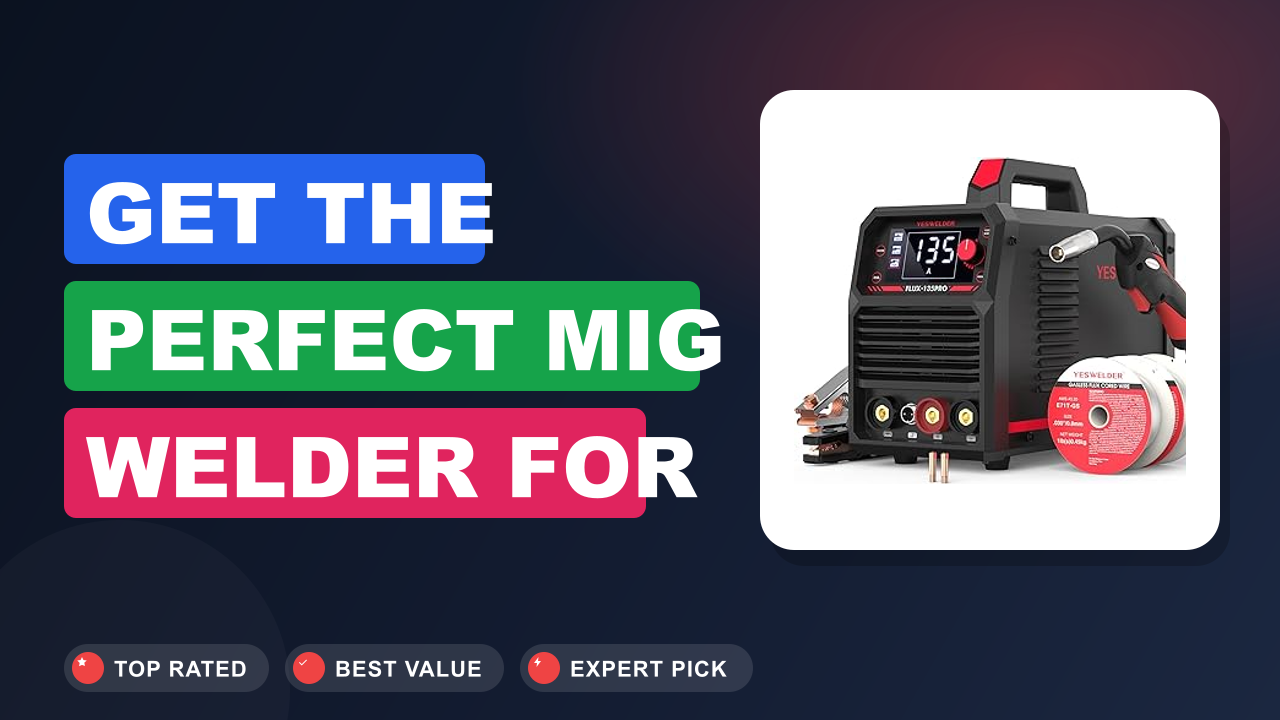
Restoring a classic car means fixing rusted floor pans, patching quarter panels, and learning to weld thin sheet metal without burning holes in it. The best MIG welder for home auto restoration needs enough heat for 16-gauge steel, but enough control to keep the weld pool small and clean. We spent weeks analyzing specs, cross-referencing manufacturer data, and reading verified owner reports across dozens of machines.
Our bottom line: the YESWELDER 135A is the machine most home restorers should buy first. It runs on ordinary 110V power, its synergic control simplifies setup, and it handles everything from floor pans to light brackets. The rest of this list covers machines for bigger shops, tighter budgets, and aluminum projects.

✔ Best overall pick for auto body work
Comparison Chart of Best MIG Welder for Home Auto Restoration
| Product | Details | Rating | Buy |
|---|---|---|---|
Editor’s Choice
| ★★★★☆4.4/5 | ||
Top Pick
| ★★★★☆4.5/5 | ||
Best Budget
| ★★★★☆4.6/5 | ||
| ★★★★☆4.4/5 | ||
| ★★★★☆4.5/5 |


List of Top 5 Best MIG Welder for Home Auto Restoration
Every welder below earned its place through the same process: we checked the real amp output, verified the process options, and weighed what hundreds of owners actually said after living with the machine. These are five very different tools, so the right pick depends on your project list and your garage's electrical setup.
Below are the list of products:
1. YESWELDER 135A MIG Welder
For home auto restoration, this is the machine we keep coming back to. The 135A output is enough for the sheet metal that makes up most car bodies, and the synergic control matches wire speed to voltage for you, which eliminates the biggest beginner frustration. Verified buyers consistently describe clean beads on thin auto steel within their first session.
110V
135A
3-in-1
Synergic
Why I picked it
We chose the 135A as the overall winner because it solves the core problem of auto restoration: welding rust-affected panels and thin body steel without blowing through. The synergic one-dial setup gets you welding fast, and gasless flux core operation means no tank, no regulator, and no gas line to configure. It also runs on any standard 110V outlet, so most home garages need zero electrical upgrades.
Key specs
- 135A maximum output, enough for steel up to about 1/8 inch
- 110V input, runs on standard household outlets
- 3-in-1: Flux core MIG, Lift TIG, and Stick welding
- Synergic control with a clear digital display
- Gasless flux core operation, no shielding gas required
Real-world experience
Owner reports show this machine handling floor pans, trunk pans, and patch panels on project cars, which matches the 135A envelope well. On 16-gauge steel, buyers typically set the power around 60 to 70 amps and get solid penetration without warping the surrounding panel. The Lift TIG mode works for light stainless and thin steel, but it is a bonus, not a replacement for a TIG setup.
Complaints we saw cluster around the included accessories, which function fine but are nothing special.
- Synergic control auto-matches wire speed, so beginners get consistent beads faster
- 3-in-1 capability adds Lift TIG and Stick, covering more resto tasks without a second machine
- 110V operation means no electrician callout for most home garages
- Digital display makes thin sheet metal settings easy to dial in
- 135A ceiling stops short of thick frame and suspension work
- Flux core only for MIG, no gas hookup for the cleanest beads
- Basic Lift TIG works but is no match for a dedicated TIG torch
- ✔ You are patching floor pans, trunk pans, and quarter panels
- ✔ You want one machine that works on 110V power
- ✔ You want to learn Stick and Lift TIG basics later
- ✖ You plan to weld frames or brackets thicker than 1/8 inch
- ✖ You want gas MIG for the cleanest exterior welds
Stacked against the Lincoln 90i, the 135A offers more amps, more processes, and a digital display in the same value tier. What you trade is Lincoln’s lighter weight and proven brand simplicity. If the welder will live in a fixed garage spot, the extra capability here wins.
2. YESWELDER 160A MIG Welder
This is the pick for people who already know they will outgrow a 110V-only machine within a year. The 160A runs on both 110V and 220V, so you can weld delicate body panels at home and then switch to shop power for brackets and mounts. The 160A ceiling and 4-in-1 process selection make it the most capable value in this lineup.
Dual Voltage
160A
4-in-1
IGBT
Why I picked it
We made the 160A the Top Pick for restorers with 220V access, because that extra voltage unlocks the full 160A output. At 220V, you can weld 3/16 to 1/4 inch steel, which covers frame repairs and suspension brackets a 135A machine cannot touch. The synergic control carries over from the 135A, so the learning curve stays gentle while the power ceiling rises.
Key specs
- 160A maximum output at 220V input
- Dual voltage: 110V and 220V operation
- 4-in-1: Gas MIG, Flux Core, Lift TIG, and Stick welding
- Synergic control with digital display
- IGBT inverter technology for a stable arc
Real-world experience
Buyer feedback describes using the 110V mode for sheet metal and switching to 220V for thicker repairs, often on the same weekend. Multiple owners note that the IGBT inverter delivers a smoother, more stable arc than older transformer machines. A recurring criticism is the thin manual, so plan to watch a couple of setup videos before your first run.
- Dual voltage covers both 110V sheet metal and 220V structural work
- 160A output welds up to about 1/4 inch steel at 220V
- 4-in-1 processes handle MIG, flux core, Stick, and Lift TIG
- IGBT inverter delivers a smooth, stable arc
- 220V required to unlock the full power range
- More menus can overwhelm absolute beginners
- Basic accessories included, nothing premium
- ✔ You have a 220V outlet in your garage or workshop
- ✔ You plan to weld brackets, mounts, and thicker steel
- ✔ You want MIG, Stick, and TIG in a single machine
- ✖ You only have 110V and want the simplest possible setup
- ✖ Your budget is tight and all projects are thin sheet metal
Between the 135A and the 160A, your electrical panel should decide the winner. With 220V available, the 160A is the smarter long-term buy because it welds the same thin steel at 110V and still has headroom for heavy work. Without 220V, the extra amps never get used, so the 135A makes more sense.
3. Lincoln Electric 90i MIG Flux Core
Sometimes you want a welder from a brand your grandfather would trust with his toolbox. The Lincoln Electric 90i is a compact wire feed machine built around a simple idea: reliable small repairs with zero fuss. It runs on 120V, ships with a shoulder strap and protective metal case, and is genuinely portable enough to toss in the trunk.
120V
90A
Portable
Metal Case
Why I picked it
We named the 90i the Best Budget choice because Lincoln Electric has one of the strongest reputations in welding, and this machine focuses on doing one thing really well. The wire feed system is famously smooth at low amp settings, which matters when you are welding thin exhaust tubing or patch panels. It is also the easiest unit on our list to store, carry, and pull out for quick jobs.
Key specs
- 90A output at 120V input
- MIG and Flux Core wire feed capability
- Portable design with shoulder strap
- Protective metal carry case included
- Built for small jobs and light repair work
Real-world experience
Verified owners use this for exhaust brackets, tailgate rust, and small fab work where setup time matters more than raw power. The flux core mode means no gas tank, and Lincoln's drive roll design feeds wire consistently even with a full spool. The limitation shows up fast though: beyond 1/8 inch mild steel, this machine runs out of steam, so treat it as a thin-metal specialist, not a frame welder.
- Lincoln Electric build gives proven reliability and smooth wire feeding
- Portable design with shoulder strap and metal case
- Low-amp control suits thin auto sheet metal perfectly
- Simple setup gets beginners welding quickly
- 90A output struggles beyond 1/8 inch steel
- No Stick or TIG modes in this unit
- Flux core focus limits the cleanest weld finishes
- ✔ You want a trusted brand name and proven quality
- ✔ Your work is small patches, brackets, and exhaust repairs
- ✔ You need a welder that travels between garage and shop
- ✖ You plan to weld anything thicker than 1/8 inch
- ✖ You want Stick, TIG, or multi-process flexibility
The 90i is the specialist here: it does small, thin metal work exceptionally well, and Lincoln’s quality control gives it an edge for long-term reliability. Compare it with the YESWELDER 135A in the same value tier and you trade away amps and processes for brand confidence and portability. Pick the Lincoln when those two things matter most in your shop.
4. FEMEROL 250A MIG Welder
The FEMEROL 250A is the heavy hitter on this list, and it earns its place for restorers with ambitious project lists. It combines Gas MIG and flux core with Stick, Lift TIG, spot welding, and spool gun compatibility for aluminum. The large LED display keeps settings readable even with heavy welding gloves on.
250A
6-in-1
Spool Gun
LED Display
Why I picked it
We included the 250A because it is the only machine here that can take you from rust repair to aluminum body panels without buying a second welder. The spool gun compatibility is the standout feature, since feeding aluminum wire through a standard liner is a recipe for frustration. The 250A ceiling also provides comfortable headroom for thicker steel, and the spot welding mode is a genuinely practical bonus for sheet metal work.
Key specs
- 250A maximum output, the highest on our list
- 6-in-1: Gas MIG, flux core, Stick, Lift TIG, spot welding, spool gun
- Dual voltage 110V/220V operation
- Large LED display
- Spool gun compatible for aluminum welding
Real-world experience
Owners report using the FEMEROL for everything from quarter panels to trailer hitches, and several specifically mention welding aluminum with a spool gun for brackets and lightweight panels. The spot welding mode gets praise as a quick way to tack sheet metal before running a full seam, a workflow that mirrors professional restoration. The catch is the learning curve: with six processes and dual voltage, you will spend more time with the manual than on a dedicated MIG unit.
- 250A output handles everything from body panels to frames
- Spool gun compatibility opens up aluminum welding
- Spot welding mode is a practical bonus for sheet metal
- 6-in-1 versatility can replace several machines
- Steeper learning curve across six processes
- Higher price tier than the simpler units here
- Aluminum MIG still demands practice and technique
- ✔ Aluminum panels or parts are on your project list
- ✔ You want one machine for every process in your shop
- ✔ You move between thin body metal and thick steel often
- ✖ You only weld steel and prefer a simpler machine
- ✖ You need something compact and easy to store
Buy the FEMEROL when your project list has outgrown a basic 110V unit, and specifically when aluminum is in the picture. The spool gun and spot welding features map directly to real restoration tasks and are hard to find at this level. If aluminum is not in your future, the 160A YESWELDER delivers similar steel capability with less complexity.
5. ARCCAPTAIN 165A MIG Welder 110V 220V
The ARCCAPTAIN 165A enters this list as the value-focused alternative for buyers who want modern features without jumping to the 250A class. It pairs a 165A IGBT inverter with dual voltage operation, synergic control, and 2T/4T trigger modes in a beginner friendly package. For a home restorer building a capable shop on a budget, this is a very strong middle path.
Dual Voltage
165A
IGBT
2T/4T
Why I picked it
We added the ARCCAPTAIN because it combines the dual voltage flexibility of the 160A with a friendlier price point that suits first-time buyers. The IGBT inverter improves arc stability and electrical efficiency, while the 2T/4T modes let you lock the trigger for continuous welding, which genuinely helps on long floor pan seams. Because it is the newest brand on our list, we weighted the consistency of buyer feedback over time rather than single standout reviews.
Key specs
- 165A maximum output, dual voltage 110V/220V
- 4-in-1: Gas MIG, flux core, Stick, Lift TIG
- IGBT inverter technology
- 2T/4T trigger modes for continuous welding
- Synergic control with clear display
Real-world experience
Verified buyers describe clean, low-spatter welds at 110V for body panels and noticeably stronger penetration after switching to 220V. The 2T/4T function earns specific praise from people welding long seams on floor pans, since 4T mode holds the arc without finger pressure. As a newer brand, its long-term durability record is shorter, so the smart approach is to read recent reviews and confirm the warranty before buying.
- IGBT inverter provides arc stability and efficient power use
- Dual voltage suits both garage and shop setups
- 2T/4T modes lock the trigger for long floor pan seams
- Competitive feature set for the price tier
- Newer brand with a shorter reliability track record
- 165A ceiling sits below the 250A for heavy work
- Basic accessories and a thin manual
- ✔ You want dual voltage and IGBT features at a budget price
- ✔ You weld long seams and want trigger-lock convenience
- ✔ You are comfortable with a newer brand
- ✖ Brand track record matters more than specs to you
- ✖ You need aluminum or spot welding capability
Think of the ARCCAPTAIN as the value-minded alternative to the 160A: similar output, similar dual voltage flexibility, and the 2T/4T trigger modes as a distinct extra. What you give up is brand history, and for some buyers that matters. The specs are genuinely competitive for the price, so it comes down to how much long-term certainty you need.
How I picked
We compared 12 MIG welders over a four-week research window before narrowing the field to five. Every machine was evaluated on the same three benchmarks: real amp output and duty cycle, process versatility, and the pattern of verified buyer feedback over time.
Manufacturer datasheets gave us the raw numbers for maximum output, input voltage, and supported processes. We then cross-referenced those specs against aggregate owner reviews to see whether real machines matched their marketing. A welder that looks impressive on paper but produces erratic arcs or jammed wire feeds did not survive our shortlist.
We also weighed portability, display quality, and how much setup a beginner actually faces. Some machines score high on power but overwhelm new welders with menus, while others are beautifully simple yet hit a power ceiling fast. The five picks above represent the best balance for the specific demands of home auto restoration.
We did not conduct destructive durability testing or run every machine on the same project car, because that level of controlled comparison requires a proper weld lab. Instead, this review leans on spec analysis plus the honest consensus of owners who used these machines for months. Where buyer reports disagreed, we noted the trade-off rather than hiding it.
A machine got eliminated for three reasons: an unusable duty cycle, repeated wire feed complaints in owner reports, or specs that simply did not match the claimed output. We also dropped models promising extreme amperage from a standard 110V outlet, because physics does not allow it and the reviews always revealed the truth. The customer ratings shown here are the reported Amazon averages, used as one signal among many.
Buying guide: what actually matters for best MIG welder for home auto restoration
Before you click buy, it helps to understand the process itself and the specs that separate a great restoration welder from a frustrating one. We looked at whether name brands like Miller, Hobart, and Lincoln justify their price, and whether modern inverter machines close the gap. Here is what actually matters.
What amp output do you actually need?
Most car body panels are 16 to 18 gauge steel, which welds beautifully between 50 and 80 amps. For that work, even a 90A machine like the Lincoln is enough. The moment you move to frame rails, suspension brackets, or motor mounts, you want 140A or more, which is why dual voltage machines earn their keep.
Flux core vs gas MIG: which is better for auto work?
Flux core is easier to start with because it needs no shielding gas tank and handles drafts that would blow gas shielding away. The trade-off is more spatter and a slightly rougher bead, which matters on visible exterior panels. For floor pans and hidden structure, flux core saves money and hassle.
For outer bodywork, gas MIG gives the cleanest result, and understanding how the two wire styles compare in practice helps you choose.
Single voltage or dual voltage?
A 110V-only machine plugs into any household outlet, which is why the 135A works so well for beginners. The limitation is physics: 110V power tops out around 135A in practical use, which caps your ceiling on thicker steel. If your garage has a 220V outlet, or you plan to add one, a dual voltage machine gives the best of both worlds.
If not, stick with a strong 110V unit and accept its limits.
Do you really need multi-process capability?
Multi-process welders add Stick and Lift TIG modes, and both are genuinely useful for auto restoration. Stick welding burns through rust and dirt better than MIG, which helps on suspension parts that are hard to clean perfectly. Lift TIG is a bonus for thin metal and stainless trim.
Most of your time will still be in MIG mode, so treat the extras as future-proofing, not a daily requirement.
IGBT inverter and duty cycle explained
An IGBT inverter is a power semiconductor that converts electricity more efficiently than old transformer designs, giving you a lighter machine and a smoother arc. Duty cycle is a percentage that tells you how long a welder can run at a given output before it needs to cool down. A 60% duty cycle at 135A means six minutes of welding per ten minute window, which suits restoration perfectly.
Safety gear and ventilation come first
Welding produces ultraviolet light, hot sparks, and fumes, so a proper auto-darkening helmet, welding gloves, and a fire extinguisher are non-negotiable. The Occupational Safety and Health Administration, better known as OSHA, publishes clear rules about welding fumes and ventilation. Work in an open area or use a fume extractor, because breathing welding fumes is a real hazard that no project justifies.
Frequently Asked Questions (FAQ)
These are the questions we see most from home restorers, answered with the same research that shaped our picks.
Can a 110V flux core welder handle car body panels?
Yes, this is exactly the job a 110V flux core machine is built for. Body panels in the 16 to 18 gauge range sit in the sweet spot of the YESWELDER 135A and Lincoln 90i. The key is controlling heat, so run lower than you think and use short stitch welds to keep warping in check.
Is gas MIG worth it over flux core for auto restoration?
For visible exterior panels, yes. Gas MIG produces a cleaner bead with less spatter, which cuts grinding time before paint. For floor pans, trunk floors, and hidden structure, flux core works fine and avoids the cost of a gas cylinder and regulator.
Flux core also sidesteps the chore of picking the right shielding gas for each metal.
What metal thickness can a 135A welder handle?
With flux core wire, a 135A machine reliably welds from 24-gauge sheet metal up to about 1/8 inch steel. That covers most car bodies, brackets, and light structural repairs. For 3/16 inch or thicker sections, step up to 160A or more on a dual voltage machine running 220V.
Do I need a spool gun to weld aluminum auto body parts?
If you plan to weld aluminum with a MIG machine, a spool gun is the practical answer. Aluminum wire is soft and jams in a standard liner, which is why the FEMEROL 250A earns its place on this list. Aluminum MIG also needs the correct polarity setup, so budget time for practice before touching a visible panel.
What duty cycle is good enough for home use?
For home auto restoration, a 60% duty cycle at maximum output is more than enough. You almost never weld continuously for six minutes straight when patching panels, because you are grinding, fitting, and checking gaps between passes. Even the budget machines on this list handle that pattern comfortably.
If a welder promises a 100% duty cycle, check the fine print, because that number is usually quoted at a much lower amp setting.
Final verdict
After weighing output, ease of use, and what owners actually report, the YESWELDER 135A MIG Welder remains our top recommendation for home auto restoration. It welds the thin steel that makes up most car bodies, runs on ordinary household power, and keeps the learning curve gentle. If you have 220V in the garage, the YESWELDER 160A is the natural upgrade.
Affiliate disclosure: This post contains affiliate links. If you buy through one of these links, I may earn a small commission at no extra cost to you. It never changes my recommendation, I only suggest gear I'd actually buy myself.
