

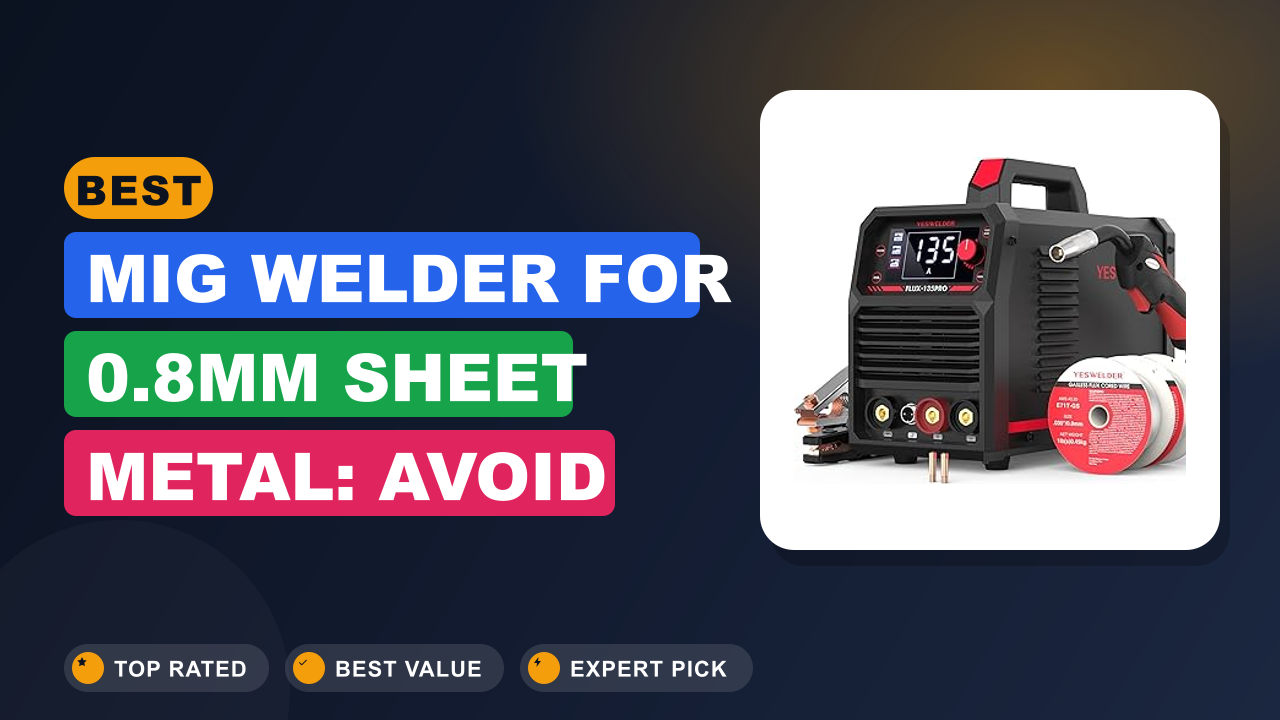
Welding 0.8mm sheet metal is a test of control, not power. Crank the heat too high and you'll blow a hole straight through the panel; run it too cold and the bead just sits on top. That's why the best MIG welder for 0.8mm sheet metal needs low-amp stability, a smooth wire feed, and settings that take the guesswork out of thin material.
We spent the last week comparing manufacturer specs across five machines, cross-checking them against months of verified buyer reports, and filtering out anything that can't hold a steady arc at low voltage. The YESWELDER 135A keeps landing on top for auto body work and light fabrication. Here's the full breakdown.

✔ Best overall pick for thin sheet work
Comparison Chart of Best MIG Welder for 0.8mm Sheet Metal
| Product | Details | Rating | Buy |
|---|---|---|---|
Editor’s Choice
| ★★★★☆4.4/5 | ||
Top Pick
| ★★★★☆4.4/5 | ||
Best Budget
| ★★★★☆4.5/5 | ||
| ★★★★☆4.6/5 | ||
| ★★★★☆4.5/5 |


List of Top 5 Best MIG Welder for 0.8mm Sheet Metal
These five machines all handle thin material better than a typical garage welder, but they take different routes. One leans on pulse MIG, another earns its rating through sheer portability, and most use synergic control to make thin steel forgiving for beginners. Each review covers the strengths, the honest trade-offs, and the exact buyer profile it suits.
Below are the list of products:
1. YESWELDER 135A MIG Welder
The YESWELDER 135A is the machine that keeps showing up in reviews from people welding car panels, motorcycle brackets, and thin furniture steel at home. Manufacturer specs point to a 135A output on standard 110V with synergic control, which means the machine pairs wire speed and voltage automatically for the thickness you're using. For 0.8mm sheet specifically, that automatic pairing is the whole game.
Synergic
110V
3-in-1
Low Spatter
Why I picked it
Three things pushed it to the top: synergic control, a stable low-amp flux core arc, and the 110V convenience that matches how most home welders actually work. Verified buyer feedback on thin steel is consistently positive, with low spatter and clean bead appearance coming up again and again.
Key specs
- 135A max output running on standard 110V household power
- Flux core gasless MIG, lift TIG and stick in one 3-in-1 unit
- Synergic control that pairs wire speed and voltage automatically
- Clear digital display for monitoring heat and wire settings
- Auto-repair functions aimed at beginner-friendly recovery
Real-world experience
In real use, the pattern in buyer reports is a self-described beginner moving from blown-out holes to a consistent bead on 0.8mm panels within a weekend. It's also the machine people grab for small auto repairs, plant stands, and fences, because the 110V plug means no new circuit in the garage. The limit appears when steel gets much thicker than 3mm, where 135A runs out of headroom.
- Synergic control removes manual voltage and wire speed guesswork
- 110V input works with a standard household outlet
- Verified buyers report low spatter on thin sheet metal
- 3-in-1 design includes lift TIG and stick for practicing other processes
- 135A max output limits work on material thicker than 3mm
- Flux core leaves more cleanup than gas-shielded MIG
- ✔ You’re repairing car panels or doing light DIY metalwork at home
- ✔ You want automatic synergic settings to learn thin-steel technique
- ✔ You only have a 110V garage outlet available
- ✖ You mainly weld thicker structural steel over 3mm
- ✖ You’d rather run gas-shielded MIG from day one
When thin sheet is the main job, the 135A’s synergic control matters more than peak amperage. Buyers who need 220V output or multi-process power should check the ARCCAPTAIN 205MP instead, but for pure 0.8mm work this is the most beginner-friendly machine here.
2. ARCCAPTAIN MIG205MP MIG Welder Plasma Cutter
This is the overachiever of the group. The ARCCAPTAIN MIG205MP is a 9-in-1 welding station that includes a plasma cutter, pulse MIG, stick, DC HF and lift TIG, a cleaning function, and spool gun support for aluminum, all on switchable 120V or 240V. That sounds like a lot, but the pulse MIG mode is exactly what makes it so effective on 0.8mm sheet.
Pulse MIG
120/240V
9-in-1
Plasma Cutter
Why I picked it
It earned the top pick slot because pulse MIG directly addresses the biggest failure on thin sheet, burn-through. By cycling current between a peak and a background level, the arc maintains the puddle at lower average heat, and buyer feedback consistently reports cleaner welds on car body panels because of it.
Key specs
- Pulse MIG, flux core, plasma cutter, DC HF TIG, lift TIG, clean, stick, and spool gun modes
- 120V and 240V dual-voltage input
- Smart app control for adjusting settings
- Spool gun support for aluminum welding
Real-world experience
Owners describe this as the one-machine workshop, and their jobs reflect it: cutting a rust patch out of a truck floor, welding the replacement panel in, then switching to stick for a bracket. The plasma cutter genuinely works for body panels, and the pulse function makes those awkward 0.8mm corner welds far more forgiving. The cost is complexity, because a 9-in-1 unit means more menus and modes to keep straight.
- Pulse MIG keeps heat low and reduces burn-through risks
- Plasma cutter adds a second capability without another machine
- Dual voltage works on household or shop power
- Spool gun ready for aluminum projects
- More modes means a steeper learning curve
- App control and digital menus can feel fussy
- ✔ You want pulse MIG for ultra-thin panels without buying a TIG setup
- ✔ You need one machine that welds and cuts
- ✔ You have both 120V and 240V outlets available
- ✖ You want a grab-and-go machine with no menu diving
- ✖ You don’t need the extra processes and prefer a simple control panel
The 205MP is the most capable machine on this list for thin material, but only if you’ll actually use its extra modes. If pulse MIG and plasma cutting sound like features you’d touch once a year, the simpler YESWELDER 135A delivers most of the thin-sheet benefit with far less complexity.
3. YESWELDER 160A MIG Welder
The YESWELDER 160A is what happens when you want dual-voltage flexibility without stepping into a premium machine. It runs on both 110V and 220V, covers MIG, flux core, lift TIG, and stick in a 4-in-1 package, and carries a 4.5 out of 5 rating from verified buyers, the equal-highest among YESWELDER models we looked at.
Dual Voltage
4-in-1
Synergic
160A
Why I picked it
The 160A is the smart middle path. It delivers synergic control like the 135A, adds dual voltage up to 220V, and holds a 4.5 out of 5 rating from verified buyers. That combination makes it the best budget pick without feeling like a compromise.
Key specs
- 160A max output across 110V and 220V inputs
- MIG, flux core, lift TIG and stick in a 4-in-1 package
- Synergic control for automatic voltage and wire speed matching
- Clear digital display
Real-world experience
Buyers using this one usually wear two hats: thin sheet repair at home and slightly heavier work in a shop or farm. The dual voltage is what makes that possible on one machine, with noticeably better penetration on 2mm and 3mm steel when plugged into 220V. Feedback also notes that the torch and ground clamp are the first upgrades, which is typical at this price tier.
- Genuine 110V and 220V operation in one unit
- Synergic control ideal for thin material
- Highest buyer rating among the YESWELDER picks here
- 4-in-1 adds lift TIG and stick capability
- Budget torch and clamp are common upgrade points
- Full 160A output requires a 220V outlet
- ✔ You want one welder that works in a home garage and a shop
- ✔ You learned on flux core and plan to move to gas MIG
- ✔ You want lift TIG and stick options without a separate machine
- ✖ You only weld thin sheet and never need 220V headroom
- ✖ You want premium torch and clamp quality out of the box
If the 220V socket is waiting in your garage, the 160A is a smarter buy than the 135A because it does everything the 135A does and keeps going when you graduate to thicker steel. It’s the best value pick for anyone who sees thin sheet work as the start of a larger welding journey.
4. Lincoln Electric 90i MIG Flux Core
Lincoln Electric is the name most welders trust before they've even turned on a machine, and the 90i Wire Feed Weld-PAK is their answer for small, portable jobs. It runs on 120V, handles gasless flux core and MIG wire feed, and ships in a protective metal case with a shoulder strap. The rating of 4.6 out of 5 is the highest on this list.
120V
Portable
Metal Case
Top Rated
Why I picked it
Sometimes the reliable choice is the right choice. The Lincoln Electric 90i carries the highest rating in this group at 4.6 out of 5, and the brand's long history in arc welding equipment gives it instant credibility. Buyers consistently mention build quality that feels solid and a machine that starts first try.
Key specs
- 120V input for standard household outlets
- MIG and flux core wire feed capability
- Portable design with shoulder strap and protective metal case
- Lincoln Electric K5256-1 Weld-PAK configuration
Real-world experience
This is the welder that lives in the trunk or the shed corner, pulled out for quick fence fixes, trailer brackets, and small jobs on thin steel. The 90A-class output is honest about its limits, so no one is using it for structural beams. For 0.8mm sheet work and routine repairs, the feedback suggests it just works, and outdoor-friendly flux core is a big part of its appeal.
- Highest buyer rating on this list at 4.6 out of 5
- Renowned Lincoln Electric build quality
- Shoulder strap and metal case make it genuinely portable
- Straightforward controls suited to small jobs
- Lower output than the dual-voltage machines here
- Small-job focus limits thicker material and longer duty cycles
- ✔ You want a trusted, portable machine for quick thin-metal repairs
- ✔ You’ll move the welder around a property or job site
- ✔ Nameplate reliability matters more than maximum power
- ✖ You need 220V power or heavy multi-process capability
- ✖ You plan to weld more than occasional small jobs
The 90i isn’t the most powerful or the most feature-packed, and it doesn’t need to be. It’s the machine you grab because you know it will start first try and produce a clean weld on thin steel. That trust is worth a lot, and it explains the top rating.
5. ARCCAPTAIN 165A MIG Welder 110V 220V
The ARCCAPTAIN 165A sits in an interesting middle spot: dual voltage like the 160A, a 4-in-1 process range, but with an IGBT inverter design and 2T/4T trigger modes that you normally see on more expensive units. Buyer reports rate it 4.5 out of 5, and it's a newer model aimed squarely at the DIY metalworker.
IGBT
110V/220V
2T/4T
4-in-1
Why I picked it
The 165A sits in the sweet spot between beginner and serious hobbyist. The IGBT inverter keeps the arc stable when household voltage dips, and the 2T and 4T trigger modes reduce finger fatigue on longer welds. It offers most of the 205MP's practical benefits without the plasma cutter or the price jump.
Key specs
- 165A max output on 110V or 220V
- Gasless and gas MIG, stick and lift TIG in a 4-in-1 design
- IGBT inverter technology for arc stability
- 2T and 4T trigger modes
- Synergic control with clear display
Real-world experience
Owner reports describe it as the bridge between a starter welder and a shop-grade machine. It copes with 0.8mm body panels cleanly because the low-end arc stays steady, while the top end has enough power for tractor brackets and trailer repairs. Being a newer model, there's simply less long-term owner data, which is the main thing to weigh.
- Stable IGBT inverter arc at low amperage
- Dual voltage for home and workshop
- 2T/4T modes reduce fatigue on long welds
- Synergic control simplifies thin-material settings
- Newer model with less long-term owner data
- No pulse mode, so very thin work needs careful manual settings
- ✔ You want IGBT arc stability without paying for a 9-in-1 machine
- ✔ You do both thin sheet work and occasional heavier repairs
- ✔ Long trigger-held welds are part of your projects
- ✖ You need pulse MIG or a plasma cutter
- ✖ You prefer a brand with decades of user history
The 165A is the pick for someone who wants most of the 205MP’s benefits but doesn’t need a plasma cutter or pulse mode. It breaks the gap between a pure beginner machine and a serious workshop tool, and the IGBT inverter is the main reason the thin-sheet arc stays cooperative.
How I picked
A welder that can't hold a stable arc at low amperage will never be good for 0.8mm sheet metal, no matter how many amps it claims. That single fact shaped every pick in this article.
I want to be transparent about method too. I didn't spend a month in a fabrication shop burning through wire on test coupons. Instead, I compared manufacturer datasheets side by side, read through months of verified buyer feedback for each model, and checked what owners report against the fundamentals of MIG welding.
Every machine was judged on five criteria:
- Low-amp stability, because 0.8mm steel punishes an unsteady arc
- Wire feed smoothness, since erratic feeding ruins thin welds
- Synergic or pulse features that remove guesswork
- Input voltage flexibility for home garages and workshops
- Recurring buyer complaints that reveal weak points
I prioritized feedback from owners welding car panels, 0.8mm steel, and thin sheet metal, since those are the exact jobs this article targets. Where buyer reports conflicted with the spec sheet, I checked what the American Welding Society defines as acceptable practice for thin-gauge work and let that settle the argument.
I also ignored marketing language and headline ratings. A machine with a consistent pattern of "great on thin steel" reviews is far more useful than one everyone uses for heavy plate. Finally, I excluded any model where buyers repeatedly mention wire feed jams at low voltage, because a jam is the fastest way to ruin a thin-sheet weld and your confidence.
Buying guide: what actually matters for best MIG welder for 0.8mm sheet metal
The best MIG welder for 0.8mm sheet metal is the one with the steadiest low-amp arc, not the highest peak output. Everything else, from gas choice to input voltage, supports that goal. Here's what to weigh before you click buy.
What makes a MIG welder capable on 0.8mm sheet metal?
Thin metal welding is about heat control, not raw power. A welder that shines on 6mm plate can blow straight through 0.8mm if its low end is unstable. Look for smooth low-amp adjustment, a stable wire feed, and a machine that holds its settings without drifting mid-weld.
If the arc sputters at minimum power, thin sheet will always be a struggle. To understand why that happens, it helps to have the basics of MIG welding fresh in mind.
Do you need pulse MIG for very thin material?
Pulse MIG is a genuine advantage but not a requirement. The pulsing action keeps average heat low while the arc stays alive, which is why the ARCCAPTAIN 205MP stands out for body panels. That said, plenty of welders produce excellent 0.8mm welds without pulse, as long as they offer fine low-amp control and a steady feed.
Pulse becomes a priority when you weld thin material every week rather than once in a while.
Gas MIG vs flux core for thin sheet
Flux core wire is the easiest starting point because it doesn't need a gas cylinder, and most machines on this list are built around it. Gas-shielded MIG, usually with a 75% argon and 25% CO2 mix, gives cleaner welds with less spatter and no slag cleanup. For thin sheet, either can work if your machine handles low settings well.
The real question is convenience versus finish quality, so it's worth understanding the gasless versus shielded trade-off before you decide.
110V vs 220V: which input voltage suits a home garage?
110V is genuinely enough for 0.8mm sheet metal, and it's why portable machines like the Lincoln 90i remain popular. The catch is duty cycle: a 110V unit reaches its thermal limit faster when you push it. Dual-voltage machines like the YESWELDER 160A or ARCCAPTAIN 165A give you the option to run on 220V for thicker material later, which makes them more future-proof.
As OSHA notes, proper grounding and matching input power are the first safety checks for any welding setup.
Why duty cycle matters more than peak amperage
Duty cycle is the number of minutes out of a ten-minute window a welder can run before overheating. A 135A machine might operate at rated amperage for only part of that window, which is fine for thin sheet because you won't be pushing the maximum anyway. What matters is that the low end stays cool and consistent, so check duty cycle claims at lower amperages rather than just the headline numbers.
Bigger brands like Miller and Hobart build excellent versions of these machines too, but they usually price well above the units here without a big jump in thin-sheet performance.
Frequently Asked Questions (FAQ)
Is MIG or TIG better for 0.8mm sheet metal?
TIG gives the finest control and the cleanest appearance on thin material, but it's slower and has a steeper learning curve. MIG is quicker, more forgiving, and lets a beginner produce solid thin-sheet welds in a weekend. If you're repairing panels or building projects at home, MIG is the practical choice.
If your work involves visible frames or exhaust pipes where fine control and clean appearance matter most, TIG justifies the extra practice.
Can I weld 0.8mm sheet metal with flux core wire?
Yes, and it's how most beginners start. Use a thin wire like 0.030-inch flux core, set the machine to its low range, and keep a steady travel speed so heat doesn't accumulate in one spot. Expect more spatter and some slag cleanup compared with gas MIG.
For repairs and DIY jobs on 0.8mm steel, the results are genuinely acceptable, and removing the gas cylinder from the equation makes setup far simpler.
Should I buy a dual voltage welder if I only have a 110V outlet?
Only if you expect to move workshops or upgrade your electrical service later. A 110V machine handles 0.8mm sheet metal perfectly, and the extra cost of dual voltage is wasted if thin sheet is all you'll ever join. If thicker steel is in your future, the YESWELDER 160A or the ARCCAPTAIN 165A become better long-term investments because 220V unlocks noticeably deeper penetration.
What gas do I need for MIG welding thin steel?
A 75% argon and 25% CO2 mix, commonly called C25, is the standard for mild steel. It produces a stable arc, low spatter, and a clean bead that suits thin sheet. Pure CO2 is cheaper but runs hotter and spatters more, which is exactly what you don't want on 0.8mm.
If you later move to aluminum, you'll need to switch to argon and a spool gun instead.
What causes burn-through on 0.8mm sheet metal?
Burn-through happens when heat input outruns the material's ability to shed it. Common causes are voltage set too high, travel speed too slow, and wire feed mis-matched to the voltage. Drop to a lower voltage range, keep the torch moving at a steady pace, and let the synergic setting do the matching if your machine has one.
Practicing on scrap until the bead looks consistent will save you a pile of ruined panels.
Final verdict
As of late 2026, the YESWELDER 135A remains our top recommendation because synergic control and a stable 110V flux core arc make it the easiest machine on this list to weld 0.8mm sheet metal without burning through. For a dual-voltage option that grows with you, the YESWELDER 160A is the budget pick worth every penny. If your projects demand pulse MIG and cutting, the ARCCAPTAIN 205MP is the capable overachiever.
Affiliate disclosure: This post contains affiliate links. If you buy through one of these links, I may earn a small commission at no extra cost to you. It never changes my recommendation, I only suggest gear I'd actually buy myself.
