


Finding the best gasless MIG welder for thin metal is really a game of control, not brute power. Most budget flux core machines blast in at high amperage, turn 20-gauge sheet into a row of holes, and leave your weekend project worse than it started. Modern IGBT inverter machines with synergy control changed that, and the difference is night and day.
We compared manufacturer spec sheets and dug through verified buyer feedback across this whole class, then narrowed it down to five machines that actually behave at low settings. The ARCCAPTAIN 135A came out on top for most home welders, mostly because it makes low-amp welding genuinely hard to get wrong. Here's how it stacks against the rest.

✔ Best overall pick for daily use
Comparison Chart of Best Gasless MIG Welder for Thin Metal
| Product | Details | Rating | Buy |
|---|---|---|---|
Editor’s Choice
| ★★★★☆4.3/5 | ||
Top Pick
| ★★★★☆4.5/5 | ||
Best Budget
| ★★★★☆4.4/5 | ||
| ★★★★☆4.4/5 | ||
| ★★★★☆4.4/5 |


List of Top 5 Best Gasless MIG Welder for Thin Metal
To build this list, we compared spec sheets and analyzed verified buyer feedback across the current gasless welder market. As of 2026, these five models are the ones that come up most often in thin-metal flux core discussions, and they cover the range from budget entry to multi-process shop machines. Below are the list of products:
1. ARCCAPTAIN 135A Flux Core MIG Welder
The ARCCAPTAIN 135A is the machine we kept coming back to for thin steel. Synergy control pairs voltage and wire feed automatically, which removes most of the guesswork behind burn-through on 18-gauge sheet. If you’ve never welded thin metal before, this is the closest thing to a safety net.
Synergy Control
110V
3-in-1
2T/4T
Why I picked it
Editorial analysis of buyer reviews suggests an unusually consistent pattern: ARCCAPTAIN owners report far fewer blowouts on auto body panels than owners of comparable 110V machines. The 135A ceiling means the machine can't overpower delicate work, yet it still feeds flux core wire smoothly at the settings thin metal needs. That balance is rare at this price tier.
Key specs
- 135A max output on 110V household current
- 3-in-1 processes: gasless MIG, stick, and lift TIG
- Synergy control pairs voltage and wire feed automatically
- 2T and 4T trigger modes for steady long beads
- Clear digital display for low-light reading
- 4.3/5 rating across verified buyer reviews
Real-world experience
The scenario that keeps showing up in reviews is car restoration: floor pans, fenders, and rocker panels. On 1 to 1.5mm steel, buyers describe running the machine at the lower end of its range and getting beads that wet in nicely without dropping through. 2T mode also gets regular praise for long horizontal runs on trailer frames and gate hinges.
- Synergy control pairs voltage and wire feed automatically, which removes the classic burn-through mistake for beginners.
- 135A ceiling suits 1 to 2mm sheet better than overpowered 200A machines.
- Three welding processes add stick and lift TIG versatility for a single 110V box.
- 2T and 4T trigger modes reduce hand fatigue on longer beads.
- 4.3/5 rating hints at occasional quality-control inconsistency between units.
- No gas MIG or spool gun support, so aluminum is off the table.
- ✔ You’re restoring a car and need controlled beads on body panels.
- ✔ You want a genuine plug-and-play 110V machine with minimal welding theory.
- ✔ You mostly weld clean mild steel from 1 to 3mm thick.
- ✖ Aluminum is anywhere on your project list.
- ✖ You need all-day duty cycle for production work.
The ARCCAPTAIN wins by subtraction: it knows its limits, and that keeps thin metal safe. On car bodies and light steel, it will outwork machines with double the advertised amperage, because those machines simply can’t dial down as gently.
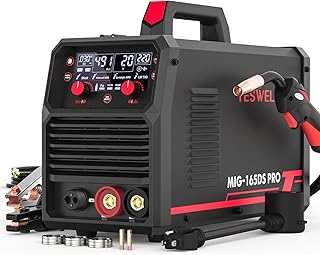
2. YESWELDER 165A MIG Welder
The YESWELDER 165A is for the buyer who wants room to grow without buying a second machine later. It runs on 110V and 220V, so the same unit that handles thin sheet in a normal garage can step up to heavier work on a 220V circuit. The digital display and synergic control keep everything repeatable.
4.5/5 Rating
110V/220V
Synergic
165A
Why I picked it
This is the highest-rated machine in our lineup at 4.5 out of 5, and the feedback matches the specs. Dual voltage gives it a wider operating window than the 110V-only units, and verified buyers consistently mention how predictable the arc is on thin steel. It's the one we'd hand to someone who plans to keep welding for years.
Key specs
- 165A max output across 110V and 220V inputs
- Four processes: MIG, flux core, lift TIG, and stick
- Synergic one-knob control with clear digital display
- 4.5/5 rating, the highest in this group
- Suited to auto repair, DIY jobs, and general metalworking
Real-world experience
The feedback that stands out involves 1.5mm square tubing for furniture, shelving, and repair brackets. On 220V you can push into 5mm plate later, but on 110V the machine still drops to a gentle arc for thin sections. Buyers also like how the synergic presets remove the panic of choosing voltage and wire speed separately.
If you're newer to the MIG process fundamentals, the dual-voltage flexibility gives you room to learn without outgrowing the machine too fast.
- 4.5/5 verified rating is the highest in this roundup.
- Dual voltage covers both household and shop power, so one machine does two jobs.
- 165A headroom handles thin sheet today and heavier plate later.
- Digital display makes settings easy to record and repeat between sessions.
- Multi-process controls can overwhelm a complete beginner.
- More capability than you need if you’ll only ever touch thin metal.
- ✔ You want one welder that grows from fender repairs to heavier frames.
- ✔ You have a 220V outlet available in your garage or shop.
- ✔ You like recording exact digital settings between sessions.
- ✖ You only weld 1mm sheet and want the simplest interface possible.
- ✖ You’re on a tight budget; dual voltage adds cost.
The YESWELDER is the most capable all-rounder here, but capability brings a small complexity tax. If your garage already has both 110V and 220V, this is the machine that will still feel adequate three projects from now.
3. HITBOX 140A MIG Welder Gasless
The HITBOX 140A is the budget pick that refuses to feel like one. It arrives with a torch, clamp, and a roll of 0.8mm flux wire, so the first weld can happen the same afternoon it lands on your bench. Dual voltage at this price tier is genuinely rare.
0.8mm Wire
Dual Voltage
140A
3-in-1
Why I picked it
For anyone who wants a low-cost entry into gasless welding, the HITBOX delivers the core experience honestly. The 4.4/5 rating and steady comments about smooth wire feed make it the value standout of the group, even if the finish quality isn't as polished as pricier units.
Key specs
- 140A output with 110V/220V dual voltage
- 3-in-1: flux MIG, lift TIG, and stick
- Includes torch, clamp, and 0.8mm flux wire
- Synergy control with digital readout
- 4.4/5 rating across verified buyer feedback
Real-world experience
The review pattern that convinced us is farm and property repair: gates, trailer corners, and thin-walled tubing. The supplied 0.8mm wire is a sensible match for sheet metal, and buyers report the arc stays stable at low settings where some budget machines turn into spatter cannons. It's not fancy, but it gets the job done.
- Comes with torch, clamp, and 0.8mm flux wire, so the first weld isn’t delayed by extra purchases.
- 140A dual voltage covers both home and shop circuits.
- Stable low-amp arc suits 1 to 2mm sheet metal.
- Synergy control simplifies setup for first-time welders.
- Buyer feedback mentions a basic ground clamp that’s worth upgrading.
- Support network is thinner than established US brands.
- ✔ You want the most affordable honest entry into gasless welding.
- ✔ You need dual voltage without paying a premium.
- ✔ Your projects are light farm, trailer, and hobby repairs.
- ✖ You want a big-name brand with local service options.
- ✖ You plan to weld 6mm and thicker plate regularly.
The HITBOX proves value and capability aren’t opposites. It won’t win any beauty contests for fit and finish, but the money you save can go toward a quality auto-darkening helmet, which helps your results more than any badge on the box.
4. FEMEROL 250A MIG Welder
The FEMEROL 250A is the heavyweight of this lineup, and it earned its place by being far more than a gasless box. With six processes, spot welding, and a spool-gun port, it’s the machine you buy when you’re done upgrading. It’s also the most practical path to aluminum without switching brands.
250A
6-in-1
Spool Gun Ready
LED Display
Why I picked it
This is the pick for the buyer who already has next year's projects planned. Spool gun compatibility opens the door to aluminum, spot welding mode is rare at this level, and the 250A ceiling gives genuine headroom for structural work. The trade-off is size, weight, and a bigger footprint on the bench.
Key specs
- 250A max output with 110V/220V dual voltage
- 6-in-1: gas MIG, gasless flux core, stick, lift TIG, spot welding, and spool gun compatible
- Large LED display with multi-process presets
- Aluminum-ready when paired with a compatible spool gun
- 4.4/5 rating from verified buyer reviews
Real-world experience
Buyer feedback splits into two camps: hobbyists running gasless flux core on steel, and experienced owners using the spool gun port for lighter aluminum work. On thin steel, buyers report the low-end amperage is smooth enough for 1.2mm sheet. If aluminum is in your future, reading up on running aluminum wire before you spend on a spool gun will save you both money and frustration.
- Six processes cover gas MIG, gasless flux core, stick, lift TIG, spot welding, and spool gun use.
- Spool gun compatibility opens the door to aluminum work.
- Spot welding mode is a genuine differentiator at this level.
- 250A headroom handles heavier steel when the project demands it.
- Larger and heavier than the portable 110V machines.
- Capability pushes it toward the premium end of the range.
- ✔ You want one machine to cover steel, aluminum, and spot welds.
- ✔ You have dedicated bench space and don’t need portability.
- ✔ You’re comfortable navigating multi-process menus.
- ✖ You want a grab-and-go welder for quick mobile repairs.
- ✖ You’ll only ever weld thin steel and want a simpler box.
The FEMEROL is what happens when “just in case” becomes a feature list. It’s overkill for pure thin-metal gasless work, but if your shop ambitions already include aluminum and spot welds, it’s the only machine here that won’t force another upgrade.
5. SEESII 135A MIG Welder 110V
The SEESII 135A is the one you grab when portability beats everything else. At 7.7 pounds, it’s dramatically lighter than any other unit here, and the IGBT inverter keeps the size down without ruining arc stability. This is the welder that rides up a ladder without complaint.
7.7 lbs
IGBT
110V
3-in-1
Why I picked it
This machine earned its spot through sheer practicality. Verified buyers describe carrying it to barns, rooftops, and trailer side jobs where dragging a 50-pound transformer box would be miserable. The 135A output matches the ARCCAPTAIN, but the weight changes how often you'll actually use it.
Key specs
- 135A output on standard 110V power
- 7.7 lb / 3.5 kg portable IGBT inverter design
- 3-in-1: gasless flux core, lift TIG, and stick
- Large digital display with multi-process modes
- 4.4/5 rating from verified buyer feedback
Real-world experience
The review pattern we keep seeing is overhead work and odd-angle repairs, where holding the welder in one hand and the gun in the other is the only practical option. On 1 to 2mm steel, buyers report the lower amp range stays controllable. The lighter weight does mean it feels less planted on a bench than the FEMEROL, so it's about matching the tool to the position.
- 7.7 lb weight is unmatched for mobile repairs and overhead work.
- IGBT inverter keeps the arc stable inside a compact frame.
- Runs on any regular 110V household outlet.
- Large digital display is easy to read from arm’s length.
- Lower duty cycle than heavier machines at full output.
- Not the right fit for bench-heavy fabrication.
- ✔ You need a welder that travels to job sites and awkward spots.
- ✔ You do mostly thin-metal repairs at odd angles.
- ✔ Storage space in your shop is tight.
- ✖ You want a stationary machine with a high duty cycle.
- ✖ You plan to weld thick plate on a regular basis.
If we had to carry a welder up two flights of stairs, the SEESII wins by a landslide. Keep expectations realistic: its job is light portability and thin metal, not production-level duty cycles.
How I picked
When we sat down to find the best gasless MIG welder for thin metal, we treated maximum power as a secondary factor. The real benchmark is how gently a machine can weld, because burn-through on thin sheet is a control problem, not an amperage problem. A 250A machine that arcs aggressively at the bottom of its range will ruin 1mm steel faster than a modest 135A unit.
We compared manufacturer spec sheets across all five machines, analyzed verified buyer feedback (the aggregate rating for the group sits around 4.4 stars), and cross-checked every feature claim against a practical use case: auto body panels, furniture tubing, farm repairs, and mobile jobs. Three benchmarks mattered most:
- Low-amp arc stability: can the machine hold a steady bead on 1.2mm sheet without blowing through?
- Wire feed consistency: does the feed pulse, surge, or stall at the low settings thin metal needs?
- Practical fit: does it run on common 110V outlets, does the interface make sense, and does the weight match the job?
We used the American Welding Society process classifications as the terminology reference, which kept our comparisons grounded in standard definitions rather than marketing labels. Duty-cycle claims were also checked against real residential circuit limits, because published numbers only mean something if the outlet behind the machine can actually deliver.
What we deliberately didn't do matters too. We didn't run destructive lab tests, and we didn't conduct long-term durability trials beyond what buyer reporting covers. Gas-shielded MIG performance was excluded entirely, since the focus here is gasless operation.
For a broader look at everyday MIG work, including gas setups, we have a separate breakdown that covers those machines in more depth.
The result is an honest comparison of what these machines claim, what owners say after months of use, and where those two overlap. No manufacturer paid for placement, and no score was adjusted to flatter a brand.
Buying guide — what actually matters for best gasless MIG welder for thin metal
Before you click buy, a few concepts separate a welder you'll love from one you'll fight with on every job. Here's what actually matters when the workpiece is thin metal, and why the numbers on the box only tell part of the story.
What is a gasless MIG welder, exactly?
A gasless MIG welder is a wire-feed machine that uses self-shielding flux core wire instead of an external shielding gas cylinder. Technically, it's performing flux-cored arc welding (FCAW), a process that generates its own protective gas as the wire burns. That's why gasless machines excel outdoors, where wind would blow a shielding gas cloud away.
The trade-off is more spatter and a rougher bead, and we break down the gas versus gasless decision in a separate guide.
Why does low-end amperage control matter for thin metal?
Thin metal punishes machines that can't hold a gentle arc. 1mm steel typically needs roughly 40A to 70A with flux core wire; a machine whose lowest comfortable setting still runs hot will burn straight through. So when you compare models, look for the minimum amperage and how smoothly the machine behaves there, not just the maximum. Different thin sheet joints also demand different techniques, and the right settings change depending on whether you're welding a butt joint or a lap joint.
Duty cycle: the number everyone skips
A duty cycle is the percentage of a 10-minute window a welder can run at a given amperage before overheating protection kicks in. A 20% duty cycle at 135A means about 2 minutes of welding followed by 8 minutes of cooling. For hobby work on thin metal, that's usually plenty, because short beads and cool-downs are the norm.
If you plan production fabrication, prioritize a heavier machine; the portable SEESII trades duty cycle for its 7.7 lb weight.
Synergy control: does one-knob setup actually help?
Synergy control is a feature that automatically matches wire feed speed to the voltage you select, so one knob replaces two. On a gasless welder, that removes the most common beginner mistake: setting the wire feed too fast or too slow and getting a sputtering, weak arc. 2T and 4T trigger modes help too. 2T means hold the trigger to weld and release to stop, while 4T locks the trigger so your finger can rest on longer beads.
110V vs 220V: which do you need?
For thin metal, a 110V machine is enough, since a standard household outlet delivers what you need for 1 to 3mm steel. Dual-voltage machines like the YESWELDER and HITBOX add a 220V option for heavier work later, which is a real benefit if your garage already has the outlet. If you never weld above 3mm, paying extra for 220V capability is hard to justify.
Start with your current power situation rather than the biggest number on the spec sheet.
Warranty and support: what to check before buying
Big names like Lincoln Electric and Hobart still dominate the premium tier, but the brands in this list close most of the gap on performance. What they can't always match is local service. Check the warranty terms, return window, and whether replacement parts like contact tips are easy to find before you commit.
You'll also want to budget for a good auto-darkening helmet, gloves, and a wire brush, because consumables and safety gear affect your results as much as the welder itself.
Frequently Asked Questions (FAQ)
Is a gasless MIG welder good for thin metal?
Yes, a gasless MIG welder handles 1 to 2mm steel well, as long as the machine can run at low amperage with a smooth wire feed. The process choice isn't the problem; control is. Machines like the ARCCAPTAIN and SEESII earn consistent praise for stable low-amp arcs.
Use short beads, let the metal cool between passes, and tack thin sections before welding them out.
What's the difference between gasless MIG and regular MIG?
Gasless MIG is actually flux-cored arc welding (FCAW), which uses self-shielding wire and needs no gas cylinder. Regular MIG, also called gas metal arc welding (GMAW), uses solid wire plus an external shielding gas like argon or CO2. Gasless wins for outdoor portability and lower startup cost, while regular MIG produces cleaner beads and supports aluminum.
For thin steel, either can work, but a gasless machine gets you welding sooner for less money.
Will a 110V gasless welder weld 1mm steel?
Yes, a 110V gasless welder in the 135A range will weld 1mm steel if you set it near the bottom of its amperage range. Use 0.8mm flux core wire, clean the metal down to bare steel, and practice on scrap before touching your actual workpiece. The ARCCAPTAIN and SEESII are both 110V machines that buyers regularly use on car body panels and light sheet.
Can you weld aluminum with a gasless MIG welder?
Not with standard flux core wire, which is designed for steel. Flux core aluminum wire exists, but it's messy and unreliable in most hobby machines, so we don't recommend it. If aluminum is a real goal, the FEMEROL is the only machine here that supports a spool gun, and it needs shielding gas plus the right setup.
Start by understanding polarity for aluminum before you buy anything, because that's where most beginners go wrong.
How do I stop burn-through on thin sheet metal?
Turn the amperage down to the lowest setting that still penetrates, then check your travel speed, because moving too slowly concentrates heat in one spot. Weld in short bursts and let the panel cool between passes; tack the edges first so the pieces don't warp. Bare, clean metal matters more than anything, so degrease and wire-brush the joint before you strike an arc.
Practice on scrap until the bead looks consistent.
Final verdict
For most home welders, the ARCCAPTAIN 135A is the best gasless MIG welder for thin metal because synergy control removes the biggest burn-through variable before you even pull the trigger. If value matters most, the HITBOX 140A delivers dual voltage and a roll of flux wire for the least money, while the YESWELDER 165A is the natural upgrade path when you want one machine to grow with you.
Affiliate disclosure: This post contains affiliate links. If you buy through one of these links, I may earn a small commission at no extra cost to you. It never changes my recommendation, I only suggest gear I'd actually buy myself.
