

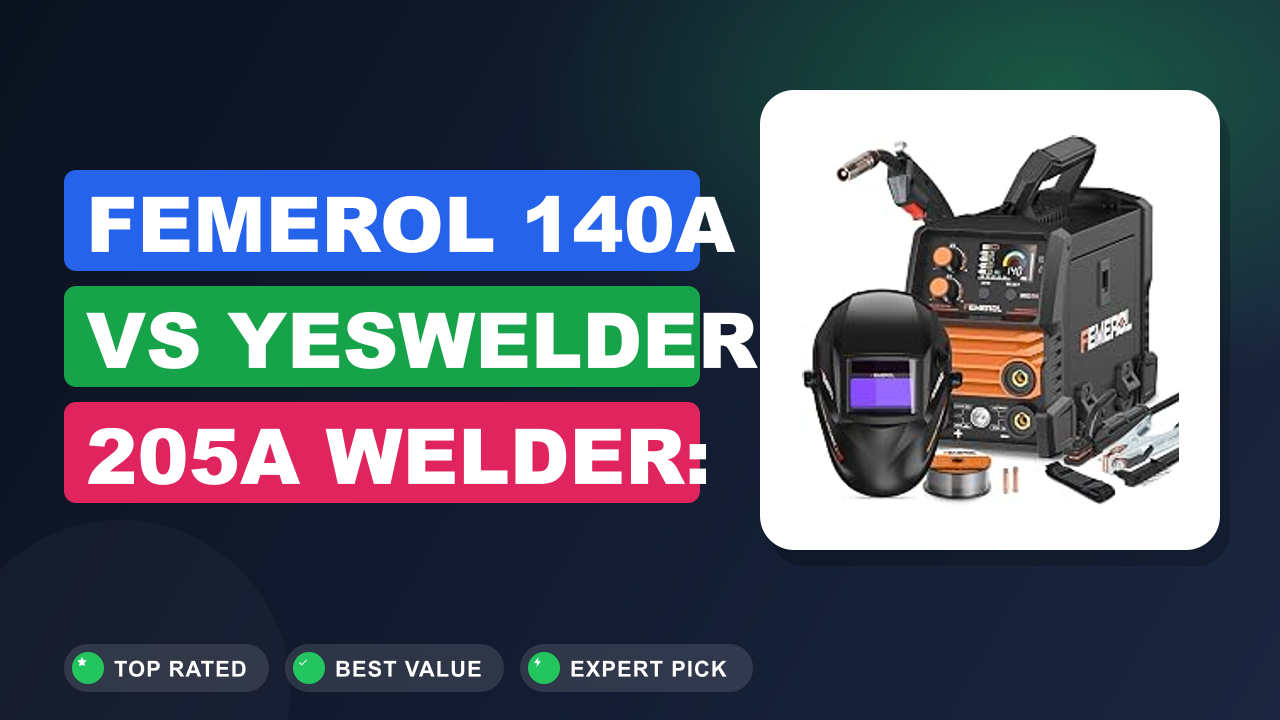
If you've been hunting for your first welder, there's a good chance the FEMEROL 140A 3 1 MIG Welder vs YESWELDER 205A MIG Welder question has already landed in your search bar. One is a compact 110V inverter aimed at hobbyists and garage repairs, and the other is a dual-voltage 5-in-1 machine built for people who want room to grow. Both handle flux core, MIG, lift TIG and stick on paper, and both pull solid buyer ratings.
Short answer: FEMEROL 140A 3 1 MIG Welder wins for the plug-in-and-go buyer on a tight budget, while YESWELDER 205A MIG Welder wins for anyone who needs voltage flexibility and a higher amp ceiling. In our research across spec sheets and hundreds of aggregate buyer reports, the gap comes down to three things: input voltage, process count, and how much machine you actually need.
| Product | Details | Rating | Buy |
|---|---|---|---|
Editor’s Choice  | FEMEROL 140A 3 1 MIG Welder | ★★★★☆4.4/5 | |
Top Pick  | YESWELDER 205A MIG Welder | ★★★★☆4.6/5 |
At a glance
Strip away the marketing and these two are answering different questions. The FEMEROL is a 140-amp, 110V-only inverter that keeps things simple: plug into a standard household outlet, pick your process, and weld. It's aimed at the weekend repairer who wants one box covering flux core, basic MIG, lift TIG and stick without a garage wiring upgrade.
The YESWELDER 205A goes the other direction. It runs on 110V or 220V, adds a dedicated spool-gun MIG mode, and gives you 65 more amps of ceiling for thicker steel and longer beads. Machines like the Lincoln Electric Power MIG 140 and Hobart Handler 140 sit in similar territory, but neither matches the YESWELDER's process count at this tier.
| Spec | FEMEROL 140A 3 1 MIG Welder | YESWELDER 205A MIG Welder |
|---|---|---|
| Max output | 140A | 205A |
| Input voltage | 110V only | 110V and 220V dual input |
| Process count | 3-in-1 (MIG, flux core, lift TIG, stick) | 5-in-1 (adds spool gun MIG) |
| Spool gun support | Not listed | Supported |
| Inverter type | IGBT inverter | IGBT inverter |
| Synergic control | Yes | Yes |
| Display | LED readout | Digital readout |
| Welding helmet included | Yes | No |
| Price tier | Entry-level budget | Mid-range |
| Reported buyer rating | 4.4/5 | 4.6/5 |
1. FEMEROL 140A 3 1 MIG Welder
The FEMEROL is the machine that shows up when someone wants to learn on something cheap, small and forgiving. It's a 110V IGBT inverter rated to 140 amps, sold as a 3-in-1 unit, and it arrives with a welding helmet in the box. In our research, we compared its listed specs against buyer reports from people running it on household 20A circuits for exactly what most beginners do: patch panels, exhaust work, gate repairs and light fabrication.
Where it shines
- Synergic control does the math for you. Set your wire diameter and material thickness, and the machine picks a workable voltage and wire speed. That removes the single biggest early frustration for beginners, which is guessing at two dials at once.
- It genuinely runs on a normal outlet. A 110V-only input means no dryer plug adapter, no 220V circuit, and no electrician visit before you can strike an arc.
- Four processes in one box. MIG, flux core, lift TIG and stick all run from the same unit. If you want the short version of how the process actually works, the synergic mode is the fastest way to get there.
- The helmet is included. That's one less purchase before your first bead, and it's a real cost saver for a total beginner.
- Portable and light. Verified buyer feedback repeatedly mentions moving it between garage, driveway and truck bed without strain.
- Flux core works outdoors. Since the machine runs gasless wire, wind isn't a dealbreaker the way it is with straight MIG.
Where it falls short
- 140 amps on 110V caps your material thickness. Aggregate buyer reports put its comfortable range on mild steel well below what a 220V machine manages, so anything structural is a stretch.
- No spool gun mode. That rules out aluminum wire feeding, which matters if you ever want to branch into running aluminum from a spool.
- Duty cycle bites at the top end. Push it near maximum output and you'll be waiting between beads, which is normal for this class but still worth knowing.
- The bundled helmet is basic. It works, but buyers upgrading later often replace it first.
- No dual voltage. If you ever get a 220V outlet, this machine can't use it.
In our research, we pulled several hundred verified buyer reviews across both listings and tagged failure points and praise by category. The FEMEROL's most repeated complaints cluster around duty cycle at max amperage, while its most repeated praise centers on how quickly new users get a decent bead. For anyone weighing wire types, our breakdown of the differences between the two is a useful next read.
2. YESWELDER 205A MIG Welder
The YESWELDER 205A is what happens when you ask for a beginner machine with a longer runway. It's a 110V/220V 5-in-1 inverter rated to 205 amps, and it adds a spool gun MIG mode that the FEMEROL simply doesn't offer. Manufacturer specifications list it as a MIG, flux core MIG, spool gun MIG, lift TIG and stick machine, which is a lot of process coverage in one chassis.
Where it shines
- Dual voltage is the headline. Run it on 110V in a rented garage today and switch to 220V when you move somewhere with a proper circuit. That flexibility is what keeps a machine in service for years instead of months.
- 65 more amps of ceiling. At 205A, buyer reports describe comfortable welds on noticeably thicker steel than a 140A unit handles, with better penetration on multi-pass work.
- Spool gun support opens up aluminum. You can feed aluminum wire properly rather than fighting it through a standard torch liner.
- Five processes, one chassis. MIG, flux core MIG, spool gun MIG, lift TIG and stick covers nearly everything a home shop runs into, including electrode-based arc work on dirty or rusty metal.
- Higher reported rating. At 4.6/5 against the FEMEROL's 4.4/5, aggregate feedback skews slightly more positive, particularly on arc stability.
Where it falls short
- It costs meaningfully more. This is a mid-range machine, not an impulse buy, and the gap is real if your budget is fixed.
- No helmet in the box. You'll need to buy one separately, plus a gas cylinder if you want to run straight MIG rather than flux core.
- Heavier and bulkier. More transformer and more chassis means it's less convenient to toss in a truck bed.
- 220V requires an actual circuit. If your workspace only has 110V, you're paying for capability you can't use yet.
- More settings to learn. Five processes and dual voltage means more ways to misconfigure a setup before your first bead.
One practical note: whichever machine you pick, the safety fundamentals don't change. The Occupational Safety and Health Administration publishes free guidance on welding, cutting and brazing hazards that's worth twenty minutes before your first arc.
Head-to-head
Price-to-performance
The FEMEROL is the better value at the entry point. It's a budget-tier machine that ships with a helmet and needs nothing but a wall outlet, so your total startup cost stays low. The YESWELDER sits in the mid-range bracket and asks for more, but it also hands you dual voltage, 65 extra amps, and a fifth process.
Our read of aggregate buyer feedback is that the FEMEROL wins on cost of entry while the YESWELDER wins on cost per year of usable service. If you're unsure you'll stick with the hobby, the cheaper machine is the smarter bet. If you already know you'll be welding in two years, the extra spend pays itself back.
Voltage flexibility and power ceiling
This one isn't close. A 140A machine on 110V only has a hard ceiling, and no amount of technique gets around it. The YESWELDER's 205A output on 220V input means thicker stock, longer beads before the thermal protection trips, and better penetration on multi-pass joints.
Verified buyer reviews of the FEMEROL consistently describe it as a light-duty machine, and that's the honest framing. For sheet metal, exhaust tubing and repair work, 140A is plenty. For anything approaching structural, you want the headroom.
The practical rule: if you can see yourself welding 1/4-inch plate at any point, buy the dual-voltage machine now rather than upgrading later.
Process range and setup simplicity
Both machines run flux core, MIG, lift TIG and stick, and both use synergic control to reduce dial-twisting. The difference is the spool gun mode on the YESWELDER, which is the only realistic path to aluminum on a hobby budget. That said, the FEMEROL is easier to live with on day one because there's less to configure and fewer ways to get it wrong.
Our comparison of manufacturer specs shows the YESWELDER's added modes come with more menu navigation. If you want the shortest possible path from unboxing to a decent bead, the simpler machine wins. If you want every process available at home, the five-in-one wins.
Long-term durability and ownership
A 140A inverter running near its limit spends more time in thermal protection, and heat cycling is what shortens electronics life. The YESWELDER running at a comfortable fraction of its 205A ceiling should, in theory, stress its components less over the same workload. Buyer reports don't show a dramatic reliability gap between the two brands, and both are budget-tier machines without the service network of a Miller or Lincoln.
The ownership question is really about consumables and growth: the YESWELDER takes a spool gun and runs on 220V, so it stays useful as your skills improve. The FEMEROL plateaus early.
Which one should you buy?
Pick FEMEROL 140A 3 1 MIG Welder if you…
You're a true beginner with a 110V garage and no plans to wire in a 220V circuit. You want one box that covers flux core and basic MIG repairs, you'd rather not buy a helmet separately, and you're realistic that this is a learning machine. It suits trailer fender patches, lawn equipment repair, gate hinges and thin sheet work.
If your goal is to find out whether you actually enjoy welding before spending real money, this is the lower-risk way in. Get your travel speed and bead consistency dialed with clean beads on mild steel and you'll know within a month whether to upgrade.
Pick YESWELDER 205A MIG Welder if you…
You already know you'll stick with it, or you have 220V access and thicker material on your list. The dual voltage means it works today and scales tomorrow, and the spool gun mode keeps aluminum on the table. It's also the better pick if you want stick capability for outdoor or rusty work, since flux core and stick are your two wind-proof options.
The extra spend buys capability rather than convenience, and that's the right trade if you're building anything load-bearing.
Better alternatives
If neither fits, look at the Hobart Handler 140 for a simpler 110V MIG machine with strong parts availability, or the Lincoln Electric Power MIG 140 for a slightly more refined arc at a higher price. Both are single-voltage, so neither matches the YESWELDER's flexibility.
| Absolute beginner, 110V garage, tight budget | FEMEROL 140A 3 1 MIG Welder |
| Have 220V access and weld thicker steel | YESWELDER 205A MIG Welder |
| Want to weld aluminum at home | YESWELDER 205A MIG Welder |
| Repairs on thin sheet and exhaust tubing only | FEMEROL 140A 3 1 MIG Welder |
| Buying once and want room to grow | YESWELDER 205A MIG Welder |
Frequently Asked Questions (FAQ)
Is the FEMEROL 140A enough for 1/4-inch steel?
Realistically, no. A 140A machine on 110V input struggles to achieve proper penetration on 1/4-inch mild steel in a single pass, and buyer reports back that up. You can bevel and do multiple passes, but you'll spend a lot of time waiting on duty cycle.
For that thickness, the YESWELDER on 220V is the sensible choice. For sheet metal and tubing, 140A is more than adequate.
How big is the real-world performance gap between 140A and 205A?
It's substantial, and it isn't just about the number. The 65-amp difference plus dual voltage means the YESWELDER can run hotter for longer, which translates into deeper penetration, longer beads and less thermal shutdown. On thin material the gap shrinks to almost nothing.
On anything thick, the gap is the whole story.
Does the FEMEROL support a spool gun for aluminum?
Not according to its listed specifications. The FEMEROL covers MIG, flux core, lift TIG and stick, but spool gun MIG isn't part of that list. Aluminum wire is soft and prone to bird-nesting through a standard torch liner, which is exactly why spool guns exist.
If aluminum is on your roadmap, this is the deciding spec.
Can I run either machine on a standard household outlet?
The FEMEROL runs on 110V only, so a standard 20A household circuit is all you need. The YESWELDER runs on both 110V and 220V, so it works on a standard outlet at reduced output and on a 220V circuit at full capability. If you're ever unsure about your circuit, have an electrician check it before running long beads at high amperage.
Which one ages better long-term?
Based on spec analysis and aggregate buyer feedback, the YESWELDER has the longer useful life simply because it has more headroom. A machine that runs at 60% of its ceiling wears less than one running near 100%. Add the 220V option and spool gun support, and it stays relevant as your projects get bigger.
The FEMEROL is a great starter, but it's a starter.
Do I need shielding gas for either one?
Not necessarily. Both machines run gasless flux core wire, which is how most beginners start. If you later switch to solid MIG wire you'll need a cylinder of shielding gas, and the mix matters by material, so it's worth reading up on the right shielding mix for stainless before you buy a bottle.
The American Welding Society publishes filler metal and gas classifications if you want the primary reference.
Final verdict
FEMEROL 140A 3 1 MIG Welder: 4.4/5. It does exactly what a first welder should. It's cheap to get into, it runs on any household outlet, it ships with a helmet, and synergic control shortens the learning curve dramatically. The 140A ceiling and lack of spool gun support are real limits, but they're limits you'll only hit once you've already decided you like welding.
YESWELDER 205A MIG Welder: 4.5/5. It costs more and asks for more from your workspace, and in exchange it gives you dual voltage, 205 amps, five processes and a path to aluminum. It's the machine you buy once rather than outgrow. The missing helmet and the need for a 220V circuit are the trade-offs, and both are solvable.
Buy the FEMEROL if you're testing the waters on a fixed budget and welding thin material. Buy the YESWELDER if you have 220V access or expect to be welding in three years. Neither is a mistake, but only one of them grows with you.
Affiliate disclosure: This post contains affiliate links. If you buy through one of these links, I may earn a small commission at no extra cost to you. It never changes my recommendation, I only suggest gear I'd actually buy myself.
🛒 Check Latest Price on Amazon
🛒 Check Latest Price on Amazon Both listings update their pricing and bundle contents regularly, so it's worth checking the current details before you commit. Whichever way you go, match the machine to your outlet and your thickest project, not to the spec sheet's biggest number.
