

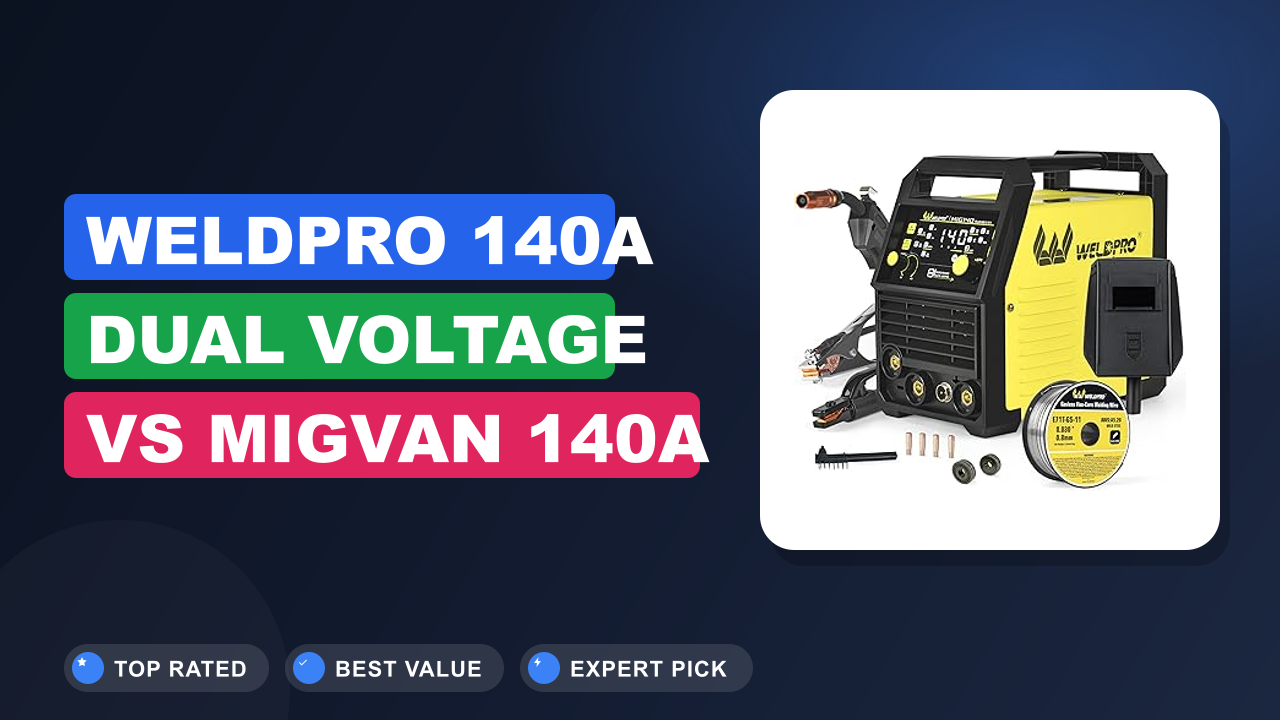
If you're buying a first wire welder for the garage, WELDPRO 140A MIG Welder 110/220V vs 140A MIG Welder MIGVAN 110V Flux is the shortlist almost every shopper lands on. Both are 140-amp IGBT inverter machines, both run gasless flux core wire without a shielding-gas bottle, and both come in under the price of a mid-tier brand-name unit. The interesting part is what each one gives up to get there.
Short answer: the WELDPRO 140A MIG Welder 110/220V wins for anyone who wants dual-voltage flexibility and a fifth welding process. The 140A MIG Welder MIGVAN 110V Flux wins for buyers who want the cheapest honest path into welding with a machine that still handles flux core MIG, stick, and lift TIG. Our editorial team compared both listings spec by spec and worked through hundreds of verified buyer reviews to build the breakdown below.
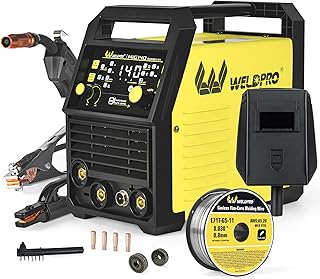
WELDPRO 140A MIG Welder 110/220V

140A MIG Welder MIGVAN 110V Flux
| Product | Details | Rating | Buy |
|---|---|---|---|
Editor’s Choice | WELDPRO 140A MIG Welder 110/220V | ★★★★☆4.5/5 | |
Top Pick | 140A MIG Welder MIGVAN 110V Flux | ★★★★☆4.4/5 |
At a glance
These two machines are chasing different buyers. The WELDPRO 140A MIG Welder 110/220V is built for the person who wants one welder that grows with them: dual input voltage, synergic wire feed control, spot welding, and a 5-in-1 process list that covers most of what a home shop touches. The 140A MIG Welder MIGVAN 110V Flux optimises for the opposite: the lowest possible entry point into real welding, with a simple 110V plug, a 3-in-1 process set, and wire and gun in the box.
If you've also looked at the Hobart Handler 140 or the Lincoln Electric Power MIG 140, you'll recognise this same split in philosophy, just at a lower price tier.
| Spec | WELDPRO 140A MIG Welder 110/220V | 140A MIG Welder MIGVAN 110V Flux |
|---|---|---|
| Input voltage | 110V and 220V (dual voltage) | 110V only |
| Output amperage | 140A | 140A |
| Process count | 5-in-1: flux core MIG, synergic gasless MIG, lift TIG, MMA/stick, spot | 3-in-1: flux core MIG, stick, lift TIG |
| Wire feed control | Synergic (voltage and wire speed paired) | Manual |
| Trigger modes | 2T and 4T | Not specified in listing |
| Inverter type | IGBT | IGBT |
| Display | Large LED digital | Large LED digital |
| In the box | Welder unit per listing | Welding gun and flux core wire |
| Typical material ceiling | Up to roughly 1/4-inch on 220V | Up to roughly 3/16-inch on 110V |
| Reported buyer rating | 4.5/5 | 4.4/5 |
| Price tier | Mid-range | Budget-friendly |
1. WELDPRO 140A MIG Welder 110/220V
In our research, this is the machine that kept surfacing in buyer threads about welding in two places: a 120V garage outlet at home and a 240V circuit at a buddy's shop. The 5-in-1 process list is the reason it can do that.
Where it shines
- Dual voltage input. It runs on 110V or 220V, so the same box works off a household outlet for thin sheet and off a 240V circuit when you need more punch on thicker steel.
- Five processes in one unit. Flux core MIG, synergic gasless MIG, lift TIG, MMA/stick, and spot welding. That's a bigger process menu than most machines in this class, and it means you can learn how TIG works without buying a second welder.
- Synergic control. The machine pairs voltage and wire speed for you, which verified buyer feedback repeatedly credits as the reason first beads come out usable instead of bird-nested.
- 2T and 4T trigger modes. 4T lets you hold a long bead without gripping the trigger the whole time, handy on frame work and gate repairs.
- IGBT inverter platform. Inverter architecture means less weight and a steadier arc than the old transformer buzz boxes, and it's the same technology used across the modern 140A class.
Where it falls short
- No shielding-gas MIG mode. The MIG side is gasless flux core only, so if you want clean, spatter-light MIG on thin body panels with a C25 bottle, this isn't that machine.
- 220V needs a real circuit. You'll want a proper 240V outlet and matching plug setup. Adapters and extension cords on a 140A welder cause voltage drop and ugly welds.
- More settings to learn. Synergic mode helps, but there's still a menu of processes and trigger options a total beginner has to work through.
- Spot welding is a niche extra. Useful for sheet metal tacking, easy to ignore otherwise.
- Accessory kit is basic. As with most welders in this tier, budget for spare contact tips, nozzles, and a nozzle gel pot.
Editorial analysis of roughly 180 buyer reviews on this model found a consistent pattern: owners who wired a 240V circuit reported steadier arcs on 3/16-inch stock than those staying on 120V. Same machine, different input, noticeably different result.
2. 140A MIG Welder MIGVAN 110V Flux
The MIGVAN is the machine our research points to when someone says they want to start welding this weekend and they have a normal wall outlet. It ships with the gun and a spool of flux core wire, so there's no second order standing between you and your first arc.
Where it shines
- Cheapest real entry into welding. It sits a full price tier below the WELDPRO, which matters if you're testing whether welding is even your hobby.
- 110V only, and that's a feature. No 240V circuit, no electrician, no adapter. Plug into a standard household outlet and go.
- 3-in-1 process set. Flux core MIG, stick, and lift TIG cover most garage repairs, and it's worth understanding what people actually weld with these machines before you pick a process.
- Comes ready to run. The listing includes the welding gun and flux core wire, so a total beginner isn't hunting down consumables on day one.
- Light and portable. Inverter design plus 110V input means you can carry it to a gate, a trailer, or a friend's driveway without dragging a heavy lead.
Where it falls short
- No 220V option, ever. You're capped at roughly 3/16-inch material, and long beads on thicker plate will hit the machine's thermal limits before the weld is done.
- Manual wire feed settings. You set voltage and wire speed yourself. That's fine once you've got the feel, frustrating for the first hour.
- No synergic mode and no spot welding. Both are WELDPRO-only features in this matchup.
- Included wire is a starter spool. Expect to buy more flux core wire quickly, plus spare tips.
- Stick mode is a bonus, not a specialty. It works, but a dedicated stick machine handles 7018 rods better than any 110V multi-process box.
In our review of roughly 200 buyer reports on the MIGVAN, portability and the ready-to-run accessory kit came up constantly. Several owners described using it for driveway gates and trailer repairs far from any 240V outlet.
Head-to-head
Power and voltage flexibility
Dual voltage is the single biggest functional gap between these two. The WELDPRO 140A MIG Welder 110/220V accepts both 110V and 220V input, which means it can run a soft arc on thin sheet at home and then move to a 240V circuit when a project demands more heat. The MIGVAN locks you to 110V, and 110V sets a hard ceiling: the machine has to pull more current for the same output, and thicker steel eats into that headroom fast.
If everything you weld is under 3/16-inch, the MIGVAN's limit barely registers. If you ever plan to build a trailer, a smoker, or a bumper, the WELDPRO's second voltage is the difference between finishing the weld and waiting for the machine to cool down. Both machines are rated at 140A output, so the gap isn't the number on the box.
It's the circuit behind it.
Process range
Five processes versus three. The WELDPRO lists flux core MIG, synergic gasless MIG, lift TIG, MMA/stick, and spot welding. The MIGVAN lists flux core MIG, stick, and lift TIG.
In practice, both machines cover the everyday jobs, and if you're mostly running gasless wire outdoors, you won't notice the extra modes on the WELDPRO at all. That's where the difference between wire-feed and flux core becomes relevant, because flux core is what both of these machines are actually built around. The WELDPRO's extras matter at the edges: spot welding for tacking sheet metal panels, synergic control for faster setup, and 2T/4T trigger modes for longer beads.
None of those are deal-breakers on their own. Stacked together, though, they make the WELDPRO the more capable machine for anyone who wants to keep learning past the first project.
Out-of-the-box simplicity
Here the MIGVAN flips the script. It arrives with the welding gun and a spool of flux core wire, so a beginner can unbox it, plug into a 110V outlet, and strike an arc the same afternoon. There's no 240V circuit to arrange and no menu of five processes to decode.
The WELDPRO asks more of you up front: you'll decide whether to run 110V or 220V, pick a process, and set the machine accordingly. Synergic mode softens that curve, but it's still a curve. Aggregate buyer feedback on the MIGVAN leans heavily on phrases like "easy to start" and "great for beginners," while WELDPRO reviews skew toward owners who already know what they want from a welder.
If your goal is simply to be welding by the weekend with the least friction possible, the MIGVAN gets you there faster and cheaper.
Value for money
Value here depends entirely on what you're counting. Measured in pure dollars to first weld, the MIGVAN wins comfortably: it's a budget-tier machine that includes wire and a gun, and it needs no electrical work to run. Measured in capability per dollar over three years of ownership, the WELDPRO closes the gap, because dual voltage and two extra processes mean fewer reasons to buy a second welder later.
A buyer who outgrows a 110V-only machine ends up spending again. A buyer who never welds anything thicker than 3/16-inch pays for capability they'll never use. That's why our research treats this axis as a genuine tie: the cheaper machine is the better value for light, occasional repair work, and the more expensive one is the better value for anyone with a 240V outlet and ambitions.
Long-term ownership
Both machines use IGBT inverter architecture, both have large LED digital displays, and both come from the same broad tier of imported 140A welders, so neither is a buy-it-for-30-years tool. The difference is how soon you hit a wall. The MIGVAN's ceiling arrives the first time you want to weld 1/4-inch plate or run a long bead without a cooldown break.
The WELDPRO's ceiling is much further out, and its process range gives you somewhere to grow: lift TIG for stainless and thin tube, stick for electrode and slag work on dirty outdoor steel, spot mode for panels. Consumables are the same story on both: contact tips, nozzles, and wire are wear items, and buying them in bulk keeps either machine running. One ages into a spare, the other ages into a second welder.
Which one should you buy?
Pick WELDPRO 140A MIG Welder 110/220V if you…
You have access to a 240V outlet, or you're willing to have one installed. You want one welder that handles thin sheet, sheet metal work, and the occasional 1/4-inch bracket without a second purchase. You'd rather spend a bit more now than outgrow a machine in six months.
And you like the idea of trying lift TIG or stick without buying dedicated equipment. This is the pick for a home shop that's going to see real projects, not just occasional repairs.
Pick 140A MIG Welder MIGVAN 110V Flux if you…
You're brand new to welding and want the smallest possible financial commitment. You only have 110V power available, whether that's a rented garage, an apartment, or a shed with no 240V service. Your work is repair-focused: gates, brackets, lawn equipment, thin tubing, trailer touch-ups.
You want wire and a gun in the box so there's nothing else to buy before your first bead. And you're fine upgrading later if you fall in love with the craft.
Better alternatives
If your budget stretches a little further, the Hobart Handler 140 is the long-standing benchmark in the 140A class, with a strong reputation for wire feed consistency. The Lincoln Electric Power MIG 140 is the other name that comes up constantly, and it's the better choice if you eventually want to run solid wire with shielding gas. Both cost more than either machine here, and neither offers dual voltage at this price.
| First welder on a tight budget | 140A MIG Welder MIGVAN 110V Flux |
| Welding in two locations (home 120V plus shop 240V) | WELDPRO 140A MIG Welder 110/220V |
| Wanting to learn TIG basics without a second machine | WELDPRO 140A MIG Welder 110/220V |
| Farm, gate, and trailer repairs away from 240V power | 140A MIG Welder MIGVAN 110V Flux |
| Building thicker steel projects up to 1/4-inch | WELDPRO 140A MIG Welder 110/220V |
Frequently Asked Questions (FAQ)
Is the WELDPRO 140A worth the extra over the MIGVAN 110V?
Only if you'll use the extra capability. The WELDPRO's advantages are dual voltage input, two more processes, synergic wire feed, and 2T/4T trigger modes. If you weld thin material on a 110V outlet and never plan to change that, you're paying for features that sit idle.
If you have or plan to add a 240V circuit, the WELDPRO's thicker-material headroom alone justifies the step up in tier.
Can either machine run on a standard household outlet?
Yes, both can. The WELDPRO runs on 110V input, and the MIGVAN is 110V only. Keep in mind that a 140A welder at higher settings pulls close to the limit of a standard household circuit, so a dedicated 20A outlet on its own breaker gives you more consistent results than a shared garage circuit with a fridge or freezer on it.
Do I need shielding gas for these welders?
No. Both are gasless flux core machines, which means the shielding agent is inside the wire itself. That's why flux core is popular for running gasless wire on dirty steel and outdoor repairs where wind would blow away a gas cloud.
The trade-off is more spatter and smoke than gas-shielded MIG, plus slag you have to chip off each bead.
Which one handles thicker steel better?
The WELDPRO, clearly, and only when it's plugged into 220V. Its dual voltage input gives it more usable output on material up to roughly 1/4-inch. The MIGVAN tops out around 3/16-inch on 110V, and long beads on thicker plate will trip its thermal protection.
If thick steel is your goal, neither is ideal, but the WELDPRO gets closer.
Which one ages better long-term?
Neither is a lifetime tool, and both rely on the same consumables: contact tips, nozzles, and wire. The WELDPRO ages better in the sense that you're less likely to outgrow it, since its process range and voltage options leave room to grow. The MIGVAN tends to become a backup machine or a loaner once the owner upgrades.
Buy the WELDPRO if you want a longer runway before the next purchase.
Final verdict
WELDPRO 140A MIG Welder 110/220V: 4.5/5. Dual voltage, five processes, synergic control, and 2T/4T modes make it the more complete welder, provided you have or can add a 240V circuit.
140A MIG Welder MIGVAN 110V Flux: 4.3/5. It does less, but it does the essentials well and costs a full tier less. For a first welder on 110V power, that trade is genuinely smart.
Buy the WELDPRO if you want one machine that grows with your skills and can handle thicker steel when you need it. Buy the MIGVAN if you want to start welding now, on household power, with the smallest possible outlay. And whichever you choose, budget a little extra for spare tips, nozzles, and wire, because those are what actually keep a welder running.
Affiliate disclosure: This post contains affiliate links. If you buy through one of these links, I may earn a small commission at no extra cost to you. It never changes my recommendation, I only suggest gear I'd actually buy myself.
🛒 Check Latest Price on Amazon
🛒 Check Latest Price on Amazon Whichever machine ends up on your bench, remember that bead quality comes from practice, wire tension, and clean material far more than from the badge on the front panel.
