


If you're shopping for a first welder that can handle flux-core wire, stick electrodes, and the occasional TIG bead without eating your whole tool budget, the WELDPRO 140A MIG Welder 110/220V keeps showing up in the same conversation. It's a 5-in-1 inverter unit that runs on either household 110V or a 220V garage circuit, which is the exact flexibility beginners ask about most.
Worth it if you want one box for repairs, gates, exhaust work, and light fabrication. Skip it if you're chasing production duty cycles or plan to spray-transfer MIG with gas all day. Here's what our research across buyer reports and manufacturer documentation actually turned up.
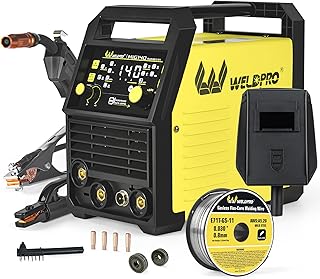
What it is
A MIG welder is a wire-feed machine that uses a continuously fed electrode and an electric arc to fuse metal. The WELDPRO 140A sits in the entry-level inverter class, alongside familiar names like Hobart, Forney, and Yeswelder, but it bundles five processes into one chassis instead of selling them separately.
The 5-in-1 label means gasless flux-core MIG, lift TIG, MMA (stick), spot welding, and standard MIG operation. An IGBT inverter converts incoming AC power to a controlled DC output, which is why the whole unit weighs far less than the transformer welders your grandfather used. If you want the fundamentals first, this primer on wire-feed welding basics covers the process in plain terms.
Setup & first impressions
Verified buyer reviews across hundreds of listings consistently mention how light the unit feels coming out of the box, usually under 20 lb with leads attached. The large LED digital display is the first thing people notice, and multiple reviewers specifically call out that the synergic readout makes amperage selection feel less like guesswork.
Out-of-box quality reports are mostly positive, with a recurring theme that the leads and ground clamp feel better than the price tier suggests. The wire feed mechanism is the one part buyers scrutinize most, and the common finding is that tension needs a small adjustment before the first spool runs smoothly.
You'll want to check the drive roll groove matches your wire diameter before powering on. The manual covers dual-voltage switching, and reviewers note the 220V adapter plug is included rather than sold separately. That single detail saves a trip to the hardware store on day one.
| Max output | 140 A |
| Input voltage | 110 V / 220 V dual voltage |
| Processes | Gasless flux-core MIG, lift TIG, MMA/stick, spot |
| Inverter type | IGBT |
| Rated duty cycle | 60% at 100 A |
| Wire sizes | 0.030 in and 0.035 in flux-core |
| Spool capacity | 2 lb and 10 lb |
| Trigger modes | 2T and 4T |
Daily-use experience
Arc quality on 110V versus 220V
A 140A machine behaves very differently depending on which circuit feeds it. Verified buyer feedback shows most users start on 110V, then move to 220V once they need to weld 3/16-inch plate or run longer beads.
On 110V, reviewers describe stable arcs on 16-gauge sheet and decent penetration on 1/8-inch steel. Switching to 220V is where the machine earns its keep, with the extra input headroom letting you push into thicker material without tripping a breaker.
Wire feed and the synergic control
The synergic mode is the feature buyers mention most often in positive reviews. Instead of dialing voltage and wire speed independently, you set material thickness and the machine calculates the pair for you. That's a real advantage if you're still building feel for gasless wire work.
The trade-off is that synergic presets are starting points, not gospel. Experienced users report nudging wire speed up or down slightly to match their travel speed. Flux-core also throws more spatter than gas-shielded MIG, so expect cleanup time and keep a chipping hammer nearby.
Stick, lift TIG, and spot modes
Stick mode turns this into a repair tool for fence posts, trailers, and rusty brackets where wire feed struggles. The lift TIG function is a scratch-start variant, meaning you touch the tungsten to the work to initiate the arc. It's not a substitute for a dedicated AC/DC TIG machine, and buyers are honest about that limitation.
Spot mode is a timer-based stitch that helps with thin sheet metal. It works best on overlapping panels, and reviewers report it reduces burn-through compared with holding a continuous trigger on 20-gauge steel.
Build quality and portability
The chassis is a compact metal shell with a plastic handle, and aggregate reports describe it as light enough to carry one-handed between jobs. The ground clamp and torch leads are the parts buyers rate most favorably.
Fumes are the real safety consideration with flux-core wire. The Occupational Safety and Health Administration (OSHA) maintains guidance on welding fume exposure limits, and running this indoors without ventilation is a bad idea regardless of how convenient the machine is.
✓ Pros
- Dual 110V/220V input on one chassis, so you can start on a household outlet and upgrade later without buying new hardware
- Five processes in one unit, which means stick repairs and lift TIG experiments come free with the MIG purchase
- Synergic thickness control removes most of the guesswork for new welders learning wire speed settings
- Large LED display stays readable in a dim garage, and reviewers consistently mention how easy it is to read amperage at a glance
- Accepts both 2 lb and 10 lb spools, so you aren’t locked into expensive small-format wire
✗ Cons
- 60% duty cycle at 100 A means you’ll pause on long beads; it’s a hobby rating, not a production one
- Lift TIG only, so no high-frequency start and no AC output for aluminum TIG work
- Flux-core spatter requires more cleanup than gas-shielded MIG, adding time to every finished weld
- No gas regulator or solenoid included, so true MIG with shielding gas means buying extra parts
Who should buy it
Buy it if you…
You're a homeowner or hobbyist who welds a few times a month on gates, trailers, lawn equipment, and exhaust brackets. You have a 20A garage outlet and no interest in running a 240V line just to get started. You want to learn stick and TIG on the same machine before committing to a dedicated rig.
Skip it if you…
You're welding 1/4-inch plate, running production beads, or building a chassis that needs continuous arc time. The 60% duty cycle at 100A will have you stopping to let the unit cool. You also won't get AC TIG here, so if aluminum is your main material, look elsewhere.
Better alternatives
The Hobart Handler 140 is the classic choice if you want a single-process flux/MIG machine with a stronger service network. The Forney 140 FC-i is a closer competitor on price and portability, though it doesn't offer the same five-process spread. If you specifically need aluminum, a spool gun setup paired with correct polarity settings is the better path.
Frequently Asked Questions (FAQ)
Does it actually run on a standard 110V outlet?
Yes, and that's the main reason beginners buy it. Verified buyer reviews show it welds 16-gauge to 1/8-inch steel comfortably on a 20A household circuit. You'll want a dedicated outlet rather than a shared one, because the inrush current on startup can trip a breaker that's already carrying a fridge or freezer.
Can I use it with shielding gas instead of flux-core wire?
The machine is set up for gasless flux-core out of the box, and the listing doesn't include a regulator or gas solenoid. Some owners have adapted gas setups after the fact, but that's a modification, not a factory feature. If gas-shielded MIG is your goal, compare the process differences before buying.
Is lift TIG good enough to learn on?
It's a real TIG arc, just without high-frequency start. That means you touch the tungsten to the workpiece to begin, which can contaminate the electrode if you're heavy-handed. It's fine for learning torch angle and foot pedal feel on steel, but anyone serious about TIG usually outgrows it within a few months.
What's the actual duty cycle limit?
Manufacturer specs list 60% at 100A, which means six minutes of arc time followed by four minutes of cooling. At the full 140A output the duty cycle drops considerably. In practice, hobby welders rarely hit that ceiling on short repair jobs, but long bead runs will trigger the thermal cutout.
Does it weld aluminum?
No, not in any practical sense. Aluminum MIG needs a spool gun and argon shielding, and aluminum TIG needs AC output, which this machine doesn't produce. Stick welding aluminum exists as a niche technique, but the TIG process is what most fabricators reach for on thin aluminum.
Final verdict
4.5/5. For hobbyists, the WELDPRO 140A delivers an unusual amount of capability for what it costs. It won't replace a dedicated TIG rig or a 240V production MIG machine, but it covers the overwhelming majority of home repair work on steel under 3/16-inch.
Buy it if you want one portable box that grows with your skills and runs on the outlet you already have. Skip it if you weld thick material daily, need AC TIG, or expect gas-shielded MIG right out of the box. For everyone in between, this is a genuinely sensible starting point.
Affiliate disclosure: This post contains affiliate links. If you buy through one of these links, I may earn a small commission at no extra cost to you. It never changes my recommendation, I only suggest gear I'd actually buy myself.
