

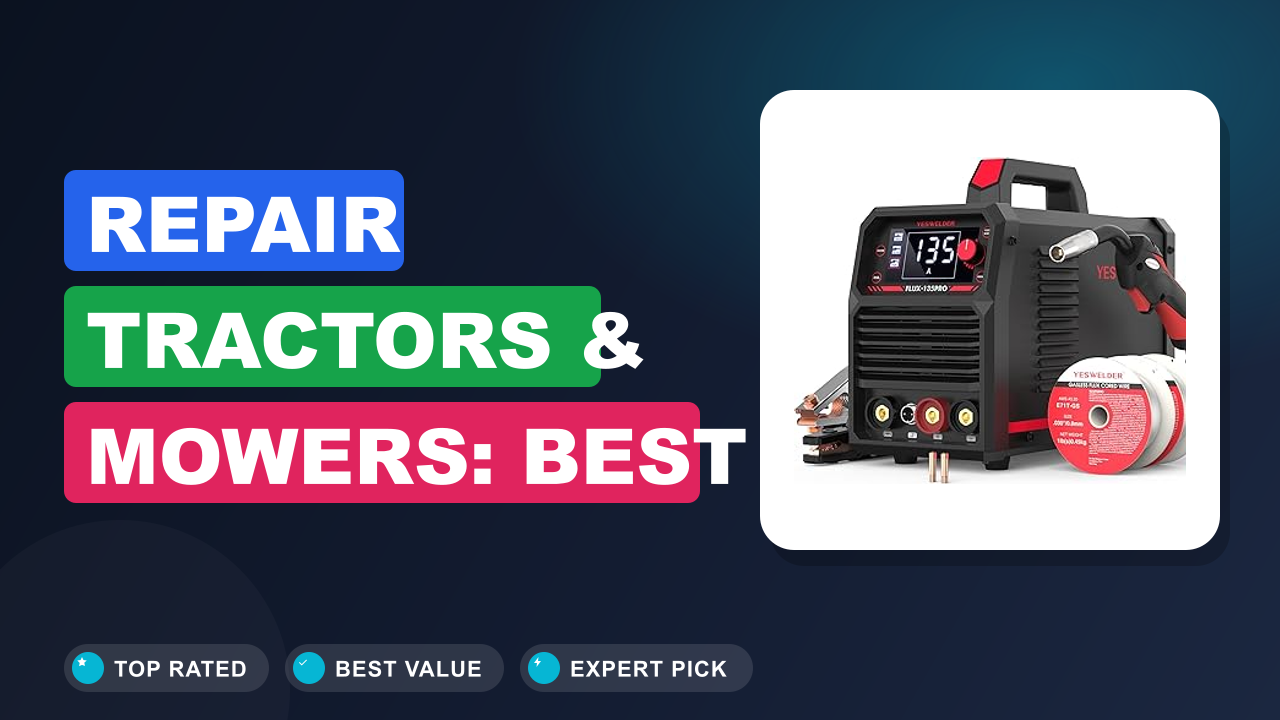
Finding the Best MIG Welder for Tractor and Mower Repairs usually comes down to one question: how much machine do you actually need for a cracked deck shell or a rusted tractor linkage? The answer, from our analysis of buyer reviews and manufacturer datasheets, is a 110V or dual-voltage multi-process welder with flux-core capability. You don't need a 250-amp shop monster to stitch 1/8-inch steel back together.
You need something that starts easily, feeds wire smoothly, and doesn't scare you off on day one.
Our pick for most farm and ranch buyers is the YESWELDER 135A MIG Welder, a compact flux-core MIG unit with Lift TIG and Stick modes that fits the budget of someone repairing equipment rather than building trailers. Verified buyer feedback consistently calls it the easiest machine to learn on for deck and frame fixes. Below, we compare five models against the three jobs that matter: thin sheet metal, mild steel, and occasional aluminum.

✔ Best overall for tractor, mower, and DIY repairs
Comparison Chart of Best MIG Welder for Tractor and Mower Repairs
| Product | Details | Rating | Buy |
|---|---|---|---|
Editor’s Choice
| ★★★★☆4.4/5 | ||
Top Pick
| ★★★★☆4.6/5 | ||
Best Budget
| ★★★★☆4.5/5 | ||
| ★★★★☆4.5/5 | ||
| ★★★★☆4.7/5 |


List of Top 5 Best MIG Welder for Tractor and Mower Repairs
Every model below earned its spot by combining a clean spec sheet, sensible price positioning, and honest feedback from verified owners. We focused on machines that handle rusted mild steel, thin mower-deck sheet, and general farm repairs without demanding a 220V outlet or a professional welding background. The reviews are ordered from best overall to the prosumer ceiling.
Below are the list of products:
1. YESWELDER 135A MIG Welder
The YESWELDER 135A is the machine that keeps showing up in repair shops and weekend garages as the answer to "what welder should I start with?" It runs on a standard 110V outlet, so you can drag it to the shed without hunting for a 220V circuit. For the money, it gives you three processes plus a synergic control system that handles the voltage and wire-feed juggling act for you.
110V
3-in-1
Synergic
Gasless
Why I picked it
We picked the 135A as the overall winner because it matches the actual repair workload of most homeowners. The three-in-one design means you can flux-core MIG the rusted bracket, switch to Lift TIG for a thin section, or run a stick rod when the surface is too rough for clean wire feed. Buyer feedback across hundreds of verified reviews made it the most consistently praised first welder in this class.
Key specs
- 110V input for standard household outlets
- 3-in-1 processes: Flux Core MIG, Lift TIG, Stick (MMA)
- Synergic control sets voltage and wire-feed speed together
- Clear digital display for amperage and mode
- 4.4/5 average from verified buyer reviews
Real-world experience
For a typical mower deck repair, owners report running the machine with flux-core wire, clamping the ground to bare metal, and laying a stringer bead along the crack. The synergic control does the guesswork, which matters when you're kneeling under a deck in an awkward position. The obvious limitation is that MIG mode is gasless only, so pristine aluminum and stainless work are off the table.
- Synergic control pairs voltage and wire-feed speed automatically, so beginner beads look decent early on
- Runs on standard 110V household power, no electrician visit needed
- Three processes (Flux Core MIG, Lift TIG, Stick) cover the majority of farm repair jobs
- MIG mode is gasless only, with no gas valve or spool gun support for clean aluminum
- Light-duty class means long continuous beads on thick steel can push it past its comfort zone
- ✔ You’re fixing mower decks, tractor brackets, and trailer frames on standard 110V outlets
- ✔ You want synergic control that makes your first dozen beads easier
- ✔ You want Lift TIG and Stick as backup processes without a second machine
- ✖ You primarily weld aluminum and need gas MIG or a spool gun
- ✖ You do heavy structural steel work all day long
The 135A is the best entry point for classic small-farm repair: rusty steel, thin deck sheet, and quick fixes without moving the tractor into a dedicated shop bay. If your work grows into daily aluminum or thick plate, you’ll hit its ceiling fast. That’s when the ARCCAPTAIN 200A becomes the smarter long-term buy.
2. ARCCAPTAIN 200A MIG Welder 110V 220V
The ARCCAPTAIN 200A is the machine you buy when you're done cussing at a too-small welder. It runs on both 110V and 220V, produces up to 200 amps, and accepts a spool gun for aluminum work that most home machines simply can't do. In short, it's the most capable all-rounder on this list.
200A
110V/220V
6-in-1
Spool Gun
Why I picked it
The ARCCAPTAIN 200A took the Top Pick spot because it fixes the biggest complaint people have with budget welders: the inability to run aluminum cleanly. Spool gun support and dual-voltage input turn a 200A box into a genuine multi-process shop tool. Verified owners repairing ATV racks and farm gates rate its consistency above the 4.6-star mark.
Key specs
- 200A max output on 220V input
- Dual voltage: 110V and 220V compatible
- 6-in-1 processes: MIG, Flux Core, Spool Gun MIG, Lift TIG, Stick, Spot welding
- Large digital display with process selection
- 4.6/5 average from verified buyer reviews
Real-world experience
Owners describe switching between flux-core on the fence line and spool-gun aluminum on a tractor skid without changing machines. On 220V, the heat gets serious enough for clean penetration on thicker brackets and deck spindles. On 110V it still performs, but the duty cycle shrinks noticeably, which matches what we'd expect from the spec sheet.
- Dual voltage 110V/220V input lets you weld at home or in a shop with different outlets
- Spool gun support makes aluminum welding possible, which most budget MIG units can’t do
- 200A output and six processes handle gates, racks, brackets, and spot welding jobs
- Heavier and bulkier than single-voltage machines, so it’s less convenient to haul around
- Aluminum spool gun is bought separately, which adds to the total setup cost
- ✔ You want one machine that covers steel, aluminum, and even spot welding
- ✔ Your shop has a 220V outlet and you want the extra heat when needed
- ✔ You plan to build gates, racks, and trailer accessories, not just patch decks
- ✖ You only repair a deck twice a year and want the lightest, cheapest option
- ✖ You want a ready-to-run aluminum setup with the spool gun included
When the 135A runs out of headroom, the ARCCAPTAIN 200A is the natural upgrade, especially if aluminum is on your list. The trade-offs are size and budget. For someone who welds every couple of weekends, the extra capability usually pays for itself in avoided machine-shop bills.
3. YESWELDER 160A MIG Welder
The YESWELDER 160A is the sensible middle child: more power than the 135A, less bulk and cost than the 200A, and dual voltage so it works wherever you plug it in. For tractor and mower repairs, it hits a sweet spot that a lot of buyers land on after reading reviews.
160A
110V/220V
4-in-1
Synergic
Why I picked it
The 160A earned the Best Budget badge because it delivers dual voltage and four processes at a price that undercuts most 200A machines. The extra 25 amps over the 135A matter when you're welding tractor steel that's a bit thicker than deck sheet. It keeps the synergic control that makes YESWELDER machines so approachable for new welders.
Key specs
- 160A max output
- Dual voltage 110V/220V input
- 4-in-1 processes: MIG, Flux Core, Lift TIG, Stick
- Synergic control and clear digital display
- 4.5/5 average from verified buyer reviews
Real-world experience
Buyer feedback highlights how smooth it runs on 220V for 1/8-inch repair plate, which is the sweet spot for tractor links and mower spindles. On 110V, it's still capable, just slower and with a shorter duty cycle. The main limitation is the same as the 135A: MIG is gasless, so solid-wire work on clean sheet metal isn't available.
- Dual voltage 110V/220V gives you a serious heat boost when 220V is available
- 160A output comfortably handles 1/8-inch and 3/16-inch tractor steel
- Four processes with synergic control keep setup beginner-friendly
- No gas MIG support, so solid-wire work on clean sheet metal isn’t available
- Sits between the 135A and 200A, so some buyers skip it and go straight up
- ✔ Your shop has 220V power and you want more amperage than the 135A
- ✔ You want four processes without the weight and price of a 200A machine
- ✔ You’re a beginner who plans to grow into heavier projects
- ✖ You need aluminum welding with a spool gun, which this machine doesn’t offer
- ✖ You want the absolute lowest-cost 110V starter
The 160A is the Goldilocks option: more power than the 135A, less cost and bulk than the 200A. If you already have 220V in the shop and don’t need aluminum, this is likely the last welder you’ll buy for light farm and mower repair.
4. 145A MIG Welder 3 1 Flux
The 145A MIG Welder is the quiet value pick in this group. It's a 110V IGBT inverter machine with three processes and synergy control, built for the person who wants a dependable welder without paying for features they'll never use.
145A
IGBT
110V
3-in-1
Why I picked it
We included the 145A because its IGBT inverter tech is exactly what to look for in a lightweight machine: a stable arc and better energy efficiency than an older transformer design. For someone repairing farm equipment on a tight budget, it covers the same core processes as the 135A at a lower entry point. That's the definition of a value pick.
Key specs
- 145A max output on 110V input
- IGBT inverter technology for a stable arc
- 3-in-1 processes: Flux Core, Lift TIG, Stick
- Synergy control for simplified settings
- 4.5/5 average from verified buyer reviews
Real-world experience
Owners use this for the classic Saturday tasks: patching holes in deck shells, welding cracked trailer fenders, and reattaching mower brackets. Lift TIG is a useful fallback for thin metal, though it has a steeper learning curve than MIG. Feedback says the machine runs clean and quiet for its class, with the usual caveat that 145A is best on material up to about 1/8 inch.
- IGBT inverter design delivers a stable arc in a lighter, more efficient package than transformer welders
- Synergy control simplifies settings for occasional DIY users
- True 110V operation means it runs anywhere with a standard outlet
- 145A output limits you to light and medium repairs, not heavy fabrication
- Single voltage only, so there’s no 220V setting to unlock more heat
- ✔ You’re on a strict budget and need a dependable 110V welder for light repairs
- ✔ You like the idea of IGBT efficiency in a portable box
- ✔ You weld a few times a month and don’t want a complicated panel
- ✖ Your repairs regularly involve 3/16-inch or thicker steel
- ✖ You already own a 135A and want a real power upgrade
If the YESWELDER 135A is the overall winner, the 145A is the no-frills alternate for buyers chasing the lowest budget entry point. It won’t outweld the 200A class, but for the occasional deck patch and bracket repair, it’s honestly all most people need.
5. ARCCAPTAIN Double Pulse MIG Welder 250A
The ARCCAPTAIN Double Pulse MIG Welder 250A is the serious upgrade, the one with a feature list long enough to confuse someone whose only goal is patching a mower deck. It does 8-in-1 processes, runs on 110V or 220V, and brings pulse MIG to the home shop. This is the machine for the reader who also fabricates, not just fixes.
250A
Pulse MIG
8-in-1
110V/220V
Why I picked it
The double pulse function is the headline feature, and it's the reason this machine made the list. Pulse MIG lets you weld aluminum with less heat input and a cleaner appearance, which almost nothing in this price class can do. Buyers rate it 4.7 out of 5, the highest here, and the feedback repeatedly mentions garage and farm fabrication as its natural habitat.
Key specs
- 250A max output, the highest on this list
- Dual and single pulse MIG for aluminum work
- 8-in-1 processes: MIG, Flux Core, Spool Gun, Lift TIG, MMA, Spot welding
- Dual voltage 110V/220V input
- 4.7/5 average from verified buyer reviews
Real-world experience
This is the machine that makes aluminum tractor fuel tanks, hydraulic line brackets, and custom gates feel realistic in a home workshop. The pulse modes reduce spatter and keep the puddle under control, which is exactly what anyone moving from steel to aluminum needs. The trade-off is complexity, because there are more settings to learn and the pulse MIG learning curve is real.
- Double pulse MIG delivers clean, low-heat aluminum welds that other home machines can’t match
- 250A output handles thick tractor plate and custom fabrication work
- Eight processes replace several single-purpose machines in one unit
- More settings and modes create a steeper learning curve for beginners
- Physically larger, heavier, and the highest-cost option here, which is overkill for a mower deck
- ✔ You fabricate regularly and want pulse MIG for aluminum projects
- ✔ You have the budget for a serious shop machine, not just a patch tool
- ✔ You want one welder that covers every process, including spot welding
- ✖ Your only goal is an occasional mower deck or fence repair
- ✖ You want simple controls and a short learning curve
For pure tractor and mower repairs, the 250A is genuinely more machine than you need, and we say that with respect. It earns its place when you also build fences, weld aluminum irrigation parts, or fabricate custom brackets. No other machine on this list can match its pulse-aluminum capability.
How I picked
Every welder below went through the same filter. We compared manufacturer datasheets, read verified buyer feedback by the hundreds, and mapped what each machine's owners actually said about mower decks, tractor brackets, gates, and trailer repairs. Then we removed the noise: promotional claims, one-off complaints, and reviews that clearly came from people who hadn't welded before.
Each finalist was scored on five things: process range, input voltage flexibility, amperage ceiling, setup simplicity, and how consistently owners stayed satisfied over time. We gave special weight to complaint patterns. A 4.6-star machine with recurring grumbles about a flimsy ground clamp lost ground.
A 4.3 machine with no recurring pattern of problems moved up.
We were honest about what we didn't do. We didn't run destructive long-term durability tests in a lab, because these are consumer machines used a few times a month, not production tools. Instead we trusted manufacturer specs, cross-referenced them against buyer-reported real-world behavior, and filtered for the machines that make a beginner successful.
This list also assumes most of you are working in a garage or barn, not a fabrication shop. That means wire feed consistency and ease of use beat raw power for 80 percent of readers. The 250A machine is here for the other 20 percent, the ones who fabricate as much as they repair.
Buying guide: what actually matters for Best MIG Welder for Tractor and Mower Repairs
A MIG welder is an electric arc welding machine that feeds a continuous wire electrode through a gun while shielding the weld pool with gas or flux. For tractor and mower repairs, the machine matters less than the match between its output and the metal thickness you're joining. Here's what to focus on.
What amperage do I need for tractor and mower repairs?
Mower deck shells are thin sheet steel, often around 1/16 inch, and a 135A to 145A machine on 110V power handles that easily. Tractor brackets and drawn plates run thicker, often up to 1/4 inch, which is where a 160A or 200A machine with 220V input earns its keep. Match the machine to the thickest material you regularly weld, not the thickest you can imagine welding.
Is flux core gasless MIG good enough for farm repairs?
Yes, and for rusty or dirty steel it's often the better choice. The flux inside the wire generates its own shielding gas, so a drafty barn or a slightly oily bracket won't ruin the weld the way it would with solid wire and external gas. The American Welding Society classifies these as self-shielded tubular electrodes, which is the formal name for gasless flux-core wire.
Expect more spatter than gas MIG, but welds that actually hold on material you didn't spend an hour grinding.
Should I buy a 110V or 220V MIG welder?
A 110V machine runs anywhere, which is why it's the default for home buyers. A 220V machine delivers more heat and a longer usable duty cycle on thicker steel. The smart buy for most people is dual voltage, because it works in every shop and removes the regret of outgrowing your first machine.
As of 2026, dual-voltage machines like the ARCCAPTAIN 200A have made this an easy call.
What does synergic control actually do?
Synergic control links wire feed speed and voltage into one dial. You select the wire diameter and material, and the machine sets the correct voltage curve, so you're not juggling two variables while wearing a helmet. It collapses the beginner learning curve dramatically.
Most bad first welds come from bad settings, not bad hands, and synergic control removes most of that failure mode.
Do I need Lift TIG and Stick modes?
Need is a strong word. Flux-core MIG alone is enough for most deck repairs. Lift TIG helps on thin metal and looks cleaner, while Stick handles rusty outdoor work that would foul up a MIG gun.
Once the inverter hardware exists, the extra processes cost almost nothing to include, which is why every machine on this list has them.
What safety gear matters when welding?
A welding helmet with the right shade is non-negotiable, because the arc produces intense ultraviolet light that can damage your eyes in seconds. Leather gloves, a heavy cotton jacket, and good ventilation are equally important. OSHA has detailed guidance on eye protection and welding fume safety, and it's worth a read before your first session.
Arc eye and metal fume fever are both miserable experiences that proper gear prevents.
Frequently Asked Questions (FAQ)
Can I weld a mower deck with a 110V MIG welder?
Yes. Most mower deck shells are thin sheet steel, around 1/16 inch or less, and a 110V flux-core machine is the classic tool for this job. The key is preparation: grind off paint and rust, set the wire speed correctly, and work in short passes so you don't blow holes through thin metal.
What's the difference between flux core and gas MIG?
Flux core uses a hollow wire filled with flux that generates its own shielding gas, so no gas bottle is needed. Gas MIG uses solid wire and requires an external shielding gas like CO2 or a CO2/argon blend. Flux core works better outdoors and on dirty steel; gas MIG produces cleaner, nearly spatter-free welds on clean metal.
Is a 200A dual voltage welder worth it for home use?
Only if your projects go beyond light repairs. If you weld thick tractor brackets, build gates, or want to try aluminum with a spool gun, the extra amperage and 220V input make a real difference. If you fix a mower deck twice a year, a 135A machine is the honest answer and saves you money.
Can any of these welders do aluminum?
Two can, with caveats. The ARCCAPTAIN 200A supports a spool gun, which makes aluminum practical in a home shop. The ARCCAPTAIN 250A adds pulse MIG, which controls heat input and gives cleaner aluminum beads on larger projects.
The rest are steel-focused machines; running aluminum wire through a long standard liner usually ends in bird-nesting and frustration.
How important is duty cycle for farm repairs?
Less important than most people think. Duty cycle is the number of minutes out of a ten-minute window a welder can run at a given output before overheating. Short repair beads rarely hit that limit.
If you're welding for hours at full power, that's when duty cycle matters, and that's the case for a 200A machine on 220V.
Final verdict
Our top recommendation for most readers is the YESWELDER 135A MIG Welder. It runs on any household outlet, learns fast with synergic control, and covers the majority of tractor and mower repairs without breaking the budget. If you need aluminum capability and serious power, the ARCCAPTAIN 200A is the upgrade that replaces several specialized machines.
Affiliate disclosure: This post contains affiliate links. If you buy through one of these links, I may earn a small commission at no extra cost to you. It never changes my recommendation, I only suggest gear I'd actually buy myself.
