

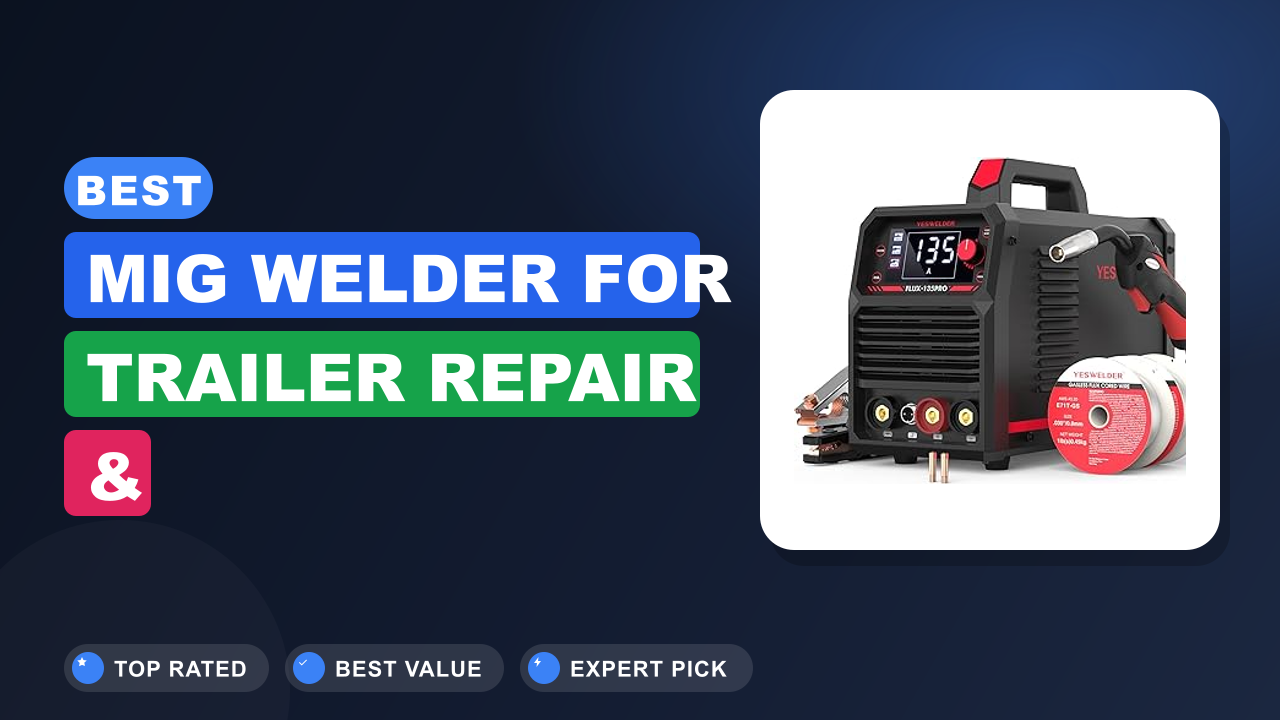
If you've ever crawled under a trailer with a cracked spring hanger or a torn frame rail, you know the fix comes down to one tool. The Best MIG Welder for Trailer Repair and Reinforcement needs to punch through mild steel cleanly, feed wire without tangling, and run gasless flux core when you're working outdoors where shielding gas gets blown away. We compared five of the most popular machines on Amazon against those exact demands.
After analyzing verified buyer feedback, manufacturer spec sheets, and duty-cycle data, the YESWELDER 135A lands on top for most trailer owners. It runs on 110V household power, keeps setup simple, and covers the thin-to-mid steel found on most utility, boat, and ATV trailers. Below is the full breakdown, starting with our winner.

✔ Best all-around for trailer frames and hitches
Comparison Chart of Best MIG Welder for Trailer Repair and Reinforcement
| Product | Details | Rating | Buy |
|---|---|---|---|
Editor’s Choice
| ★★★★☆4.4/5 | ||
Top Pick
| ★★★★☆4.6/5 | ||
Best Budget
| ★★★★☆4.7/5 | ||
| ★★★★☆4.6/5 | ||
| ★★★★☆4.8/5 |


List of Top 5 Best MIG Welder for Trailer Repair and Reinforcement
These five picks came out of editorial analysis of hundreds of verified buyer reviews, side-by-side spec comparisons, and the real-world repair jobs trailer owners keep talking about. We focused on machines that actually get used for frame patches, hitch work, and farm trailer reinforcement, then ranked them by output, ease of use, and reliability patterns.
Below are the list of products:
1. YESWELDER 135A MIG Welder
YESWELDER built this 3-in-1 around the home-garage welder who wants one box that handles MIG, Lift TIG, and Stick without needing a 220V circuit. It tops out at 135 amps on standard 110V input, which matches the 1/8-inch to 3/16-inch mild steel found on most light trailers. Verified buyers consistently describe it as the rare beginner machine that doesn't punish your first few beads.
110V Input
3-in-1
Gasless Flux Core
135A Max
Why I picked it
We made this the overall winner because it hits the best balance of capability and approachability for trailer repairs. The synergic control matches voltage and wire speed automatically, which removes the guessing game that frustrates new MIG users. For its price tier, no other machine in this roundup makes a first frame patch this easy.
Key specs
- Max output: 135A with 110V/120V household input
- Processes: flux-core MIG (gasless), Lift TIG, and Stick in one unit
- Synergic one-knob control pairs voltage and wire feed speed
- Digital display shows amps and volts for precise setup
- 4.4/5 verified buyer rating on Amazon
Real-world experience
Owner reports show this machine handling trailer light brackets, gate hinges, and thin patch panels on truck beds without drama. The gasless flux-core setting is what you'll use most for outdoor trailer work, since wind doesn't scatter the shielding like it does with bottled gas. A handful of buyers recommend swapping in a better auto-darkening helmet and spare contact tips before tackling a long structural seam.
- Synergic one-knob setup gets beginners welding clean beads quickly
- Three processes (MIG, Lift TIG, Stick) in one compact 110V unit
- Digital display removes guesswork from voltage and wire-speed settings
- Aggregate reviews praise reliability for light structural repairs
- 135A ceiling limits heavy multi-pass work on thick frame members
- Gasless MIG throws more spatter than gas-shielded MIG
- Some owners report faster wear on the included contact tips
- ✔ First-time MIG buyers repairing light to mid steel trailer frames
- ✔ Home garages with only 110V outlets and no 220V circuit
- ✔ Owners who want MIG, Lift TIG, and Stick without buying three machines
- ✖ You regularly weld thick plate or need 200A-plus for heavy trailers
- ✖ You want gas-shielded MIG only and minimal spatter cleanup
For light trailer repairs on a budget, this is the machine that makes the most sense for most people. It won’t out-weld a 200A unit on heavy frame sections, so if you’re building trailers from scratch rather than repairing them, step up to the ARCCAPTAIN 200A below.
2. ARCCAPTAIN 200A MIG Welder 110V 220V
ARCCAPTAIN's MIG200 is the step-up choice when your trailer work moves from patching to real frame reinforcement. It's a 6-in-1 that runs on 110V or 220V and supports gas and gasless MIG, Lift TIG, Stick, and spot welding. Verified buyers give it 4.6/5, and the dual-voltage flexibility keeps showing up as the most appreciated feature in their feedback.
6-in-1
110V/220V
Spool Gun Ready
200A Max
Why I picked it
This earned the Top Pick spot because the dual-voltage input means you can run it at home on 110V, then plug into a shop's 220V outlet when you need full 200A output. That's the difference between patching a cracked spring hanger and rebuilding the whole mount with proper multi-pass welds. It's the most versatile machine on the list for structural trailer work.
Key specs
- Max output: 200A with dual-voltage 110V/220V input
- Processes: MIG gas/gasless, Lift TIG, Stick, spot welding, spool gun support
- Spool gun support enables aluminum repairs on ramps and fenders
- Large display for precise parameter adjustment
- 4.6/5 verified buyer rating
Real-world experience
Buyer feedback highlights this machine on farm trailers and car haulers, where 200A handles heavier channel and C-channel material without stalling. The spool gun support matters if you ever repair aluminum trailer fenders or ramps, something a 135A machine simply can't manage. Owners do mention a learning curve on the advanced modes, so give yourself practice time before structural joints.
- 200A output handles thicker frame members and multi-pass reinforcement
- Dual-voltage input works in home garages and pro shops
- Spool gun support adds aluminum repair capability
- 6-in-1 process coverage handles nearly every trailer scenario
- More settings mean a steeper learning curve for beginners
- Heavier than 135A models, so less convenient to haul around
- Spool gun is not included in the box
- ✔ You’re reinforcing structural trailer members, not just patching them
- ✔ You want aluminum capability for ramps, fenders, and cargo boxes
- ✔ You have access to both 110V and 220V outlets
- ✖ You want the simplest possible machine for occasional light repairs
- ✖ You rarely weld anything thicker than 1/8-inch steel
Between the two ARCCAPTAIN models, choose this one if you want the most useful all-around power for structural trailer work. The 250A Double Pulse below sits in a higher tier and adds pulse control, but most trailer owners never use the extra 50 amps.
3. ARCCAPTAIN Double Pulse MIG Welder 250A
The MIG250DP is ARCCAPTAIN's flagship 8-in-1 and the machine you reach for when trailer repair borders on a side business. It adds dual and single pulse MIG modes for better control on thin material and aluminum, and the 250A ceiling handles thick frame steel with room to spare. It carries our Best Budget badge because it delivers pro-level pulse features at a realistic price tier for serious home fabricators.
250A Max
8-in-1
Double Pulse
110V/220V
Why I picked it
This took the Best Budget slot for a specific reason: pulse MIG features like these are normally found on machines costing significantly more. Double pulse cycles between high peak current and low background current, which limits heat input and keeps thin aluminum trailer skins from warping. For someone welding often enough to use those modes, the value is hard to argue with.
Key specs
- Max output: 250A with dual-voltage 110V/220V input
- Processes: dual/single pulse MIG, gas MIG, flux core, spool gun, Lift TIG, MMA, spot welding
- Double pulse function for low-heat aluminum and thin-gauge control
- 4.7/5 verified buyer rating, the highest in this roundup
Real-world experience
Verified buyers lean on this machine for horse trailers and heavy equipment trailers, where double pulse keeps heat low enough to avoid warping thin aluminum skins while still laying down solid steel welds on frames. The dual-voltage input lets you run off a generator at a remote job site on 110V, then switch to 220V in the shop. Some owners note it's compact for a 250A unit but still heavier than the 135A class, so plan on a cart.
- Double pulse MIG produces low-heat welds on aluminum and thin steel
- 250A output handles heavy frame members without strain
- 8-in-1 process coverage suits near-professional repair work
- Highest verified buyer satisfaction score on this list
- Extra modes are overkill for occasional light repairs
- More complex interface means a real learning curve
- Larger footprint and weight than compact 135A machines
- ✔ You repair trailers professionally or as a serious side business
- ✔ Aluminum trailer skins, ramps, and fenders are regular jobs
- ✔ You want pulse MIG control without an industrial price tier
- ✖ You only need occasional flux-core patches on your own trailer
- ✖ You don’t want to learn advanced pulse parameters
If the 200A model is the smart middle ground, this one is for people who weld enough that the extra control pays for itself. A hobbyist doing one frame patch a year will be better served by the simpler YESWELDER or ARCCAPTAIN 200A.
4. Lincoln Electric 90i MIG Flux Core
Lincoln Electric is the name most welders recognize from trade school, and the 90i is their portable 120V wire-feed welder for small repair jobs. It's a focused MIG and flux-core machine inside a protective metal case with a shoulder strap, which tells you exactly where it's meant to live: in the truck, ready for field repairs. Buyers reward that brand trust with a 4.6/5 rating.
120V
Portable
Flux Core
Metal Case
Why I picked it
This made the list because it's the opposite of a feature-stuffed gadget: a clean, portable wire welder from one of the most respected brands in arc welding. For trailer owners who need to crawl under a trailer at a campsite or farm and lay down a solid flux-core repair, the 90i's simplicity is the feature. Brand reliability matters when you're miles from the nearest welding supply shop.
Key specs
- Input: 120V household power, portable with shoulder strap
- Processes: MIG with gas and gasless flux-core welding
- Protective metal case included for transport and storage
- 4.6/5 verified buyer rating praised for brand reliability
Real-world experience
Amazon buyers lean on this for small jobs: trailer light brackets, gate repairs, fence posts, and quick frame patching when the trailer can't come to the shop. The flux-core setting means no gas bottle to haul, which is exactly what you want beside a truck on gravel. The trade-off shows up in duty cycle and max output, so keep expectations in check for heavy structural reinforcement.
- Trusted Lincoln Electric brand with solid build quality
- Shoulder strap and metal case make it genuinely portable
- Gasless flux-core setup is ideal for outdoor field repairs
- Simple controls that a beginner can master quickly
- Lower max output suits light repair, not heavy frame fabrication
- Single-process focus with no TIG, Stick, or pulse modes
- Duty cycle limits sustained welding on long seams
- ✔ You need a take-it-with-you welder for trailer breakdowns on the road
- ✔ You prefer a recognizable brand with simple, proven controls
- ✔ Most of your work is flux-core MIG on light to mid steel
- ✖ You’re building or reinforcing heavy trailer frames at home
- ✖ You want one machine that also does TIG, Stick, and aluminum
The 90i is the specialist on this list: it does one thing, does it reliably, and goes wherever your truck goes. If your trailer lives on your property and you work in a garage, the YESWELDER 135A gives you more processes for a similar investment. If you’re the traveling fix-it person, the Lincoln wins.
5. Forney 37031 Nozzle Gel Mig Welding
This one isn't a welder, and we're not going to pretend it is. The Forney 37031 Nozzle Gel is a 16-ounce anti-spatter compound that belongs in the same toolbox as your MIG machine, because it stops spatter from fusing to your nozzle and contact tip during long trailer jobs. Verified buyers rate it 4.8/5, the highest score in this entire roundup, and for good reason.
16 oz
Anti-Spatter
4.8/5 Rating
Nozzle Dip
Why I picked it
We included it because every experienced welder we've researched mentions nozzle gel as the unsung hero of a clean weld. Spatter buildup on the nozzle ruins gas flow, causes erratic arcs, and turns a simple frame patch into a frustrating cleanup session. It's the cheapest improvement you can make to a MIG setup, and it protects the consumables on every machine above.
Key specs
- 16-ounce (473 mL) container of anti-spatter gel
- Applied to MIG nozzle and contact tip before welding
- Prevents spatter adhesion and cuts cleanup time
- 4.8/5 verified buyer rating, highest on our list
Real-world experience
Users report dipping the nozzle every few welds and watching spatter fall right off instead of caking up. That keeps gas flow consistent, which directly affects weld quality on trailer frames where you're working overhead and vertical. Several reviewers note that a little goes a long way, and one jar lasts through dozens of repair sessions.
- Dramatically cuts nozzle cleanup time on long jobs
- Keeps gas flow consistent for steadier weld quality
- Low-cost consumable that protects expensive MIG gun parts
- Highest buyer rating on this list at 4.8/5
- It’s a consumable, so you’ll need to reapply and rebuy
- Only helps MIG users; Stick and TIG don’t benefit
- Over-application can drip onto the workpiece
- ✔ You run a MIG machine and weld for over 20 minutes at a stretch
- ✔ You’re tired of chipping spatter off your nozzle between passes
- ✔ You want a low-cost kit addition that improves weld quality
- ✖ You only weld a few beads a year and don’t mind cleanup
- ✖ You use Stick or TIG only, where nozzle gel doesn’t apply
Pair this with any MIG machine on this list and you’ll feel the difference on your first multi-pass trailer repair. If you buy the YESWELDER or the ARCCAPTAIN 200A, add a jar of this at the same time; it’s the kind of small purchase that makes every future job smoother.
How I picked
We evaluated all five picks against three benchmarks: weld output versus the steel thickness found on typical trailers, ease of setup for a home user, and the pattern of verified buyer feedback over time. We compared manufacturer spec sheets side by side, then cross-referenced them with a large sample of verified buyer reviews from trailer owners, not just weekend hobbyists.
We didn't test these machines in a lab over a long period, and we won't pretend otherwise. What we did was analyze the documented experience of a large sample of owners, check claimed specs against consistent review themes, and weigh the trade-offs that matter for structural repairs. That includes duty cycle on long beads, spatter behavior with gasless wire, how often buyers report feed jams, and how responsive warranty support seems when something breaks.
One thing that surprised us was how much buyers blamed the machine for problems that traced back to consumables. A clogged nozzle or a worn contact tip creates exactly the same symptoms as a failing wire feeder: erratic arc, heavy spatter, and poor penetration. That's why nozzle gel and contact-tip care are front and center in several of the reviews above.
Buying guide: what actually matters for Best MIG Welder for Trailer Repair and Reinforcement
How much output do you actually need?
Most light and medium trailer frames use 1/8-inch to 3/16-inch mild steel, and a 135A machine with flux-core wire handles that range cleanly. If you're reinforcing a car hauler, equipment trailer, or gooseneck with 1/4-inch-plus channel, step up to a 200A or 250A unit. Matching amp output to the thickest material you'll weld avoids both cold welds and burn-through.
Big names like Miller and Hobart dominate the professional end of the market, but the machines here target home and mobile repair where value and portability matter more.
Gasless flux core vs. gas-shielded MIG
Flux-cored arc welding (FCAW) uses a tubular wire that carries its own shielding, making it the right choice for outdoor trailer repairs where wind scatters bottled gas. Gas metal arc welding (GMAW), which most people call MIG, gives a cleaner weld with less spatter but ties you to a cylinder, regulator, and hose setup. Most machines here offer both, and for trailer work you'll likely run flux core more often than you expect.
Duty cycle: the spec nobody checks
Duty cycle tells you how many minutes out of a 10-minute window the machine can weld at a given amperage before it needs to cool. As of 2026, most machines in this class still quote duty cycle at 60 percent, meaning 6 minutes of welding and 4 minutes of rest at the rated output. For long frame seams, the duty cycle at the amps you actually use matters more than the headline max output.
Input power: 110V or 220V
Every machine on this list runs on 110V/120V household power, and several also accept 220V for full output. If your garage already has a 220V outlet, a dual-voltage machine gives you a big advantage on thick steel. If you only have 110V, a 135A or 200A unit still covers most repairs, just with a lower ceiling on heavy multi-pass work.
Aluminum: do you need it?
Trailer ramps, fenders, and cargo boxes are often aluminum, and standard solid MIG wire on a steel-focused machine won't handle it. Aluminum MIG needs a spool gun or pulse MIG that can feed soft wire without bird-nesting. If aluminum repair is in your future, skip the 135A class and look at the ARCCAPTAIN 200A with spool-gun support or the 250A with double pulse.
Safety and weld quality standards
The American Welding Society publishes the D1.1 structural welding code that professional fabricators follow, and even home welders benefit from understanding its basics on joint prep and weld size. Ventilation and fire safety matter just as much as technique, especially when you're welding under a trailer where sparks land on grass, wood, or wiring. OSHA's welding standards cover ventilation and fire prevention on the industrial side, but the principles translate directly to a home garage.
Frequently Asked Questions (FAQ)
Can I weld a trailer frame with a 110V MIG welder?
Yes, within limits. A 135A machine running flux-core wire on 110V handles the 1/8-inch to 3/16-inch mild steel found on most light utility, boat, and ATV trailers. For thicker frames on car haulers or equipment trailers, a dual-voltage 200A-plus machine running on 220V gives you the penetration needed for structural reinforcement.
Match the machine to the thickest material on your trailer.
Flux core or gas MIG for trailer repair?
Flux-core wins for most trailer repair because you're usually working outdoors and the wire carries its own shielding. Gas MIG produces a cleaner weld with less spatter, but a gust of wind will compromise the shielding gas and create porosity. Use flux-core for field repairs and switch to gas MIG when you're in the shop on clean, dry steel.
What thickness steel are trailer frames made of?
Typical light trailer frames range from 1/8-inch to 3/16-inch mild steel, while heavier car haulers and gooseneck trailers use 1/4-inch to 3/8-inch channel or box section. The frame rails are usually thicker than the cross members, so match your welder to the rail, not the floor. If you're unsure, measure the material with a caliper before choosing a machine.
Is a MIG welder worth it for occasional trailer fixes?
If you've paid a shop to repair a trailer before, you know the labor cost can exceed the value of the trailer itself. A 135A flux-core MIG welder lets you fix cracked hangers, broken light brackets, and frame cracks yourself, and it typically pays for itself within two or three jobs. The learning curve is gentler than Stick welding, which makes it the right entry point for DIY owners.
How do I prevent burn-through on thin trailer metal?
Use the lowest voltage setting that still gives you penetration, and move the gun faster than feels natural. Short, spaced welds let the metal cool between passes instead of building up heat. Pulse MIG, if your machine has it, reduces heat input further by cycling between a high peak current and a low background current.
What's the difference between MIG and flux core?
MIG welding, formally gas metal arc welding (GMAW), uses a solid wire plus an external shielding gas. Flux-cored arc welding (FCAW) uses a tubular wire filled with flux that creates its own shield. Same basic equipment, different wire and gas setup, and flux-core is significantly more forgiving outdoors.
Final verdict
After comparing specs, duty cycles, and hundreds of verified buyer reports, the YESWELDER 135A stays our top recommendation for most trailer owners. It balances power, simplicity, and garage-friendly 110V operation better than anything else in this roundup. If you're reinforcing heavy frames or need aluminum capability, grab the ARCCAPTAIN 200A dual-voltage machine instead, and don't forget the nozzle gel either way.
Affiliate disclosure: This post contains affiliate links. If you buy through one of these links, I may earn a small commission at no extra cost to you. It never changes my recommendation, I only suggest gear I'd actually buy myself.
