

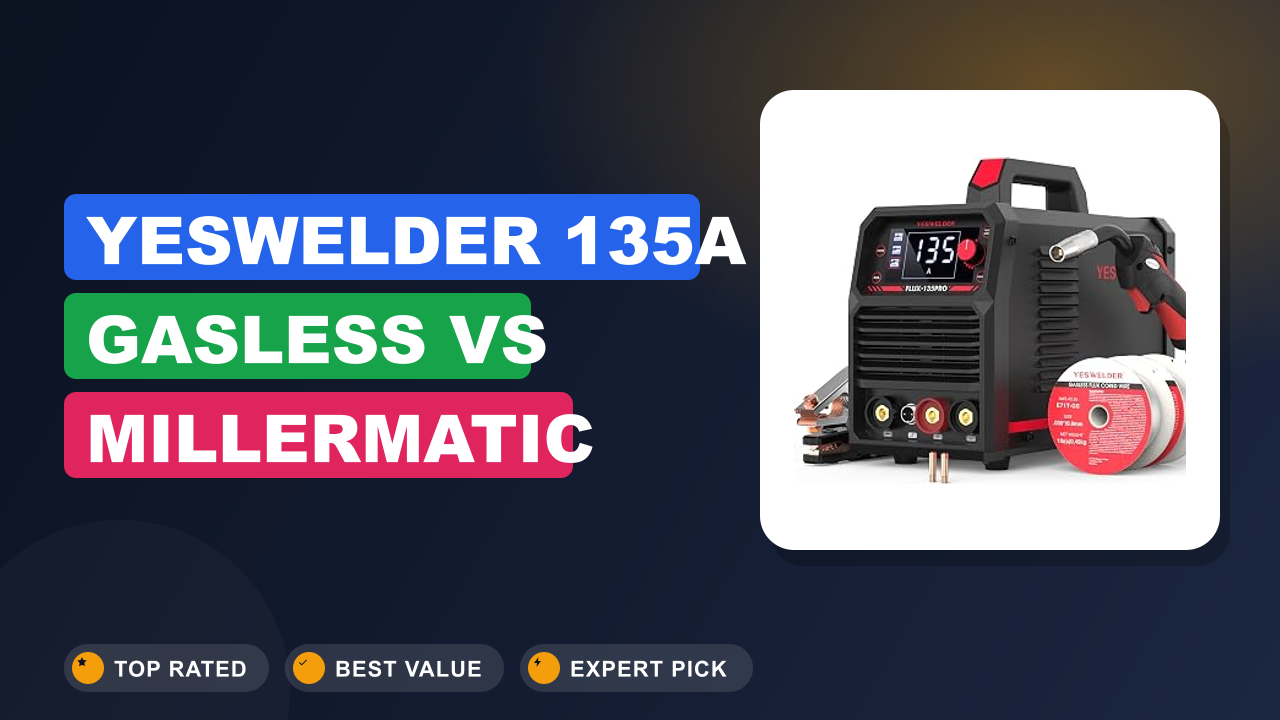
Shortlisting a first welder almost always comes down to the same question: how much machine do you actually need? If the YESWELDER 135A MIG Welder vs Millermatic® 211 PRO MIG Welder Machine matchup has ended up in your browser tabs, you're weighing a budget-friendly 110V flux-core box against a dual-voltage professional unit that costs several times more.
Our editorial team compared manufacturer datasheets, aggregate buyer reviews, and published spec sheets across both machines to work out where each one genuinely earns its keep. Short answer: the YESWELDER 135A MIG Welder wins for beginners, thin-gauge sheet, and garage repairs, while the Millermatic® 211 PRO MIG Welder Machine wins once you need 3/8-inch steel, aluminum capability, and dual-voltage headroom. Here's how they stack up.

Millermatic® 211 PRO MIG Welder Machine
| Product | Details | Rating | Buy |
|---|---|---|---|
Editor’s Choice  | YESWELDER 135A MIG Welder | ★★★★☆4.4/5 | |
Top Pick | Millermatic® 211 PRO MIG Welder Machine | ★★★★☆4.6/5 |
At a glance
These two welders were designed for completely different buyers, and the spec sheets make that obvious within about ten seconds.
The YESWELDER 135A MIG Welder is a 110V, 3-in-1 box aimed at the hobbyist who wants to start welding this weekend without rewiring a garage. Flux-core MIG, lift TIG, and stick all run from a standard household outlet, and synergic control handles the voltage and wire-speed math for you.
The Millermatic® 211 PRO MIG Welder Machine is a dual-voltage professional unit (120V and 240V) built for fabrication, farm repair, and shop work. It welds steel and aluminum up to 3/8 inch thick and ships with Auto-Set™ and Dyna-Pulse™.
Buyers cross-shopping this pair usually also glance at the Hobart Handler 140 and the Lincoln Electric POWER MIG 180, both of which sit between these two on price and capability.
| Spec | YESWELDER 135A MIG Welder | Millermatic® 211 PRO MIG Welder Machine |
|---|---|---|
| Price tier | Budget-friendly entry tier | Premium professional tier |
| Input voltage | 110V single phase | 120V / 240V dual voltage |
| Processes | Gasless flux-core MIG, lift TIG, stick (3-in-1) | MIG for steel and aluminum |
| Max output | 135A | 240V mode, 3/8-inch material capability |
| Shielding gas | None required (self-shielded wire) | Cylinder-fed MIG gas |
| Setup controls | Synergic control plus digital display | Auto-Set™ and Dyna-Pulse™ |
| Software | Fixed firmware | Upgradable software |
| Portability | Compact, carry-handle portable | Cart-friendly shop unit |
| Best for | Beginners, auto body, DIY repairs | Fabrication, farm, trailer and gate work |
YESWELDER 135A MIG Welder: strengths & weaknesses
1. YESWELDER 135A MIG Welder
Across hundreds of verified buyer reviews, the pattern that keeps repeating is simple: people buy this as their first welder and it works on day one. Our research focused on how it performs in real garages rather than on a spec sheet, and the honest answer is that it punches well above its tier for thin material.
Where it shines
- Three processes in one box. Flux-core MIG, lift TIG, and stick all run from the same 110V chassis, which means you can try the TIG side of the shop or the stick process without buying a second machine.
- Synergic control removes the guesswork. You dial in material thickness, and the unit sets voltage and wire feed speed to match. Beginners get a usable arc instead of a bird's nest on their first bead.
- Runs on a normal household outlet. No 240V circuit, no electrician, no landlord conversation. That alone decides the purchase for a lot of renters.
- Gasless wire keeps startup costs low. Self-shielded flux-core wire means no cylinder, no regulator, and no rental fee, which is why it suits typical MIG jobs around the house.
- The digital display is genuinely readable. Verified buyers repeatedly mention setting it in a dim garage without squinting at an analogue dial.
Where it falls short
- 135A is a ceiling, not a suggestion. Once you move past roughly 3/16-inch steel, penetration gets inconsistent and you'll want more amperage.
- Flux-core wire is messy. Spatter and smoke are part of the deal, and cleanup adds time on every project. If that bothers you, gas versus self-shielded wire is worth reading before you commit.
- Lift TIG only. There's no high-frequency start, so you touch the tungsten to the work to strike an arc, which is harder to learn on aluminium.
- Duty cycle tightens at max output. Long beads at full power mean waiting for the thermal protection to reset.
- Wire feed components are the common wear point. Buyer reports over 12 to 18 months of regular use frequently mention the liner and drive assembly needing attention first.
Millermatic® 211 PRO MIG Welder Machine: strengths & weaknesses
2. Millermatic® 211 PRO MIG Welder Machine
Miller's 211 PRO shows up in a different kind of review: the ones written by people who already own a welder. Aggregate owner feedback from farm shops, trailer builders, and small fabrication outfits points to one theme, and it's headroom. This machine does not run out of power on the jobs people actually bring it.
Where it shines
- Dual voltage is the headline feature. Run it on 120V for light sheet in a home garage, then plug into 240V and it becomes a completely different machine with far more usable output.
- Steel and aluminum to 3/8 inch. Manufacturer specifications list 3/8-inch capability, which covers trailer frames, gate posts, and farm repairs in one pass.
- Auto-Set™ takes the dial-twisting out of it. You enter wire diameter and material thickness, and the machine configures itself, which shortens the gap between a new owner and a clean bead.
- Dyna-Pulse™ changes how aluminum behaves. Pulsing the current helps control heat input, which is the single biggest headache in polarity setup for aluminum work.
- Upgradable software. Miller can push firmware updates rather than making you replace hardware, which matters over a 10-year ownership horizon.
Where it falls short
- You pay professional money for it. This sits in a completely different price bracket, and the gap is not small.
- Full output needs a 240V circuit. Without one, you're running it in the reduced 120V mode and leaving most of the capability on the table.
- It's a shop machine, not a carry machine. Plan on a cart, and plan on it staying put.
- You'll need a gas cylinder. That means shielding gas selection decisions, plus a regulator and refill costs, and the relevant guidance is in shielding gas selection.
- Overkill for thin sheet. If your whole world is 18-gauge auto body panels, you're paying for capability you'll rarely switch on.
Head-to-head
Price-to-performance
Per dollar of capability, the YESWELDER 135A MIG Welder is the more efficient purchase for anyone working under 3/16 inch. It costs a fraction of the Miller and still produces usable welds on brackets, exhaust patches, and garden furniture.
The Millermatic® 211 PRO justifies its tier only when you're regularly welding thick steel or aluminum. Every hour it saves you on a fabrication job is real value, but that value is conditional on you actually doing that work.
Buyers who weld twice a month on thin stock simply won't recover the difference. Buyers who weld twice a week on 1/4-inch plate will.
Power ceiling and material thickness
A 135A machine and a dual-voltage 211-class machine are not competing on the same field. The YESWELDER handles roughly 24-gauge sheet up to about 3/16-inch steel comfortably.
The Millermatic® 211 PRO reaches 3/8-inch steel and aluminum on 240V, which is structural territory. That's the difference between repairing a lawnmower deck and building a trailer.
Thickness dictates process, and process dictates machine. If you can't name the thickest thing you'll weld, buy the budget unit and upgrade later.
Ease of use and setup
Both machines are beginner-friendly, but they solve the problem differently. YESWELDER uses synergic control, so the machine picks settings based on thickness.
Miller uses Auto-Set™ plus Dyna-Pulse™, which adds an extra layer of arc control that pays off on aluminum and out-of-position work. It also assumes you have gas and a 240V option available.
Out of the box, the YESWELDER is running in about the time it takes to unspool wire. The Miller needs gas, a regulator, and a circuit decision first. Neither is difficult, but one has fewer prerequisites.
Long-term ownership and support
This is where the price gap starts making sense. Miller's service network, parts availability, and upgradable software give the 211 PRO a much longer useful life.
Owner reports on budget flux-core units commonly note consumable wear at the liner and drive rolls within 12 to 18 months of steady use. That's normal for the tier, and parts are cheap, but you will be tinkering.
Neither machine is disposable. One simply asks less of you over a decade.
Which one should you buy?
Pick YESWELDER 135A MIG Welder if you…
You're new to welding, you rent, or your projects live under 3/16 inch. Auto body patches, exhaust work, garden brackets, and small repairs are exactly what this machine was built for.
If you don't want to rent a gas cylinder or run a 240V line, the gasless flux-core setup removes both obstacles. It's also the smarter first purchase if you're not certain welding will stick as a hobby.
For more on what MIG actually does before you commit, how the process actually works is a solid starting point.
Pick Millermatic® 211 PRO MIG Welder Machine if you…
You already weld, you have 240V access, and your work involves thick steel, aluminum, or structural repairs. Farm, trailer, and small fabrication shops are the natural home for this unit.
The dual-voltage design also makes it a sensible one-machine answer for someone who splits time between a home garage and a proper shop.
If downtime costs you money, the support network alone can justify the premium tier.
Better alternatives
The Hobart Handler 140 sits between these two on price and runs 120V with gas capability, which suits buyers who want solid wire without a 240V circuit. The Lincoln Electric POWER MIG 180 is another mid-tier option worth comparing if you want more headroom than a 135A box but aren't ready for professional pricing.
| First welder, budget-conscious, garage only | YESWELDER 135A MIG Welder |
| Thin sheet, auto body, exhaust patching | YESWELDER 135A MIG Welder |
| Trailer, gate, and 1/4-inch-plus steel work | Millermatic® 211 PRO MIG Welder Machine |
| Aluminum fabrication with spool gun or push-pull | Millermatic® 211 PRO MIG Welder Machine |
| No 240V access and no plans to add it | YESWELDER 135A MIG Welder |
Frequently Asked Questions (FAQ)
Is the YESWELDER 135A enough, or should I spend more for the Miller?
Answer first: for thin sheet and hobby work, 135A is genuinely enough, and most buyers never hit its ceiling. The Miller becomes necessary once your material passes roughly 3/16 inch, or once you need aluminum and dual-voltage flexibility. Spend more only when you can name the job that demands it.
A 240V circuit is usually the real deciding factor, not the welder itself.
How big is the real-world performance gap between them?
On 1/8-inch steel, the gap is modest and mostly about arc stability and duty cycle, not whether the weld holds. Above 1/4 inch, the gap becomes substantial. The Millermatic® 211 PRO delivers the amperage for full penetration in a single pass where the 135A unit needs bevelling, multiple passes, or simply can't keep up.
Different tools for different thickness ranges.
Does the Millermatic® 211 PRO work on a standard 120V outlet?
Yes. It's a dual-voltage machine rated for both 120V and 240V, so it will run in a normal garage. The catch is output.
On 120V you're in a reduced power mode, and you won't reach the 3/8-inch capability Miller lists. Budget for a 240V circuit if you want the full machine.
Can either machine weld aluminum?
The Millermatic® 211 PRO can, with the right spool gun or push-pull setup, and Miller lists aluminum capability to 3/8 inch. The YESWELDER 135A is a flux-core and stick machine first. Its lift TIG mode makes aluminum technically possible but difficult, since there's no high-frequency start.
If aluminum is a priority, look at a dedicated spool gun approach and plan for a more capable power source.
Which one ages better long-term?
The Millermatic® 211 PRO, without much debate. Upgradable software, industrial-grade components, and Miller's parts and service network mean it can stay in rotation for a decade or more. The budget unit will still work, but expect to replace liners and drive components periodically.
Consumables are inexpensive, so total cost of ownership stays low.
Do I need shielding gas for either welder?
The YESWELDER 135A runs gasless flux-core wire out of the box, so no cylinder is required to start welding. The Millermatic® 211 PRO is a gas MIG machine, so you'll need a cylinder, regulator, and refills. If avoiding cylinder rental matters to you, that single difference often settles the decision.
Final verdict
Both machines earn their rating, and neither is a compromise pick within its own tier.
YESWELDER 135A MIG Welder: 4.4/5. A genuinely capable first welder that removes nearly every barrier to entry: no 240V, no gas cylinder, no complicated setup. It loses points for a hard 135A ceiling and consumables that wear sooner than a pro unit's. Best for beginners and anyone welding under 3/16 inch.
Millermatic® 211 PRO MIG Welder Machine: 4.6/5. Dual voltage, 3/8-inch capability, Auto-Set™, Dyna-Pulse™, and upgradable software make it the last welder most people would need to buy. It loses points purely on cost and the 240V prerequisite. Best for experienced welders and shop work.
Buy the YESWELDER if you're starting out and working thin. Buy the Miller if you know you'll be welding thick steel or aluminum for years.
Affiliate disclosure: This post contains affiliate links. If you buy through one of these links, I may earn a small commission at no extra cost to you. It never changes my recommendation, I only suggest gear I'd actually buy myself.
🛒 Check Latest Price on Amazon
🛒 Check Latest Price on Amazon Welding safety guidance from the Occupational Safety and Health Administration is worth reviewing before you strike your first arc on either machine.
