

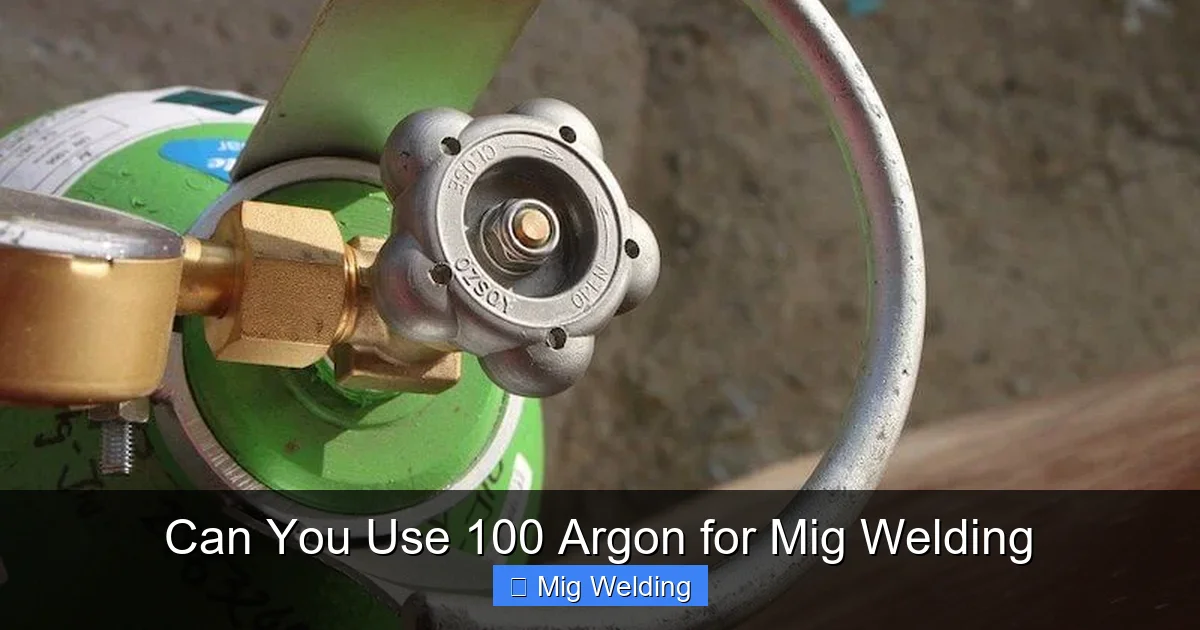
Using 100% argon for MIG welding is possible but not ideal for most steel applications. While it works well for aluminum and non-ferrous metals, pure argon can cause poor arc stability and lack of penetration when welding steel. This guide explains when and how to use pure argon effectively, along with safer gas mix alternatives.
Key Takeaways
- 100% argon is not recommended for welding mild steel because it lacks the reactivity needed for a stable arc and deep penetration.
- Pure argon works best for MIG welding aluminum and non-ferrous metals, where its inert properties prevent oxidation and contamination.
- Using 100% argon on steel can lead to a “lazy” arc, poor fusion, and excessive spatter due to insufficient ionization and heat transfer.
- For steel, a 75% argon / 25% CO₂ mix (C25) is the industry standard because it balances arc stability, penetration, and clean welds.
- Always match your shielding gas to the base metal and welding process to ensure strong, high-quality welds.
- Adjust your welding machine settings when switching to pure argon, including voltage, wire feed speed, and contact tip size.
- Proper technique and joint preparation are critical when using pure argon, especially on thicker materials or critical joints.
Can You Use 100 Argon for MIG Welding? A Complete Guide
If you’re new to MIG welding or experimenting with different shielding gases, you might be wondering: *Can you use 100% argon for MIG welding?* The short answer is yes — but with important caveats. While pure argon is a common shielding gas, it’s not suitable for every material or welding situation. In this guide, we’ll walk you through everything you need to know about using 100% argon in MIG welding, including when it works, when it doesn’t, and how to do it safely and effectively.
Whether you’re welding aluminum, stainless steel, or mild steel, choosing the right shielding gas is just as important as selecting the correct wire and machine settings. This guide will help you understand the science behind shielding gases, the role of argon in welding, and how to get the best results — no matter what you’re working on.
What Is Argon and Why Is It Used in Welding?
Argon is an inert (non-reactive) noble gas that’s widely used in welding because it doesn’t react with molten metal. In MIG (Metal Inert Gas) welding, a continuous wire electrode is fed through the welding gun into the weld pool, and a shielding gas protects the weld from contamination by oxygen, nitrogen, and moisture in the air.
Pure argon is especially useful because it creates a clean, stable environment for the arc to form. It’s commonly used in TIG welding and is a key component in many MIG gas mixtures. However, when used alone in MIG welding, its behavior changes depending on the metal being welded.
Properties of Pure Argon
- Inert nature: Doesn’t react with metals, preventing oxidation.
- Low thermal conductivity: Helps maintain arc stability at lower voltages.
- Smooth arc initiation: Great for starting arcs on aluminum and thin materials.
- Poor ionization compared to CO₂: Can lead to a less focused arc on ferrous metals.
When Can You Use 100% Argon for MIG Welding?
The short answer: Yes, you can use 100% argon for MIG welding — but only under specific conditions. It’s not a one-size-fits-all solution. Let’s break down the scenarios where pure argon works and where it falls short.
Best Applications for 100% Argon
1. Aluminum Welding
Pure argon is the go-to shielding gas for MIG welding aluminum. Aluminum oxidizes quickly when exposed to air, and argon’s inert properties prevent this reaction. It also helps create a smooth, stable arc that’s essential for welding soft, reflective metals like aluminum.
2. Non-Ferrous Metals
Metals like magnesium, copper, and titanium also benefit from pure argon shielding. These materials are highly reactive and require an inert environment to avoid contamination and porosity.
3. Thin Materials and Short-Circuit Transfer
When welding thin aluminum or doing short-circuit MIG (also called “dip transfer”), pure argon helps prevent burn-through and allows for better control at lower heat inputs.
When NOT to Use 100% Argon
1. Mild Steel (Carbon Steel)
This is where pure argon runs into trouble. Mild steel requires a more reactive gas mixture to achieve proper arc characteristics and penetration. Using 100% argon on steel often results in:
- A “lazy” or wandering arc
- Poor fusion and lack of penetration
- Excessive spatter
- Difficulty maintaining a consistent weld pool
The reason? Argon doesn’t ionize as easily as CO₂, so the arc doesn’t transfer heat as efficiently into the steel. This leads to a shallow, uneven weld.
2. Spray Transfer Mode
Spray transfer requires high voltage and a stable, focused arc — something pure argon struggles to provide on steel. You’ll get better results with a tri-mix (argon + CO₂ + oxygen) or C25 gas.
How to Use 100% Argon for MIG Welding (Step-by-Step)
If you’ve determined that pure argon is right for your project — say, you’re welding aluminum — here’s how to set up and execute a successful weld.
Step 1: Confirm Your Base Metal
Before you even turn on your welder, make sure you’re working with aluminum or another non-ferrous metal. If you’re welding steel, switch to a 75/25 argon/CO₂ mix instead.
Step 2: Choose the Right Wire
For aluminum, use an aluminum MIG wire such as ER4043 or ER5356. These wires are designed to work with pure argon and provide good flow and strength. Never use steel wire with pure argon — it won’t weld properly.
Step 3: Set Up Your MIG Welder
Adjust your machine settings to match the material and wire:
- Voltage: Start in the 18–22V range for thin aluminum, 22–26V for thicker sections.
- Wire Feed Speed (WFS): Typically 200–400 inches per minute (IPM), depending on thickness.
- Contact Tip: Use a U-groove or knurled drive roll for aluminum wire to prevent shaving.
- Gas Flow Rate: Set your regulator to 20–25 cubic feet per hour (CFH).
Step 4: Prepare the Joint
Aluminum oxidizes quickly, so clean the surface thoroughly before welding:
- Use a stainless steel brush (dedicated to aluminum only) to remove the oxide layer.
- Wipe with acetone or a degreaser to remove oils and dirt.
- Fit-up should be tight — gaps can lead to lack of fusion.
Step 5: Weld with Proper Technique
- Hold the gun at a 10–15 degree push angle.
- Maintain a short arc length (about 1/4 inch).
- Use a steady, consistent travel speed.
- Avoid excessive weaving — a straight bead usually works best.
Step 6: Post-Weld Inspection
Check your weld for:
- Porosity (small holes in the weld)
- Lack of fusion
- Cracking or discoloration
If you see issues, adjust your technique or gas flow.
Troubleshooting Common Issues with 100% Argon
Even with the right setup, problems can arise. Here’s how to fix the most common issues when using pure argon.
Problem: Wandering or Unstable Arc
Cause: Pure argon has lower ionization potential, especially on steel. On aluminum, it can still happen if voltage is too low or the surface isn’t clean.
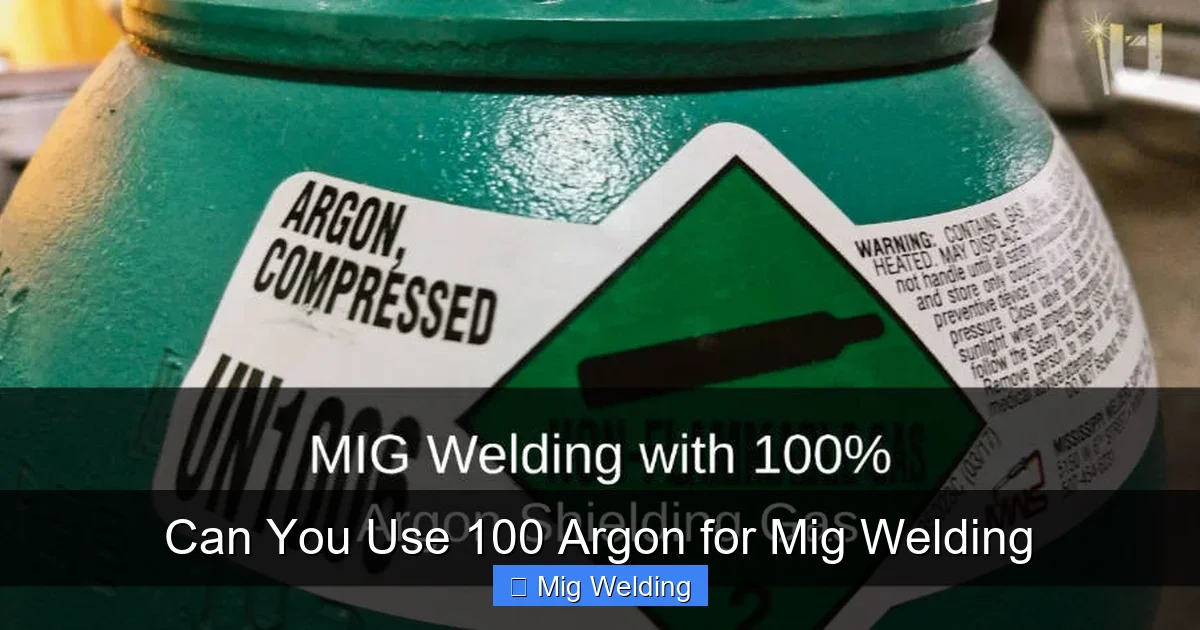
Visual guide about Can You Use 100 Argon for Mig Welding
Image source: welditu.com
Visual guide about Can You Use 100 Argon for Mig Welding
Image source: weldingtroop.com

Visual guide about Can You Use 100 Argon for Mig Welding
Image source: weldguru.com
Solution: Increase voltage slightly, clean the base metal thoroughly, and ensure proper grounding.
Problem: Lack of Penetration
Cause: Argon doesn’t transfer heat as efficiently as CO₂-based mixes, leading to shallow welds.
Solution: Increase voltage and wire feed speed. For thicker materials, consider a pulsed MIG setup or switch to a tri-mix gas.
Problem: Excessive Spatter
Cause: Incorrect voltage/WFS balance or contaminated base metal.
Solution: Fine-tune your settings. A slight increase in voltage or decrease in WFS can help. Also, recheck cleanliness.
Problem: Porosity in the Weld
Cause: Moisture, oil, or inadequate gas coverage.
Solution: Clean the metal, check for leaks in your gas line, and ensure proper gas flow. Use a gas lens or longer nozzle if needed.
Alternatives to 100% Argon for MIG Welding
While pure argon has its place, most MIG welders use gas mixtures for better performance. Here are the most common alternatives:
75% Argon / 25% CO₂ (C25)
The most popular mix for mild steel. CO₂ increases arc stability and penetration while argon keeps spatter low and improves arc initiation.
90% Argon / 10% CO₂
A milder mix for thinner steel or when you want less spatter and a smoother arc.
Tri-Mix (90% Argon / 7.5% Helium / 2.5% CO₂)
Used for stainless steel and aluminum, especially in spray transfer mode. Helium increases heat input for better penetration.
100% CO₂
Cheaper than argon mixes and offers deep penetration, but produces more spatter and a rougher arc. Often used in industrial settings.
Safety Tips When Using Pure Argon
Argon is non-toxic, but it can displace oxygen in confined spaces, leading to asphyxiation. Always:
- Weld in a well-ventilated area.
- Use an exhaust system if working indoors.
- Never weld in a sealed or poorly ventilated room.
- Wear proper PPE: welding helmet, gloves, and flame-resistant clothing.
Also, store argon cylinders upright and secure them to prevent tipping.
Conclusion: Should You Use 100% Argon for MIG Welding?
So, can you use 100% argon for MIG welding? Yes — but only for the right materials. It’s excellent for aluminum and non-ferrous metals, where its inert properties prevent oxidation and support a clean, stable arc. However, for mild steel and most ferrous applications, pure argon is not recommended due to poor arc characteristics and lack of penetration.
If you’re welding steel, stick with a 75/25 argon/CO₂ mix. If you’re working with aluminum, pure argon is your best friend — just make sure your machine settings, wire, and technique are dialed in.
By matching your shielding gas to your material and process, you’ll achieve stronger, cleaner, and more reliable welds every time. Remember: the right gas isn’t just about protection — it’s about performance.
