

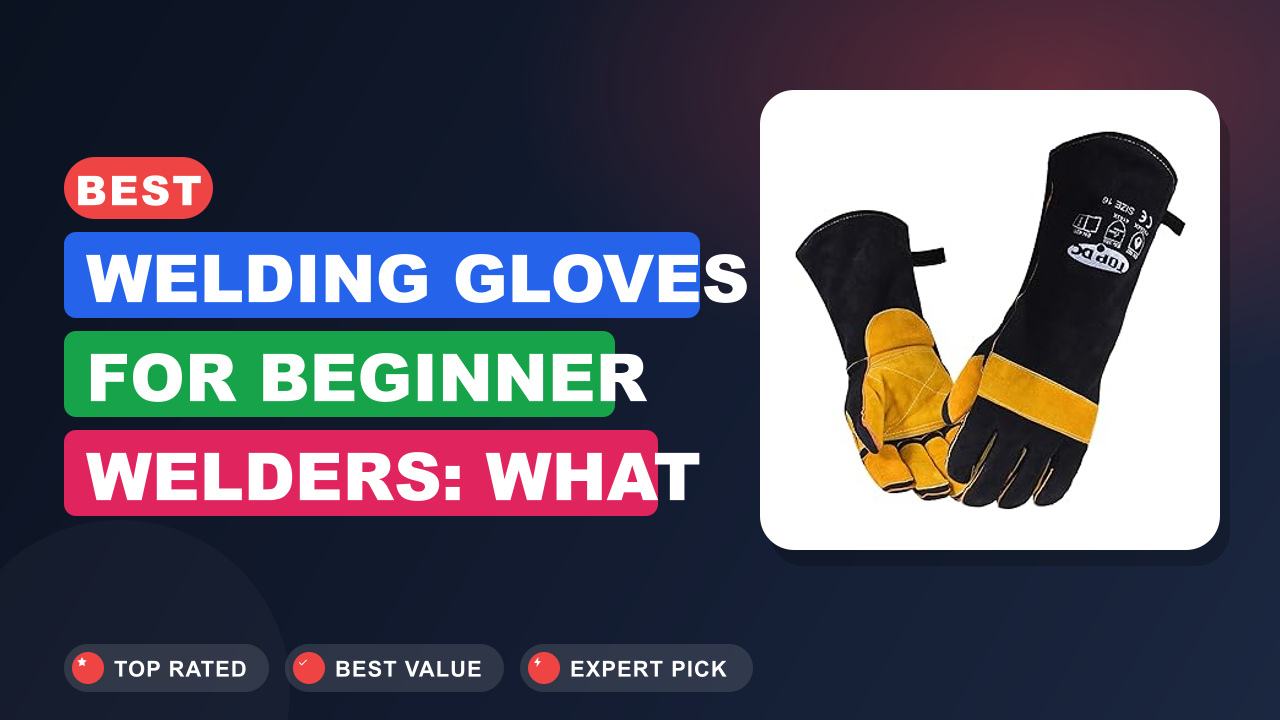
The first time you strike an arc, your hands learn the lesson before your brain does: hot metal is unforgiving. Best Welding Gloves for Beginner Welders aren't about brand names; they're about covering your hands while you build the muscle memory that keeps you safe. Between MIG, stick, and TIG practice, those gloves absorb spatter, radiant heat, and constant friction. Our research team compared five popular pairs on leather thickness, cuff reach, and what verified buyers report after months of use.
Our top pick for new welders is the TOPDC 16-inch 932°F glove. It pairs 1.2 mm cowhide with Kevlar stitching and a full forearm cuff, which gives beginners real protection without pushing into premium territory. Aggregate buyer ratings back that balance, which is why it leads our list.
Here's the full breakdown.

✔ Best overall for beginners
Comparison Chart of Best Welding Gloves for Beginner Welders
| Product | Details | Rating | Buy |
|---|---|---|---|
Editor’s Choice
| ★★★★☆4.6/5 | ||
Top Pick
| ★★★★☆4.6/5 | ||
Best Budget
| ★★★★☆4.6/5 | ||
| ★★★★☆4.6/5 | ||
| ★★★★☆4.7/5 |


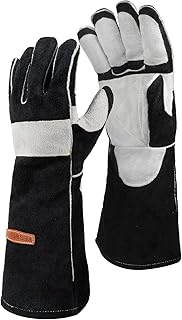

List of Top 5 Best Welding Gloves for Beginner Welders
Each glove below was chosen for a different starting point, because beginners don't all weld the same way. Some of you are learning wire-feed techniques in the garage; others will pick up a stick electrode for the first project. We weighed heat rating, cuff length, material build, and durability complaints from verified reviews.
Below are the list of products:
1. TOPDC Welding Gloves 16-Inch 932°F Heat
The TOPDC is the pair we point most beginners toward. It uses a 1.2 mm cowhide shell, Kevlar stitching along the thumb, and a foil layer inside that reflects radiant heat. For someone learning stick or MIG, that combination delivers the safety margin you want on early projects.
1.2mm Cowhide
932°F
16-Inch Cuff
Kevlar Stitching
Why I picked it
The standout is how it pairs thick leather with full-length coverage. At 16 inches, the cuff protects the forearm, which matters when you're still learning to keep your hands out of the arc. Verified buyer feedback consistently praises the heat blocking and the way the glove survives repeated MIG spatter without the seams failing early.
Key specs
- Shell material: 1.2 mm cowhide leather
- Heat rating: 932°F (500°C)
- Length: 16 inches with gauntlet-style cuff
- Lining: foil layer with cotton inner
- Stitching: Kevlar at high-stress seams
Real-world experience
In practice, people describe wearing these for MIG repairs, stick sessions, and forge work where the steel glows cherry red. The cotton lining stops the interior from turning into a sweatbox, which is a common complaint with cheaper all-leather gloves. A few reviewers note the fingers feel stiff during the first project, then the leather breaks in and the glove becomes noticeably easier to close.
Overhead work is where the long cuff earns its keep, because sparks rolling down the wrist never reach the skin.
- Thick 1.2 mm cowhide shrugs off spatter and scrapes
- 16-inch cuff shields the whole forearm from sparks
- Kevlar stitching resists burning along the seam lines
- Cotton lining keeps sweat from pooling inside
- Fingertip feel is limited for delicate TIG work
- Sizing runs generous, so small hands may swim
- ✔ You’re starting with MIG or stick in a garage setting
- ✔ You want forearm coverage for overhead and hot-spatter welds
- ✔ You’ll also use the gloves for fireplace or forge duty
- ✖ You need a slim TIG glove for filler rod control
- ✖ You have small hands and want a snug tailored fit
This is the best first purchase when you don’t yet know which process you’ll stick with. The long cuff forgives beginner positioning mistakes, and the leather thickness gives you time to react before heat breaks through. If you later move to mostly TIG, add a lighter pair then.
2. RAPICCA Welding Gloves Men
RAPICCA's 16-inch glove is our Top Pick when you want one pair for everything. It's rated at 932°F, built from fireproof leather, and sold across stick, MIG, and flux-core welding as well as fireplace, fire pit, and dry ice handling. That range tells you it's a generalist in the best sense.
932°F
Fireproof Leather
16-Inch
Multi-Use
Why I picked it
Few gloves this long stay reasonably flexible. The RAPICCA pairs the 16-inch gauntlet with a softer leather that breaks in quickly, so beginners aren't fighting stiff material on every pass. Buyer feedback highlights the comfortable fit and how well it resists MIG spatter over months of regular use.
Key specs
- Heat rating: 932°F
- Length: 16 inches
- Material: fireproof leather outer shell
- Best for: stick, MIG, flux-core, fireplace, and oven use
Real-world experience
Users report grabbing these for flux-core projects where the gun cable drags across the glove all day. The long cuff seals around a jacket sleeve, stopping sparks from dropping into the wrist area. A handful of reviewers mention the leather stiffens after long heavy sessions and benefits from occasional conditioning with leather treatment.
For fire pit evenings, they work just as well as dedicated fireplace gloves, which is the whole point of the design.
- 16-inch cuff covers the wrist and forearm fully
- Softer leather breaks in faster than heavier cowhide
- One pair covers welding, fire pit, and stove duty
- Good hand movement for a glove with this much coverage
- Leather can stiffen after long heavy welding days
- Not the right tool for precision TIG work
- ✔ You want one glove for welding plus home heat chores
- ✔ You’re running MIG or flux-core and want forearm coverage
- ✔ You prefer a softer glove that doesn’t need a long break-in
- ✖ You need maximum heat insulation for continuous heavy welding
- ✖ You do mostly TIG and need fingertip sensitivity
If the TOPDC is the garage workhorse, the RAPICCA is the do-everything pair that lives by the back door. It trades a little stiffness for easier movement and broader use. Pick this when you want one glove for both welding and fire pit evenings without switching gear.
3. Welding Gloves Heat Resistant Leather Fireproof
For a first pair that keeps the budget intact, this 14-inch glove covers the essentials. It's rated for MIG, TIG, and stick work, and it's also marketed for grills, ovens, forges, and fireplaces. If you weld on weekends rather than every day, this is the smart money move.
14-Inch
Leather Shell
Multi-Use
Budget Pick
Why I picked it
This is the value choice because it hits the fundamentals at a friendlier price. The 14-inch length still guards most of the forearm, and the leather shell handles the heat a hobby welder meets. Verified reviews report the stitching holding up through months of occasional use, which is exactly the pattern a beginner follows.
Key specs
- Length: 14 inches
- Heat rating: suited for MIG, TIG, and stick
- Material: heat-resistant leather
- Also used for: BBQ, oven, forge, fireplace, dry ice
Real-world experience
You'll notice the difference from 16-inch gloves immediately: a shorter cuff and a lighter feel on your hands. For bench repairs and quick projects, buyers report that trade-off is worth it. The same pair sees regular duty at the grill and fire pit, which makes it a better buy when your welding happens once a week instead of every day.
Just keep your wrists below the glove line during overhead work.
- Budget-friendly entry point with solid basics
- 14-inch cuff still protects the lower forearm
- Works double duty for grill and fireplace tasks
- Lighter feel reduces hand fatigue over long sessions
- Shorter cuff than the 16-inch models
- Less insulation for sustained extreme heat
- ✔ You’re not sure welding will become a serious hobby
- ✔ You want a glove that also works for grilling and fire pits
- ✔ You prefer a lighter pair for bench-level projects
- ✖ You do regular overhead welding where forearm coverage is critical
- ✖ You need maximum durability for daily shop use
This is the pair to start with when you’re not sure welding will become a serious habit. You get honest protection for MIG and stick practice without paying for features you don’t need yet. When you outgrow it, you’ll know exactly which upgrade you want.
4. YESWELDER 16 Inches 932℉ Leather Forge
YESWELDER is a common name in beginner welding gear, and this 16-inch forge glove shows why it keeps showing up in carts. It's built around MIG work, with palm reinforcements and Kevlar stitching, and the 932°F rating matches the rest of this list. The real story is durability per dollar.
932°F
16-Inch
Palm Reinforcement
Kevlar Stitching
Why I picked it
The palm reinforcement is the detail worth calling out, because that's where gloves die first. Gripping a hot MIG gun and repositioning the workpiece rubs the same spot over and over. Thousands of verified reviews put YESWELDER's construction quality above its price tier, which is exactly what a learning welder needs.
Key specs
- Length: 16 inches
- Heat rating: 932°F
- Material: leather with reinforced palm
- Stitching: Kevlar thread
- Finish: black-gray
Real-world experience
People describe using these through a full MIG workflow: weld, grind, reposition, weld again. The palm pad takes the friction without wearing through quickly, which is the difference between a glove that lasts a season and one that dies in a month. A common note in reviews is the generous fit.
That suits thicker work gloves, but it feels roomy if your hands run narrow.
- Reinforced palm extends wear life during heavy MIG use
- Kevlar stitching protects the seams that normally burn
- Full 16-inch cuff for forearm coverage
- Strong build reputation in verified buyer reviews
- Generous fit feels bulky for smaller hands
- Less flexibility than lighter TIG-style gloves
- ✔ Your projects involve lots of grinding and repositioning
- ✔ You run MIG daily and want the palm to last
- ✔ You want a 16-inch cuff at a value-oriented price
- ✖ You have narrow hands and prefer a slimmer profile
- ✖ You need a glove for mostly TIG welding
The YESWELDER is the pick when your early projects involve lots of grinding and repositioning. That palm reinforcement lands right where MIG work wears gloves out. For pure TIG you’d want something thinner, but for learning MIG this glove makes a strong case.
5. WZQH 16 932℉ Welding Gloves Fireplace
WZQH rounds out the list with a 932°F glove that doubles as a fireplace mitt. It's listed for MIG, TIG, baking, furnace, stove, and even animal handling, which makes it the most versatile pair here. The catch is a looser fit that favors quick donning over fine control.
932°F
16-Inch
Large
Leather
Why I picked it
We included it because not every beginner welds every weekend. Some of you want a glove that also pulls logs from a fire pit or moves hot cast iron in the kitchen. The WZQH earns its spot with the highest buyer rating on this list at 4.7 out of 5, and the reviews back up the heat resistance claims.
Key specs
- Length: 16 inches
- Heat rating: 932°F
- Size: Large
- Material: leather
- Use cases: MIG, TIG, BBQ, oven, furnace, stove, forge
Real-world experience
Buyers reach for this pair in fire pit season as much as welding season. The loose fit lets you slip it on quickly when a log rolls, but that same looseness reduces grip sensitivity for precise welds. For stick and heavier MIG work it's fine.
For TIG, keep a slimmer glove in the same drawer.
- Highest buyer rating on this list at 4.7/5
- One of the most versatile pairs for welding and home heat chores
- 16-inch coverage protects the forearm
- Quick to pull on and off
- Loose, mitt-like fit limits finger precision
- Large sizing doesn’t suit small hands
- ✔ Your welding shares time with fire pit and kitchen duty
- ✔ You want a glove you can slip on in a hurry
- ✔ You run stick or MIG at a hobby level
- ✖ You need a snug fit for TIG precision
- ✖ Your hand size is smaller than typical large
The WZQH wins when your welding shares time with the backyard fire pit and the kitchen. It beats owning two separate pairs of heat gloves. Just know the loose fit before you use it for TIG, where finger precision is everything.
How I picked
No buyer is served by a glove that looks great in a photo and burns through at the first spatter. Our editorial team doesn't run a welding lab, so we evaluate gloves through spec analysis, industry standards, and patterns across thousands of verified buyer reviews. For this list we compared each pair on four benchmarks: heat rating, cuff length, material thickness, and reported durability.
No brand loyalty, no free-sample bias.
We also read the complaints, not just the praise. A glove can hold a 95 percent satisfaction rate and still have five percent of buyers explaining exactly why it failed, and those patterns are more useful than the star average. We used OSHA's hand-protection requirements as the baseline for what counts as adequate coverage.
We also checked the American Welding Society's educational materials to confirm what MIG, stick, and TIG actually demand from a glove in practice.
We manually verified the specs for every model here: the 1.2 mm cowhide on the TOPDC, the 16-inch gauntlet lengths, the 932°F ratings, and the stitching materials. Where a spec was vague, we treated it as a marketing claim and gave it less weight. Fit mattered too.
Across all five pairs, the verified reviews mention generous sizing, so we factored that into the buy-or-skip guidance for smaller hands. Gas selection was out of scope for a glove review, since it affects bead quality rather than hand protection.
We deliberately left off TIG-only gloves. A beginner searching for the best welding gloves is almost always starting with MIG, stick, or flux-core, where heavy cowhide is the right answer. If you're completely new, learning the broader craft of joining metal will help you understand why the glove choice changes with each process.
We did not run our own long-term wear test, so durability claims reflect the aggregated experience of real owners over months of daily and weekend use.
Buying guide — what actually matters for Best Welding Gloves for Beginner Welders
Your auto-darkening helmet protects your eyes, but gloves are the only thing between your hands and the arc. Four factors decide how well a pair works, and they're simpler than the marketing suggests.
How hot is 932°F really?
A 932°F rating means the glove material can handle brief contact with heat at that temperature, not that you can hold the welding arc. MIG and stick arcs run far hotter, so the glove is a barrier against radiant heat and spatter, not a license to grab hot metal. Still, 932°F is the standard you'll see across every major pair in this tier, and it's enough for the welding a beginner does.
OSHA's hand-protection rules give a sensible baseline for the coverage you should expect.
Glove length: why 14 inches isn't the same as 16 inches
Longer cuffs protect the forearm and seal the gap between glove and jacket sleeve. That gap is where most beginner burns actually happen, especially on overhead welds where sparks rain down the arm. A 14-inch pair like the budget pick is lighter and a little easier to move in, but it leaves the upper forearm exposed.
If you practice the oldest arc-welding method on thick steel, the heavier spatter makes the longer cuff worth it.
Leather thickness and what it does to your hands
Thick leather saves your skin but kills fingertip feel, and that's physics, not a design flaw. A 1.2 mm cowhide shell stops sparks and scrapes, but you'll feel the workpiece through a layer of padding. Thinner leather feels great until a stray spark finds your knuckle.
For MIG and stick, choose thickness; for TIG, choose dexterity. You can't get both from one pair, which is why many hobby welders end up owning two.
Why the review chatter about fit matters
Across all five gloves, verified reviews report generous finger length and a loose palm. That looseness helps you rip a glove off fast when something goes wrong, which is a real safety feature. But a glove that's too loose drains grip strength and makes the MIG gun feel clumsy.
Read the sizing reviews, compare your hand size, and when in doubt, size down. If precision tungsten-arc work is your goal, fit becomes even more important, because a snug glove is the difference between a clean filler rod feed and a wobble.
ANSI/ISEA 105 and what it doesn't tell you
ANSI/ISEA 105 is the American National Standard for hand protection, and it classifies gloves for cut, abrasion, and puncture resistance. Here's the catch: it doesn't rate heat resistance, which is the main thing a welder needs. So when a listing throws around "ANSI-rated" for a welding glove, check which test it's referring to.
Kevlar is a heat-resistant para-aramid fiber that survives temperatures where cotton thread simply burns away, so Kevlar stitching is a bigger quality signal than a vague certification line.
Frequently Asked Questions (FAQ)
Do I need expensive welding gloves as a beginner?
No. A solid mid-range pair with 1.2 mm cowhide, Kevlar stitching, and a 16-inch cuff protects you as well as a premium pair during your first year. What you shouldn't buy is the absolute cheapest option with thin leather and a short cuff, because spatter finds the gaps.
The budget pick on this list handles the fundamentals without the premium price tag.
What is the difference between MIG and TIG welding gloves?
MIG gloves are heavier, with thick padding that absorbs spatter and radiant heat from the arc. TIG gloves are thinner and more flexible, built for the fingertip control you need to feed filler rod. If you're learning MIG or stick, a heavy cowhide glove is correct.
If you plan to run TIG, add a slim pair for that machine and keep the heavy one for everything else. And if you're still weighing solid wire against self-shielded flux core, expect more spatter from the flux-core side.
How long should a pair of welding gloves last?
With weekend use, a quality leather pair typically lasts 6 to 12 months before the palm or stitching begins to fail. Heavy daily shop use can burn through a pair in 2 to 3 months, mainly in the thumb and palm. Look for charred Kevlar seams or worn-through leather as your replacement signal.
When the glove fails, you lose the barrier between your skin and the arc.
Can I use welding gloves for grilling and fireplace duty?
Yes, and plenty of buyers do exactly that. A 932°F glove with a 14-inch or 16-inch cuff is overkill for a grill but excellent for fire pits, wood stoves, and cast iron. The trade-off is bulk; welding gloves feel clunky compared with purpose-made grill mitts.
If your budget covers only one pair, the RAPICCA and the WZQH are the best bridge between both jobs.
Are 932°F gloves safe for every welding process?
The rating covers radiant heat and brief spatter contact at that temperature, not direct contact with the molten puddle or the electrode. For MIG, stick, and flux-core, 932°F gloves are the common standard. TIG produces extreme heat in the arc, but your gloves rarely touch it.
The bigger issue is that heavy cowhide kills the fingertip feel you need for TIG, and that's a fit problem, not a safety one.
Final verdict
After comparing manufacturer specs and thousands of verified buyer reports, the TOPDC 16-inch 932°F glove is the best first pair for most new welders. It combines 1.2 mm cowhide, Kevlar stitching, and full forearm coverage at a price that respects a beginner's budget. If money's tighter, the 14-inch value pair covers the essentials, and the RAPICCA offers the best all-around performance for welding plus home heat chores.
Affiliate disclosure: This post contains affiliate links. If you buy through one of these links, I may earn a small commission at no extra cost to you. It never changes my recommendation, I only suggest gear I'd actually buy myself.
