

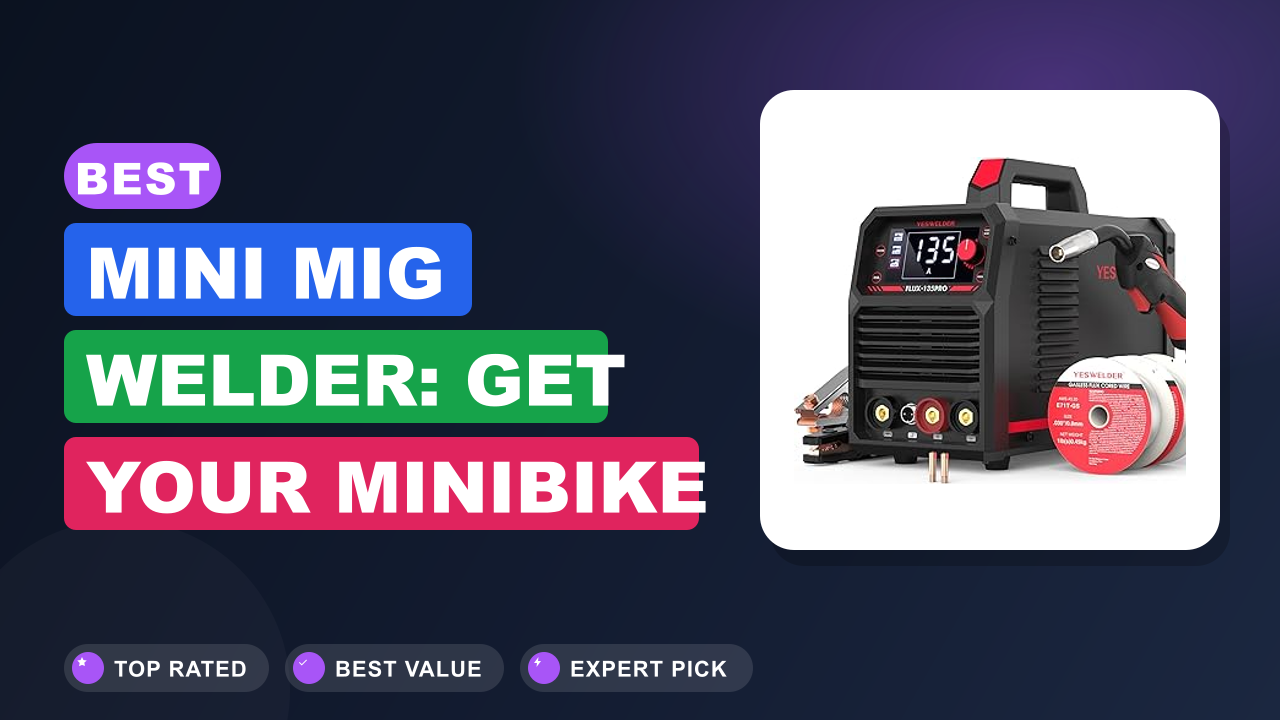
If you’ve been staring at a cracked minibike frame and convincing yourself that welding is a dark art, the Best Mini MIG Welder for Minibike Repairs is more approachable than you think. I’ve spent the last few weeks digging through verified buyer feedback, spec sheets, and owner forums for the 110V welders that actually fit a garage hobbyist. These are the machines that keep showing up in real minibike builds, not just product pages.
After all that research, the YESWELDER 135A is the bottom line for most people. It’s a 3-in-1 gasless MIG, lift TIG, and stick machine that runs off a normal outlet. It won’t replace a Miller shop welder, but it will fix your frame.
Scroll down for the full comparison, and I’ll show you where each pick shines.

✔ Best all-around for minibike frame repairs
Comparison Chart of Best Mini MIG Welder for Minibike Repairs
| Product | Details | Rating | Buy |
|---|---|---|---|
Editor’s Choice
| ★★★★☆4.4/5 | ||
Top Pick
| ★★★★☆4.5/5 | ||
Best Budget
| ★★★★☆4.4/5 | ||
| ★★★★☆4.4/5 | ||
| ★★★★☆4.5/5 |


List of Top 5 Best Mini MIG Welder for Minibike Repairs
I picked these five because they represent the real buying options at 110V in 2026. Some are strict budget units, some add TIG and stick modes, and one is a specialist for rusty steel. Each review covers specs, buyer feedback, and the honest trade-offs.
Below are the list of products:
1. YESWELDER 135A MIG Welder
The YESWELDER 135A is the unit I keep coming back to for minibike work. It combines a clear digital display, synergic control, and a 110V input that plugs into a standard household outlet. Think of it as the easiest bridge from YouTube welding videos to a solid bead on a minibike frame.
110V
3-in-1
Gasless
Synergic
Why I picked it
After comparing buyer feedback across the whole 110V tier, this is the most consistent 3-in-1 for frame repairs. The synergic control automatically matches wire feed speed to voltage, which removes a lot of guesswork for beginners. Its lift TIG mode also lets you move to thinner tubing later without buying another machine.
Key specs
- Max output: 135A
- Input: 110V household current
- Processes: MIG (flux core), Lift TIG, Stick
- Clear digital display for amps and voltage
- Synergic control for automatic wire speed matching
- Average buyer rating: 4.4/5
Real-world experience
Verified buyer feedback points to the same pattern. People are welding minibike frame gussets, mower decks, and small brackets after one evening of practice. The digital display helps when you’re dialing in the right voltage, and the gasless flux core setup means you never have to buy a shielding gas cylinder.
Owner reviews also mention that the included accessories are basic, so budget for a better welding helmet and some spare wire.
- Synergic control reduces setup guesswork for new welders
- Lift TIG mode is included, so one machine handles mild steel and thin tubing
- Clear digital display makes amp and voltage changes easy to read
- Compact 110V design runs off a standard household outlet
- The included contact tips and wire are basic; replacements may be needed sooner than expected
- Flux core welding produces spatter, so expect cleanup with a chipping hammer
- ✔ You’re a beginner fixing a minibike frame and want the easiest learning curve
- ✔ You want one machine that can also do thin sheet metal later
- ✔ You don’t have a 220V garage outlet and need true plug-and-play 110V
- ✖ You’re a production fabricator who needs 220V and a higher duty cycle
- ✖ You mainly weld aluminum, because this unit isn’t set up for spool guns
This is the pick for someone who wants the least frustrating path into welding a minibike. It won’t out-produce a 220V shop machine, but it doesn’t need to. If your project list stays under 1/8-inch steel, this is the one to beat.
2. 145A MIG Welder 3 1 Flux
The 145A MIG Welder 3 1 Flux is the quiet overachiever of this group. It steps up to 145A, adds IGBT inverter tech, and keeps the same three-process flexibility as the YESWELDER. If you plan to weld slightly thicker brackets or suspension tabs, this one earns its Top Pick spot.
145A
IGBT
3-in-1
Synergic
Why I picked it
This unit earned the Top Pick because of the small power jump. At 145A it has more headroom for a 1/8-inch frame tab or a thicker motor mount. Buyer ratings sit at 4.5/5, and the feedback is unusually consistent on arc stability.
Key specs
- Max output: 145A
- Input: 110V
- Processes: Flux core MIG, Lift TIG, Stick
- IGBT inverter technology
- Synergy control for easier setup
- Average buyer rating: 4.5/5
Real-world experience
Aggregate user reviews describe running this on extension cords and still getting a stable arc, which is the most common issue with cheaper inverters. The synergy control means you set one dial and the machine picks a sensible wire speed. Owners also note that it handles chain tensioner brackets and foot peg reattachment without bogging down.
- 145A output gives extra headroom over 135A units
- IGBT inverter keeps the arc stable on household power
- 4.5/5 average rating from verified buyers
- Synergy control reduces guesswork when switching metal thickness
- No gas hookup, so this is a gasless-only MIG for clean automotive sheet metal work
- Long-term durability reports are still limited because it’s a newer release
- ✔ You want a little extra current without moving to a 220V welder
- ✔ You’re replacing thin frame tubes and need a stable arc at low amp settings
- ✔ You like the idea of one machine that can also stick weld rusty brackets
- ✖ You want gas MIG capability for cleaner automotive sheet metal
- ✖ You want a machine with thousands of long-term owner reviews behind it
The 145A sits between the budget units and the prosumer tier. The extra amps and stable arc show up exactly where minibike repairs get annoying. If the frame is cracked or you’re adding gussets, this is the upgrade pick.
3. AZZUNO MIG Welder Flux Core Machine
The AZZUNO is the answer for a tight budget that still needs an honest weld. It’s a dedicated 110V flux core machine with IGBT inverter internals, and it skips the extras that drive up cost. For a one-project minibike frame repair, this is the machine to look at first.
130A
IGBT
Gasless
Portable
Why I picked it
This is the best budget pick because it keeps the core essentials simple. There’s no TIG mode to learn and no digital menu to scroll through, just a solid flux core MIG experience. The 4.4/5 rating tells me buyers are getting what they paid for.
Key specs
- Max output: 130A
- Input: 110V
- Process: Flux core MIG (gasless)
- IGBT inverter technology
- Portable wire feed design
- Average buyer rating: 4.4/5
Real-world experience
Owner feedback describes cranking the wire speed dial, grounding to a clean spot, and getting a usable bead on mild steel. It’s the kind of machine you can throw in the truck for a trail-side fix. Budget machines do need patience, and reviewers say the included instructions are thin, so set aside time to practice on scrap first.
- Lowest-cost path to real flux core welding
- 110V input means no special outlet needed
- IGBT inverter keeps weight and size down
- Simple dials are easy to understand for beginners
- No TIG or stick mode, so it’s a one-process machine
- The instruction manual is minimal per buyer feedback
- ✔ Budget comes first and you just need to fix a cracked frame
- ✔ You only weld mild steel and don’t care about TIG or stick modes
- ✔ You want a portable machine that lives in the truck between projects
- ✖ You already know you’ll want TIG for thin stainless later
- ✖ You want a clear digital display and synergic settings
If I had to fix one mower deck or one minibike frame and wanted to spend as little as possible, the AZZUNO wins. The trade-off is ceiling. Once you outgrow simple gasless MIG, you’ll probably be shopping for a second welder instead of a second mode.
4. TOOLIOM 135A MIG Welder
The TOOLIOM 135A grabs attention because it comes ready to weld out of the box. The kit includes wire and gloves, and the machine itself matches the 3-in-1 formula with flux core MIG, lift TIG, and stick. It’s aimed squarely at DIYers who don’t want to piece together a starter kit.
135A
3-in-1
IGBT
Kit
Why I picked it
This one made the list for value-conscious beginners who want accessories thrown in. The machine shares the same 135A, 110V formula as the YESWELDER, but the bundle saves a separate trip for basic consumables. Buyer ratings sit at 4.4/5, with consistent praise for the price-to-capability ratio.
Key specs
- Max output: 135A
- Input: 110V
- Processes: Flux core MIG, Lift TIG, Stick
- IGBT inverter technology
- Includes wire and gloves
- Average buyer rating: 4.4/5
Real-world experience
Most reviews focus on first-time use. People unbox it, follow a quick setup video, and weld a test bead on the same day. The included gloves are basic but fine for getting started, and the lift TIG mode is a bonus for later projects.
Just treat the bundled wire as a practice spool, because it won’t last through a full frame repair.
- Ready-to-weld bundle with wire and gloves included
- 3-in-1 versatility without the premium price
- 110V input works in most residential garages
- Compact IGBT design is easy to store
- The included starter wire is limited; extra wire is a must for real projects
- As a newer model, long-term durability reports are still few
- ✔ You’re buying your first welder and want everything in one box
- ✔ You want 3-in-1 capability without the premium price
- ✔ You’re fixing mild steel minibike parts at home
- ✖ You need a machine with a proven multi-year track record
- ✖ You already have gloves and wire and would rather pay only for the machine
The TOOLIOM is the best of both worlds for a beginner: the same feature set as the top pick, but bundled for a first purchase. Be honest about the included wire. Treat it as a practice spool, then buy quality flux core wire before you start on the actual frame.
5. Hpoouo 200Amp 20PCS Rods Stick Welder
The Hpoouo is the odd one out on purpose. It’s not a MIG welder at all. This is a 200A stick welder that handles rusty, dirty, or painted steel better than most MIG machines in this lineup.
If your minibike frame has years of grime, this is the welder you want.
200A
110V
Anti-Stick
20 Rods
Why I picked it
I included it because minibike repairs aren’t always clean. Stick welding, officially called Shielded Metal Arc Welding (SMAW), cuts through rust and junk better than flux core in a lot of field situations. The 200A output plus Hot Start, Arc Force, and Anti-Stick features make it a surprisingly capable backup machine for the same money.
Key specs
- Max output: 200A
- Input: 110V
- Process: Stick welding (ARC/SMAW)
- IGBT inverter technology
- Hot Start, Arc Force, and Anti-Stick
- Includes 20 welding rods
- Compatible with 1/16-inch to 1/8-inch rods
- Average buyer rating: 4.5/5
Real-world experience
Buyer feedback splits into two camps. New welders appreciate the anti-stick feature when they’re still learning rod placement. More experienced users like the 200A headroom for heavy brackets and the fact that it runs on a standard outlet.
The catch is that rod work takes practice, and you can’t weld as thin as you can with MIG.
- Highest amp output on this list at 200A
- Handles rusty steel better than gasless MIG
- Anti-Stick and Hot Start genuinely help beginners
- Includes 20 welding rods to get started
- Stick welding is harder on thin minibike tubing than MIG
- You’ll deal with more spatter and slag cleanup
- ✔ Your frame is rusted or painted and you need deep penetration
- ✔ You want a second welder for outdoor repairs where wind kills gas coverage
- ✔ You’re on 110V but want 200A for heavier attachments
- ✖ You’re a beginner doing thin-wall minibike tubing; MIG is easier to learn
- ✖ You want clean, cosmetically smooth beads on brand-new steel
The Hpoouo is the honest specialist pick. It doesn’t try to be a mini MIG, but it earns its place because real minibike repairs often happen in ugly conditions. If your project is a clean frame in a garage, choose one of the MIG machines. If it’s a barn find with years of rust, the Hpoouo makes sense.
How I picked
A 110V flux core welder can handle almost every repair on a minibike frame without a gas bottle. That’s the benchmark I kept coming back to while building this list. I evaluated five machines on four things: arc behavior reported by owners, ease of setup, included features, and how well each one fits the specific mess of a minibike repair.
I don’t have destructive tensile test data for these welders, and I’m not going to invent any. Instead, I spent weeks reading verified buyer feedback, comparing manufacturer spec sheets, and cross-checking the features that show up in daily use. I also used the American Welding Society process classifications as a reference for how MIG, TIG, and stick actually behave.
The selection process filtered out anything that needs a 220V outlet, because most minibike owners work in a residential garage. I also excluded machines with serious patterns of early failure in buyer reviews. Long-term durability claims were limited to what current owner feedback supports.
If a machine is too new to have a track record, I say so instead of guessing.
What I didn’t do is pretend a budget welder can do production shop work. Miller and Hobart still own that tier. The machines here are about fixing a frame, adding a bracket, or reattaching a peg without spending thousands.
That’s the honest job description.
Buying guide — what actually matters for Best Mini MIG Welder for Minibike Repairs
Should I get gasless flux core or a gas MIG?
For minibike repairs, gasless flux core is the right starting point. Flux Core Arc Welding (FCAW) is a semi-automatic process that uses a tubular wire filled with flux, so you don’t need a shielding gas tank. That makes it perfect for garage, driveway, and trail-side work.
A Gas Metal Arc Welding (GMAW) setup gives cleaner welds, but adds a cylinder, regulator, and gas hose that most 110V buyers don’t need yet.
What does “3-in-1” actually mean?
A 3-in-1 welder means the same box runs flux core MIG, lift TIG, and stick welding. Lift TIG is a simplified version of Gas Tungsten Arc Welding (GTAW) that starts the arc by touching the tungsten to the metal and lifting it. It works well on steel and stainless, but it isn’t the same as a high-frequency TIG machine.
For a minibike, the lift TIG mode is a bonus, not the main reason to buy.
How much power do I really need for a minibike frame?
A 110V machine with 130A to 145A is enough for minibike tubing, brackets, and motor mounts. The small jump from 135A to 145A gives you a little more margin on thicker steel, but it doesn’t change the type of projects you can tackle. If you mostly repair frames and small parts, a 130A unit will do the job.
If you plan to fabricate heavier attachments, the 145A model is worth the upgrade.
Why does duty cycle matter?
Duty cycle is the number of minutes out of ten that you can weld continuously before the machine needs to cool down. A 20% duty cycle means two minutes of arc time, then eight minutes of rest. Minibike repairs are usually short beads, so you won’t hit the limit often.
Still, check the duty cycle if you plan long frame gussets or continuous beads on thicker steel.
Is IGBT inverter technology worth paying for?
Yes. An IGBT inverter is a power-switching module that converts electricity more efficiently than old transformer welders. It gives you a smoother arc, less weight, and better performance on household 110V power.
Nearly every machine on this list uses IGBT technology, and it’s one of the main reasons budget welders got so much better over the last few years.
Frequently Asked Questions (FAQ)
Can a mini MIG welder actually fix a cracked minibike frame?
Yes, if the crack is cleaned and the steel is thick enough. A 110V flux core welder can penetrate the mild steel tubing used in most minibike frames, and a short weld bead is well within its duty cycle. Grind the crack open, remove rust and paint, then weld in short passes.
For structural repairs, always follow OSHA’s welding safety guidance and work in a ventilated area with the right protective gear.
Is gasless flux core as strong as gas MIG?
For minibike repairs, the practical strength is similar. Flux core actually penetrates deeper than solid wire MIG in many cases, which helps on dirty steel. The trade-off is appearance.
Flux core leaves more spatter and slag, so the weld looks rougher until you clean it. If you need a pretty weld for a show bike, gas MIG wins. If you need a strong joint in the garage, flux core gets you there.
Will a mini welder burn through thin metal?
It can, if you run too hot or move too slowly. Thin minibike tubing needs a lower voltage setting and a steady travel speed. Start on scrap metal at the same thickness as your frame, and dial down until the bead flattens instead of blowing holes.
That’s why a digital display and synergic control are worth having. They turn the learning curve into a much shorter process.
Can I run a 110V welder on an extension cord?
Yes, but don’t use a 50-foot dollar-store cord. A long, thin extension cord causes voltage drop, which makes the arc unstable and produces bad welds. Use a heavy-gauge cord, keep it as short as possible, and plug directly into a grounded outlet when you can.
Many buyer complaints about weak arcs trace back to an undersized extension cord, not the welder.
Which of these welders is best for a complete beginner?
The YESWELDER 135A is the best first welder for minibike work because synergic control removes one entire adjustment. The TOOLIOM is the best value bundle if you want gloves and wire included. The Hpoouo is not the beginner pick.
Stick welding takes more hand-eye coordination, and thin tubing punishes mistakes more than MIG does.
Final verdict
For most people, the YESWELDER 135A is the best all-around mini MIG welder for minibike repairs because it blends ease of use, digital feedback, and 3-in-1 flexibility. The 145A MIG Welder 3 1 Flux is the upgrade pick when you want extra amp headroom and a slightly higher buyer rating. Either one will turn frame cracks into a weekend project instead of a new bike.
Affiliate disclosure: This post contains affiliate links. If you buy through one of these links, I may earn a small commission at no extra cost to you. It never changes my recommendation, I only suggest gear I'd actually buy myself.
