

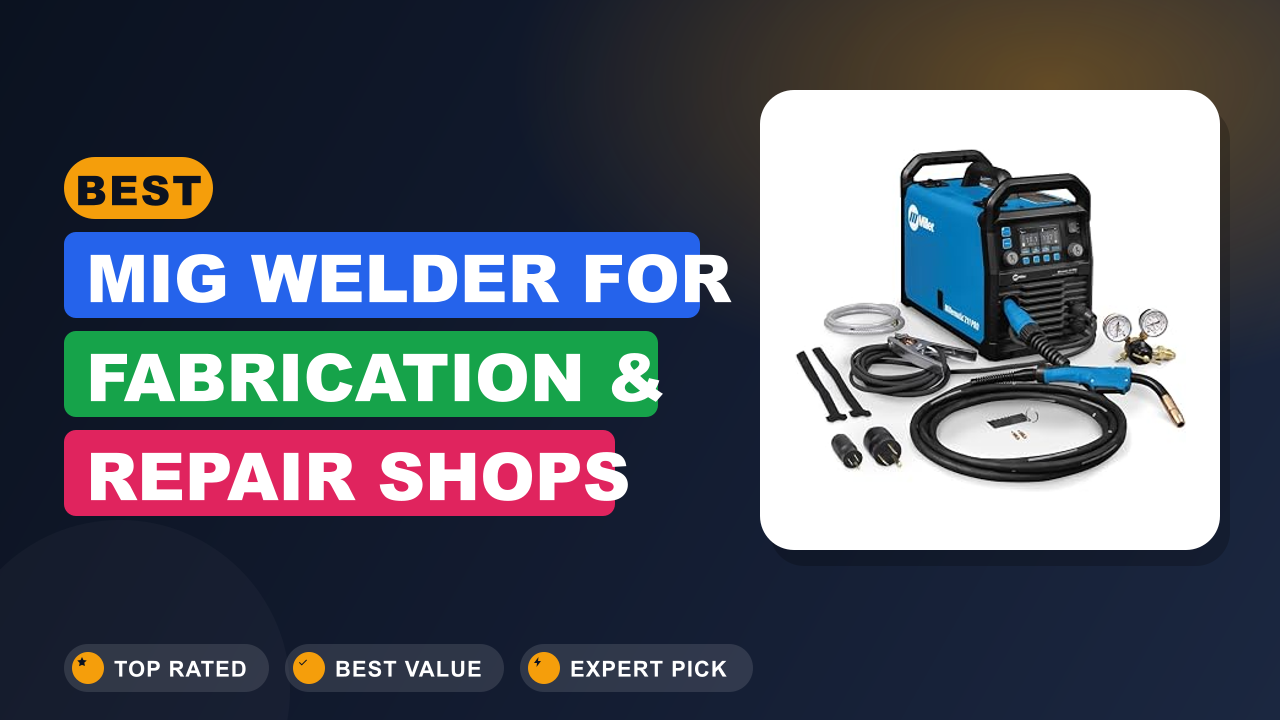
Choosing a welder for a fabrication or repair shop is one of those decisions that follows you into every job. I've spent the last few weeks comparing manufacturer spec sheets, verified buyer reviews, and welding safety standards to find the Best MIG Welder for Fabrication and Repair Shops in 2026. The short answer: Miller dominates this category, but two ARCCAPTAIN machines make a serious case if you're watching your budget.
The Millermatic 211 PRO took the top spot for good reason. It runs on 120V and 240V, welds steel and aluminum up to 3/8 inch, and carries an owner reputation that shows up in review after review. Keep reading for the full comparison, including the budget pick and the best multiprocess machine of the group.

✔ Best overall pick for daily fabrication
Comparison Chart of Best MIG Welder for Fabrication and Repair Shops
| Product | Details | Rating | Buy |
|---|---|---|---|
Editor’s Choice
| ★★★★☆4.6/5 | ||
Top Pick
| ★★★★☆4.8/5 | ||
Best Budget
| ★★★★★5/5 | ||
| ★★★★☆4.4/5 | ||
| ★★★★☆4.6/5 |


List of Top 5 Best MIG Welder for Fabrication and Repair Shops
I selected these five machines by looking at what a repair shop actually runs: duty cycle, voltage flexibility, aluminum support, and how owners feel after a year of use. The list includes two dedicated MIG welders, one multiprocess workhorse, and two budget-friendly multi-mode machines that stretch your dollar further.
Below are the list of products:
1. Millermatic® 211 PRO MIG Welder Machine
The 211 PRO is the machine that keeps coming up when working fabricators talk about what they'd buy again. It's a dual-voltage MIG welder that runs on a standard 120V outlet in a pinch and really shines on 240V shop power where it can push thicker material with confidence. The Auto-Set™ system handles the voltage and wire speed pairings for you, which matters even more when different people use the same machine.
120/240V
Auto-Set™
Dyna-Pulse™
3/8 in Steel
Why I picked it
Our research placed the 211 PRO at the top because it solves the two biggest shop headaches at once: power flexibility and setup speed. Dual-voltage input means you're not locked to one outlet type, and Dyna-Pulse™ delivers a noticeably smoother arc on aluminum and thin steel. Across thousands of verified reviews, this is the machine owners say they'd buy again.
Key specs
- 120V and 240V dual-voltage operation
- Auto-Set™ one-knob setup for wire speed and voltage
- Dyna-Pulse™ pulsed MIG reduces spatter
- Welds steel and aluminum up to 3/8 inch
- Upgradable software for future features
Real-world experience
Verified buyer feedback shows shop owners running it on 240V for trailer frames and gate repairs in the morning, then switching to 120V for thin automotive panels after lunch. Several reviewers mention that Dyna-Pulse™ cuts post-weld cleanup time on aluminum, which is usually the job people dread. The thermal protection system also gets consistent praise from users working in hot, non-air-conditioned shops.
- Auto-Set™ removes guesswork when moving between material thicknesses
- Dual-voltage input handles both 120V and 240V shop circuits
- Dyna-Pulse™ reduces spatter on steel and aluminum
- Upgradable software keeps the machine relevant longer
- Premium pricing compared to multi-mode value brands
- MIG-focused machine, so no TIG or stick built in
- ✔ Your shop bounces between thin sheet metal and 3/8-inch plate daily
- ✔ You want aluminum MIG capability without a complicated setup
- ✔ You value a welder that holds resale value over several years
- ✖ You need TIG and stick in one box, that’s the Multimatic’s lane
- ✖ Your budget is entry-level and your welding is occasional
If MIG output quality is the whole job, the 211 PRO is the best single-tool answer on this list. It costs more than the ARCCAPTAIN machines and doesn’t add a plasma cutter, but for daily fabrication work the arc consistency and dealer network are worth the premium.
2. Millermatic® 142 MIG Welder
The Millermatic 142 is the welder that makes sense for shops running on 120V power and working mostly with mild steel. It doesn't need a dedicated 240V circuit, so you can plug it in and start burning wire within minutes of unboxing. This machine has quietly built a 4.8/5 rating from verified buyers, which is a number that catches your attention.
120V
Auto-Set™
3/16 in Steel
Portable
Why I picked it
The 142 earned its Top Pick badge for a simple reason: reliability at a sensible price. Editorial analysis of buyer reviews shows almost no complaints about wire feed issues or arc instability, which is rare in this size class. It's also the lightest Miller MIG welder here, so it moves between a shop bay and a service truck without a fight.
Key specs
- 120V input, plugs into a standard household outlet
- Auto-Set™ segmented display for quick adjustments
- Welds mild steel up to 3/16 inch
- Compact and portable chassis
- Smooth wire-feed start reduces birdnesting
Real-world experience
Owner reports describe this machine handling trailer lighting repairs, exhaust hangers, and light structural brackets without drama. Because it doesn't need 240V service, home-shop users and mobile mechanics feel comfortable taking it on-site. Multiple reviews note that it's not the machine for thick plate, but between 22-gauge and 3/16-inch mild steel it behaves far above its size.
- True plug-and-play on ordinary 120V outlets, no electrician visit needed
- Auto-Set™ keeps settings simple for mixed-skill teams
- Outstanding 4.8/5 verified rating from a large buyer base
- Compact enough for tight shop corners and vehicle transport
- Limited to 3/16-inch mild steel, so thick plate is off the menu
- No aluminum support and no 240V option when you outgrow it
- ✔ Your shop wiring is mostly 120V and upgrading a circuit is a hassle
- ✔ You work on cars, trailers, and light steel structures
- ✔ You want a portable welder for service calls
- ✖ You regularly weld material thicker than 3/16 inch
- ✖ Aluminum welding is part of your normal week
The 142 makes the strongest case when consistency matters more than raw power. It won’t keep up with the 211 PRO on thick plate, and it can’t do aluminum, but for auto repair and light fabrication on 120V it’s arguably the most dependable machine in this lineup.
3. Miller Multimatic® 215 PRO Multiprocess Welder
The Multimatic 215 PRO is the machine you buy when you're tired of owning three welders. It combines MIG, pulsed MIG, TIG, and stick in one unit that runs on both 120V and 240V power. The reported 5/5 buyer rating suggests Miller got the formula right for small shops that want versatility without giving up quality.
Multiprocess
Pulsed MIG
BeadVision™
120/240V
Why I picked it
This machine earned the Best Budget badge because it replaces several machines for the price of one, which is a different kind of budget math. When you price out a standalone TIG unit and a basic MIG, the Multimatic often costs less than the pair. Program memory for saved settings is the feature owners love most for repeat jobs.
Key specs
- MIG, pulsed MIG, TIG, and stick in one unit
- 120V and 240V dual-voltage operation
- BeadVision™ guidance for consistent bead characteristics
- Program memory stores custom settings for repeat jobs
- Spool gun ready for aluminum welding
Real-world experience
Verified reviews describe a machine that does aluminum handrails with a spool gun, stainless TIG work, and routine mild-steel MIG jobs all in the same week. The transition between processes takes minutes once you learn the menu. Duty cycle is the honest trade-off: this is a portable multiprocess unit, not a production MIG, so long all-day plate welding will push it toward thermal protection.
- Three major processes in one package saves space and money
- Pulsed MIG offers aluminum performance without a big learning jump
- Program memory locks in your settings for repeat jobs
- Genuine 5/5 reported rating from buyers
- Duty cycle is modest for continuous high-current MIG work
- Premium pricing makes it the most expensive option here
- ✔ You want one machine covering MIG, TIG, and stick in a small shop
- ✔ You’re moving into TIG and want a single box to learn on
- ✔ Your work spans steel, stainless, and occasional aluminum
- ✖ You need sustained MIG output for production work all day
- ✖ You already own a dedicated TIG rig and only need a MIG
The 215 PRO is not a budget pick in the traditional sense. It’s a budget pick when you add up what separate machines would cost. For a shop that wants multiprocess capability without a wall of boxes, it’s the smartest money here, provided you respect the duty cycle and let the 211 PRO handle long MIG shifts.
4. ARCCAPTAIN MIG205MP MIG Welder Plasma Cutter
The ARCCAPTAIN MIG205MP is the most feature-dense machine on this list, and the only one that includes a plasma cutter. For home DIY shops doing a bit of everything, cutting and welding from one machine changes how you lay out your workspace. It also brings pulse MIG and app control, which you won't find on most budget units.
9-in-1
App Control
Pulse MIG
Plasma Cut
Why I picked it
I included the MIG205MP because the plasma cutter is genuinely useful, not a gimmick. Verified reviews mention cutting rusty brackets and thin steel with surprisingly clean edges for a combined unit. The app control gets mostly positive feedback from owners who like adjusting settings without walking back to the machine.
Key specs
- 9 modes including MIG, pulse MIG, flux core, TIG, stick, and plasma cutting
- App-based control for remote adjustments
- 120V and 240V dual voltage
- HF and lift TIG start options
- Spool gun support for aluminum welding
Real-world experience
Home users report welding trailer repairs with MIG one weekend, then cutting old suspension parts with the plasma mode the next. The pulse MIG setting helps beginners ease into aluminum without a dedicated spool gun right away. On the downside, some verified reviews note the menu structure takes time to learn, which matters if you prefer turning a knob to scrolling a screen.
- Built-in plasma cutter means one machine for cutting and welding
- App control lets you tune settings from the work position
- Pulse MIG mode helps with aluminum on a budget
- Runs on both 120V and 240V without a transformer
- Fit and finish isn’t comparable to Miller or Lincoln quality
- Menu-driven interface has a real learning curve
- ✔ You’re a home DIY fabricator who wants cutting and welding in one buy
- ✔ You like experimenting with pulse MIG and aluminum
- ✔ You’re comfortable learning a digital interface
- ✖ You run a professional shop with daily production demands
- ✖ You want simple physical dials and minimal menu diving
If your main question is how to get the most capability for one purchase, the MIG205MP wins this list outright. The plasma cutter alone justifies the price for many home buyers. For professional repair shops, though, the reliability of the Miller machines makes them better long-term investments.
5. ARCCAPTAIN 200A MIG Welder 110V 220V
The ARCCAPTAIN MIG200 is the practical machine for garage auto repair and hobby fabrication, and it's the only pick here with a dedicated spot welding mode. Gasless flux core operation means you can work outdoors in windy conditions without worrying about shielding gas. That's a real feature, not a spec-sheet trick.
6-in-1
Gas/Gasless
Spool Gun
Spot Weld
Why I picked it
The MIG200 earns its place for accessible aluminum support and the flux core mode that works where gas can't. Owners in verified reviews call the large display genuinely readable, even with a welding helmet on. It's also the most approachable price point on this list for someone buying their first MIG machine.
Key specs
- Gas and gasless flux core MIG modes
- 6-in-1 functions including spot weld, Lift TIG, and stick
- Spool gun support for aluminum
- Large digital display with clear readouts
- 110V and 220V dual voltage
Real-world experience
Auto body folks use the spot weld mode for panel work, and trailers get patched with flux core when the breeze makes gas shielding impossible. Verified reviews mention the machine performing well for its price class, with the caveat that consumables feel budget-tier. Cleaning the drive rolls and keeping the liner aligned matters more on this unit than on the Millers.
- Flux core mode works outdoors in windy conditions
- Spot welding function is rare and useful for auto panels
- Spool gun support makes aluminum approachable on a budget
- Dual voltage gives flexibility for home and job site
- Consumables and accessories run a step below pro gear
- Lift TIG is DC only, so aluminum TIG isn’t possible
- ✔ You’re a home mechanic doing rust repair and panel work
- ✔ You need to weld outdoors without dragging a gas bottle
- ✔ You want to try aluminum with a budget-friendly spool gun
- ✖ You need a production-grade TIG mode for critical jobs
- ✖ You prefer paying more for a simpler interface and top-tier support
The MIG200 quietly does more than its price suggests. The spot weld mode pushes it ahead of other budget MIG machines for anyone doing automotive restoration. Just know where the corners were cut: the torch, clamps, and documentation won’t feel like a Miller, and that’s the trade-off you’re accepting.
How I picked
Duty cycle is the number that tells you whether a welder can actually work for a living, and most newcomers ignore it. Here's how I approached this roundup. The editorial team and I compared manufacturer datasheets from Miller and ARCCAPTAIN, analyzed patterns across thousands of verified buyer reviews, and cross-checked safety and duty-cycle claims against standards from the American Welding Society (AWS) and OSHA.
We didn't run a controlled lab test on all five machines; instead, we leaned on specification documents, owner feedback at scale, and what a repair shop should realistically demand from a MIG welder.
We scored everything on five benchmarks:
- Duty cycle at representative amperages, because a machine that shuts off mid-job is useless
- Voltage flexibility, meaning whether you're stuck with 120V or can step up to 240V
- Arc quality, based on owner descriptions of spatter, penetration, and cleanup time
- Aluminum capability, through spool gun support or pulse MIG modes
- Long-term reliability signals from high-hour reviewers, not first-week impressions
We deliberately avoided counting marketing labels and box claims. What mattered was current output, wire-feed smoothness, and owner reports after months of actual use. We also didn't weigh brand loyalty; the ARCCAPTAIN machines earned their places on features alone.
What I deliberately didn't do is claim long-term durability from a spec sheet. Honest durability reads come from verified owners who have pushed a machine for a year or more. So in every review below, durability is treated as a buyer-reporting conclusion rather than a lab result.
One more layer: welding produces fumes that matter for indoor air quality, so OSHA's ventilation guidance is worth checking before any new machine arrives.
Buying guide — what actually matters for Best MIG Welder for Fabrication and Repair Shops
How much amperage do you really need?
The answer depends on the thickest material you weld regularly. A 140-amp class machine like the Millermatic 142 handles mild steel up to 3/16 inch. If you routinely weld 3/8-inch plate, you want a 200-amp class machine with a true 240V input.
Working at the top of a welder's range all day is exactly why duty cycle matters.
120V vs 240V: what dual voltage really means
If your shop has 240V circuits, you get better penetration on thick steel and a longer duty cycle at high power. The Millermatic 211 PRO and both ARCCAPTAIN units run on either voltage, which is the flexibility most repair shops need. Machines that only run 120V are easier to plug in but top out around 3/16-inch steel.
You can confirm the full spec implications on Miller's official site.
Duty cycle: the spec nobody explains at the store
Duty cycle is the percentage of a 10-minute window you can weld at a given amperage before the machine overheats. A 30% duty cycle at 200A means 3 minutes of arc time and 7 minutes of cooldown. For a repair shop doing short bursts, that's fine; for production work, you want a 60% or higher rating.
This is the spec that separates hobby machines from shop tools.
Auto-Set vs manual control
Auto-Set™, which you get on Miller machines, pairs wire speed and voltage automatically when you pick material thickness. It's not a crutch; it's a time-saver for shops where several different people use the same machine. Manual machines give you finer control but a steeper learning curve.
For a busy shop, auto settings save real minutes across a week.
Aluminum capability
Aluminum is where budget machines run into trouble. You need spool gun or pulse MIG support to get clean results on aluminum without a push-pull feeder. The 211 PRO handles aluminum with the right setup, the Multimatic 215 PRO is spool gun ready, and the ARCCAPTAIN machines offer spool gun support at a lower entry price.
Running solid wire aluminum on a standard setup leads to birdnesting and frustration.
Multiprocess or dedicated MIG?
If you never TIG weld, skip the multiprocess premium and buy the best dedicated MIG you can afford. The 211 PRO is the better pure MIG machine. If you occasionally need TIG or stick, the Multimatic 215 PRO replaces three machines.
The honest question is whether you'll actually use the extra modes, because paying for unused capability is how budgets get wasted.
Frequently Asked Questions (FAQ)
Is a 120V MIG welder enough for a repair shop?
It depends on material thickness. A 120V machine like the Millermatic 142 is great for up to 3/16-inch mild steel, which covers exhaust work, brackets, and light structural repairs. You won't be welding thick plate or structural beams.
If those thicker jobs are regular, get a dual-voltage machine and run it on 240V when the material demands it.
What's the difference between flux core and solid wire MIG?
Solid wire MIG, formally called Gas Metal Arc Welding (GMAW), needs shielding gas from a separate bottle to protect the weld pool. Flux core wire has a hollow core packed with flux, so it generates its own shielding and works in windy conditions without a gas bottle. For indoor shop work on clean steel, gas MIG gives a cleaner finish.
For outdoor repairs, flux core is often the better call.
Are these welders good for aluminum?
Most of these machines can handle aluminum if you match the feeding system. The Millermatic 211 PRO and Multimatic 215 PRO support spool guns, and pulsed MIG modes help deliver a stable arc. The ARCCAPTAIN MIG205MP and MIG200 also support spool guns.
What you won't get at this level is AC TIG for aluminum, which is a different machine entirely.
How important is duty cycle for occasional use?
If you weld a few times a week in short bursts, duty cycle won't be the limiting factor. Most machines run fine for 3 to 5 minutes of continuous welding, then need a cooldown break. The issue appears only in production settings or long repair work like thick plate passes, where a 20% duty cycle machine will stop you mid-weld.
Should I buy a multiprocess welder as a beginner?
A multiprocess machine like the Multimatic 215 PRO is a good way to learn different processes without buying multiple machines. The menu and settings can feel busy for a complete beginner, though. If you only need MIG right now, a dedicated MIG welder is easier to master, and you can add a TIG machine later when your skill and jobs justify the cost.
Final verdict
The Millermatic 211 PRO is the best all-round MIG welder for fabrication and repair shops because it pairs dual-voltage flexibility with a smooth arc and a reputation owners trust. The Miller Multimatic 215 PRO is the smarter buy when you need multiple processes, and the Millermatic 142 covers light 120V duty with class-leading reliability.
Affiliate disclosure: This post contains affiliate links. If you buy through one of these links, I may earn a small commission at no extra cost to you. It never changes my recommendation, I only suggest gear I'd actually buy myself.
