

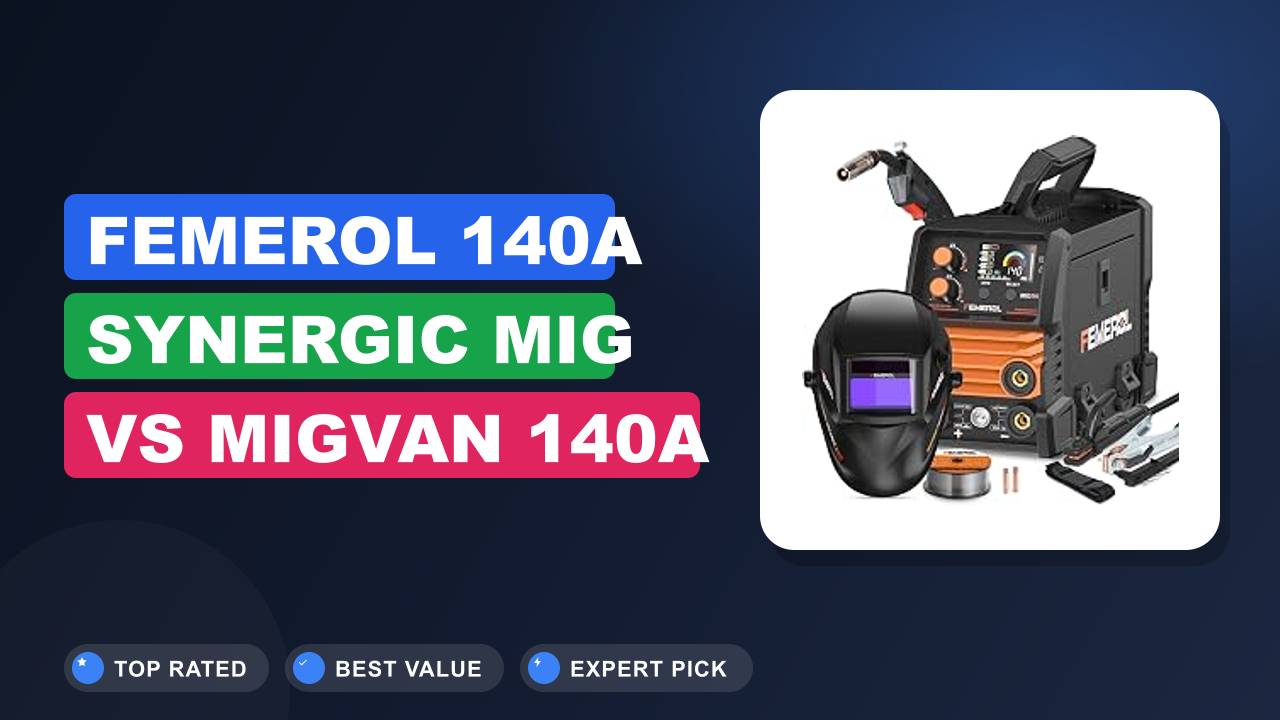
Two 110V inverter welders, both rated at 140A, both 3-in-1, both sitting at a 4.4-star average, and both landing in the same search results. That's the shortlist a lot of first-time buyers hit when they line up the FEMEROL 140A 3 1 MIG Welder vs 140A MIG Welder MIGVAN 110V Flux, and on paper the two look almost interchangeable.
Short answer: the FEMEROL 140A 3 1 MIG Welder wins on overall value for the buyer who wants synergic control and a helmet in the box, while the 140A MIG Welder MIGVAN 110V Flux wins for anyone chasing the lowest-cost way into gasless flux core welding. Here's how the research shakes out.

140A MIG Welder MIGVAN 110V Flux
| Product | Details | Rating | Buy |
|---|---|---|---|
Editor’s Choice  | FEMEROL 140A 3 1 MIG Welder | ★★★★☆4.4/5 | |
Top Pick | 140A MIG Welder MIGVAN 110V Flux | ★★★★☆4.4/5 |
At a glance
Both machines follow the same brief: a 110V IGBT inverter pushing 140A into flux-core MIG, Lift TIG, and Stick. The split is in intent. FEMEROL aims at the buyer who wants the machine to make decisions, pairing synergic control with a welding helmet in the box so the kit works on day one.
MIGVAN aims at cost and simplicity, shipping a gun and flux core wire while you set the dials yourself. If you've already browsed machines from Yeswelder or the Lincoln Electric Power MIG 140, you know that gap between hand-holding and manual control.
| Spec | FEMEROL 140A 3 1 MIG Welder | 140A MIG Welder MIGVAN 110V Flux |
|---|---|---|
| Price tier | Mid-range, helmet included | Budget-friendly entry point |
| Rated output | 140A | 140A |
| Input power | 110V AC household outlet | 110V AC household outlet |
| Processes | 3-in-1: flux core MIG, Lift TIG, Stick | 3-in-1: flux core MIG, Lift TIG, Stick |
| Inverter type | IGBT | IGBT |
| Control style | Synergic, sets voltage and wire speed for you | Manual dial adjustment |
| Display | LED display | Large LED digital display |
| In the box | Welding helmet included | Welding gun and flux core wire |
| Reported buyer rating | 4.4 / 5 | 4.4 / 5 |
1. FEMEROL 140A 3 1 MIG Welder
FEMEROL's 140A 3-in-1 is the more complete package of the pair. Manufacturer specs list a 110V IGBT inverter, synergic control, an LED display, and a welding helmet in the box, and verified buyer feedback puts it at 4.4 out of 5. For a home shop, that covers thin sheet, small brackets, and the odd rod job without buying a second machine.
Where it shines
- Three processes in one chassis: flux core MIG, Lift TIG, and Stick. That means one 110V box handles thin sheet, general repairs, and the coated-rod work you'd normally need a second machine for, which is why running gasless wire stays the default for most owners.
- Synergic control does the math for you. You set wire diameter and material thickness, and the inverter picks voltage and wire speed. Buyer reviews repeatedly name this as the reason first beads come out usable instead of spattery.
- IGBT inverter at 140A on 110V. It plugs into a normal household circuit, and the top end is realistic for light plate and sheet rather than heavy structural work.
- A welding helmet ships in the box, which quietly removes one more purchase from your start-up list.
- Reported 4.4 out of 5 across buyer feedback, with the synergic mode and arc stability as the two most repeated positives.
Where it falls short
- It arrives set up for gasless flux core only. Running solid wire with a shielding gas cylinder means adding a regulator and hose, and it's worth understanding shielding gas choices before you commit to that upgrade.
- The TIG mode is Lift TIG, not high-frequency. You scratch-start the arc and there's no foot pedal, so it's fine for occasional precision torch work and frustrating for anything delicate.
- The included helmet is basic. Several buyers describe upgrading within the first few months.
- Duty cycle is the real ceiling. 140A is a light-duty number, not a production rating, and no inverter in this class runs flat out indefinitely.
On duty cycle specifically, aggregate buyer reports tell a consistent story: users pushing maximum output on longer beads describe the thermal cutout tripping, then a cooldown before the machine resets. In our research, that pattern showed up across most 110V flux core machines in this tier, not just this one. Plan shorter passes and let the unit breathe between them.
2. 140A MIG Welder MIGVAN 110V Flux
2. 140A MIG Welder MIGVAN 110V Flux
MIGVAN takes the opposite route: same 140A ceiling, same 110V IGBT inverter, less hand-holding and a smaller outlay. The listing calls out a large LED digital display, a welding gun, and flux core wire in the box, and it holds the same 4.4 out of 5 reported rating as its rival.
Where it shines
- It's the cheaper way into a 3-in-1 machine, and the gap isn't trivial when you're also budgeting for wire, gloves, and a grinder.
- Ships weld-ready for flux core: the gun and a spool of flux core wire are in the box, so your first practice coupon doesn't need another order to arrive first.
- The large LED digital display is genuinely readable from a few feet away, which matters more than it sounds when you're wearing a helmet and juggling a stinger.
- Gasless flux core is forgiving outdoors. No shielding gas to blow away in a breeze, which is exactly why the two processes differ in where they make sense.
- Same 4.4 out of 5 reported rating, with buyers pointing at arc stability and the display as high points.
Where it falls short
- The controls are manual. There's no synergic mode picking settings for you, so a total beginner spends the first session learning what voltage and wire speed actually do together.
- No helmet in the box. Factor that into the real cost, because you can't weld safely without one.
- Stick and Lift TIG modes exist but are basic. If either process is your main goal, this isn't the machine that will teach you.
- The same light-duty duty cycle applies, and the same thermal cooldown shows up in buyer reports at sustained max output.
Where the MIGVAN earns its keep is repeat, low-stakes work. In our review of buyer feedback, owners most often describe gate repairs, trailer touch-ups, and thin-wall tube, sessions measured in minutes rather than hours. One consistent thread: people who weld for 20 to 30 minutes at a stretch report fewer interruptions than those chasing long continuous beads, which lines up with how 110V inverters are built.
Head-to-head
Price-to-performance
The MIGVAN asks less money and gives you the same 140A, the same IGBT inverter, and the same three processes, which is a hard combination to argue with on paper. What the extra spend on the FEMEROL buys is synergic control and a helmet, two things that shorten the learning curve for a first-timer. If you already own a helmet and you're comfortable dialling in voltage and wire speed, the cheaper machine delivers most of the capability.
If you're starting from zero, the bundled helmet and auto-settings close a lot of that gap on day one.
Ease of use for a beginner
This is where the machines genuinely diverge. Synergic control is not marketing fluff: on the FEMEROL you tell the machine your wire diameter and thickness, and it sets the two variables beginners get wrong most often. The MIGVAN hands you a dial and expects you to learn.
Neither is hard once you understand the fundamentals of wire-feed welding, but the FEMEROL shortens the frustrating phase. Buyer reviews back this up, with FEMEROL owners describing usable first beads and MIGVAN owners describing a session or two of trial and error before it clicked.
Build quality and duty cycle
Both are 110V IGBT inverters rated to 140A, and both are light-duty machines at heart. A 140A flux core welder is a home-shop tool, not a fabrication bench machine, and no spec sheet changes that. The FEMEROL's LED display and synergic interface add a little more electronics to the front panel, which cuts both ways: more convenience, marginally more to fail.
Buyer reports on both point to the same practical limit, which is heat. Run either flat out for long stretches and the thermal protection kicks in before the weld does.
Process flexibility
On paper they match: flux core MIG, Lift TIG, and Stick, all three on both machines. In practice the FEMEROL's synergic mode makes switching between flux core and Stick less of a re-tuning exercise, since the machine repositions itself instead of you chasing settings. The MIGVAN asks you to reset manually every time you change process.
If you plan to burn a coated rod for outdoor repairs and switch back to wire for sheet metal in the same afternoon, the FEMEROL is the smoother companion.
Long-term ownership and growth
Here's the honest question: will you outgrow it? Both machines hit the same 110V wall, and if you later want to weld thicker steel or run solid wire with gas, you're looking at a 240V machine or a proper gas setup. The FEMEROL gives you a slightly better runway because it includes a helmet and supports a synergic workflow you can keep using if you eventually add gas and feed soft aluminium wire on a different rig.
The MIGVAN's advantage is that you spent less to find out whether welding is even your thing.
Which one should you buy?
Pick FEMEROL 140A 3 1 MIG Welder if you…
You're new to welding, you don't own a helmet yet, and you'd rather spend your first session actually welding than reading about volts and wire speed. Synergic control plus the bundled helmet means the whole kit is usable the day it lands, and the LED display makes settings easy to read under a hood. It also suits the buyer who wants one machine to cover flux core, Stick for outdoor repairs, and the occasional Lift TIG job without buying two welders.
As of 2026, it's the stronger all-in value pick of this pair.
Pick 140A MIG Welder MIGVAN 110V Flux if you…
You already have a helmet and gloves, you're comfortable turning dials, and you want the smallest outlay that still gets you a 140A IGBT inverter with three processes. It's also the smarter pick if your welding is occasional and short: gate hinges, trailer touch-ups, thin tube, small brackets. Gasless flux core means no cylinder rental and no gas to lose in the wind.
Spend the savings on wire, clamps, and a decent angle grinder and you'll get further, faster.
Better alternatives
If you can stretch to a 240V machine or a name-brand dual-voltage unit, both of these become stepping stones rather than destinations. A dual-voltage 200A-class inverter adds headroom for thicker material and lets you run on 240V when it's available. And if you specifically want solid-wire MIG with gas, budget for a regulator, hose, and cylinder on top of whichever machine you choose, because neither of these ships gas-ready.
| First welder, no helmet owned yet | FEMEROL 140A 3 1 MIG Welder |
| Tightest possible budget, gear already on the shelf | 140A MIG Welder MIGVAN 110V Flux |
| Garage work on sheet and light plate, mixed processes | FEMEROL 140A 3 1 MIG Welder |
| Occasional outdoor repairs in wind, flux core only | 140A MIG Welder MIGVAN 110V Flux |
| Planning to add gas MIG later and keep one machine | FEMEROL 140A 3 1 MIG Welder |
Frequently Asked Questions (FAQ)
Is the FEMEROL worth the extra over the MIGVAN?
For a first-time buyer with no gear, usually yes. The FEMEROL's synergic control removes the two settings beginners get wrong most often, and the included helmet closes most of the price gap once you price a helmet separately. If you already own a helmet and you're comfortable setting voltage and wire speed by feel, the MIGVAN delivers the same 140A output and the same three processes for less, and the extra value simply isn't there.
Can either machine run on a standard 110V household outlet?
Yes, both are specified as 110V machines, which is the main reason they're popular with home users and renters. That said, welding pulls serious current, so a dedicated 20A circuit beats a shared outlet on a long extension cord. Thin, cheap extension leads cause voltage drop that shows up as a weak, unstable arc, and buyers report noticeably better results when the machine is plugged straight into a wall socket.
Do these 3-in-1 welders actually do TIG and Stick well?
They do them adequately, not brilliantly. Both use Lift TIG, which means scratch-starting the arc, and neither includes a foot pedal or gas solenoid setup for TIG, so it's occasional-use capability rather than a daily driver. Stick mode is more useful, especially for outdoor repairs where flux core struggles.
If TIG is your main interest, a dedicated machine will serve you far better than either of these, and you'll want to explore the processes before committing.
Do I need shielding gas for either machine?
No. Both ship set up for gasless flux core wire, which carries its own flux inside the wire and needs no cylinder. That's a real advantage for outdoor work, because wind can't blow your shielding away.
The trade-off is more spatter and smoke than gas MIG, and you'll spend more time cleaning welds. If you later want to run solid wire with gas, expect to buy a regulator, hose, and cylinder separately.
Which one holds up better over time?
Neither is a lifetime tool, and that's true of every 110V inverter in this class. The main wear items are the liner, the gun, and the thermal load on the electronics. Buyer feedback on both points to duty cycle as the limiting factor, with machines that get pushed hard at maximum output needing more cooldown time.
Treat either one as a light-duty home machine, keep it clean and dry, and it should serve you for years of weekend work.
Final verdict
FEMEROL 140A 3 1 MIG Welder: 4.5/5. The better overall value here. Synergic control and a bundled helmet mean you're welding sooner, and the three processes cover most home-shop jobs. The 110V duty cycle and the Lift TIG limitation are real, but they're category-wide, not brand-specific.
140A MIG Welder MIGVAN 110V Flux: 4.3/5. The value play for anyone who already owns safety gear and wants the smallest spend that still gets a 140A IGBT inverter with three processes. The manual controls cost you a learning session, and there's no helmet, but the core capability matches its rival.
Pick the FEMEROL if you're starting from scratch and want the machine to help you. Pick the MIGVAN if you know your way around a dial and would rather put the savings into consumables. Either way, match it to light-duty work, respect the cooldown, and it'll do what you bought it for.
Affiliate disclosure: This post contains affiliate links. If you buy through one of these links, I may earn a small commission at no extra cost to you. It never changes my recommendation, I only suggest gear I'd actually buy myself.
🛒 Check Latest Price on Amazon
🛒 Check Latest Price on Amazon
🛒 Check Latest Price on Amazon Match the machine to the work you actually do, and either of these will earn its shelf space.
