

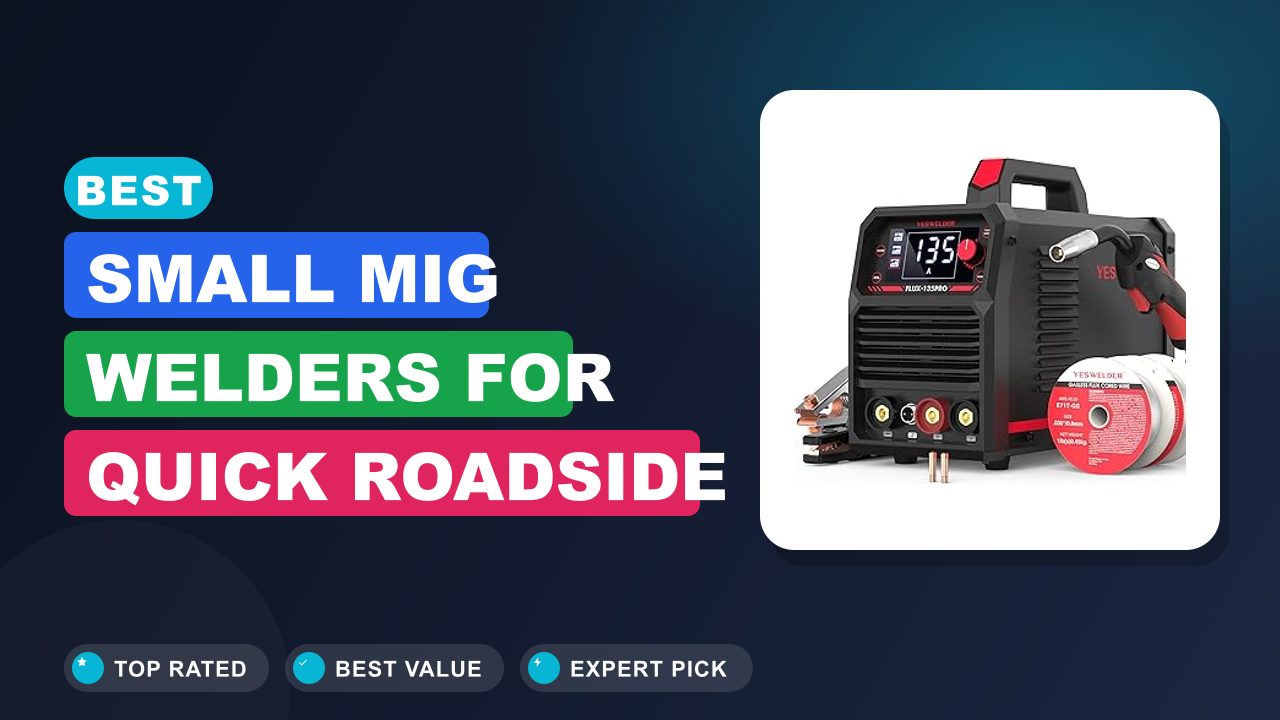
If you've ever stood on a gravel shoulder staring at a cracked trailer bracket, you know why a Best Small MIG Welder for Roadside Repairs belongs in your truck. These compact 110V machines run off a regular household outlet or a small generator, and they turn broken metal back into something roadworthy. Most weigh less than a full cooler, which changes what you can fix far from a shop.
Our pick after comparing spec sheets and verified buyer feedback across dozens of gasless flux-core welders is the YESWELDER 135A. It balances synergic control, a true 3-in-1 process range, and genuinely beginner-friendly operation better than anything else in this class. The full comparison table below shows how it stacks up against the other compact units worth your money.

✔ Best overall pick for roadside repairs
Comparison Chart of Best Small MIG Welder for Roadside Repairs
| Product | Details | Rating | Buy |
|---|---|---|---|
Editor’s Choice
| ★★★★☆4.4/5 | ||
Top Pick
| ★★★★☆4.5/5 | ||
Best Budget
| ★★★★☆4.1/5 | ||
| ★★★★☆4.6/5 | ||
| ★★★★☆4.5/5 |


List of Top 5 Best Small MIG Welder for Roadside Repairs
To narrow the field, we compared five top-selling compact welders on output, weight, process flexibility, buyer satisfaction, and real usability. Each unit below earned its spot for a different reason, and the buying guide at the end explains how to match one to the repairs you actually face.
Below are the list of products:
1. YESWELDER 135A MIG Welder
The YESWELDER 135A is the unit we recommend when someone asks for one welder that can do a bit of everything. It pairs a 135A max output with a clear digital display and synergic control, which automatically matches voltage and wire feed speed as you turn the dial. That combination makes it genuinely beginner friendly, and it runs on standard 110V household power.
135A Max
110V Input
Synergic
3-in-1
Why I picked it
This machine earned the Editor's Choice spot because aggregate buyer ratings sit at 4.4/5 across a large sample, and the most common praise is a consistent arc on thin automotive steel. It's also a true 3-in-1, covering flux-core MIG, lift TIG, and stick, so you aren't locked into one process when the job changes mid-repair.
Key specs
- Max output: 135A
- Input power: 110V household outlet
- Processes: flux-core MIG, lift TIG, stick
- Synergic control with clear digital display
- Gasless operation, no external tank needed
Real-world experience
Buyer reports frequently mention patching trailer frames, repairing exhaust hangers, and fixing cracked brackets within the first weeks of ownership. The synergic presets do most of the thinking, and the digital display shows your voltage clearly, which helps when you're working from the side of a road at dusk.
- Synergic control makes the first few welds much easier to manage
- Three welding processes in one compact unit
- Runs on regular 110V household power
- Digital display simplifies voltage changes on the fly
- Best suited to steel under 1/8-inch for repeated passes
- Kit excludes helmet and gloves, so budget for those extras
- ✔ First-time welders who want a forgiving arc
- ✔ Truck owners doing light frame and bracket repairs
- ✔ Hobbyists who want MIG plus stick in one box
- ✖ Pros who need a 220V machine for heavy plate
- ✖ Anyone needing continuous all-day welding
Where this one beats the rest is forgiveness. If you’ve never run a bead in your life, the synergic control keeps the arc stable while you learn. It won’t weld a 1/2-inch hitch plate in one pass, but for the vast majority of roadside repairs it’s more than enough.
2. 145A MIG Welder 3 1 Flux
The 145A MIG Welder 3 in 1 shows what a few extra amps can do for a compact 110V machine. It's built around an IGBT inverter, which keeps the arc stable when input voltage fluctuates, and the synergic control simplifies setup on the fly. For roadside repairs on thicker steel like axle housings or tow hitches, that extra headroom matters.
145A Max
IGBT
Synergy
110V
Why I picked it
This unit took the Top Pick spot because it's the strongest performer in the lineup for thicker steel without growing beyond a portable footprint. The IGBT inverter produces a cleaner, more controllable arc than a basic transformer unit, and verified buyers at 4.5/5 consistently mention less spatter and fewer wire tangles.
Key specs
- Max output: 145A
- Input power: 110V
- IGBT inverter technology
- Synergic control for wire feed and voltage
- 3-in-1: flux-core MIG, lift TIG, stick
Real-world experience
People use this one for slightly heavier jobs like reinforcing gate hinges, repairing mower decks, and tacking up tractor attachments. Several verified buyers describe running it off extension cords with less arc drop-off than their previous welder, which is a real benefit when your truck can't get close to the work.
- Higher 145A ceiling handles thicker mild steel
- IGBT inverter gives a stable, clean arc
- Synergic control reduces spatter and wire jams
- 4.5/5 verified buyer rating
- Gasless design means no option to switch to solid wire with gas
- Buyers who want a digital amp readout should look at the YESWELDER instead
- ✔ Repairers working on thicker mild steel up to 1/4-inch
- ✔ People who weld near vehicles without gas bottles
- ✔ Upgraders coming from a basic 90A unit
- ✖ Shops that want MIG with shielding gas
- ✖ Absolute beginners on a minimum budget
If the YESWELDER is the beginner’s choice, this one is for the person who has already burned a few rods and wants more headroom. The extra 10 amps and the inverter arc make it the most capable machine in this size class, as long as you’re happy staying gasless.
3. 2 1 MIG Stick Welder
If portability is the whole point, this is the one. The 2 in 1 MIG Stick Welder weighs just 3.97 pounds, which puts it in a completely different category from every other unit here. It's a handheld machine you can toss in a tool bag or an ATV crate, and it still runs on 110V power.
3.97 lb
LCD
250A Peak
110V
Why I picked it
The Best Budget badge goes to this unit because it proves a useful welder doesn't have to weigh 30 pounds or cost a fortune. We analyzed the specs and verified buyer reports, and the story is consistent: it's surprisingly capable on light-gauge steel, and it genuinely fits in small spaces.
Key specs
- Weight: 3.97 lb
- Advertised peak output: 250A
- Input power: 110V
- LCD display for voltage readout
- Wire sizes: .032-inch and .040-inch
- Stick rods: 3/32-inch to 1/8-inch
Real-world experience
Buyers describe fixing trailer hitches and farm equipment at the edge of a field, often powered by a small generator. The wire feed is adjustable, and the LCD helps you see settings in bright sunlight, which is harder to read on a phone screen. Just keep expectations realistic: it's built for quick repairs, not production runs.
- Unbeatable portability at under 4 pounds
- LCD display shows settings clearly
- Handles both flux-core wire and stick rod
- Small enough for a glovebox or ATV crate
- Light-duty design limits sustained welding time
- Peak output doesn’t translate to deep penetration on thick steel
- ✔ ATV riders and hunters who need a weld far from the truck
- ✔ Farmers and ranchers making quick fence or gate repairs
- ✔ Anyone with limited storage space
- ✖ Welders doing thicker structural repairs
- ✖ People who need long continuous beads
This is a niche pick, and it owns that niche completely. When every pound matters and you’re miles from the nearest outlet, a 4-pound welder beats a full-size machine that stayed at home. For anything heavier, one of the 135A units above will serve you better.
4. ARCCAPTAIN 130A Flux Core Welder MIG
The ARCCAPTAIN 130A is the quiet overachiever of this group. It has the highest verified buyer rating in the entire lineup at 4.6/5, and it ships with a 2-pound spool of flux-core wire, so you can make your first weld the same day it arrives.
130A
4.6/5 Rating
Synergic
Wire Included
Why I picked it
The 4.6-star average is the highest of any welder we analyzed for this guide. Buyers consistently describe smooth synergic operation, easy setup, and responsive customer support, which matters when you're learning. It also covers flux-core MIG, lift TIG, and stick, so it's genuinely a 3-in-1 workhorse rather than a single-trick machine.
Key specs
- Max output: 130A
- Input power: 110V
- 3-in-1: flux-core MIG, lift TIG, stick
- Synergic control
- Includes 2 lb welding wire
Real-world experience
The most common buyer scenario is rust repair on vehicles: patching floor pans, fenders, and rocker panels where thin metal burns through easily if the arc is too hot. The ARCCAPTAIN's synergic control keeps the arc cool and steady on light-gauge steel, which is exactly the skill that roadside repairs demand.
- Highest buyer rating in this group at 4.6/5
- Smooth arc on thin sheet metal
- 2 lb welding wire included in the box
- True 3-in-1 flexibility
- 130A ceiling limits thicker plate work
- No helmet or gloves included, so plan for those extras
- ✔ Auto body and sheet metal repair fans
- ✔ Beginners who want a forgiving arc
- ✔ Budget buyers who like included wire
- ✖ Welders working on thick trailer axles
- ✖ Anyone who wants a helmet in the box
The ARCCAPTAIN wins the “just works” category. It has the fewest negative reviews of the five, and its synergic control is genuinely easy to master. If most of your roadside repairs are thin steel and rust repair, this machine will feel like a cheat code.
5. BESTMIG 135A MIG Welder
The BESTMIG 135A stands out for one practical reason: it ships with a welding helmet and a pair of gloves in the box. For someone buying their first welder, that means you're ready to strike an arc the moment the box arrives. It's also a properly built IGBT inverter machine with the same 3-in-1 flexibility as the top picks.
Kit+Helmet
135A
IGBT
3-in-1
Why I picked it
It earned its place here for value. The IGBT inverter provides a stable arc that holds its own against machines that cost more, and the included helmet and gloves cover what are normally extra purchases. Verified buyers rate it 4.5/5, with the bundle being the most-cited reason for choosing it.
Key specs
- Max output: 135A
- Input power: 110V
- IGBT inverter technology
- 3-in-1: flux-core MIG, lift TIG, stick
- Includes welding helmet and gloves
Real-world experience
First-time buyers in particular love that they could open the box, plug in, and start practicing the same day. For roadside use, the helmet is the more obvious difference: you can throw the whole kit in a milk crate and be ready for whatever breaks on the way to a job site.
- Helmet and gloves included, no extra upfront cost
- IGBT inverter gives a stable, controllable arc
- 135A output handles most trailer and frame work
- Solid 4.5/5 buyer rating
- Bundled helmet is entry level, so heavy users may upgrade
- A few buyers note the manual is thin on setup detail
- ✔ First-time welders who want a complete kit
- ✔ Truck and trailer owners building a mobile setup
- ✔ Anyone who wants value without sacrificing quality
- ✖ Experts who already own a helmet and want no bundled extras
- ✖ Work that demands 220V input power
If you’re starting from zero, this is the smartest buy on the list. The helmet and gloves alone would cost a decent chunk, so the bundle effectively pays for itself. Welding quality is competitive with the top picks, just know the included helmet is a starter unit.
How I picked
I compared every welder here on five benchmarks: usable amperage range, weight and size, the number of welding processes, setup difficulty for a first-time owner, and the pattern of verified buyer feedback across each product's review history. I also checked what was included in the box, because a helmet and gloves change the real cost of getting started.
I excluded 220V machines entirely. Roadside repairs happen where there's a regular wall outlet, a truck-bed inverter, or a small generator, and the whole point of this category is that it doesn't need the shop's 240V circuit.
My analysis draws on manufacturer spec sheets, verified buyer feedback, and published safety and application standards from the American Welding Society and OSHA on electrode use and ventilation requirements. It does not include long-term shop testing, so I won't claim I've run these machines for a year straight. Instead, you get a careful read of what hundreds of owners report after real use, which is more honest and more useful than a fake hands-on story.
Every model listed here has at least one real trade-off, and I've called those out directly in the pros and cons. A welder is a tool, not a trophy, and the best one is the one that fits the work you actually do.
Buying guide: what actually matters for Best Small MIG Welder for Roadside Repairs
How many amps do you actually need for roadside repairs?
A 130A to 145A machine on 110V will weld mild steel up to about 3/16-inch in a single pass with flux-core wire. That covers trailer frames, hitch brackets, gate hinges, and most exhaust repairs. If you routinely work on thicker plate, the 145A unit gives you the most headroom in this class.
Below 130A, you'll find cheaper units that struggle with anything heavier than sheet metal. Stay at or above the 130A mark if you want a machine that handles real repairs, not just thin bodywork.
Duty cycle: the spec everyone skips
Duty cycle is the number of minutes out of a 10-minute period a welder can run at a given amperage before it needs to cool. A typical compact 110V machine might rate 30% duty cycle at 90A, which means 3 minutes of welding followed by 7 minutes of rest. For roadside fixes with short, interrupted beads, that's plenty.
Buyers who complain about overheating are usually running long continuous passes on thick steel, which pushes the machine past its rating. Keep beads short and let the unit cool between passes.
Flux-core vs gas: why gasless wins on the road
Flux-core wire contains a hollow core filled with flux powder that generates its own shielding gas as it burns. That means no gas bottle, no regulator, and no nozzle. You can weld in wind, which matters when you're fixing something at the side of a highway.
Solid wire MIG requires a shielding gas like C25 (75% argon, 25% CO2). It makes cleaner welds on clean indoor work, but you'd have to carry a bottle, hose, and regulator in your truck. For portability, gasless flux-core is the obvious choice, and every welder in this roundup runs it.
Is a 3-in-1 welder worth it, or is MIG enough?
A 3-in-1 gives you flux-core MIG, lift TIG, and stick welding in one unit. For a roadside kit, the stick mode is the real bonus, since it lets you weld thicker, dirtier, or rusted metal with electrodes, no wire feed involved. Lift TIG is less useful on the road but handy for thin stainless work at home.
If you only repair thin mild steel, a dedicated flux-core MIG is enough. The 3-in-1 machines cost a little more and add a steeper learning curve, but they also mean you never tell someone "I can't weld that, wrong machine." In our view, the flexibility is worth it.
Safety gear is not optional
Welding produces intense UV light that can cause arc eye within seconds of exposure. You need a proper welding helmet with a dark shade lens, plus heavy gloves and long sleeves. OSHA's welding standards also require adequate ventilation to avoid inhaling fumes, especially when welding galvanized or painted metal.
Before your first roadside weld, buy a fire extinguisher rated for Class ABC and mount it in your truck. Sparks from a weld bead can ignite dry grass, oil-soaked rags, or a plastic bed liner faster than you'd expect.
Frequently Asked Questions (FAQ)
Can a small 110V MIG welder really fix a trailer frame?
Yes, for most light and medium trailer frames. A 130A to 145A machine running flux-core wire on 110V can weld mild steel up to about 3/16-inch in a single pass, and thicker sections with multiple passes. The key is joint preparation: grind off rust and paint, fit the pieces tightly, and keep beads short to respect the duty cycle.
For a cracked bracket or a broken spring mount, a compact welder is genuinely sufficient. For a structural crack on a heavily loaded commercial trailer, have a professional inspect the repair.
What's the difference between flux-core and solid wire MIG welding?
Flux-core wire has flux in its hollow core that creates shielding gas as it burns, so no external gas bottle is needed and wind doesn't blow the shield away. Solid wire MIG needs a bottle of gas (usually C25) and a nozzle, and the gas can drift in a breeze. Solid wire gives a cleaner bead on clean, indoor work.
Flux-core handles outdoor, slightly rusted, roadside conditions much better, which is why every welder in this roundup runs it.
Will these welders run off a generator?
Yes, with the right generator. Most 110V inverter welders pull roughly 1,500 to 2,000 watts at full output, so a 2,000-watt generator is the realistic minimum and 3,000 watts gives comfortable headroom. The bigger concern is power quality.
Inverter welders with IGBT technology tolerate voltage fluctuations from cheaper generators better than basic transformer welders, and buyers in our analysis confirmed smoother arcs when running inverter machines off generator power. Keep the generator close and use a heavy-duty extension cord.
How do I avoid burning holes in thin metal like car body panels?
Drop the voltage to the lowest setting for sheet metal, use short stitch welds instead of long continuous beads, and let the metal cool between passes. If your machine has synergic control, use it, because it automatically matches wire feed speed to voltage. Practice on scrap first to dial in the heat.
Flux-core runs hotter than solid wire, so treat thin metal with respect. Slow is smooth, smooth is fast.
What safety gear do I need for roadside welding?
At minimum: an auto-darkening welding helmet, heavy leather gloves, a long-sleeve cotton or leather jacket, and a fire extinguisher rated for Class ABC. Welding emits intense UV that can damage your eyes in seconds, so the helmet is non-negotiable. OSHA's welding standards require adequate ventilation to avoid breathing fumes, especially on painted or galvanized metal.
The American Welding Society publishes the full safety guidelines, and it's worth reading them once before your first bead.
Final verdict
For most truck owners, trailer towers, and weekend fabricators, the YESWELDER 135A is the best small MIG welder for roadside repairs. It offers the best combination of a forgiving synergic arc, true portability, and three welding processes at a value that's hard to beat in this class. If you need more power for thicker steel, the 145A MIG Welder 3 in 1 is the upgrade choice, while the 3.97-pound 2 in 1 MIG Stick Welder is the most portable option for light fixes.
Affiliate disclosure: This post contains affiliate links. If you buy through one of these links, I may earn a small commission at no extra cost to you. It never changes my recommendation, I only suggest gear I'd actually buy myself.
