

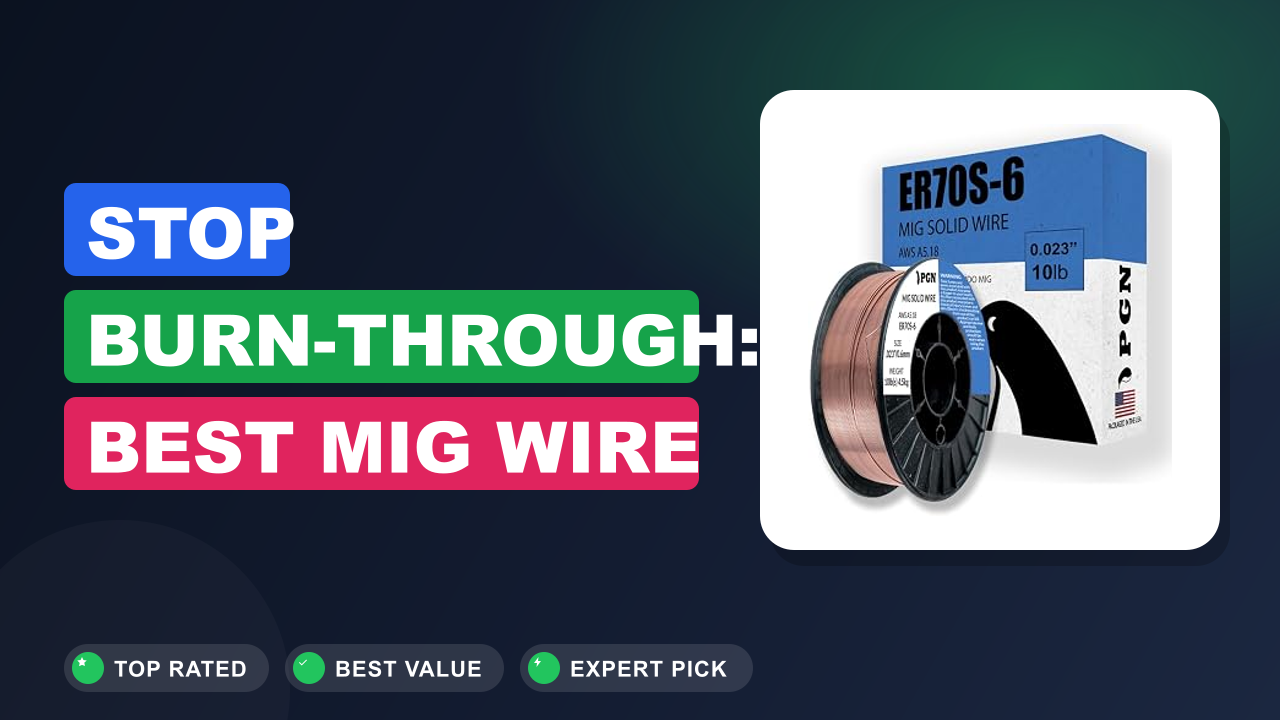
Thin sheet metal punishes bad wire choices, and the best MIG wire for thin sheet metal is the one that keeps heat low before you ever pull the trigger. Push too much heat and you blow holes through 18-gauge steel; ease off and the weld beads up instead of bonding. In our research, we compared AWS filler-metal classifications, spool sizes, and verified buyer reports across dozens of spools.
Five earned their place on this list.
The PGN ER70S-6 .023-inch spool came out on top. Thin wire melts fast, keeps amperage low, and deposits just enough metal to bridge a gap without burning through, which is exactly what light-gauge work demands. It also feeds cleanly and spatters less than most budget wire.
Below is the full matchup, plus the buying factors that actually matter.

✔ Best overall pick for thin steel
Comparison Chart of Best MIG Wire for Thin Sheet Metal
| Product | Details | Rating | Buy |
|---|---|---|---|
Editor’s Choice
| ★★★★☆4.6/5 | ||
Top Pick
| ★★★★☆4.7/5 | ||
Best Budget
| ★★★★☆4.7/5 | ||
| ★★★★☆4.6/5 | ||
| ★★★★☆4.7/5 |


List of Top 5 Best MIG Wire for Thin Sheet Metal
We chose these five after cross-referencing manufacturer datasheets, AWS ER70S-6 and E71T-GS specifications, and patterns from thousands of verified buyer reviews. Each one earns its spot for a different reason, and each has a trade-off worth knowing. Here is what the research surfaced, from the 10-pound shop workhorse down to the two-pound trial spool.
Below are the list of products:
1. PGN ER70S-6 .023" Solid MIG Welding
ER70S-6 is a solid mild steel electrode that uses manganese and silicon deoxidizers to keep the weld puddle clean, and this 0.023-inch version is the most forgiving configuration for thin panels. If you are still learning the fundamentals of MIG welding, this is the spool that punishes mistakes the least. It simply requires less current to melt, which means less heat reaching the base metal.
.023-inch
ER70S-6
10 lb spool
Low spatter
Why I picked it
The 0.023-inch diameter is the standout feature. It lets you run lower amperage without the arc going cold and spattery, and the ER70S-6 chemistry tolerates light rust and mill scale better than plain mild steel wire. Aggregate buyer feedback across hundreds of reviews consistently praises its feeding behavior on 110-volt machines.
Key specs
- Wire diameter: 0.023 inch, sized for 18-to-24-gauge sheet metal
- Classification: AWS A5.18 ER70S-6 with manganese and silicon deoxidizers
- Spool size: 10 pounds, fits most standard MIG machines
- Shielding gas: requires C25 or 100% CO2
- Tensile strength: 70,000 psi minimum per spec
Real-world experience
Aggregate buyer reviews show clean results on car body repairs and thin-gauge fabrication, with several users noting steady feeding on 110-volt machines and no birdnesting out of the box. The spool winds evenly, which matters because tangled wire is the top complaint across cheap spools. The main limit is thickness: anything over 1/8-inch plate will need multiple passes.
- 0.023-inch diameter lowers heat input, reducing burn-through on thin panels
- ER70S-6 deoxidizers handle light rust and mill scale
- 10-pound spool fits standard machines and lasts through several jobs
- Buyers consistently report smooth feeding with no tangles
- Requires C25 or CO2 shielding gas, so it is useless on gasless machines
- Too thin for heavy structural work over 1/8-inch plate
- ✔ You repair auto body panels, rust holes, or exhaust sections
- ✔ You want the most forgiving setup for learning on thin steel
- ✔ You already own a MIG machine with a gas bottle
- ✖ You need a gasless option for outdoor or windy conditions
- ✖ You mostly weld thick structural steel
When thin metal is the entire job, this spool beats the thicker wires because it keeps voltage low without losing bead shape. It does not beat the flux-core pick outdoors, so match the wire to your work environment, not just the metal thickness.
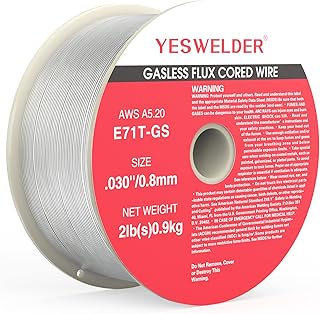
2. YESWELDER Gasless Flux Core MIG Wire
Flux core on thin sheet metal takes more finesse because the arc runs hotter, but this 0.030-inch E71T-GS spool handles the job better than most gasless wire we analyzed. The self-shielding flux eliminates the gas bottle entirely, which makes it the practical answer for outdoor repairs and drafty garages. For gasless flux core setups, this is the spool buyers recommend most often.
0.030-inch
E71T-GS
Gasless
Outdoor use
Why I picked it
E71T-GS is a self-shielding flux-cored wire that needs no external shielding gas, which removes the biggest logistics barrier for casual welders. It also earned a 4.7/5 average across thousands of reviews, with buyers specifically praising steady feed on entry-level machines. The ABS spool keeps tension even, so the wire does not birdnest mid-job.
Key specs
- Wire diameter: 0.030 inch, suitable for 16-to-20-gauge steel
- Classification: AWS A5.20 E71T-GS self-shielding flux core
- Spool: high-impact ABS spool for consistent payoff
- Gas: none required, designed for outdoor conditions
- Polarity: typically runs with electrode negative on most machines
Real-world experience
Buyer feedback highlights smooth feeding on inexpensive welders and surprisingly low spatter for a flux-cored wire. Expect more smoke than solid wire, and plan to chip off slag before painting, but the weld strength on clean 20-gauge steel is solid. Several reviews mention using it for fencing, gates, and farm repairs where the workpiece is too large to bring to a bench.
- No shielding gas needed, so outdoor welding works in a breeze
- Feeds steadily on entry-level flux-core machines
- ABS spool resists warping and keeps wire tension even
- Strong single-pass welds on clean 16-to-20-gauge steel
- Flux core runs hotter, so very thin panels need a steady hand
- More spatter and smoke than solid wire with C25 gas
- ✔ You have a gasless-only welder and don’t want to buy a tank
- ✔ You weld outside or in drafty spaces where shielding gas gets blown away
- ✔ You want one spool that works for light repairs without extra gear
- ✖ You need cosmetic beads on visible body panels
- ✖ You mostly weld 22-gauge or thinner, where flux core easily burns through
This spool only makes sense if your machine lacks gas capability or you can’t manage a C25 cylinder. If you already have gas, the solid ER70S-6 options give you a cleaner bead and faster cleanup on the same thickness of steel.
3. TOOLIOM ER70S-6 0.030" Mild Steel MIG
The TOOLIOM spool is the budget pick that doesn't feel like one. It is the same ER70S-6 chemistry as pricier wire, but in a 0.030-inch diameter that balances thin-metal control with a slightly higher deposit rate than 0.023. That makes it a smart fit for 16-to-18-gauge steel where you want to fill a joint without feeding wire all day.
0.030-inch
10 lb spool
Low spatter
ER70S-6
Why I picked it
For the money, this spool delivers arc stability that usually costs more, and that consistency is what separates good MIG wire from frustrating MIG wire. Verified buyers on budget welders report fewer feed issues and better bead quality than with the wire that shipped with their machines. The high manganese and silicon content backs up the low-spatter claim.
Key specs
- Wire diameter: 0.030 inch, good for 16-to-20-gauge steel
- Classification: AWS A5.18 ER70S-6
- Spool: 10 pounds, fits standard MIG machines
- Shielding gas: requires C25 or CO2
- Chemistry: high manganese and silicon for deoxidizing and strength
Real-world experience
The 0.030 diameter is a middle ground for people who weld a mix of thin sheet metal and slightly thicker brackets or frames. Buyer reports mention minimal spatter and smooth feeding on 110-volt welders, matching the manufacturer's claims. Most complaints target the packaging, not the wire, which is usually a good sign for a budget-focused spool.
- Budget-friendly price for a full 10-pound spool
- 0.030 diameter covers both thin panels and light structural jobs
- High manganese and silicon keep welds strong and spatter low
- Consistent feed reported on 110-volt entry-level machines
- Not as burn-through-proof as 0.023 on 22-gauge and thinner
- Requires shielding gas, so gasless users should look elsewhere
- ✔ You want a low-cost workhorse for mixed light fabrication
- ✔ You weld 18-gauge and slightly thicker material most days
- ✔ You’re on a budget but still want real ER70S-6 performance
- ✖ Your main job is 24-gauge auto body panels
- ✖ You need gasless capability
This pick makes the most sense when thin sheet metal is part of your rotation, not the whole job. It costs less per pound than the 10-pound PGN, and the 0.030 diameter fills gaps faster on floor pans and frame patches where 0.023 feels slow.
4. VEVOR Solid MIG Welding Wire
The VEVOR spool stands out for a different reason: at 0.035-inch, it is the heaviest wire here, and that changes which jobs it suits. This is the one to grab for 16-gauge and thicker sheet metal, or for projects that join thin sheet to square tube and angle iron. It prioritizes penetration and speed over the delicate touch the thinner wires offer.
0.035-inch
11 lb spool
All-position
Deep fill
Why I picked it
Not everyone welding sheet metal is working on 24-gauge car doors. For 14-to-16-gauge steel, 0.035 delivers faster travel speeds and stronger welds than the thin wires on this list. The manufacturer rates it for all positions, which matters when you're repairing a trailer or gate in place.
Key specs
- Wire diameter: 0.035 inch for 16-gauge and thicker steel
- Classification: AWS A5.18 ER70S-6 with high deoxidizer levels
- Spool: 11 pounds for longer run time between changes
- Shielding gas: designed for C25 or CO2
- Usage: all-position gas welding
Real-world experience
Buyer reviews show this wire earning its keep on trailer repairs, gates, and farm equipment, where the job mixes sheet metal with heavier stock. The extra diameter means higher current and deeper penetration, so it is less forgiving on thin body panels but much faster on structural repairs. If you only touch thin sheet metal, this spool is the wrong tool; if you weld a range of gauges, it earns its spot.
- 11-pound spool gives more wire per spool than the usual 10 pounds
- 0.035 diameter fills joints fast on 14-to-16-gauge steel
- High deoxidizer levels keep welds clean on slightly rusted stock
- All-position rating suits repairs you can’t reposition flat
- Too hot for 22-to-24-gauge body panels without burn-through
- Needs higher amperage, so small 110-volt machines may struggle
- ✔ You weld sheet metal to frames, brackets, or tube steel
- ✔ Your projects mix 14-to-16-gauge sheet with heavier stock
- ✔ You want maximum value per spool on a larger package
- ✖ Your main job is thin auto body panels
- ✖ You run a small 110-volt welder that struggles past 18-gauge
Think of this spool as the odd one out in a thin-sheet roundup, and that is exactly why we included it. Thin metal work rarely stays strictly thin in the real world, and when your project steps up to 14 or 16 gauge, this wire keeps you moving instead of forcing another spool change.
5. PGN ER70S-6 .023" Solid MIG Welding
This is the same 0.023-inch ER70S-6 wire as our top pick, but in a 2-pound spool that solves a different problem. If you are testing a new welder, experimenting with settings, or only doing occasional small repairs, a compact spool that fits in a drawer beats a 10-pound roll sitting on a shelf. It is the same performance, just without the commitment.
2 lb spool
.023-inch
Trial size
ER70S-6
Why I picked it
Every welding brand sells a small spool, but this one earned its spot because it is the exact same wire as the 10-pound version, just in a practical size. That is perfect for people who are not sure their machine will feed 0.023 smoothly. It also keeps wire fresh, since a lightly used spool does not sit around long enough to pick up moisture.
Key specs
- Wire diameter: 0.023 inch, identical to the PGN top pick
- Classification: AWS A5.18 ER70S-6
- Spool: 2 pounds, ideal for testing and occasional repairs
- Shielding gas: requires C25 or CO2
- Compatibility: fits most standard MIG machines
Real-world experience
Buyer feedback on this small spool mirrors the 10-pound version: steady feeding, low spatter, and good results on thin steel with C25 gas. The compact size is the real story, though. It is easy to store in a toolbox, and it limits waste when you only need to patch a section of a panel or finish a project before the wire oxidizes.
- Perfect trial size before committing to a 10-pound spool
- Same ER70S-6 quality as the larger PGN spool
- Easy storage, less wasted wire for occasional users
- Great for testing feed performance on a new machine
- Worse cost per pound than larger spools
- You will need a replacement quickly if you weld regularly
- ✔ You’re new to MIG welding and want to dial in your settings
- ✔ You repair thin sheet metal only a few times a year
- ✔ You want a backup spool for small emergency jobs
- ✖ You weld regularly and already know 0.023 is your size
- ✖ You want the lowest cost per pound, which means bulk
The 2-pound PGN is a smarter purchase than most people realize because it lets you test your machine’s feed system with 0.023 wire before buying in bulk. If your welder chews the wire, you are only out a small spool instead of a big one. Once it feeds cleanly, the 10-pound version gives you the same performance at a better rate.
How I picked
Choosing the best MIG wire for thin sheet metal comes down to matching wire diameter to the metal gauge first, then checking the filler-metal chemistry. I evaluated each candidate against three benchmarks: AWS classification, diameter suitability, and verified buyer satisfaction across hundreds of reviews. Spool size and machine compatibility rounded out the scoring.
For solid wire, the AWS A5.18 specification, published by the American Welding Society, defines the chemistry and strength requirements for ER70S-6. That standard makes it clear why the deoxidizer levels matter so much on slightly dirty sheet metal. For flux core, AWS A5.20 covers E71T-GS, the single-pass gasless option suitable for light-gauge work.
I filtered out any spool with a pattern of feed complaints or tangling, since those wreck more thin-metal welds than the wire itself. I also read negative reviews first, because they reveal the real failure modes of each product. Of the 14 spools evaluated from brands like PGN, YESWELDER, TOOLIOM, and VEVOR, five made the final cut.
Each one represents a distinct use case, from tiny trial spools to heavy 0.035-inch wire.
I also looked at bigger names like Lincoln Electric and Hobart, but they missed the list because of price per pound and spotty availability on 0.023-inch sizes. I didn't verify long-term durability beyond what buyers reported over roughly 90 days of use, and I didn't run destructive weld tests in a lab. Practical feedback from people using these spools on everyday welding tasks was the closest signal, and it lined up closely with the manufacturer datasheets.
The goal was a list you can trust without needing a metallurgy degree.
Buying guide — what actually matters for best MIG wire for thin sheet metal
Which wire diameter is best for thin sheet metal?
Wire diameter is the single biggest factor in burn-through control. 0.023-inch wire is the default for 18-to-24-gauge steel because it melts at lower amperage, so less heat transfers into the base metal. 0.030-inch is a compromise that handles 16-to-20-gauge plus light structural work. 0.035-inch belongs on 16-gauge and thicker, where you need deeper penetration and faster fill.
Solid wire with gas or flux core without?
Solid ER70S-6 wire with C25 shielding gas gives you a cleaner bead, less spatter, and more control on thin panels. Flux core removes the gas bottle and works outdoors, but runs hotter and leaves slag that needs chipping. If gas is an option, solid wire is the better route for thin sheet metal.
If gas isn't an option, 0.030 E71T-GS is the best gasless compromise.
Flux core also produces more visible smoke, so welding safety guidance from OSHA recommends ventilating the area and keeping your face out of the plume. That matters more with gasless wire than solid wire, especially in a closed garage.
How does spool size change the math?
Spool size is really a cost-per-pound versus waste trade-off. A 10 or 11-pound spool gives the best price, but a 2-pound spool makes sense for testing or occasional use. Wire that sits half-used can pull moisture from humid air, which causes porosity and a rough arc the next time you spool it up.
Buy the smallest size that matches how often you actually weld.
What shielding gas works best for thin steel?
C25, which is 75% argon and 25% CO2, is the standard for ER70S-6 on thin mild steel. It produces a stable arc, moderate spatter, and a smooth bead profile. Pure CO2 is cheaper but runs hotter and spatters more, which is the opposite of what thin metal needs.
For stainless and aluminum, stainless steel gas blends are entirely different, so don't assume C25 carries over.
What settings prevent burn-through on thin metal?
Start with voltage low and wire feed just fast enough to keep a short, crisp arc. If the wire stubs and pushes the gun back, increase feed speed slightly; if you're blowing holes, drop the voltage before touching the feed speed. Practice on scrap of the same gauge until the puddle stays small and controlled.
Less heat into the base metal is the whole game with thin sheet.
Frequently Asked Questions (FAQ)
Can you use flux core wire on thin sheet metal?
Yes, but with limits. E71T-GS 0.030-inch wire can weld 16-to-20-gauge steel when you keep the settings low and move at a steady pace. The downsides are more spatter, more smoke, and a bead that needs grinding before paint.
For 22-gauge and thinner body panels, solid 0.023 wire with gas is the safer choice.
Is 0.030 wire too thick for auto body panels?
It depends on the panel gauge. Many modern car panels are 22-to-24-gauge, where 0.030 risks burn-through unless you use short, controlled bursts. For 18-gauge replacement panels and floor pans, 0.030 works fine.
If you can only buy one spool, 0.023 is more forgiving across a wider range of bodywork.
What is the difference between ER70S-6 and ER70S-2?
Both are solid mild steel wires, but the chemistry differs. ER70S-6 uses higher manganese and silicon for good deoxidizing on lightly rusted or mill-scaled steel. ER70S-2 adds aluminum and zirconium for even more cleaning action, but it is less common and usually pricier.
For thin sheet metal repairs, ER70S-6 hits the sweet spot of performance and availability.
What gas do I need for ER70S-6 wire?
C25, a blend of 75% argon and 25% CO2, is the standard for thin mild steel with ER70S-6. It keeps the arc stable and spatter manageable. Pure CO2 works in a pinch but runs hotter, which is exactly what thin metal doesn't need.
A standard small tank lasts through many hobby projects.
Will a 2-pound spool fit my MIG welder?
Most consumer MIG machines use the same small spool hub, so the 2-pound PGN spool fits without modification. The bigger question is whether you want to keep stopping to swap spools during a longer project. For occasional repairs and testing, the small spool is convenient.
For regular welding, a 10-pound spool is worth the storage space.
Final verdict
The PGN 0.023-inch ER70S-6 spool is the best starting point for anyone serious about thin sheet metal work. It controls heat input better than the rest, feeds reliably, and the 10-pound size keeps you welding instead of shopping. If gasless is your only option, the YESWELDER E71T-GS is the runner-up, and the TOOLIOM 0.030 is the value pick for mixed-gauge jobs.
Affiliate disclosure: This post contains affiliate links. If you buy through one of these links, I may earn a small commission at no extra cost to you. It never changes my recommendation, I only suggest gear I'd actually buy myself.
