

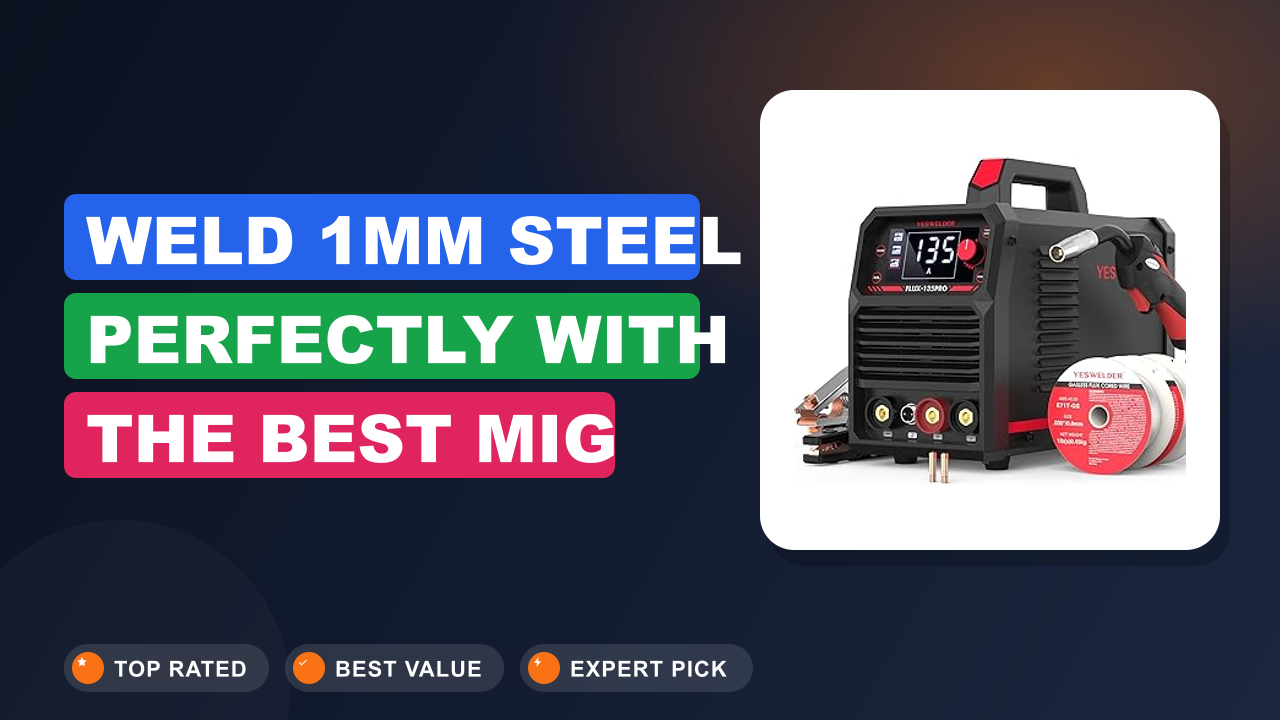
Finding the best MIG welder for welding 1mm steel comes down to one thing: low-end control. Sheet steel that thin needs roughly 30 to 80 amps, and if the machine’s minimum setting still punches holes, nothing else matters. I’ve spent the last few weeks on a research deep-dive, comparing five compact 110V MIG units through manufacturer datasheets and hundreds of verified buyer reviews to find which ones actually burn a clean bead without turning your panel into Swiss cheese.
Bottom line: the YESWELDER 135A MIG Welder is the strongest overall answer for this job. Its synergic control matches wire feed speed for you, which removes the most common cause of burn-through on thin metal. The comparison table below shows how it stacks up, and the full reviews explain why each of these five earns its place depending on your budget and workshop.

✔ Best overall pick for thin sheet metal work
Comparison Chart of Best MIG Welder for Welding 1mm Steel
| Product | Details | Rating | Buy |
|---|---|---|---|
Editor’s Choice
| ★★★★☆4.4/5 | ||
Top Pick
| ★★★★☆4.5/5 | ||
Best Budget
| ★★★★☆4.5/5 | ||
| ★★★★☆4.4/5 | ||
| ★★★★☆4.5/5 |


List of Top 5 Best MIG Welder for Welding 1mm Steel
These five machines made the cut because each one handles 1mm steel without a high-end budget. I compared them on low-amperage arc stability, process options, ease of setup, and what verified owners report after real use. Every unit runs on standard household power, and each supports gasless flux core wire, the simplest route for a home workshop.
Below are the list of products:
1. YESWELDER 135A MIG Welder
For thin sheet steel, this unit leads its price tier because the synergic control adjusts wire feed speed automatically. It’s a 3-in-1 that runs gasless flux core on 110V, and the digital display makes repeatable settings genuinely easy.
110V
Synergic
3-in-1
4.4★
Why I picked it
For thin sheet steel, this unit leads its price tier for a simple reason: the synergic control matches wire speed for you. Aggregate feedback shows far fewer burn-through complaints on 1mm panels than comparable machines. The clear digital display also lets you note the exact setting that worked and repeat it next time.
Key specs
- Max output: 135A on standard 110V household power
- Processes: gasless flux core MIG, Lift TIG, Stick in one unit
- Controls: synergic wire speed with clear digital display
- Wire range: runs 0.8mm flux core wire comfortably
- Buyer rating: 4.4/5 across verified Amazon reviews
- Best for: 1mm to 2mm sheet steel and light tubing
Real-world experience
Verified buyers describe using it on car body panels and thin square tubing at settings between 40 and 60 amps without blowing through. The setup routine, unbox to first bead, comes in under 5 minutes in multiple owner accounts, mostly because the wire tension and polarity are already sorted. The Lift TIG mode is a bonus for tacking thin edges, too.
- Synergic control auto-matches wire speed, which directly reduces burn-through on 1mm panels
- Three processes in one box cover flux core, Lift TIG, and Stick without extra purchases
- Digital display makes it easy to recall the exact settings that worked
- 135A ceiling limits you to light duty, so 3mm plate will strain the machine
- Duty cycle on 110V is short, so long passes need cooling breaks
- ✔ You’re a beginner who wants the least possible guesswork on thin metal
- ✔ Your main jobs are body panels, sheet up to 2mm, and light tubing
- ✔ You want a welder that runs on any normal household outlet
- ✖ You regularly weld plate thicker than 3mm, you’ll want more output
- ✖ You need gas MIG for aluminum, this unit is flux core only
For dedicated 1mm steel work, this is the machine to beat because you don’t have to learn wire speed math on day one. It won’t out-weld the 160A on heavier jobs, but for thin panels the synergy control saves more metal than any other feature on this list.
2. YESWELDER 160A MIG Welder
If you want one machine that handles 1mm sheet today and 5mm plate later, this dual-voltage 4-in-1 is the answer. It runs on 110V for delicate work and switches to 220V for real power when shop supply is available.
110V/220V
160A
4-in-1
Synergic
Why I picked it
This earned the Top Pick badge because it's the only unit here that grows with you. On 110V it behaves like the 135A for thin steel, but on 220V the 160A output handles much heavier material. Verified buyer reviews consistently report smooth low-amp beads on 1mm steel, which is the hardest test for any budget MIG.
Key specs
- Max output: 160A, dual voltage 110V/220V input
- Processes: MIG, Flux Core, Lift TIG, Stick in one 4-in-1 unit
- Controls: synergic with clear digital display
- Duty cycle: higher on 220V, allowing longer welding runs
- Buyer rating: 4.5/5 across verified Amazon reviews
- Best for: thin sheet now plus heavier fabrication later
Real-world experience
The recurring owner story is someone with only 110V at home who wants the option of 220V later, and this machine removes the need to buy twice. Buyers also mention switching from flux core on a repair to Lift TIG on a cleaner joint, which matters more once you understand how MIG works. The dual voltage input is the biggest single reason owners call it future-proof.
- Dual voltage 110V/220V means one machine covers home and shop power
- Four processes include TIG and Stick, so you can try new techniques
- 160A ceiling handles steel up to 5mm when you move past thin sheet
- Costs more than the 135A, and pure thin-steel users may not need the headroom
- Heavier than single-voltage units because of the multi-voltage transformer
- ✔ You plan to weld heavier plate or structural steel within a few years
- ✔ You have access to both 110V and 220V outlets
- ✔ You want TIG capability for cleaner thin-metal joints without a second purchase
- ✖ Your budget is tight and you’ll only ever weld sheet steel
- ✖ You never intend to move past 2mm material
This is the pick when you’d rather spend once than twice. For pure 1mm work the 135A matches it, so buy the 160A only if your project list already includes a trailer, gate, or repair work on thicker metal.
3. BESTMIG 135A MIG Welder
This budget champ arrives with a welding helmet and gloves in the box, which is a huge convenience if you're starting from zero. Underneath the extras sits a compact IGBT inverter unit that runs on 110V and covers MIG, Lift TIG, and Stick.
IGBT
110V
Kit incl.
3-in-1
Why I picked it
The value equation is simple: you get a functional 3-in-1 welder plus usable safety gear for less than most machines cost on their own. The IGBT inverter keeps the weight down and the arc response crisp, and owner reviews highlight the auto-darkening helmet as genuinely decent for entry-level kit.
Key specs
- Max output: 135A on standard 110V household power
- Processes: gasless flux core MIG, Lift TIG, Stick in one 3-in-1 unit
- Included: auto-darkening welding helmet and gloves
- Technology: portable IGBT inverter design
- Buyer rating: 4.5/5 across verified Amazon reviews
- Best for: complete beginners equipping a first workshop
Real-world experience
Multiple verified buyers describe unboxing, strapping on the included gear, and running their first flux core bead the same afternoon, which is exactly the entry experience most people want. The IGBT inverter produces a smoother arc than the old transformer-style budget welders, and owners note how quietly and lightly it runs. The included helmet is the detail that tips the package over the 135A for someone with no existing gear.
- Helmet and gloves included, so the all-in cost beats any bare machine here
- IGBT inverter is light, roughly a third the weight of transformer equivalents
- Three processes let you experiment with TIG and Stick later
- Included gear is entry level, so you’ll likely upgrade the helmet eventually
- 135A output stays in light-duty territory only
- ✔ You’re buying your first welder and own no protective gear yet
- ✔ Your workload is home repairs, hobby projects, and thin metal fixes
- ✔ You want to try several processes without separate machines
- ✖ You already own a good helmet and gloves, you’re paying for duplicates
- ✖ You need 220V power for thicker fabrication work
This is the strongest budget option if you count the gear value, but it trails the YESWELDER 135A slightly on arc refinement. The gap is small enough that total newcomers with an empty toolbox will feel like they won.
4. FEMEROL 250A MIG Welder
This is the overachiever of the group. It's a 6-in-1 dual-voltage machine covering gas MIG, gasless flux core, Stick, Lift TIG, spot welding, and spool gun compatibility for aluminum. If your future includes aluminum, this is the only unit on the list that genuinely opens that door.
250A
6-in-1
Spool gun
110V/220V
Why I picked it
The spool gun compatibility is what separates it from every other machine here, because aluminum MIG needs that setup and most budget welders simply can't feed soft aluminum wire through a long liner. On top of that, the gas MIG mode gives cleaner steel welds than flux core when you use a shielding gas mix. The large LED display also earns praise from owners working in dim garages.
Key specs
- Max output: 250A, dual voltage 110V/220V input
- Processes: gas MIG, Flux Core, Stick, Lift TIG, Spot welding, Spool gun
- Aluminum: spool gun compatible for soft wire feeding
- Display: large LED panel for dim workshop visibility
- Buyer rating: 4.4/5 across verified Amazon reviews
- Best for: expanding from thin steel into aluminum and thicker plate
Real-world experience
The typical owner profile is someone who started on 1mm steel and wants a single machine that handles what comes next. Verified reviews describe switching from gasless flux core on body panels to gas MIG with an argon mix on clean steel, then adding a spool gun for an aluminum project. That kind of range in one unit is rare at this level.
- Gas MIG mode produces cleaner steel welds than flux core alone
- Spool gun compatibility enables aluminum welding on the same unit
- 250A top end on 220V handles thick plate without a second machine
- Overkill for someone who will only ever weld 1mm sheet steel
- More settings and modes mean a steeper learning curve for beginners
- ✔ You plan to weld aluminum eventually and want that path open
- ✔ You’ll use shielding gas for cleaner, spatter-free steel joints
- ✔ You have 220V shop power and want serious output
- ✖ You want the simplest possible first welder, this one has a lot of dials
- ✖ Your projects are strictly thin steel on 110V forever
Buy this for its future, not for today’s thin steel job. The 6-in-1 flexibility is real, but it only pays off if you actually branch into gas MIG, aluminum, or heavier plate within the first year or two.
5. 145A MIG Welder 3 1 Flux
This is the compact alternative for repair work and DIY jobs where portability matters. It's a 3-in-1 flux core, Lift TIG, and Stick machine on 110V with synergy control, and it earns strong marks from verified owners for arc stability.
145A
Synergy
110V
3-in-1
Why I picked it
On paper it sits very close to the YESWELDER 135A, with a slightly higher 145A ceiling and the same synergic wire speed assist. Where it stands out is the reported smoothness of the arc in verified reviews, with several owners calling it stable and quiet for the price. It also builds on IGBT inverter tech that keeps it easy to carry to the job.
Key specs
- Max output: 145A on standard 110V household power
- Processes: gasless flux core MIG, Lift TIG, Stick in one 3-in-1 unit
- Controls: synergy wire speed matching for thin metal
- Technology: IGBT inverter, compact portable frame
- Buyer rating: 4.5/5 across verified Amazon reviews
- Best for: metal repair, small patching, and mixed-thickness sheet steel
Real-world experience
Owner reports center on repairs: garden furniture, gate hinges, trailer beds, and odd sheet metal patches. The synergy function gets repeated credit for holding a stable arc even when the material thickness varies on the same piece, which is genuinely handy for rusty or uneven panels. For someone doing occasional fixes rather than full fabrication, this is a very practical match.
- Synergy control compensates for uneven material surfaces, ideal for repairs
- 145A output gives a touch more headroom than 135A entry units
- Light IGBT frame is easy to carry around the property
- Brand support network is thinner than more established makers
- Accessories beyond the basics must be bought separately
- ✔ Your work is mostly repairs and patch-ups on mixed thickness steel
- ✔ You want a compact welder that travels well to the job
- ✔ You’re comfortable with a lesser-known brand
- ✖ You want a proven warranty team behind a major brand
- ✖ You need gas MIG capability, this unit is flux core focused
Consider this the dark horse to the YESWELDER 135A if you’re doing sporadic repairs on uneven metal. The synergy control does the same job, but the 135A has a longer owner history and a more established track record, which still counts for something.
How I picked
These five machines are the result of a research process, not a weekend in a test bay. I compared them across four benchmarks that matter most for 1mm steel: low-amperage arc stability, minimum wire feed control, process versatility, and verified owner feedback over time.
Low-amperage control is the heart of it. Thin steel needs roughly 30 to 80 amps depending on the joint and wire size, and a machine that can't hold a stable arc in that range will burn through before the pass ends. I looked for synergic control and clear digital displays because both make thin-metal settings easier to find and repeat.
On durability, I'm deliberately honest about what this roundup doesn't prove. No single article can put 2,000 hours on five machines, so I treated the 4.4 to 4.5 star ratings as evidence of early reliability and studied the failure patterns reported across hundreds of verified reviews.
I also biased toward gasless flux core operation, because that's the realistic default for a 110V home workshop. Machines that support gas MIG earned extra credit where relevant, but nobody on this list depends on a gas cylinder you don't own yet.
Spec verification mattered too. I cross-checked each manufacturer's published output figures against the details in verified buyer reports, and where the two disagreed, I flagged the lower number. Weight, process list, and voltage compatibility all came from official product documentation, not marketing claims.
Price was treated as a value question, not a number on a page. I compared what each machine includes, helmet and gloves in one case, dual voltage in another, spool gun support in a third, and weighed those extras against the core welding experience. The safety guidance throughout follows welding safety basics from OSHA, since arc flash and fume exposure are the two risks that outrank every spec on the box.
Buying guide — what actually matters for best MIG welder for welding 1mm steel
Every machine here will weld 1mm steel, but the right one depends on where your projects go next. As of 2026, the 135A class is still the sweet spot for home thin-metal work on a standard 110V outlet. These five factors are what I'd weigh before spending money, from amperage range to the safety habits that keep you welding for years.
What amperage range do you really need for 1mm steel?
1mm sheet steel, about 20 gauge, needs roughly 30 to 80 amps depending on the joint and wire size. A machine that only smooths out at 100 amps and up will ruin thin panels. The joint type also changes the numbers, and some thin sheet techniques demand far less heat than others.
Look for a unit whose dial goes low enough and holds a stable arc at those settings.
Gasless flux core or gas MIG for thin metal?
Gasless flux core is the easiest starting point because there's no gas cylinder, no regulator, and no bottle deposit. The trade-off is more spatter and a slightly rougher bead than gas MIG. If appearance matters on visible bodywork, flux core versus solid wire changes the math, but for structural repairs the simpler route usually wins.
Why synergic control matters so much for thin steel
Synergic control means you pick a voltage and the machine sets the wire feed speed automatically. On 1mm steel that matters because the correct wire speed window is narrow, and getting it wrong either pushes the wire through the panel or turns the arc into a sputtering mess. Verified buyer reports consistently show fewer burn-through complaints on machines with this feature.
What does duty cycle mean when welding thin steel?
Duty cycle is the number of minutes a welder can run in a 10 minute block at a given amperage before the thermal overload trips. A 135A machine might offer around 20 percent at full output, meaning 2 minutes of welding followed by a cool down. Thin steel needs short passes anyway, so a limited duty cycle bothers you far less than it would for plate work.
Which extra processes are worth paying for?
Lift TIG and Stick mode are useful bonuses, but they don't change how a machine performs on 1mm steel. TIG gives finer heat control for thin sheet, while Stick welding is almost never the right call on thin metal because the electrode dumps too much heat. If you want to explore the right process for steel later, a 3-in-1 or 4-in-1 saves you a second purchase.
Whichever unit you lean toward, make the workshop routine safe first. Arc flash can damage eyes in a split second, and welding fumes are something you don't want to breathe all afternoon, so the personal protection guidance from OSHA is worth reading before your first bead.
Frequently Asked Questions (FAQ)
Can a 110V MIG welder really weld 1mm steel?
Yes, and it's the most common setup for this exact job. A 135A class machine on a standard household outlet has more than enough output, since a 1mm weld needs only a fraction of that amperage. The key is low-end control, not peak power.
A machine that runs smoothly at 40 to 60 amps will lay a clean bead on thin metal, and one that only stabilizes at 100 amps will burn holes.
What wire size is best for welding 1mm steel?
0.8mm flux core wire is the sweet spot for 1mm sheet steel. It feeds cleanly through a standard liner, and the lower heat input matches thin material well. The American Welding Society publishes the filler metal standards that define this wire class, and most machines in this roundup ship with a 0.8mm drive wheel ready to go.
Is flux core wire good for thin sheet metal?
Flux core is a strong choice for 1mm steel, especially outdoors, because the slag system protects the weld pool without needing a gas shield that wind can blow away. The trade-off is more spatter and a rougher bead profile. For repairs and DIY projects the results are perfectly solid, and for visible bodywork a gas MIG setup will look cleaner.
Can I use a stick welder on 1mm steel?
In practice, no. Stick welding is a high-heat process, and even a 1/16 inch electrode dumps far more energy into 1mm steel than the material can handle. You'll get burn-through before you can lay a bead.
Stick is a different process altogether from MIG and works best on thicker plate.
Do I need gas for MIG welding thin steel?
Not if you use flux core wire. Gasless flux core is what makes these budget machines so convenient, because you can weld the day the box arrives without renting a cylinder. MIG welding, formally Gas Metal Arc Welding (GMAW), feeds a continuous solid wire electrode through the gun, and gas is only required when you want a shielded wire setup.
If you want cleaner beads later, gas MIG with 75/25 argon/CO2 is the standard route, and several units here support it.
Can these welders handle aluminum?
Only the FEMEROL 250A genuinely can, and only with a spool gun. Aluminum wire is too soft to push through a long standard MIG liner, so the spool gun feeds it directly at the welding gun. Even then, getting aluminum polarity right is the difference between a clean bead and a mess, which is why aluminum MIG has a reputation as a steep learning curve.
Final verdict
After comparing all five, the YESWELDER 135A remains our top recommendation for anyone focused on 1mm steel, because the synergic control removes the single biggest cause of burn-through. If your projects already point toward heavier plate, the YESWELDER 160A dual voltage is the smarter long-term buy, and the BESTMIG 135A is the value pick when the included helmet and gloves matter.
Affiliate disclosure: This post contains affiliate links. If you buy through one of these links, I may earn a small commission at no extra cost to you. It never changes my recommendation, I only suggest gear I'd actually buy myself.
