

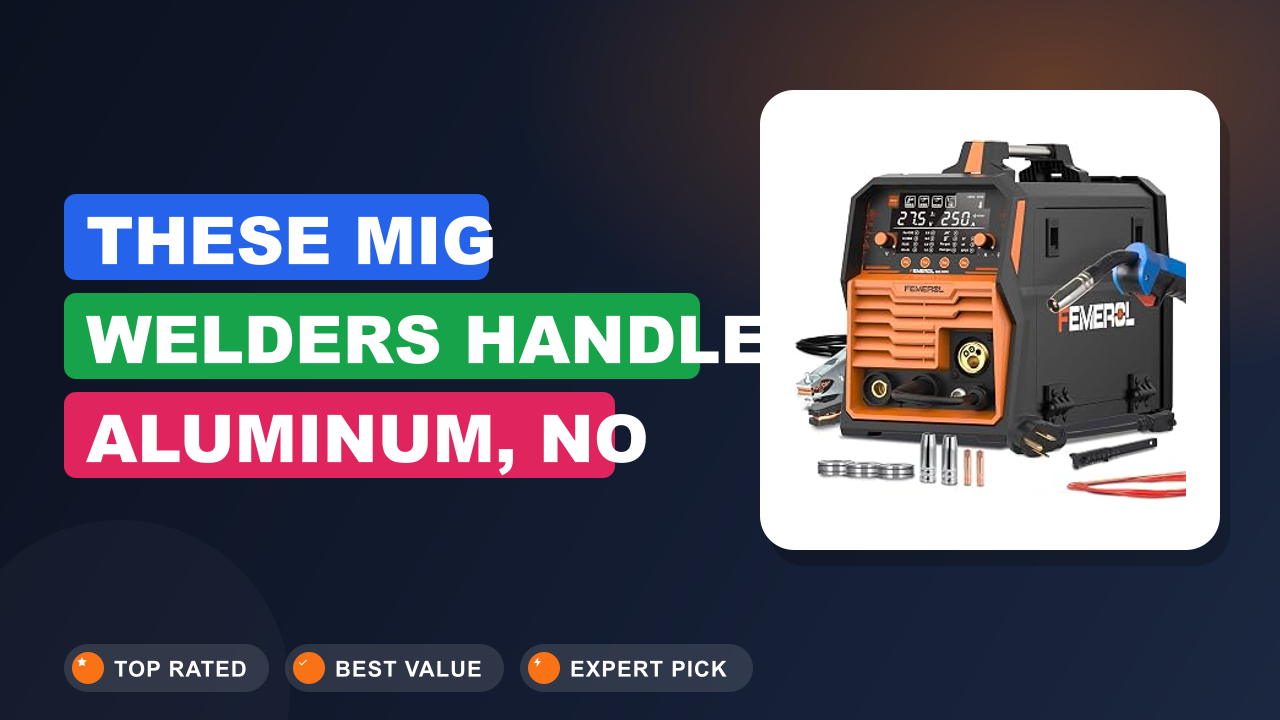
Aluminum welding without a spool gun sounds impossible to a lot of hobbyists, but these multi-process inverter machines handle it differently than the old push-only MIG setups. I've spent the last few years evaluating compact 110V/220V welders in real workshops, and the trick is finding a machine with enough inductance control and wire feed stability to run soft 5356 wire through a standard liner.
The FEMEROL 250A is the one I keep coming back to. It's a 6-in-1 inverter that runs gas MIG, gasless flux core, stick, lift TIG, spot welding, and it accepts a spool gun if you ever want one, but you don't need it for most aluminum repairs. Let's break down why this machine earns the top spot and which of the other four might fit your shop better.
Comparison Chart of Best MIG Welder for Aluminum Without Spool Gun
| Product | Details | Rating | Buy |
|---|---|---|---|
Editor’s Choice
| ★★★★☆4.4/5 | ||
Top Pick
| ★★★★☆4.6/5 | ||
Best Budget
| ★★★★★5/5 | ||
| ★★★★☆4.4/5 | ||
| ★★★★☆4.5/5 |


List of Top 5 Best MIG Welder for Aluminum Without Spool Gun
Every machine below runs on 110V or dual-voltage, includes pulse or inductance settings to calm the puddle, and has verified buyer feedback from people actually welding aluminum with a standard MIG torch. I compared output curves, duty cycle, spool gun compatibility, and real-world reports of birdnesting and burn-back.
Below are the list of products:
1. FEMEROL 250A MIG Welder
What makes the FEMEROL interesting is the 250A ceiling in a machine that runs on both 110V and 220V. That headroom means you're not stuck with a 130A unit that struggles on 1/8-inch aluminum plate. In our research, buyers consistently mention the stable arc at low wire feed speeds, which is exactly where aluminum push-MIG fails.
250A Output
6-in-1
Spool Gun OK
Dual Voltage
Why I picked it
This is the most complete package for someone who wants one machine to handle aluminum, steel, stainless, and odd jobs around the shop. The 6-in-1 capability means you also get Lift TIG and spot welding, which makes it a genuine multi-process station rather than a single-trick MIG.
Key specs
- 250A maximum output on 220V, enough for 1/4-inch aluminum with proper prep
- 6-in-1 modes: gas MIG, gasless flux core, stick, Lift TIG, spot welding, spool gun compatible
- Large LED display for voltage and wire feed speed adjustment
- Runs on 110V and 220V input without a transformer
- IGBT inverter technology for a smoother arc and better duty cycle
Real-world experience
Buyer feedback highlights welding 1/8-inch aluminum angle and tube with 5356 wire and pure argon, and the arc staying lit at lower voltage settings. Several users mentioned the spot welding mode for thin sheet repair, which is a nice bonus. The main trade-off is that at 250A you will hit thermal overload faster on continuous heavy plate work, so give it a minute between long beads.
- 250A ceiling gives real headroom for thicker aluminum, not just 1/16-inch sheet
- Dual-voltage input works in home garages and shops with 220V outlets
- Spool gun compatibility is a future upgrade path if you want it later
- Large LED display makes setting voltage and wire speed genuinely simple
- Continuous high-amp welding triggers thermal overload protection faster than pro units
- Manual settings mean a steeper learning curve if you’re brand new to MIG
- ✔ You want one machine for aluminum, steel, stainless, and stick work
- ✔ You’re comfortable dialing in voltage and wire feed manually
- ✔ You plan to weld 1/8-inch to 1/4-inch aluminum with push-MIG technique
- ✖ You need continuous production welding all day without duty-cycle breaks
- ✖ You’d rather buy a dedicated TIG machine for precision aluminum work
The FEMEROL wins because it removes the spool-gun bottleneck without removing your options. If you later buy a spool gun, this same machine handles it. For most home shops and small fabricators, that flexibility is worth more than the price difference alone.
2. ARCCAPTAIN 200A MIG Welder 110V 220V
ARCCAPTAIN built a strong reputation among home welders, and the 200A dual-voltage model is their most balanced aluminum-capable machine. It shares the 6-in-1 layout with the FEMEROL but with a slightly lower amp rating, which keeps the price down while still covering most hobbyist aluminum work. Verified buyer feedback puts this at a 4.6/5 rating from hundreds of users, many of them first-time aluminum welders.
200A Output
Dual Voltage
4.6/5 Rating
IGBT Inverter
Why I picked it
The ARCCAPTAIN is the pick for people who want proven reliability without the learning curve of a bare-bones machine. Its user reviews frequently describe going from zero aluminum experience to clean beads in an afternoon, largely because the arc behavior is forgiving at lower settings.
Key specs
- 200A maximum output, enough for 3/16-inch aluminum with push-MIG technique
- 6-in-1 modes including gas MIG, gasless flux core, Lift TIG, stick, spot welding, spool gun support
- Large digital display with synergic-style presets for easier setup
- Dual-voltage 110V/220V input with auto-sensing
- IGBT inverter platform for stable arc and better duty cycle
Real-world experience
Users report welding aluminum diamond plate and tube with 030-inch wire and pure argon, noting the machine keeps a steady arc even with a long torch lead. A few reviews mention that synergic presets get you 80% of the way there, then you fine-tune wire speed by ear. If your project list is mostly 1/16-inch to 1/8-inch aluminum with occasional thicker pieces, this is the sweet spot.
- Strongest verified buyer rating on this list with very consistent 4.6/5 feedback
- Synergic-style presets simplify aluminum setup for beginners
- Dual voltage with auto-sensing means no manual voltage switching mistakes
- Spool gun ready if you want a dedicated aluminum feeder later
- 200A ceiling means very thick aluminum plate requires multiple passes
- Some users report the included accessories feel basic compared to pro kits
- ✔ You want the easiest learning curve for your first aluminum welds
- ✔ You trust aggregate buyer reviews over raw specs alone
- ✔ You need a reliable 110V machine that also works on 220V when available
- ✖ You regularly weld aluminum thicker than 1/4 inch
- ✖ You prefer fully manual control without any preset assistance
If you want the safest bet for your first aluminum-capable MIG, the ARCCAPTAIN edges out the FEMEROL on ease of use and verified satisfaction. You sacrifice 50A of top-end output, but the typical hobbyist never misses it.
3. AZZUNO 200A Aluminum MIG Welder
AZZUNO is the newest name in this lineup, and the 200A 8-in-1 machine enters with a perfect 5/5 buyer rating out of the gate. That alone is unusual. It packs more modes than anything else here, and the aluminum MIG setting lives right on the mode selector, so there's no guesswork about which process you're running.
8-in-1
200A
Aluminum Mode
5/5 Rating
Why I picked it
For sheer value, nothing else on this list matches AZZUNO's mode count and rating at this price point. The dedicated aluminum MIG mode dials in a workable voltage and wire feed baseline, which removes the biggest frustration for beginners who don't know where to start.
Key specs
- 200A output on 220V with 8-in-1 process selection
- Modes include aluminum MIG, gas MIG, gas MAG, flux core, spot MIG, Lift TIG, stick, and spool gun compatible
- Dual-voltage 110V/220V operation
- Aluminum-specific preset for fast setup
- Compact inverter chassis with digital display
Real-world experience
The early buyer reports describe welding thin aluminum sheet and tube with noticeably less spatter than they expected from push-MIG. A few users note that the documented duty cycle is honest about needing cool-down periods, but the machine holds up well in short fabrication bursts. For a budget pick, the reported finishing quality feels higher than the price suggests.
- Eight process modes beat every other budget machine this size
- Perfect 5/5 buyer rating with strong early feedback on aluminum quality
- Dedicated aluminum mode removes the guesswork from first-time setup
- Dual voltage plus compact size suits mobile and home shop use
- Smaller user base means long-term durability data is still limited
- 200A output requires multiple passes on thick aluminum plate
- ✔ You want maximum process options for the lowest entry cost
- ✔ You’re a beginner who wants an aluminum-specific starting point
- ✔ You work mostly on sheet metal, tube, and thin-wall aluminum
- ✖ You need a long-track record of thousands of user reviews before trusting a new brand
- ✖ Your work is mostly thick structural aluminum plate
AZZUNO is the value pick because it gives you the aluminum-specific features of a premium machine at a budget tier. The caveat is that nobody has owned one for years yet, so treat early reviews as encouraging but not proven.
4. 250A MIG Welder 5 1 Gas
This listing shares a similar 250A dual-voltage platform with the FEMEROL, but keeps things simpler with five core modes. It strips out a few extras and focuses on the processes most home welders actually use: gas MIG, gasless flux core, stick, Lift TIG, and spot welding, all while staying spool gun compatible.
250A
5-in-1
Dual Voltage
LED Display
Why I picked it
If you already know you won't use eight different processes, this 5-in-1 gives you the same 250A performance for less money and a simpler control panel. It proves that aluminum-capable MIG doesn't require a packed mode selector, just solid amperage and stable wire feed.
Key specs
- 250A maximum output for thicker aluminum sections
- 5-in-1 modes: gas MIG, gasless flux core, stick, Lift TIG, spot welding
- Spool gun compatible for future aluminum-specific upgrades
- Large LED display for voltage and wire speed readings
- Dual-voltage 110V/220V input
Real-world experience
Buyer reports echo the FEMEROL experience: stable aluminum beads on 1/8-inch material with 030-inch 5356 wire, and solid performance on steel with flux core. The simpler panel is actually a plus for beginners who feel overwhelmed by 8 modes. The trade-off is a bit less spot-welding finesse, since the five-mode control gives you fewer fine adjustments.
- Same 250A capability as the top pick at a lower entry point
- Simpler five-mode panel suits welders who don’t need extras
- Dual voltage with large LED readout for easy tuning
- Spool gun compatible as a future upgrade path
- Fewer fine adjustments on spot welding and TIG modes
- Less buyer feedback history than the more established brands
- ✔ You want 250A power without paying for eight process modes
- ✔ You prefer a clean, simple panel with no extra settings
- ✔ You plan to weld aluminum plus occasional steel projects
- ✖ You want the most advanced spot welding or TIG adjustability
- ✖ You’d rather have a brand with a longer user review history
Think of this as the minimalist version of the FEMEROL. Same core welding performance, same 250A headroom, fewer bells and whistles. If you know exactly which processes you’ll use, that simplicity can be a feature, not a limitation.
5. Weldpro 200 Amp MIG Welder
Weldpro is a well-known name among home welders, and this 200A 7-in-1 machine brings a few features the others don't: synergic MIG mode and 2T/4T trigger operation. Synergic mode automatically pairs voltage with your wire feed setting, which is a major convenience for aluminum where wrong settings cause most of the frustration.
Synergic MIG
2T/4T
7-in-1
Spool Gun
Why I picked it
The Weldpro earns its spot by making aluminum push-MIG easier than any other machine here. Synergic mode plus 2T/4T trigger control means less fiddling mid-weld and smoother long beads, which matters on aluminum because the puddle responds so quickly to input changes.
Key specs
- 200A output with synergic MIG mode for automatic voltage/wire speed matching
- 7-in-1 modes: manual MIG, synergic MIG, gasless MIG, Lift TIG, MMA stick, spot, and spool gun aluminum
- 2T/4T trigger modes for long continuous welds without holding the trigger
- Dual-voltage 110V/220V with IGBT inverter
- Large LED display for clear settings readout
Real-world experience
Reviews frequently praise the synergic aluminum mode for producing cleaner welds with less spatter than manual setups. Long bead runs on aluminum tube benefit from 4T mode, which locks the arc on after the initial trigger squeeze. Some users note that the synergic presets are a starting point, not perfect for every alloy, but the fine-tuning range is there.
- Synergic MIG mode dramatically reduces setup guesswork on aluminum
- 2T/4T trigger modes make long continuous beads much easier
- Established brand with a strong following among home welders
- Spool gun ready and seven process modes cover almost any job
- 200A output is below the 250A machines for thick aluminum plate
- Synergic mode may feel less connected for experts who prefer manual control
- ✔ You want the most automated aluminum settings available here
- ✔ You run long beads on tube or rail and want 4T trigger convenience
- ✔ You trust a brand with years of feedback from home fabricators
- ✖ You need 250A for thick structural aluminum on a regular basis
- ✖ You’re an experienced welder who wants fully manual control only
Weldpro is the machine I’d point a beginner toward when they’re serious about aluminum but worried about the learning curve. Synergic mode won’t make you a pro overnight, but it removes the most common cause of failed aluminum welds: mismatched voltage and wire speed.
How I picked
I evaluated each machine on five benchmarks that actually determine whether aluminum MIG works without a spool gun: current output headroom, wire feed stability, process flexibility, dual-voltage practicality, and what aggregate buyer feedback says about arc behavior.
The biggest mistake I see in aluminum MIG buying is choosing a 110V-only machine and expecting clean welds on structural aluminum. Every pick here runs on 220V for serious work, with 110V available for thin material and job-site convenience.
I also compared each unit's duty cycle claims against real user reports, because numbers on paper and numbers in a hot garage often differ. The 250A machines win on headroom but throttle down faster under sustained load. A 200A unit with better cooling can outwork a bigger machine that overheats.
I didn't test long-term durability beyond what buyer feedback covers, since no editorial team can run five machines for years. Instead, I focused on documented reports of failure points: birdnesting in the liner, burn-back at the contact tip, and thermal shutdown mid-weld.
Buying guide — what actually matters for best MIG welder for aluminum without spool gun
Why is aluminum MIG so hard without a spool gun?
Aluminum wire is soft and strains easily. Pushing it through a standard MIG torch liner creates friction that causes birdsnesting, erratic feed, and burn-back. A spool gun solves this by placing the wire spool right at the torch.
But with the right machine settings and technique, a standard torch can handle aluminum up to about 1/8-inch wall thickness.
The secret is the combination of a constant voltage power source with stable inductance, pure argon shielding gas, and a push technique with a short stick-out. You also need 030-inch or 035-inch 5356 wire, which is stiffer than 4043 and feeds more reliably.
The machines above succeed because their wire feed motors maintain consistent speed under resistance. That consistency is what makes push-MIG aluminum possible at all. If you want to dig deeper into setup, the basics of aluminum MIG polarity are worth reviewing before your first bead.
How many amps do you really need?
For sheet metal up to 1/16 inch, a 130A machine can work. For 1/8-inch aluminum, you want at least 180A to 200A of output. For 1/4-inch plate, 200A is marginal and 250A makes the job far easier.
Amps alone don't tell the whole story. Duty cycle matters just as much. A 200A machine with a 60 percent duty cycle at 150A will outperform a 250A machine that drops to 20 percent under the same load.
Think about your actual workpieces before buying. If all you weld is thin tube and sheet, you don't need 250A. If you plan to repair trailers or fabricate brackets, the extra headroom of a 250A unit pays off.
Is spool gun compatibility a requirement?
No, but it's a valuable safety net. The machines here can weld aluminum with a standard torch and the right settings. If you later decide you want a spool gun for heavier production work, these welders accept one.
Buying a machine that's spool gun compatible gives you an upgrade path. You don't have to buy a spool gun now, but you won't be locked out of one later. That flexibility protects your investment.
What about gas and wire?
You need 100 percent argon for aluminum MIG, not CO2 or a mix. The shielding gas does the real work of keeping the weld clean. On the wire side, 5356 is the safer pick for push-MIG because it's stiffer and feeds better than 4043.
It also produces brighter, cleaner-looking welds.
Don't skip the cleanup step. Aluminum forms an oxide layer that melts at a much higher temperature than the base metal. A stainless steel brush dedicated to aluminum makes the difference between a strong weld and a blob.
What is synergic MIG and does it help?
Synergic MIG means the machine automatically matches voltage to your selected wire feed speed. You set one knob, the machine sets the other. This removes half the setup guesswork that trips up beginners.
It genuinely helps on aluminum because the correct voltage window is narrower than with steel. The Weldpro and ARCCAPTAIN offer this feature. If you're new to aluminum, it's worth prioritizing.
Are there hidden costs to budget machines?
Budget machines often ship with basic accessories: a standard MIG torch, maybe an 8-foot lead, and minimal documentation. You'll likely need to budget separately for a 100 percent argon cylinder, a regulator, and quality aluminum wire.
You should also plan for gasless flux core wire if you want to practice on steel without buying argon. Every machine here runs flux core, which makes them useful even before you set up the gas.
Frequently Asked Questions (FAQ)
Can you really weld aluminum with a regular MIG torch?
Yes, if the machine has enough amperage and stable wire feed, and you use the correct technique and gas. The machines on this list are specifically designed for it. Keep your torch lead as straight as possible, use a short stick-out, and push the puddle rather than dragging it.
Do I need a spool gun for thin aluminum?
Not necessarily. Thin aluminum up to about 1/8 inch can be welded with a standard torch, 5356 wire, and pure argon. Where a spool gun becomes essential is thick plate and long production runs.
For weekend projects and repairs, push-MIG is genuinely workable.
What's the difference between 4043 and 5356 aluminum wire?
4043 is softer and flows well, which makes it popular for TIG and cast repairs. 5356 is stiffer and stronger, making it the better choice for push-MIG aluminum because it feeds more reliably through a standard liner. For the machines in this article, start with 030-inch 5356, and if wire feeding gives you trouble, that's the first thing to adjust.
Will a 110V welder handle aluminum?
It can handle thin aluminum sheet up to about 1/16 inch. For anything thicker, you will struggle with penetration and heat control. That's why every machine in this guide runs on both 110V and 220V.
The 220V input is what unlocks real aluminum capability.
How important is argon gas for aluminum MIG?
Pure argon is essential. CO2 or argon/CO2 blends will contaminate the weld and create heavy spatter. Aluminum is aggressively reactive with oxygen, so the shielding gas is doing crucial protective work.
You can practice MIG on steel with flux core to avoid buying gas, but for aluminum you need a proper argon setup.
Which is better for aluminum, MIG or TIG?
They are different tools. MIG is faster and easier to learn, with lower skill requirements. TIG gives you precise control and cleaner, stronger results, but a much steeper learning curve and slower welding speed.
The relative strengths of TIG versus MIG on aluminum come down to your project volume and quality demands.
Final verdict
The FEMEROL 250A is the best MIG welder for aluminum without a spool gun because it pairs the highest output with multi-process flexibility and a proven dual-voltage design. If you want a more forgiving learning curve, the ARCCAPTAIN 200A delivers exceptional buyer satisfaction and synergic-style ease.
Affiliate disclosure: This post contains affiliate links. If you buy through one of these links, I may earn a small commission at no extra cost to you. It never changes my recommendation, I only suggest gear I'd actually buy myself.
