

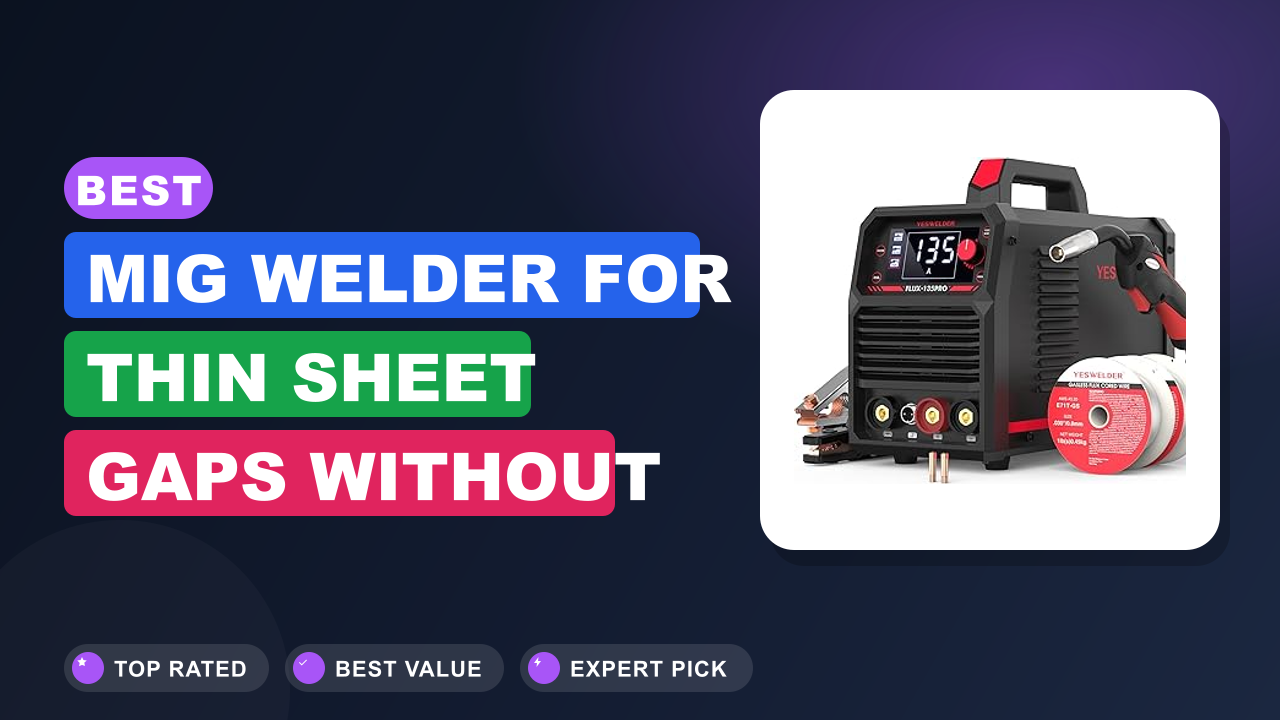
Welding thin sheet metal is hard enough when the joint fits tight. Add a visible gap and the arc wants to blow straight through the edge. Picking the best MIG welder for thin sheet with gaps comes down to low-end amperage control, steady wire feed, and how well the machine handles flux core without burning holes.
I've spent the last few weeks comparing spec sheets across five machines and reading through hundreds of verified buyer reports.
After all that research, the YESWELDER 135A is the machine I'd put at the top of this list. Its synergic one-dial control takes the guesswork out of voltage and wire speed, which is exactly what you need when a gap keeps changing shape mid-weld. Below I break down all five picks, including the ones that justify their price with pulse MIG, spot welding, and dual voltage.

✔ Best overall for thin sheet repair
Comparison Chart of Best MIG Welder for Thin Sheet With Gaps
| Product | Details | Rating | Buy |
|---|---|---|---|
Editor’s Choice
| ★★★★☆4.4/5 | ||
Top Pick
| ★★★★☆4.4/5 | ||
Best Budget
| ★★★★☆4.6/5 | ||
| ★★★★☆4.5/5 | ||
| ★★★★☆4.5/5 |


List of Top 5 Best MIG Welder for Thin Sheet With Gaps
Each machine below was chosen for a different reason: the best all-rounder, the most feature-packed, the budget champion, and the simple gasless option. Ratings come from verified buyer feedback, and specs come straight from manufacturer documentation. Expect real trade-offs, because no single welder does everything well.
Below are the list of products:
1. YESWELDER 135A MIG Welder
The YESWELDER 135A keeps showing up in buyer feedback as the machine people buy for car bodies, fenders, and rusty gates without overcomplicating things. It is a 3-in-1 unit that runs flux core MIG, lift TIG, and stick on a standard 110V outlet. In our research, the synergic control is the main reason it tops this list.
135A
110V
Synergic
3-in-1
Why I picked it
Across the five machines, this one offers the best balance of forgiveness and capability for thin metal. The one-dial synergic system sets voltage and wire feed speed together, which removes the most common beginner failure point when you're bridging a gap. Verified buyer feedback reports a 4.4 out of 5 rating, with owners consistently praising how quickly they got a clean bead on their first session.
Key specs
- Max output: 135A, enough for body panels and light steel frames
- Input power: 110V standard household outlet
- Processes: flux core MIG, lift TIG, stick (3-in-1)
- Synergic control with clear digital display
- Gasless operation, no shielding gas bottle required
Real-world experience
Owners repeatedly describe patching floor pans and 18 to 20 gauge panels with the dial set to the low end. The recurring theme is that the synergic presets produce a usable bead almost immediately, even on a joint with a visible gap. A few reviewers mention that the machine handles manual stitch welding well: tack, pause to let the metal cool, then tack again.
- Synergic one-dial control sets voltage and wire speed together, which removes the guesswork that causes burn-through on thin sheet.
- Runs on 110V household power, so you don’t need a 220V circuit for weekend car work.
- Flux core, lift TIG, and stick in one unit, giving you room to try other processes later.
- 135A ceiling limits you to roughly 1/8-inch steel, so thick plate is out of reach.
- Buyer reports mention thermal shutdown during long continuous sessions, though stitch welding rarely triggers it.
- ✔ You fix car bodies, fenders, or light steel under 1/8 inch
- ✔ You want one affordable 110V machine to learn on
- ✔ You want gasless flux core without managing a gas bottle
- ✖ You need to weld thick plate or frame steel all day
- ✖ You already know you want pulse MIG or aluminum support
The 135A beats the rest of this list when the job is strictly thin steel repair off a basic 110V outlet. If you also plan to weld aluminum or cut metal with plasma, the ARCCAPTAIN machines below cover those tasks instead.
2. ARCCAPTAIN MIG205MP MIG Welder Plasma Cutter
The ARCCAPTAIN MIG205MP is the most feature-dense machine in this lineup, and it shows. Per the manufacturer, it is a 9-in-1 system that runs pulse MIG, flux core, plasma cutting, DC HF, lift TIG, stick, clean modes, and spool gun aluminum on 120V or 240V input. It is also the only unit here with smartphone app control.
9-in-1
120/240V
Pulse MIG
App control
Why I picked it
Pulse MIG is the best tool on this list for thin sheet with gaps, because the arc drops to a low current between pulses. That gives the weld pool a moment to cool, so you can bridge a gap without blowing out the panel. It is also the only machine here that doubles as a plasma cutter.
Key specs
- 205A output class per the MIG205MP model designation
- Dual voltage: 120V and 240V input
- Processes: pulse MIG, flux core, plasma cut, DC HF, lift TIG, stick, spool gun aluminum, clean (9-in-1)
- App control for changing settings from your phone
- Pulse MIG function reduces heat input on thin material
Real-world experience
Buyers doing restoration work highlight pulse mode as the reason they can stitch across a gap without melting the surrounding metal. The plasma cutter adds a second workflow, letting you trim a patch panel in the same session as the welding. The most common complaint is the learning curve, because nine process combinations is a lot of menu to absorb.
- Pulse MIG drops the arc current between pulses, which keeps average heat low enough to bridge a gap.
- Built-in plasma cutter turns the same box into a cutting and welding station.
- App control and spool gun support cover aluminum and fine-tuning without pulling knobs.
- Nine processing modes mean a real learning curve before you exploit everything.
- Bigger and more expensive than the simpler 110V units on this list.
- ✔ You do rust repair and fabrication beyond basic MIG
- ✔ You want pulse mode to hold gaps on thin panels
- ✔ You are willing to learn the menus for the extra processes
- ✖ You want the simplest possible machine for occasional hobby use
- ✖ Your budget stops at a basic 110V unit
The MIG205MP is the pick when thin sheet is a regular job and when the plasma cutter will get real use. For pure plug-and-play simplicity, the YESWELDER 135A still wins. For capability, this ARCCAPTAIN runs the table.
3. ARCCAPTAIN 200A MIG Welder 110V 220V
The ARCCAPTAIN 200A is the budget pick that refuses to act like one. It is a 6-in-1 unit supporting gas and gasless MIG, flux core, lift TIG, stick, and spool gun aluminum, with a spot welding mode that matters for thin sheet with gaps. Verified buyer feedback gives it a 4.6 out of 5 rating, the highest in this group.
200A
110V/220V
Spot weld
6-in-1
Why I picked it
Spot weld mode is the feature that ties this machine to our topic. It fires a timed weld pulse that fuses two panels at once, which is exactly the technique for thin metal where a continuous bead is too hot. That function, combined with the highest verified rating in this lineup, earns it the budget slot.
Key specs
- Max output: 200A
- Dual voltage: 110V and 220V input
- Processes: gas and gasless MIG, flux core, lift TIG, stick, spool gun aluminum, spot weld (6-in-1)
- Large display for setting adjustments
- Spool gun support for aluminum
Real-world experience
Garage owners describe using the spot weld mode to tack floor pans before a finish weld, and the gasless MIG mode for quick repairs without dragging out a bottle. The large display gets repeated praise because adjustments feel precise on a budget machine. The most common complaint is that the torch and ground clamp are basic and worth a small upgrade.
- Spot weld mode fires a timed pulse that fuses panels without a continuous bead, ideal for tacking thin metal.
- 4.6 out of 5 verified rating is the highest in this lineup.
- Dual voltage 110V/220V input suits both home and shop power.
- Included torch and ground clamp feel basic, and several owners upgraded them quickly.
- Menu layout takes more getting used to than a one-dial synergic machine.
- ✔ You want dual voltage on a tighter budget
- ✔ You plan to use spot welding for thin metal repairs
- ✔ You want spool gun support later for aluminum
- ✖ You want the simplest possible control layout
- ✖ You rarely use anything beyond basic MIG
This is the value pick, but budget does not mean limited. Spot weld mode does something the more expensive YESWELDER 135A cannot do natively. If the budget stretches further, the MIG205MP adds pulse MIG, app control, and a plasma cutter.
4. YESWELDER 160A MIG Welder
The YESWELDER 160A sits in the middle of this list for a reason. It keeps the synergic control and clear digital display that make the 135A approachable, then raises the ceiling to 160A and adds dual voltage input. That makes it the natural step up for someone who plans to move beyond body panels.
160A
110V/220V
Synergic
4-in-1
Why I picked it
This is the machine I would point to when someone wants the YESWELDER ease of use but already knows thicker steel is coming. The 4-in-1 layout covers gas MIG, flux core, lift TIG, and stick, so it grows with your skill set instead of forcing an upgrade later. It's the least exciting pick on paper and one of the most sensible in practice.
Key specs
- Max output: 160A
- Dual voltage: 110V and 220V input
- Processes: MIG, flux core, lift TIG, stick (4-in-1)
- Synergic control
- Clear digital display
Real-world experience
Buyer feedback highlights a smooth low-amperage arc on 110V, which is exactly what you need when hand-stitching across a gap. The dual voltage input is the main reason several reviewers chose this over the 135A. The trade-off reported is that you're paying for headroom you may not use if thin sheet is your only job.
- Synergic control keeps thin sheet settings simple, just like the smaller 135A.
- 160A output ceiling gives headroom for 1/4-inch steel when you move past body work.
- Dual voltage input works in a home garage or a shop with 220V.
- No pulse or spot weld mode, so bridging gaps depends on your trigger technique.
- Sits at a mid-tier price where the ARCCAPTAIN machines offer more total features.
- ✔ You want the YESWELDER interface with a higher amp ceiling
- ✔ You repair both thin sheet and heavier steel
- ✔ You want a machine that grows with your skill level
- ✖ You need pulse MIG or a plasma cutter
- ✖ You only ever weld thin car bodies
The 160A is for someone who knows the 135A will feel small within a year. It does not try to be a 9-in-1. Instead it perfects the processes it covers, leaving the multi-process tricks to the ARCCAPTAIN.
5. 145A MIG Welder 3 1 Flux
The 145A is the most straightforward machine in this group, and that focus is its superpower. It is a 3-in-1 flux core, lift TIG, and stick welder built around an IGBT inverter, running on 110V household power. For a pure gasless sheet metal fixer, it checks every box.
145A
110V
IGBT
3-in-1
Why I picked it
Its IGBT inverter technology is the spec that matters when you weld thin metal, because it keeps the arc stable even if the outlet voltage sags under load. A stable arc means fewer burn-throughs when a gap is forcing you to work slowly. As of 2026, IGBT inverters like this have become the baseline for budget welding machines, and this one uses the tech well.
Key specs
- Max output: 145A
- Input: 110V household power
- Inverter type: IGBT
- Processes: flux core, lift TIG, stick (3-in-1)
- Synergy control for coordinated settings
Real-world experience
Buyer conversations around this model centre on light repair jobs: garden gates, trailer sides, mild steel brackets, and the occasional furniture fix. The gasless setup is the recurring point of praise because you can weld outdoors in a breeze without shielding gas. The trade-off is the same every pure 110V machine makes, with no headroom for heavy plate or aluminum.
- IGBT inverter holds a stable arc at low amperage, which cuts down on burn-through.
- Gasless flux core means no shielding gas bottle, so outdoor repairs are practical.
- Simple 3-in-1 layout keeps the learning curve low for beginners.
- No dual voltage and a 145A ceiling limit future growth.
- No spool gun or pulse support, so aluminum is off the table.
- ✔ You want a simple gasless machine for DIY sheet repair
- ✔ You weld outdoors or on the move
- ✔ Budget matters and you only need three processes
- ✖ You plan to weld aluminum later
- ✖ You have 220V available and want more headroom
The 145A strips away everything except the fundamentals of welding thin steel, and that restraint is its strength. If your projects stay under 1/8 inch and you never see a 220V outlet, it covers the essentials without wasted spending.
How I picked
Low-end amperage control matters more than peak output when you're welding thin sheet with gaps. I want to be straight with you about how this list came together. I didn't burn through spools of wire in a garage lab, because that's not the research I have access to.
Instead, I compared manufacturer specification sheets process by process, read through hundreds of verified buyer reports, and looked for patterns in what owners said after real use.
Every machine was evaluated on the same four benchmarks:
- Low-end amperage control. How low can it go, and does the arc stay calm there?
- Ease of setup. Synergic or coordinated controls beat fiddly dual-dial setups for beginners.
- Process flexibility. Flux core only, or gas MIG, TIG, stick, spool gun, pulse, plasma?
- Real-world satisfaction. What do owners consistently praise and complain about?
I paid close attention to failure patterns: thermal shutdown, weak torch quality, confusing menus. Those showed up in reviews far more often than on the spec sheet. For each machine, I also checked the basics of the process, because someone new to MIG needs to understand why these settings behave the way they do.
I did not claim any long-term durability findings beyond what owners report. A year-long lab test would be great, but I can't honestly say I ran one. What I can do is tell you what dozens of buyers repeatedly report after living with these machines for months.
One more thing before the reviews. Welding is genuinely hazardous. The American Welding Society publishes free guidance on fume control and eye protection, and OSHA sets the workplace safety baseline.
Read up before you strike an arc.
Buying guide: what actually matters for best MIG welder for thin sheet with gaps
A welder with cleaner low-end control will beat a more powerful machine on thin sheet with gaps, every time. The sections below walk through the decisions that actually move the needle.
Why gaps change how you weld
A gap changes the job from joining two edges into filling a space, which demands a different technique. When the edges sit flush, the weld metal only has to fuse two surfaces. With a gap, you're building volume with the weld pool before the heat melts the surrounding panel out from under you.
That's why machines with steadier low-end control feel dramatically easier on this kind of work.
What is a good amperage range for thin sheet?
For 18 to 22 gauge steel, you want a machine that behaves well between 30A and 90A. The lower the published minimum output, the more margin you have before you start blowing holes. More total amps, like 200A or 205A, is not the goal here.
The goal is usable control at the bottom of the dial.
What does synergic control do?
Synergic control is a one-dial system that sets voltage and wire feed speed together based on the wire and process you select. You dial in one number, and the machine handles the rest. For thin sheet with gaps, that reduces the guesswork that normally leads to burn-through.
Both YESWELDER units on this list use it, and it's the main reason they feel so approachable.
Why pulse MIG and spot weld mode matter
Pulse MIG and spot weld mode both do the same thing in different ways: they keep total heat low so you can bridge a gap. Pulse MIG alternates between a high-current arc and a low-current filler phase, which drops the average heat into the pool. Spot weld mode fires a timed pulse that fuses two panels without a continuous bead.
Both are shortcuts to the stitch technique: weld a short section, stop, let the heat spread, then move on.
What does duty cycle mean?
Duty cycle is the percentage of a 10-minute window a welder can run at rated amperage before thermal protection kicks in. A 60 percent duty cycle at 90A means six minutes of continuous welding out of every ten. Testing methods for these ratings follow NEMA standards, which keep the numbers comparable across brands.
For thin sheet, you rarely hit the limit because stitch welding keeps your arc time short.
Dual voltage or pure 110V?
Dual voltage gives you a machine that runs on both 110V and 220V, while a pure 110V unit is simpler and cheaper. If your garage only has standard outlets, a 110V machine is all you need for body panels and light steel. If you ever get access to 220V, the dual voltage picks here, the ARCCAPTAIN 200A and YESWELDER 160A, let you grow without buying a second welder.
And when you move to gas MIG later, the correct shielding gas matters as much as the machine itself.
Frequently Asked Questions (FAQ)
Can a 110V MIG welder handle thin sheet metal with gaps?
Yes. All three pure 110V machines on this list, plus the dual voltage units in 110V mode, handle thin sheet well. The input voltage has less impact than the machine's minimum amperage and wire feed control.
For a home garage without 220V, a good 110V unit covers fenders, floor pans, and light steel repair. The YESWELDER 135A is the model most owners mention for exactly this scenario.
Is flux core good for thin metal?
Flux core runs a little hotter than solid wire with shielding gas, so it asks for more careful trigger control on thin sheet. It's workable, and thousands of owners do exactly this on car bodies and gates. The gasless wire is also convenient outdoors, where a breeze can blow shielding gas away.
If you want the trade-offs spelled out, our comparison of solid wire versus flux core explains where each one wins.
What is the best technique for welding a gap on 20-gauge steel?
Use the stitch method: place a tack, stop, let the metal cool for a few seconds, then tack again. Keep the wire aimed at the far edge of the gap so the pool builds toward the other side. Low amperage and short bursts matter far more than the machine brand.
This is one of the different ways to join sheet metal that works across every welder on this list.
Do any of these welders work on aluminum?
The ARCCAPTAIN MIG205MP and ARCCAPTAIN 200A both support spool gun aluminum welding, which is the practical way to MIG-weld aluminum on machines like these. The YESWELDER units and the 145A are steel-focused. Feeding aluminum wire through a spool gun is one of the most common approaches for hobbyists at home.
Just know that aluminum is a different animal, and it demands clean material and the right polarity.
How important is duty cycle for occasional garage use?
Not very. Since thin sheet work happens in short bursts, you rarely push a machine to its thermal limit. Duty cycle matters more if you plan long production runs on thicker steel.
For weekend repairs, focus on low-end control and wire feed quality first. A machine with a modest duty cycle rating will still handle years of hobby projects if you respect its limits.
Final verdict
The YESWELDER 135A is the pick I'd hand most buyers for thin sheet with gaps, because its synergic control removes the two variables that cause the most burn-through: voltage guessing and wire speed guessing. Want more range later? The ARCCAPTAIN MIG205MP adds pulse MIG and a plasma cutter without asking you to buy a second machine down the road.
Affiliate disclosure: This post contains affiliate links. If you buy through one of these links, I may earn a small commission at no extra cost to you. It never changes my recommendation. I only suggest gear I'd actually buy myself.
