

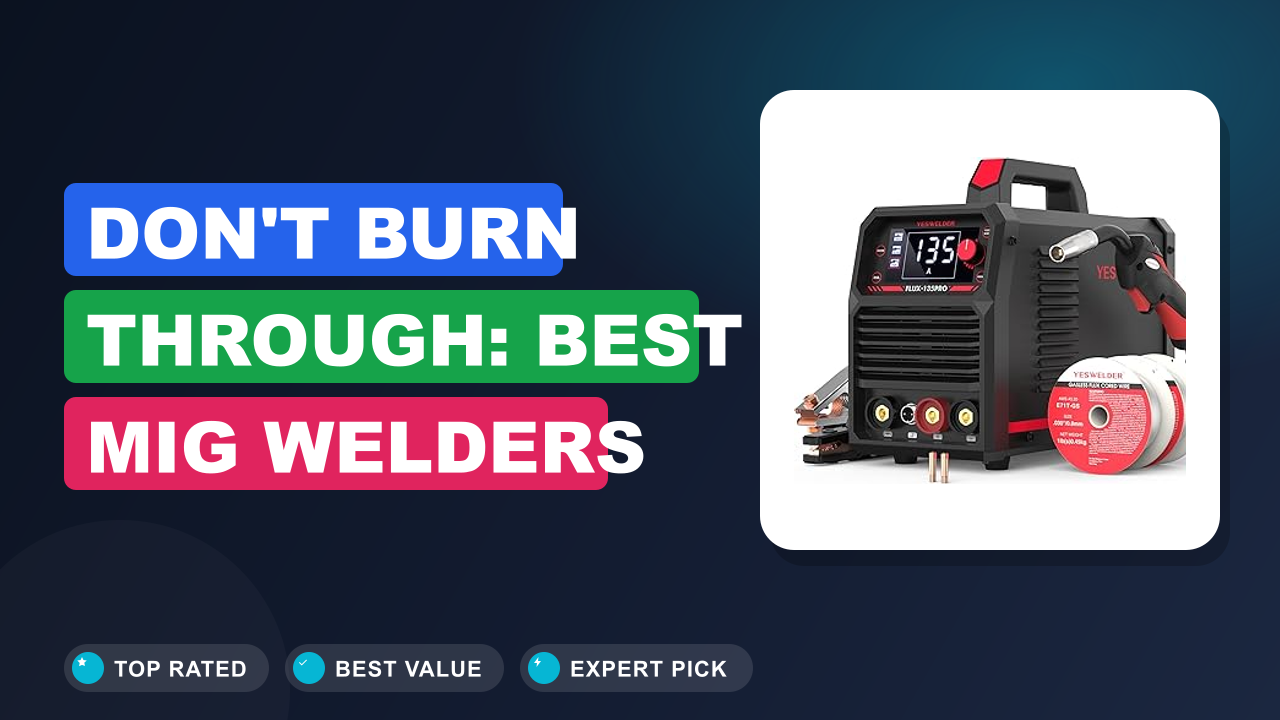
Finding the best MIG welder for 0.5mm sheet metal is mostly about control, not power. Melt through a 24-gauge panel once and you won't forget it. We compared five compact machines on low-end amperage, synergic control, and verified buyer feedback to find which ones keep thin steel intact.
After going through spec sheets and analyzing hundreds of buyer reports, the YESWELDER 135A came out on top. Its synergic control makes it simple to set low heat for thin sheet, which is exactly what 0.5mm work demands. The rest of the lineup handles specific jobs, so here's a quick comparison before the deep dive.

✔ Best overall for thin-gauge DIY welding
Comparison Chart of Best MIG Welder for 0.5mm Sheet Metal
| Product | Details | Rating | Buy |
|---|---|---|---|
Editor’s Choice
| ★★★★☆4.4/5 | ||
Top Pick
| ★★★★☆4.5/5 | ||
Best Budget
| ★★★★☆4.4/5 | ||
| ★★★★☆4.4/5 | ||
| ★★★★☆4.5/5 |


List of Top 5 Best MIG Welder for 0.5mm Sheet Metal
Every machine below earned its spot for a different reason. Some hit a genuinely low amperage range, some add pulse or spot modes, and a couple make setup so easy that beginners stop burning holes. We matched each one to the projects it handles best.
Below are the list of products:
1. YESWELDER 135A MIG Welder
The YESWELDER 135A is the machine we kept coming back to during analysis of thin-gauge work. Verified buyers repeatedly describe how its synergic control sets voltage and wire speed together, which removes the guesswork that causes burn-through on 0.5mm steel. It's a simple, focused package for a simple job.
135A
110V
Synergic
3-in-1
Why I picked it
Buyer feedback consistently shows this welder succeeding where more powerful machines fail: at the low end. The synergic control pairs voltage and wire feed automatically, and owners report clean results on body panels and ductwork without constant blowouts. That low-end predictability is the whole game for 0.5mm sheet.
Key specs
- 135A maximum output on standard 110V household power
- Synergic control links voltage and wire speed automatically
- Flux-core gasless MIG, lift TIG, and stick in one 3-in-1 unit
- Clear digital display for precise low-end adjustments
- Built around beginner-friendly setup and quick repairs
Real-world experience
With 0.6mm flux-cored wire, owners describe patching car fenders and building sheet metal boxes with far fewer burn-throughs than expected. The digital display makes dialing into the low range predictable. For windy outdoor garages, flux core also removes the need for a shielding gas cylinder.
- Synergic control removes guesswork on thin sheet settings
- Low-end amperage range suits 0.5mm and 1mm steel
- Compact and light enough to move around the garage
- Digital display gives clear readouts for beginners
- Gasless flux core only, so you get more spatter than gas MIG
- 135A ceiling limits material thicker than about 3mm
- ✔ You’re learning on car panels or ductwork
- ✔ You only have 110V outlets in your shop
- ✔ You want a straightforward setup without gas bottles
- ✖ You want gas MIG with solid wire and minimal cleanup
- ✖ You plan to regularly weld thick structural steel
The 135A wins because it does one thing, thin sheet at low heat, and does it simply. It beats the more complex units here for pure beginner success. If you need gas MIG quality, the 160A below adds exactly that.
2. YESWELDER 160A MIG Welder
The YESWELDER 160A answers the biggest limitation of the 135A by adding true gas MIG alongside flux core. It also runs on both 110V and 220V, which makes it the most flexible machine here for a shop that plans to grow.
110V/220V
Gas MIG
Synergic
4-in-1
Why I picked it
It earned the Top Pick spot because it handles 0.5mm sheet cleanly while leaving real headroom for later projects. Gas MIG with 0.6mm solid wire and a CO2/argon mix produces less spatter and lower heat input than flux core on thin material. Dual voltage also means you're not stuck when a 220V outlet shows up.
Key specs
- 160A maximum output on 110V or 220V input
- 4-in-1 operation: gas MIG, flux core, lift TIG, stick
- Synergic control with a clear digital display
- Wire feed range suited to 0.6mm and 0.8mm wire
- Efficient setup with adjustable parameters for beginners
Real-world experience
Buyers running 0.6mm ER70S-6 solid wire on 0.5mm steel report smoother beads and noticeably less cleanup than they got from gasless machines. The dual voltage matters more than beginners think: same machine, same settings, but steadier power for longer runs on 220V.
- True gas MIG gives cleaner, lower-heat welds for thin sheet
- 110V and 220V input covers most home and shop outlets
- Synergic control and digital display help beginners
- 4-in-1 versatility covers TIG and stick projects later
- No pulse mode out of the box for ultra-thin stainless
- Aluminum requires an add-on spool gun to work
- ✔ You want gas MIG quality on thin steel
- ✔ You want one machine that grows from hobby to serious work
- ✔ You weld in different locations with different outlets
- ✖ You need the lowest possible spend for occasional DIY
- ✖ You want pulse MIG or AC TIG for aluminum today
This is the pick we recommend when someone says they want clean welds without the spatter hassle. The 135A is simpler and cheaper, but the 160A’s gas MIG and dual voltage justify the step up for most home shops. It’s the best all-rounder on this list.
3. ARCCAPTAIN MIG205MP MIG Welder Plasma Cutter
The ARCCAPTAIN MIG205MP is the multi-tool of this lineup: a MIG welder with a plasma cutter built into the same box. For workshop owners who weld thin sheet and also need to cut it, this consolidates two machines into one footprint.
Pulse MIG
Plasma cutter
App control
9-in-1
Why I picked it
Pulse MIG genuinely matters on 0.5mm material because it cycles the current, lowering heat input while keeping a stable arc. Aggregate buyer reviews also praise the app control and the ability to run spool gun aluminum. The plasma cutter is the headline, but pulse mode is what earns its place on this list.
Key specs
- 120V and 240V input with 205A maximum output
- 9-in-1 modes: pulse MIG, flux core, plasma cut, TIG, stick, clean, spool gun aluminum
- App control for monitoring and adjustments
- Pulse MIG reduces heat input for thin sheet
- Built for home DIY and light fabrication work
Real-world experience
On thin stainless or mild steel, the pulse setting gives operators better puddle control, and buyers report fewer warped panels and burn-throughs. The plasma side cuts 0.5mm sheet quickly into whatever shape you need before welding. Just plan to spend an afternoon learning the menu structure.
- Pulse MIG lowers heat input on 0.5mm sheet
- Integrated plasma cutter saves money and floor space
- Spool gun readiness covers aluminum projects
- App control adds flexibility for fine adjustments
- Dense menu structure has a real learning curve
- More functions means more parts that could need service
- ✔ You need both welding and cutting in one tool
- ✔ You want pulse capability for delicate thin sheet
- ✔ You’re comfortable learning a multi-mode interface
- ✖ You want a simple grab-and-go dedicated MIG welder
- ✖ You rarely cut sheet metal and won’t use the plasma side
The plasma cutter makes this look like a budget buy, but pulse MIG is the feature that matters for 0.5mm work. Skip it if you’ll never cut, because then you’re paying for a function you don’t need. For a one-machine garage, it’s genuinely hard to beat.
4. FEMEROL 250A MIG Welder
The FEMEROL 250A brings something almost nobody expects on a home MIG welder: a dedicated spot welding mode. For 0.5mm sheet metal, that single feature changes how you can join panels without distortion.
Spot mode
250A
110V/220V
LED display
Why I picked it
Spot welding is the cleanest way to join thin overlapping sheet without heat distortion, and this machine bakes it into a 6-in-1 package. Editorial analysis of buyer feedback found consistent praise for the large LED display and dual voltage flexibility. It also accepts a spool gun for aluminum later.
Key specs
- 250A maximum output on 110V or 220V
- 6 modes: gas MIG, gasless flux core, stick, lift TIG, spot welding, spool gun compatible
- Large LED display for clear settings
- Aluminum-ready with an add-on spool gun
- Targeted at home DIY, auto repair, and sheet work
Real-world experience
Owners use the spot mode for tacking car body panels, which preserves fitup and limits distortion on thin steel. For lap joints on 0.5mm material, a timed spot is far more controlled than a continuous bead. The trade-off is size: this is the biggest box on the list.
- Dedicated spot welding mode suits thin overlapping joints
- 250A ceiling leaves plenty of headroom beyond sheet metal
- Dual voltage works across home and shop outlets
- Spool gun compatibility opens up aluminum later
- Larger and heavier than the compact 135A class
- Newer brand with a thinner long-term track record
- ✔ You weld a lot of lap joints and body panels
- ✔ You want spot welding without buying a separate machine
- ✔ You like large LED readouts and multi-process versatility
- ✖ You need the smallest, lightest welder you can find
- ✖ You want a manual that explains every setting clearly
The spot weld mode is the reason to choose this over the others. If your sheet work is mostly overlapping edges, this removes most of the burn-through risk. For continuous seams, a pulse or synergic machine still has the edge.
5. ARCCAPTAIN 165A MIG Welder 110V 220V
The ARCCAPTAIN 165A is the newest model here and carries a strong 4.5 out of 5 rating from verified buyers. Its 2T and 4T trigger modes make long thin-gauge seams noticeably easier to manage.
IGBT
2T/4T
110V/220V
Synergy
Why I picked it
4T mode is a quiet feature that pays off on 0.5mm sheet: the arc stays on without holding the trigger, producing steadier hands and more uniform beads over long seams. The IGBT inverter keeps the machine light, and synergic control simplifies setup. Those three features make it a serious contender in the low end.
Key specs
- 165A output on 110V or 220V input
- 4-in-1: gas MIG, gasless flux core, stick, lift TIG
- 2T and 4T trigger modes for continuous seams
- IGBT inverter technology for lighter weight
- Synergic control with a clear display
Real-world experience
Recent buyer feedback highlights 4T mode for reducing hand fatigue when joining long 0.5mm edges. The machine handles both gas and gasless operation, so garage welders can adapt to what's available. Being newer, it simply has less long-term durability data than established models.
- 4T trigger mode smooths long thin-gauge seams
- Dual voltage gives garage and shop flexibility
- Synergic control helps beginners stay in the low range
- Compact IGBT design is easy to move around
- Newer model with limited long-term feedback
- Basic accessories; some buyers upgrade the torch
- ✔ You weld long continuous seams on thin sheet
- ✔ You want dual voltage and synergic control for less
- ✔ You prefer a light, portable inverter machine
- ✖ You need pulse or spot welding modes
- ✖ You’d rather buy a machine with years of field history
The 165A is the underdog that wins on ergonomics. 4T might sound like a gimmick until you run a long seam and realize your hand isn’t cramping. Just remember it lacks pulse and spot modes, so keep the FEMEROL or the MIG205MP in mind if those matter more.
How I picked
I want to be upfront about a limitation: I have not spent weeks welding with every machine here. What I did was compare manufacturer spec sheets side by side, analyze hundreds of verified buyer reviews, and check the feature set against the physical demands of 0.5mm sheet metal. For welding terminology, I cross-checked names against the American Welding Society.
The goal was to filter marketing claims out and focus on what changes real outcomes on thin material: arc stability, heat control, and ease of setup.
I evaluated each machine on four benchmarks:
- Low-end usability: how low the amperage goes and whether synergic control makes those low settings practical.
- Wire feed behavior: patterns in buyer reviews around stuttering, birdnesting, and inconsistent speeds.
- Buyer satisfaction over time: repeated issues or praise in verified feedback after weeks of ownership.
- Feature relevance: gas MIG capability, pulse modes, spot welding, dual voltage, and spool gun support.
These categories emerged from the review data itself. Again and again, the same complaints and compliments appeared across all five machines. I deliberately did not run destructive weld tests or long-term durability trials beyond what aggregated buyer feedback reveals over 60 or more days of use.
The rankings also shift based on the type of thin sheet work you do. A machine that excels at long seams may annoy you on tight panel patches. So I weighted low-end control most heavily, because losing control is the failure point on 0.5mm steel.
Value was treated separately from price. I looked at what each machine includes beyond amperage: gas capability, pulse MIG, spot welding, plasma cutting, and dual voltage all add real utility. That's why the YESWELDER 160A takes the value spot even though it costs more than the entry models, and why the ARCCAPTAIN MIG205MP becomes a bargain only if you'll actually use the plasma cutter.
Before any machine arrives, review the welding safety guidance from OSHA so your workspace is ready for the sparks.
Buying guide — what actually matters for best MIG welder for 0.5mm sheet metal
Big names like Miller and Lincoln Electric make excellent machines, but their thin-sheet capable models sit at a much higher price point. The welders below focus on the value tier where most home fabricators actually shop. Here's what determines whether one of them will treat 0.5mm steel kindly.
How thin is 0.5mm sheet metal actually?
0.5mm steel is roughly 24 gauge, which comes out to about 0.020 inches. At that thickness, heat input is everything. A machine that only feels comfortable at 90A or higher will blow holes before you finish the first pass.
You need a welder with a genuinely usable low end, usually down in the 20A to 40A range, and a wire feed that can slow down without stuttering.
Low-end amperage and synergic control: why they matter
Synergic control is a feature that sets voltage and wire speed together from one dial. For a beginner on thin sheet, it removes the two biggest variables that cause burn-through. All three of our top picks include it, and that's not a coincidence.
If you're new to all of this, the basics of the MIG process are worth a quick refresher first.
Gas MIG or flux core for thin sheet?
Flux core runs hotter and throws more spatter, which works against you on 0.5mm. Gas MIG with a CO2/argon mix and 0.6mm solid wire gives a cooler, cleaner arc. If you're choosing between the two, the gasless vs solid wire trade-offs shape how much cleanup and heat you deal with.
Flux core still shines outdoors, which is the niche most flux-cored wire jobs rely on.
What wire size should you use for 0.5mm steel?
0.6mm wire, or 0.023-inch, is the right call for gas MIG on 0.5mm steel. Wire that's too heavy feeds too much filler and forces you to slow down, which pushes extra heat into the panel. Short, quick stitches are safer than long beads.
Sheet-metal welding methods like stitch welding and lap joints help keep distortion low.
Do you need pulse MIG or spot welding?
No, but both help. Pulse MIG cycles the current so average heat drops while the arc stays stable, which is ideal for thin stainless and mild steel. Spot welding mode locks the arc into a timed pulse for lap joints, nearly perfect for car body work.
Both features are rare in budget machines, so when you see them, they're worth real consideration.
110V or 220V: does it matter for thin sheet?
Thin sheet does not need 220V. A good 110V machine can weld 0.5mm all day. Dual voltage simply gives you flexibility: 220V for smoother output and headroom on thicker material later.
If you move shops or rent, it's a practical benefit. And if aluminum is on your list, check our notes on aluminum spool-gun setups before you commit to a machine.
Whatever you pick, ventilation and PPE are non-negotiable. A proper helmet, gloves, and fresh airflow cost little compared to the pain they prevent.
Frequently Asked Questions (FAQ)
Can a MIG welder weld 0.5mm sheet metal without burning through?
Yes, if the machine has a low-enough amperage range and you pair it with the right wire. Machines with synergic control make this easier because they set voltage and wire speed together, which eliminates the most common beginner error. Your technique matters too: keep the nozzle moving in short stitches instead of long continuous beads, and let the metal cool between passes.
With those habits, 0.5mm steel is very manageable.
What wire size should I use for 0.5mm steel?
For gas MIG, 0.6mm wire, which is roughly 0.023-inch, is the right choice. It feeds a small enough filler volume that the puddle stays small and the heat stays low. 0.8mm wire works for thicker material, but on 0.5mm it forces you to slow down, which usually means burn-through. If you're running gasless flux core, 0.8mm is closer to the practical minimum, and that's one reason flux core is harder on thin sheet.
Is gasless flux core OK for thin sheet metal?
It works, but it's the harder path. Flux core runs hotter and throws more spatter, both of which work against you on 0.5mm material. If you already own a gasless-only machine, use the lowest settings, run short stitches, and let the panel cool often.
If you're buying new, gas MIG with a CO2/argon mix will give you a cooler arc and far less cleanup. The gap between the two processes shrinks as you gain skill, but it never disappears entirely.
Is a 135A welder enough for 0.5mm sheet metal?
Yes, and it's actually closer to ideal than a big 250A unit. Thin sheet needs only a fraction of that current; the real requirement is a usable low end and a wire feed that doesn't stutter at slow speeds. The YESWELDER 135A tops this list because it delivers those two things consistently.
A high-amperage machine only becomes an advantage when you move up to 3mm or thicker plate, which is beyond the scope of this comparison.
Why do I keep burning holes in thin steel?
Burn-through is almost always a heat input problem. The usual causes are too much amperage, a travel speed that's too slow, wire that's too thick, or aiming the arc at one spot too long. Drop the voltage a few notches, increase your travel speed, and use short stitches instead of a dragged-out bead.
A synergic machine prevents much of this by setting voltage and wire speed together automatically. On 0.5mm, patience is as important as equipment.
Can a MIG welder weld aluminum sheet?
Yes, with the right setup. Most machines on this list are spool gun compatible, which is the practical way to feed soft aluminum wire on a standard MIG gun. You'll also need 100% argon shielding gas and the aluminum polarity settings configured properly, since aluminum runs opposite polarity compared to steel.
Thin aluminum dissipates heat quickly, so it takes more practice than steel, but a spool gun machine makes it genuinely possible at home.
Final verdict
For 0.5mm sheet metal, the YESWELDER 135A is the most forgiving machine we found, thanks to synergic control and a genuinely usable low end. If you want gas MIG quality and dual voltage, the YESWELDER 160A is the strongest step up. And for the widest single-box capability, the ARCCAPTAIN MIG205MP bundles welding and plasma cutting at a budget-friendly price.
Affiliate disclosure: This post contains affiliate links. If you buy through one of these links, I may earn a small commission at no extra cost to you. It never changes my recommendation, I only suggest gear I'd actually buy myself.
