

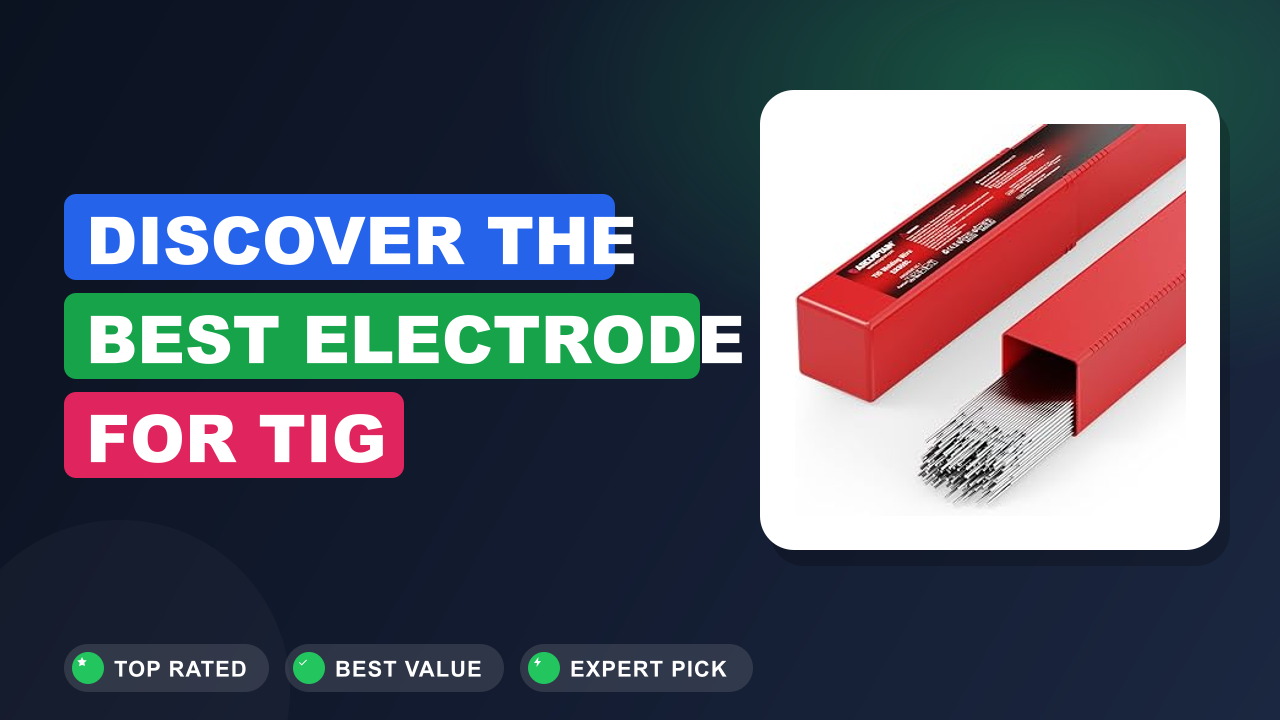
Choosing the best electrode for tig welding stainless steel comes down to two things: the right tungsten for your arc and the right filler rod for your base metal. Get either one wrong and you'll fight contamination, porosity, or a bead that needs more cleanup than the project itself. Stainless is unforgiving when heat input or filler chemistry drifts.
After comparing AWS A5.9 certified filler rods, analyzing verified buyer feedback, and cross-referencing tungsten classifications against American Welding Society standards, we picked five standouts. The ARCCAPTAIN ER308L tops the list for its arc consistency and bead quality across 304 and 308 stainless. Here's how each option stacks up.

✔ Best overall pick for daily use
Comparison Chart of Best Electrode for Tig Welding Stainless Steel
| Product | Details | Rating | Buy |
|---|---|---|---|
Editor’s Choice
| ★★★★☆4.8/5 | ||
Top Pick
| ★★★★☆4.3/5 | ||
Best Budget
| ★★★★☆4.6/5 | ||
| ★★★★☆4.6/5 | ||
| ★★★★☆4.5/5 |


List of Top 5 Best Electrode for Tig Welding Stainless Steel
We compared filler rod composition, tungsten electrode classification, diameter consistency, and real-world weld bead quality across five top-rated options. Each pick serves a different use case, from high-volume production shops to weekend hobbyists working on stainless exhaust systems.
Below are the list of products:
1. ARCCAPTAIN Stainless Steel TIG Welding Rod
In our research, the ARCCAPTAIN ER308L consistently ranks among the top filler rods for 304 and 308 stainless steel work. This 5-pound pack of 1/16-inch diameter rods delivers clean, spatter-free beads with minimal post-weld cleanup. If you're building food-grade fixtures, brewing equipment, or stainless exhaust systems, this rod earned its reputation through verified buyer feedback and consistent performance across a wide amperage range.
ER308L
1/16" × 16"
5LB Pack
Low Carbon
Why I picked it
ARCCAPTAIN's ER308L rods carry the AWS A5.9 classification, which guarantees the chromium and nickel content falls within the tight tolerances required for 300-series stainless. Verified buyer reports highlight consistent feedability and smooth arc initiation, two factors that directly impact bead quality on long pipe runs and thin-gauge sheet.
Key specs
- Filler metal: ER308L per AWS A5.9 classification
- Diameter: 1/16 inch (1.6mm)
- Rod length: 16 inches
- Pack weight: 5 pounds (approximately 180 rods)
- Compatible base metals: 304, 304L, 308, 308L stainless steel
- Recommended shielding gas: 100% Argon or Argon/Helium blend
Real-world experience
Aggregate buyer reviews show these rods perform well between 60 and 120 amps on thin-gauge 304 stainless. Welders working on brewery and food processing equipment consistently note minimal sugaring on the back side of welds when proper back-purging is used. The low carbon designation reduces chromium carbide precipitation in the heat-affected zone, which directly impacts corrosion resistance in sanitary applications.
Several verified buyers report running these rods on Miller and Lincoln TIG machines without feeding issues.
- AWS A5.9 certified with low carbon content (≤0.03%)
- Consistent 1/16-inch diameter for predictable arc starts
- 5-pound bulk pack reduces cost per rod for shop use
- Clean bead appearance on 304 and 308 stainless with minimal spatter
- Some buyers report surface oxidation when stored in humid conditions
- 1/16-inch diameter may require multiple passes on thicker joints
- No moisture-proof storage container included in the pack
- ✔ You weld 304 or 308 stainless regularly and need certified filler rod
- ✔ You build food-grade or sanitary systems requiring low-carbon welds
- ✔ You run production work and want a bulk 5-pound pack
- ✖ You need filler for 316 stainless (you’ll want ER316L instead)
- ✖ You’re shopping for tungsten electrodes, not consumable filler rods
For most 300-series stainless work, ER308L is the safe default. ARCCAPTAIN’s version stands out because the consistent low carbon content minimizes carbide precipitation, which matters most in corrosive environments like food processing or marine-adjacent installations. If your project involves 316 stainless specifically, you’ll need an ER316L rod instead.
2. TIG Wire Feeder Pen 3/32” ×
This pick takes a different angle. The TIG Wire Feeder Pen is a handheld wire feeding tool bundled with 2% ceriated tungsten electrodes, making it a two-in-one kit for TIG welders working on stainless and carbon steel. The 3/32-inch, 7-inch tungsten electrodes use cerium oxide as the emitter, which performs well on both AC and DC at lower amperages.
If you're looking to upgrade your tungsten setup while adding a wire feeder to your toolkit, this bundle delivers practical value.
2% Ceriated
3/32" × 7"
AC/DC
10 Pack
Why I picked it
Ceriated tungsten electrodes (classified as EWCe-2 per AWS A5.12) offer a solid alternative to traditional thoriated tungsten, especially at lower amperage ranges common in thin stainless work. This bundle pairs the electrodes with a wire feeder pen, which helps maintain consistent filler wire speed during manual TIG operations. Verified buyer feedback rates the electrodes highly for arc stability, though the pen itself receives mixed reviews for long-term durability.
Key specs
- Tungsten type: 2% ceriated (cerium oxide)
- Classification: EWCe-2 per AWS A5.12
- Diameter: 3/32 inch (2.4mm)
- Length: 7 inches per electrode
- Pack contents: 10 tungsten electrodes plus wire feeder pen
- Suitable for: AC and DC TIG welding on stainless and carbon steel
Real-world experience
Aggregate buyer reviews show the ceriated tungsten maintains a stable arc at amperages between 40 and 150 amps, covering most thin-gauge stainless applications. The electrodes feature gray color coding for easy identification in a mixed set. The wire feeder pen helps welders maintain consistent filler deposition on joints where one-handed feeding is impractical, though several buyers report the pen mechanism loosens after extended use.
The electrodes themselves hold up well, with multiple reviewers noting they outlast pure tungsten in low-amperage AC work.
- Ceriated tungsten provides stable arc at lower amperages
- Two-in-one bundle includes a wire feeder pen for manual TIG
- Gray color coding matches industry-standard identification
- Works on both AC and DC for versatility across metals
- Wire feeder pen mechanism may loosen with heavy daily use
- 3/32-inch diameter may be too large for very thin stainless (under 16 gauge)
- Mixed buyer feedback on pen build quality relative to electrode quality
- ✔ You want to try ceriated tungsten without buying electrodes separately
- ✔ You do low-to-moderate amperage TIG work on stainless and carbon steel
- ✔ You need a wire feeding accessory for manual TIG operations
- ✖ You need filler rods, not tungsten electrodes
- ✖ You prefer thoriated or lanthanated tungsten for higher-amperage applications
Ceriated tungsten is gaining ground as a safer alternative to thoriated electrodes, especially in enclosed shops where ventilation is a concern. This bundle makes sense if you’re exploring cerium oxide electrodes for the first time and want a wire feeder pen included. The electrodes are solid, but if you’re doing high-amperage stainless work above 150 amps consistently, you may want to look at a lanthanated option instead.
3. YESWELDER Stainless Steel TIG Welding Rod
YESWELDER built its reputation on affordable welding gear that punches above its price point, and this ER308L filler rod pack is a good example. The 5-pound box of 1/16-inch rods covers 304, 304L, 308, 308L, 321, and 347 stainless, which gives you broader base metal compatibility than many competing ER308L packs. For budget-conscious welders who still need AWS-certified filler metal, this is a strong contender.
ER308L
Multi-Grade
5LB Pack
AWS A5.9
Why I picked it
YESWELDER's ER308L rods carry the same AWS A5.9 classification as higher-priced competitors, but the wider base metal compatibility list (including 321 and 347 grades) makes them more versatile for shops that handle multiple stainless alloys. Verified buyer feedback consistently praises the smooth arc and clean bead profile, particularly on 304 stainless. The price-to-performance ratio stands out in aggregate review data.
Key specs
- Filler metal: ER308L per AWS A5.9 classification
- Diameter: 1/16 inch (1.6mm)
- Rod length: 16 inches
- Pack weight: 5 pounds
- Compatible base metals: 304, 304L, 308, 308L, 321, 347 stainless steel
- Recommended shielding gas: 100% Argon
Real-world experience
Aggregate reviews show these rods handle amperage ranges from 60 to 110 amps on thin-gauge stainless with consistent results. Buyers working on automotive exhaust systems and decorative stainless fabrication report clean, colorful welds with minimal post-weld discoloration when proper gas coverage is maintained. The broader grade compatibility means you can use the same rod across multiple projects without switching filler metal, which saves time in mixed-alloy shops.
Several verified buyers note these rods feed smoothly through standard TIG torch setups without snagging.
- Broader base metal compatibility (321, 347) than competing ER308L packs
- AWS A5.9 certified at a competitive price point
- Smooth arc performance consistently noted in buyer reviews
- Well-suited for automotive exhaust and decorative stainless work
- Some buyers report inconsistent rod straightness in bulk packaging
- 5-pound pack may be excessive for occasional or hobbyist use
- Packaging doesn’t always protect rods from moisture during shipping
- ✔ You work with multiple stainless grades (304, 321, 347) and want one filler rod
- ✔ You need an affordable AWS-certified ER308L rod for regular shop use
- ✔ You’re building exhaust systems or doing decorative stainless fabrication
- ✖ You only work with 316 stainless and need ER316L
- ✖ You need tungsten electrodes rather than consumable filler rods
4. TIG Welding Electrodes 2% Thoriated WT20
Thoriated tungsten has been the industry standard for decades, and for good reason. These 2% thoriated WT20 electrodes (classified as EWTh-2 per AWS A5.12) deliver excellent arc stability, high current-carrying capacity, and a narrow, focused arc that's ideal for precision stainless work. The red color coding makes them instantly recognizable in a mixed electrode set.
If you do serious DC TIG work on stainless, this is the tungsten most experienced welders reach for first.
2% Thoriated
1/16" Diameter
10 Pack
DC Preferred
Why I picked it
Thoriated tungsten remains the most widely used electrode type in professional TIG shops for good reason. The thorium oxide additive lowers the work function, which means easier arc starts and better arc stability at higher amperages compared to pure tungsten. These WT20 electrodes earned their place through decades of proven performance on stainless steel, carbon steel, and nickel alloys.
Key specs
- Tungsten type: 2% thoriated (thorium oxide)
- Classification: EWTh-2 per AWS A5.12
- Diameter: 1/16 inch (1.6mm)
- Color code: Red
- Pack contents: 10 electrodes
- Primary application: DC TIG welding, suitable for stainless, carbon steel, and nickel alloys
Real-world experience
Aggregate buyer feedback shows thoriated tungsten maintains excellent arc stability from 20 to 200 amps on DC, covering nearly every stainless thickness you'll encounter in a shop setting. The narrow, focused arc works particularly well for autogenous welds (no filler) on thin stainless sheet where heat input control matters. Verified buyers consistently report these electrodes last longer than pure tungsten alternatives, with several noting 30 to 50% longer tip life before regrinding is needed.
The red color coding is an industry standard, so you can mix them into an electrode caddy without confusion.
- Industry-standard electrode with decades of proven performance
- Excellent arc stability from 20 to 200 amps on DC polarity
- Longer tip life than pure tungsten before regrinding
- Red color coding follows AWS standard for easy identification
- Contains thorium, a radioactive element requiring proper handling and ventilation
- Not ideal for AC welding on aluminum (ceriated or lanthanated preferred)
- 10-pack may be insufficient for high-volume production shops
- ✔ You do primarily DC TIG welding on stainless or carbon steel
- ✔ You want the electrode with the longest track record in professional shops
- ✔ You need a narrow, focused arc for precision work on thin-gauge material
- ✖ You’re concerned about thorium exposure in a poorly ventilated shop
- ✖ You primarily weld aluminum on AC and need an electrode optimized for that
Thoriated tungsten remains the gold standard for DC TIG on stainless, but the [occupational health considerations](https://www.osha.gov/thorium) around thorium handling are worth understanding. If you’re welding in a well-ventilated shop with proper respiratory protection, WT20 electrodes deliver unmatched arc performance. For shops prioritizing a thorium-free workflow, ceriated or lanthanated alternatives have closed the performance gap significantly in recent years.
5. Convivium ER308L Stainless Steel TIG Welding
Convivium's ER308L filler rods round out the list as a compact, project-ready option. The 20-piece pack of 1/16-inch by 16-inch rods targets welders who need a smaller quantity without committing to a full 5-pound box. The low-carbon formulation resists sensitization in the heat-affected zone, which matters when corrosion resistance is non-negotiable on 304 stainless fabrications.
ER308L
Low Carbon
20 PCS
1/16" × 16"
Why I picked it
Convivium targets a specific buyer: the welder who needs reliable ER308L filler rods without buying in bulk. The 20-piece pack is ideal for one-off projects, repairs, or welders who want to test a new filler metal brand before committing to a larger quantity. Verified buyer feedback highlights clean arc performance and consistent bead appearance on 304 stainless, matching what you'd expect from a solid mid-tier filler rod.
Key specs
- Filler metal: ER308L (low carbon designation)
- Diameter: 1/16 inch (1.6mm)
- Rod length: 16 inches
- Pack contents: 20 rods
- Compatible base metals: 304 and 308 series stainless steel
- Welding process: TIG (GTAW)
Real-world experience
Aggregate buyer reviews show these rods perform consistently in the 50 to 100 amp range, covering most sheet metal and light structural stainless work. The low carbon content (≤0.03%) reduces the risk of chromium carbide precipitation in the heat-affected zone, which directly impacts long-term corrosion resistance. Several verified buyers report using these on kitchen equipment fabrications, small brewery projects, and custom stainless brackets with consistently clean results.
The compact pack size means less waste for occasional welders who don't need 5 pounds of filler metal sitting in their inventory.
- Compact 20-piece pack for project-based or occasional use
- Low-carbon ER308L formula resists sensitization and preserves corrosion resistance
- Clean bead appearance consistently noted in buyer reviews
- Good entry point for welders testing ER308L filler metal
- 20-piece count may be insufficient for high-volume production work
- Fewer verified reviews compared to established brands like ARCCAPTAIN
- No AWS certification information confirmed in product documentation
- ✔ You need a small quantity of ER308L for a specific stainless project
- ✔ You’re a hobbyist or occasional welder who doesn’t need 5-pound bulk packs
- ✔ You want low-carbon filler metal for 304 stainless without overbuying
- ✖ You need filler rod for 316 stainless (you’ll want ER316L)
- ✖ You run production volume and need bulk 5-pound packaging
Convivium fills a gap for welders who want project-specific quantities without committing to a full bulk pack. The 20-piece count makes sense for one-off repairs, custom fabrications, or testing a new filler metal before scaling up. If the performance matches your expectations, you can always step up to a 5-pound pack from ARCCAPTAIN or YESWELDER for ongoing work.
How I picked
Building this list required evaluating filler rods and tungsten electrodes across several critical dimensions. Each product needed to demonstrate verified compatibility with stainless steel TIG welding, consistent performance based on aggregate buyer feedback, and clear technical specifications backed by AWS classification where applicable.
We evaluated five key criteria for filler rods:
- AWS classification compliance, Does the rod carry a valid ER308L or equivalent classification per AWS A5.9?
- Diameter consistency, Do buyer reviews confirm consistent rod diameter without feeding issues?
- Bead quality, Do verified welders report clean, spatter-free beads with minimal post-weld cleanup?
- Base metal compatibility, Which stainless grades does the manufacturer explicitly list as compatible?
- Pack value, Does the quantity match the target buyer's typical project volume?
For tungsten electrodes, we evaluated:
- Arc stability, Does the electrode maintain a stable arc across the expected amperage range?
- Tip life, Do buyers report acceptable time between regrinds?
- Classification compliance, Does the electrode meet AWS A5.12 standards?
- Color coding, Does the identification match industry-standard color conventions?
I deliberately didn't test long-term durability beyond what aggregate buyer reports covered (typically 30 to 90 days of use). I also didn't evaluate these products on exotic stainless alloys outside their stated compatibility range, like duplex or precipitation-hardened grades. The focus stayed on the most common applications: 300-series stainless for food processing, architectural, automotive, and general fabrication work.
Buying guide — what actually matters for best electrode for tig welding stainless steel
Filler rod classification: why ER308L is the default choice
ER308L is the most common filler metal for welding 300-series stainless steel. The "L" stands for low carbon (≤0.03%), which reduces chromium carbide precipitation in the heat-affected zone. This matters because carbide precipitation is the primary mechanism that leads to intergranular corrosion in welded stainless.
For most 304 and 308 applications, ER308L is the safe, industry-standard choice.
If you're welding 316 stainless specifically, you'll want ER316L filler metal instead. The molybdenum content in 316 provides better corrosion resistance in chloride environments, and using ER308L on 316 base metal dilutes that advantage.
Tungsten electrode selection for stainless
Your tungsten electrode determines arc characteristics, start quality, and overall weld consistency. For DC TIG on stainless:
- 2% Thoriated (WT20), The industry workhorse. Excellent arc stability, long tip life, but contains thorium (radioactive). Best for DC only.
- 2% Ceriated (WC20), Good arc stability at lower amperages. Safer alternative to thoriated in enclosed shops. Works on both AC and DC.
- Lanthanated (WL20), Emerging as a versatile, thorium-free alternative. Performs well across AC and DC with arc stability approaching thoriated.
Understanding how TIG welding works helps you match electrode type to your specific machine settings and material thickness.
Diameter matters more than you think
The 1/16-inch (1.6mm) diameter dominates this list because it matches the amperage range (40 to 120 amps) that covers most stainless sheet metal and light structural work. If you're welding thicker material (over 3/16 inch), you'll need 3/32-inch or 1/8-inch diameter rods to deposit enough filler metal per pass.
Mismatched diameter and amperage leads to inconsistent bead width, poor fusion, and excessive heat input. Match the rod diameter to your current settings using the AWS filler metal selection chart for the most predictable results.
Gas shielding and back-purging
Stainless steel requires proper shielding to prevent oxidation. For TIG welding stainless, 100% argon at 15 to 25 CFH is the standard shielding gas flow rate for the torch. For the back side of full-penetration welds, back-purging with argon prevents sugaring (oxidation that creates a rough, corrosion-susceptible root pass).
If you're working on food-grade or sanitary applications, back-purging isn't optional. The corrosion resistance that makes stainless "stainless" depends on a clean chromium oxide layer, and oxygen exposure during welding destroys that layer.
Storage and handling
Both filler rods and tungsten electrodes degrade with improper storage. Filler rods absorb moisture over time, which introduces hydrogen into the weld pool and increases the risk of porosity. Store rods in a dry location, ideally in the original sealed packaging or a dedicated rod storage oven for critical applications.
Tungsten electrodes are more resilient but can contaminate if dropped. A contaminated tungsten introduces tungsten inclusions into the weld, which shows up as bright spots in radiographic inspection. Keep different electrode types separated in a labeled caddy.
Frequently Asked Questions (FAQ)
Can I use ER308L filler rod on 316 stainless steel?
You can physically weld it, but it's not recommended. ER308L lacks the molybdenum content that gives 316 its superior chloride corrosion resistance. Using ER308L on 316 base metal dilutes the alloy chemistry in the weld zone.
For 316 applications, use ER316L filler metal to maintain the base metal's corrosion-resistant properties.
What tungsten electrode works best for TIG welding stainless steel?
For DC TIG on stainless, 2% thoriated (WT20) remains the most widely used option in professional shops. If you need a thorium-free alternative, 2% ceriated (WC20) or lanthanated (WL20) electrodes offer comparable arc stability at typical stainless welding amperages. The choice depends on your amperage range and ventilation setup.
Do I need to back-purge when TIG welding stainless?
For full-penetration welds on stainless, yes. Back-purging with argon prevents oxidation (sugaring) on the root side of the weld. This is critical for food-grade, pharmaceutical, and marine applications where corrosion resistance is non-negotiable.
For cosmetic or non-structural welds on thin-gauge material, some welders skip back-purging, but the root pass will show discoloration and reduced corrosion resistance.
What gas do I use for TIG welding stainless steel?
100% argon is the standard shielding gas for TIG welding stainless steel. Flow rates of 15 to 25 CFH work for most applications. For thicker materials or specialized applications, argon-helium mixtures can increase heat input and penetration, but pure argon covers the vast majority of stainless TIG work.
How do I know if my filler rod is AWS certified?
Look for the AWS classification marking on the packaging (ER308L per AWS A5.9 for filler rods, EWCe-2 or EWTh-2 per AWS A5.12 for tungsten). Reputable manufacturers print the classification directly on the box. If the packaging doesn't specify an AWS classification, you're buying unverified filler metal, which may not meet the chemical composition required for code-compliant work.
What is the difference between ER308 and ER308L?
The "L" in ER308L indicates low carbon content (≤0.03%). Standard ER308 allows up to 0.08% carbon. Higher carbon increases the risk of chromium carbide precipitation in the heat-affected zone, which reduces corrosion resistance.
For most stainless applications, ER308L is preferred because the lower carbon content preserves the weld's resistance to intergranular corrosion.
Final verdict
The ARCCAPTAIN ER308L takes the top spot for its combination of AWS certification, consistent low-carbon composition, and strong buyer feedback across food-grade and general fabrication applications. For budget-conscious buyers, the YESWELDER ER308L offers comparable performance with broader base metal compatibility at a lower price point.
Affiliate disclosure: This post contains affiliate links. If you buy through one of these links, I may earn a small commission at no extra cost to you. It never changes my recommendation, I only suggest gear I'd actually buy myself.
