

Understanding what polarity for MIG welding is essential for strong, clean welds. This guide explains the difference between DCEP and DCEN, how to set your machine correctly, and why polarity matters for different metals and wire types.
Key Takeaways
- Polarity determines arc stability and penetration: Using the right polarity ensures a smooth arc, proper penetration, and minimal spatter.
- Most MIG welding uses DCEP (reverse polarity): This is the standard setting for steel and stainless steel with solid or flux-cored wire.
- DCEN (straight polarity) is rare in MIG welding: It’s mostly used in specialized TIG applications, not typical MIG setups.
- Check your wire and gas combination: The correct polarity depends on whether you’re using solid wire with CO₂/argon mix or flux-cored wire.
- Wrong polarity causes poor weld quality: Signs include excessive spatter, weak penetration, and an unstable arc.
- Always consult your machine’s manual: Some welders have specific polarity recommendations based on model and wire type.
- Double-check connections before welding: Loose or reversed leads can mimic incorrect polarity and ruin your weld.
What Polarity for MIG Welding? A Complete Guide
If you’re new to MIG welding or just looking to improve your technique, one of the first things you need to understand is what polarity for MIG welding is correct. Polarity might sound like a technical detail, but it plays a huge role in how well your welds turn out. Get it right, and you’ll have smooth arcs, deep penetration, and clean beads. Get it wrong, and you’ll face spatter, weak welds, and frustration.
In this guide, we’ll walk you through everything you need to know about MIG welding polarity. You’ll learn the difference between DCEP and DCEN, when to use each, how to set up your machine, and how to troubleshoot common issues. Whether you’re welding mild steel, stainless steel, or using flux-cored wire, this guide has you covered.
Understanding Welding Polarity
Before diving into MIG-specific settings, let’s clarify what polarity means in welding.
Polarity refers to the direction of electrical current flow in your welding circuit. In DC (direct current) welding—which is what most MIG welders use—there are two types of polarity:
- DCEP (Direct Current Electrode Positive): Also called reverse polarity. The electrode (your welding wire) is positive, and the workpiece is negative.
- DCEN (Direct Current Electrode Negative): Also called straight polarity. The electrode is negative, and the workpiece is positive.
Each polarity affects heat distribution, arc behavior, and penetration differently. In MIG welding, the electrode is the consumable wire fed through your gun, so its polarity directly impacts how the weld forms.
Why Polarity Matters in MIG Welding
You might wonder, “Can’t I just set it and forget it?” Not quite. Polarity influences three key factors:
1. Arc Stability
The right polarity gives you a smooth, consistent arc. With DCEP, electrons flow from the workpiece to the wire, creating a stable arc that’s easy to control. Wrong polarity can make the arc wander or sputter.
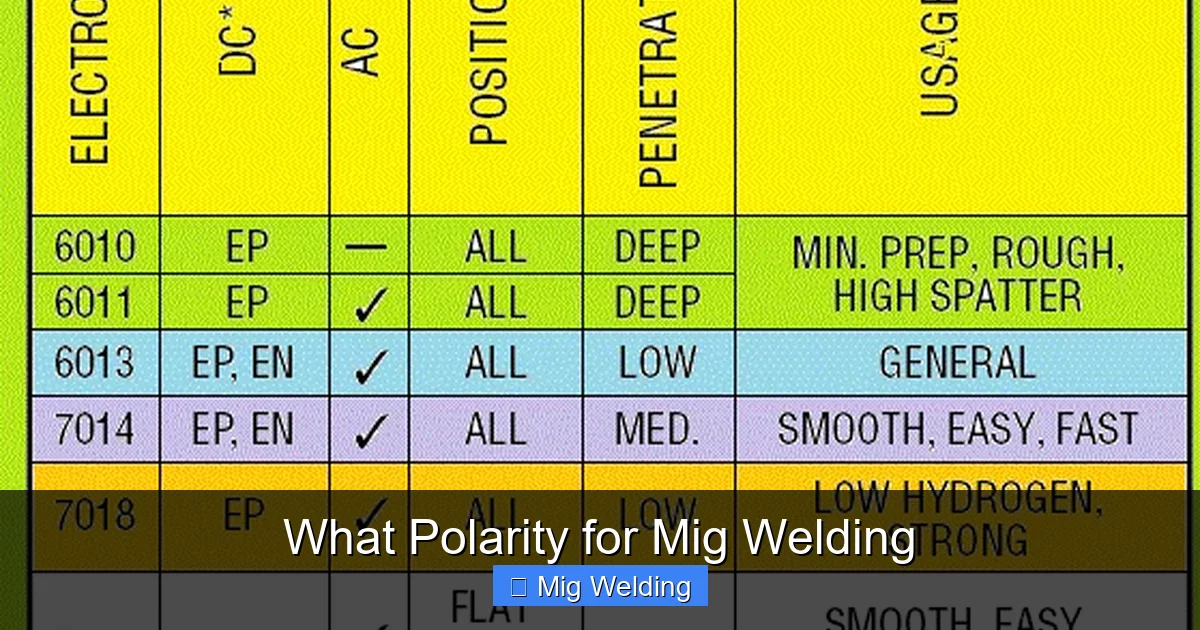
Visual guide about What Polarity for Mig Welding
Image source: materialwelding.com

Visual guide about What Polarity for Mig Welding
Image source: i1354.photobucket.com
2. Penetration
DCEP delivers more heat to the workpiece, which means deeper penetration. This is crucial for strong, structural welds. DCEN puts more heat on the wire, which can lead to shallow welds and burn-through on thin materials.
3. Spatter Control
Incorrect polarity often causes excessive spatter—those annoying little blobs of molten metal that stick to your workpiece and gun nozzle. Using DCEP reduces spatter and keeps your weld area cleaner.
The Standard: DCEP for Most MIG Welding
For the vast majority of MIG welding applications, DCEP (reverse polarity) is the correct setting. Here’s why:
- Solid wire with shielding gas: Whether you’re using ER70S-6 wire with 75% argon / 25% CO₂ or 100% CO₂, DCEP is the standard. The positive electrode allows efficient melting of the wire and strong fusion with the base metal.
- Flux-cored wire (gas-shielded): Most flux-cored wires (like E71T-1) are designed for DCEP. The flux inside the wire works best with this polarity to produce a clean, slag-covered weld.
- Materials like mild steel and stainless steel: These common metals respond best to DCEP, giving you good arc control and penetration.
In short, if you’re welding steel with a typical MIG setup, set your machine to DCEP.
When Might You Use DCEN?
DCEN is rarely used in MIG welding, but there are a few exceptions:
1. Self-Shielded Flux-Cored Wire
Some flux-cored wires (like E71T-8) are designed for DCEN. These wires don’t require external shielding gas and are often used in outdoor welding where wind might blow gas away. Always check the wire manufacturer’s specs—using DCEP with a DCEN wire can cause poor performance.
2. Specialized Applications
In rare cases, such as welding very thin materials or specific aluminum alloys with pulsed MIG, DCEN might be used. However, this is more common in advanced TIG welding, not standard MIG work.
3. Machine Limitations
Some older or budget MIG welders may only offer DCEN. In these cases, you’re limited in material and wire choices, and weld quality may suffer. Upgrading to a DCEP-capable machine is recommended for better results.
How to Set Polarity on Your MIG Welder
Setting polarity is usually straightforward, but it depends on your machine. Here’s a step-by-step guide:
Step 1: Identify Your Machine Type
Most modern MIG welders are DC-only and support DCEP. Check your user manual to confirm. If your machine has both AC and DC options, make sure it’s set to DC.
Step 2: Locate the Polarity Terminals
Open the side panel or access door on your welder. You’ll see two heavy-duty terminals labeled “+” and “–”. These are where your welding leads connect.
Step 3: Connect the Gun and Ground Leads
- For DCEP (most common): Connect the MIG gun to the positive (+) terminal and the ground clamp to the negative (–) terminal.
- For DCEN (rare): Connect the MIG gun to the negative (–) terminal and the ground clamp to the positive (+) terminal.
Step 4: Double-Check Connections
Loose or reversed leads are a common mistake. Make sure both cables are tight and correctly placed. A loose ground, for example, can mimic incorrect polarity symptoms.
Step 5: Test with a Short Weld
Run a test bead on a scrap piece of metal. Look for a smooth arc, minimal spatter, and good penetration. If the arc is rough or spattery, recheck your polarity and connections.
Troubleshooting Polarity Issues
Even with the right settings, things can go wrong. Here’s how to spot and fix polarity-related problems:
Excessive Spatter
If you’re getting blobs of metal flying everywhere, check your polarity. Wrong polarity—especially using DCEN when you should be on DCEP—is a common cause. Also, verify your voltage and wire feed speed are matched.
Weak or Shallow Penetration
This often means the arc isn’t delivering enough heat to the workpiece. Switching to DCEP usually fixes it. Also, ensure your ground clamp is attached to clean, bare metal.
Unstable or “Sputtering” Arc
An erratic arc can result from reversed polarity, dirty connections, or incorrect wire type. Recheck your setup and clean all contact points.
Wire Burns Back to the Nozzle
This can happen if the wire feed is too slow or the polarity causes poor arc initiation. DCEP typically provides better arc start than DCEN.
Tips for Getting Polarity Right Every Time
- Read the wire label: Most packaging clearly states recommended polarity. When in doubt, start with DCEP.
- Use a polarity checker: Some welders come with built-in indicators, or you can buy a simple polarity tester.
- Label your cables: Color-code or tag your gun and ground leads to avoid mix-ups.
- Keep connections clean: Dirt, rust, or paint on terminals can disrupt current flow.
- Consult your manual: Manufacturer guidelines are your best resource for model-specific settings.
Conclusion
So, what polarity for MIG welding? In nearly all cases, the answer is DCEP (reverse polarity). It delivers the best arc stability, penetration, and spatter control for steel and stainless steel welding with solid or flux-cored wire. DCEN is rare and typically reserved for specific self-shielded flux-cored applications.
Getting polarity right is one of the simplest ways to improve your weld quality. It takes just a minute to check your connections, but it can save hours of cleanup and rework. Remember: when in doubt, go with DCEP, double-check your leads, and always test on scrap metal first.
With this guide, you’re now equipped to set up your MIG welder correctly and tackle any project with confidence. Happy welding!
