

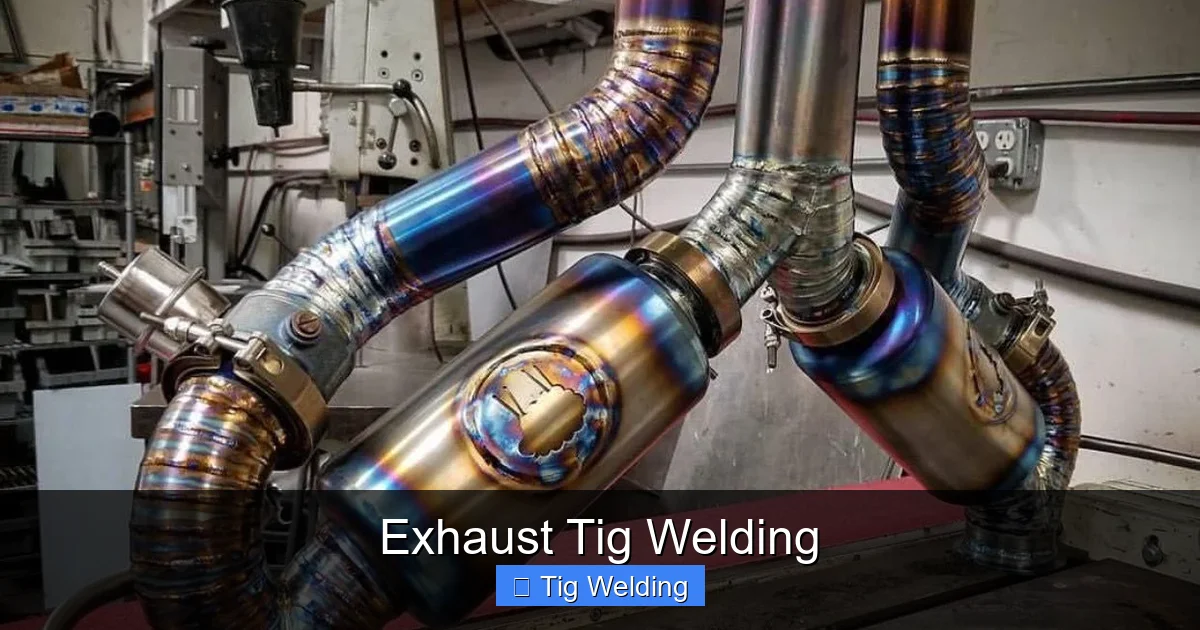
This guide offers a detailed walkthrough of exhaust TIG welding, perfect for DIY enthusiasts and aspiring fabricators. We cover everything from essential setup and material preparation to advanced techniques for achieving strong, clean, and leak-free welds on exhaust systems. With practical tips and troubleshooting advice, you’ll be ready to tackle your next exhaust project with confidence.
Key Takeaways
- Proper setup is crucial: Selecting the right TIG welder, tungsten, gas, and filler material significantly impacts weld quality and ease of execution.
- Material preparation is non-negotiable: Thoroughly cleaning and de-greasing the exhaust components prevents contamination and ensures strong, aesthetically pleasing welds.
- Mastering the fundamentals: Understanding arc length, amperage control, and filler rod manipulation is key to creating consistent and durable exhaust TIG welds.
- Specific techniques for exhaust: Learning about back-purging, stitch welding, and proper joint preparation will lead to leak-free and visually appealing results.
- Troubleshooting common issues: Being aware of potential problems like porosity, burn-through, and undercut allows for proactive problem-solving and improved weld quality.
Exhaust TIG Welding: Your Comprehensive How-To Guide
Exhaust systems are the lifeblood of any internal combustion engine, and for many enthusiasts, a beautifully crafted exhaust is as much about performance as it is about aesthetics. While MIG welding can be used for exhaust fabrication, TIG welding (Tungsten Inert Gas) offers a level of precision, control, and visual appeal that’s hard to beat. This guide will walk you through everything you need to know to successfully TIG weld exhaust components, from basic setup to advanced techniques. Whether you’re building a custom header, repairing a muffler, or creating a full cat-back system, you’ll learn the skills to achieve strong, clean, and leak-free welds.
Understanding TIG Welding for Exhausts
TIG welding is an arc welding process that uses a non-consumable tungsten electrode to create the weld. An inert shielding gas, typically Argon, protects the weld pool from atmospheric contamination. Filler metal is added separately, often by hand, allowing for incredible control over the weld bead. This precision makes TIG ideal for thin materials like those often found in exhaust systems, and for achieving a beautiful, stacked-dime look.
Getting Your Gear Ready: Essential Equipment
Before you even think about striking an arc, you need to have the right tools. For exhaust TIG welding, this means more than just a welder.
The TIG Welder
For exhaust work, an AC/DC TIG welder is often preferred. AC is excellent for aluminum, while DC is ideal for steel and stainless steel, both common exhaust materials. Ensure your welder has adjustable amperage control, which is critical for managing heat on thinner exhaust tubing. A machine with a duty cycle that matches your welding needs is also important. For hobbyist use, a 150-200 amp machine is usually sufficient.
Tungsten Electrodes
The type of tungsten you use depends on the material you’re welding and your welder’s capabilities.
- Pure Tungsten: Best for AC welding of aluminum.
- Thoriated Tungsten (Red Tip): Good all-around for DC welding of steel and stainless steel, but can be a health hazard due to thorium.
- Ceriated Tungsten (Gray Tip): A good alternative to thoriated for DC welding, safer to use.
- Lanthanated Tungsten (Blue or Gold Tip): Excellent for both AC and DC welding, offering good arc stability and longevity. Blue tip is often preferred for DC.
Always grind your tungsten to a sharp point for DC welding to create a focused arc. For AC, a slightly blunted tip is better.
Shielding Gas
Pure Argon is the most common shielding gas for TIG welding steel and stainless steel exhaust components. It provides excellent shielding and arc stability. For aluminum, Argon is also the standard. Ensure your Argon cylinder is full and your regulator is set correctly.
Filler Metal
Choosing the right filler metal is crucial for compatibility with your base material and for achieving the desired strength and corrosion resistance.
- For Mild Steel Exhaust: ER70S-2 or ER70S-6 are common choices. They are readily available and provide good strength.
- For Stainless Steel Exhaust: 308L is the standard filler for 304 stainless steel, which is very common in aftermarket exhausts. 309L can be used for dissimilar metals or when welding stainless to mild steel.
Ensure your filler rod is clean and free from rust or oil.
Other Essential Gear
- TIG Torch: A standard 17 or 26 torch is usually suitable.
- Gas Lens: A gas lens kit is highly recommended for exhaust work. It provides better gas coverage, allowing you to hold a longer electrode stickout and achieve cleaner welds, especially on tighter bends.
- Flowmeter: To accurately control your shielding gas flow rate (typically 15-25 CFH).
- Safety Gear: A good auto-darkening TIG helmet, welding gloves, leather apron, and fire-resistant clothing are non-negotiable.
Preparing Your Exhaust Components
Cleanliness is paramount in TIG welding, especially when working with exhaust components that can be coated in oil, grease, carbon, and rust. Any contamination will lead to weld defects like porosity and weak joints.
Step 1: Disassembly (If Necessary)
If you’re working on an existing exhaust, you might need to remove it from the vehicle. Mark components before removal to ensure proper reassembly.
Step 2: Thorough Cleaning
This is the most critical preparation step.
Use a degreaser (like brake cleaner or a dedicated automotive degreaser) and a wire brush or Scotch-Brite pad to remove all oil, grease, and grime from the welding surfaces. For stubborn carbon buildup, a rotary tool with a wire wheel can be effective. After degreasing, wash the parts with soap and water to remove any residue from the degreaser.
Step 3: Addressing Rust and Scale
If the metal is rusty or has mill scale (common on new mild steel tubing), you need to remove it completely.
- For Mild Steel: Use a wire wheel on a grinder or a flap disc to get down to clean, bare metal.
- For Stainless Steel: A stainless steel wire brush or dedicated stainless steel grinder discs should be used. It’s important to use brushes and discs *only* on stainless steel to avoid cross-contamination, which can lead to rust.
Step 4: Final Cleaning and Deburring
Once you’ve removed rust and scale, give the area a final wipe-down with denatured alcohol or acetone to ensure it’s completely free of any remaining contaminants. Use a deburring tool or a file to gently smooth out any sharp edges or burrs on the cut ends of the tubing.
Step 5: Fitment and Clamping
Before welding, ensure your pieces fit together perfectly. If you’re welding pipes together, they should butt up cleanly. Use appropriate clamps, fixtures, or tack welds to hold everything in place securely. Loose or misaligned parts will lead to difficult welds and poor results.
TIG Welding Techniques for Exhaust Systems
Now that your materials are prepped and your gear is ready, it’s time to focus on the welding itself.
Setting Up Your Machine
- Amperage: Start with a lower amperage setting and be prepared to adjust. A good starting point for 16-gauge (1.5mm) mild steel tubing might be around 70-90 amps. For thinner stainless steel, you might need to go slightly lower. Always do test welds on scrap pieces of the same material and thickness.
- Gas Flow: Set your Argon flow to about 15-25 CFH. You want a steady, even stream of gas without it being so strong that it causes turbulence.
- Pulse Function (Optional but Recommended): If your welder has a pulse function, it can be very helpful for exhaust welding. It allows you to control heat input by alternating between a high peak amperage and a lower background amperage. This helps prevent burn-through on thin materials.
Tack Welding
Tack welding is crucial for holding your exhaust components together before making full, continuous welds.
- Purpose: Tack welds secure the joint, prevent shifting, and help maintain alignment.
- Technique: Make small, controlled tacks. Aim for them to penetrate just enough to hold the pieces together without distorting them. Leave small gaps between tacks to allow for expansion and contraction during full welding, which helps prevent cracking.
The Welding Process: From Start to Finish
1. Establishing the Arc
With your tungsten electrode about the thickness of a dime away from the workpiece, strike the arc. You can do this by high-frequency start (preferred for cleanliness) or by scratching the tungsten against the metal (use this sparingly if high-frequency isn’t available).
2. Maintaining Arc Length and Angle
Keep your arc length consistent – roughly the same as the diameter of your tungsten electrode. A consistent arc length provides consistent heat input. Hold your torch at a slight angle (around 10-15 degrees) towards the direction of travel.
3. Adding Filler Metal
Once you have a stable puddle, begin adding filler rod. Dip the filler rod into the leading edge of the puddle, just enough to melt and blend into the weld. Avoid submerging the rod into the arc, as this can contaminate the tungsten. Move the filler rod in a consistent pattern, like a gentle “J” or “U” motion, to help tie it into the puddle.
4. Moving the Torch and Filler
The key is coordination. As you move the torch forward, you’ll be melting the base metal. As you dip the filler rod, you’re adding material. The goal is to create a smooth, consistent bead where the filler metal blends seamlessly with the melted base metal. Imagine pushing a small, molten ball forward and adding just enough filler to keep it growing.
5. Stitch Welding
For exhaust pipes, especially on bends or areas prone to distortion, stitch welding can be very effective.
- Technique: Weld a short section (1/2 to 1 inch), then move to a different part of the circumference and weld another section. Alternate around the joint. This distributes heat more evenly and reduces the risk of warping.
- Overlap: Ensure each stitch overlaps slightly with the previous one to create a continuous, leak-proof weld.
Back-Purging: The Secret to Leak-Free Welds
Back-purging is essential for high-quality exhaust TIG welding, especially with stainless steel. It involves introducing a stream of inert gas (Argon) to the *inside* of the tubing while you weld the outside.
- Why it’s important: It prevents the shielding gas on the outside from escaping and forming a void. More importantly, it prevents oxidation and weld defects on the inside of the pipe. For stainless steel, it helps maintain the corrosion resistance of the material.
- How to do it: You’ll need a way to introduce gas to the inside of the pipe, often via a small fitting or by blocking one end with a specialized purging plug. Ensure the gas flow on the inside is sufficient to displace all air but not so strong that it blows out the shielding gas on the outside. This often requires experimenting with flow rates. A flow of 5-10 CFH is usually a good starting point.
Specific Challenges and Tips for Exhausts
Exhaust systems present unique challenges due to their shape, thin materials, and the need for gas-tight seals.
Welding Bends and Tight Radii
- Heat Management: Bends can be tricky. The outside of the bend is stretched and thinner, while the inside is compressed. You’ll need to be very light on the pedal and may need to add filler rod more deliberately to build up the outside.
- Gas Lens: A gas lens is invaluable here, providing better gas coverage around the torch head and allowing for a longer electrode stickout, which is helpful in tight spaces.
Dealing with Thin Wall Tubing
Thin wall tubing (like 18-gauge or 20-gauge) is prone to burn-through.
- Low Amperage: Keep your amperage as low as possible.
- Pulse Function: Use the pulse function aggressively if available. Set a fast pulse frequency and a lower background amperage.
- Quick Dips: Dip your filler rod quickly and precisely.
- Travel Speed: Move quickly but deliberately. Don’t linger in one spot.
Achieving a Clean, Stacked-Dime Look
This aesthetic is highly sought after.
- Consistency: The key is consistent torch movement, consistent filler rod dips, and consistent puddle manipulation.
- Rhythm: Develop a rhythm. As you move the torch forward, melt the base metal. As you dip the filler, the puddle grows. The goal is to have each dip of filler create a slight ripple that blends into the previous one.
Troubleshooting Common Exhaust TIG Welding Issues
Even with practice, you might encounter problems. Here’s how to fix them.
Porosity
Tiny holes in the weld bead, indicating trapped gas.
- Causes: Insufficient shielding gas, contaminated filler rod or base metal, dirty tungsten, or poor gas coverage.
- Solutions: Check gas flow, ensure all materials are thoroughly cleaned, grind your tungsten, and ensure your gas lens is functioning correctly.
Burn-Through
The weld puddle has melted through the base metal.
- Causes: Too much amperage, moving too slowly, or not adding filler material quickly enough.
- Solutions: Reduce amperage, increase travel speed, or practice adding filler rod more precisely. Use the pulse function to your advantage.
Undercut
A groove or channel along the edge of the weld bead where the base metal has melted away.
- Causes: Too much amperage, moving too fast, or holding the arc too far from the joint.
- Solutions: Reduce amperage, slow down your travel speed, and keep your arc closer to the joint. Slightly increasing filler rod addition can help fill minor undercut.
Cracked Welds
Welds that show visible cracks.
- Causes: Improper filler metal selection, excessive heat, or rapid cooling.
- Solutions: Ensure you’re using the correct filler metal. Allow welds to cool naturally between passes if making multiple welds. For stainless steel, proper heat control and back-purging are critical.
Conclusion: Welded for Performance and Style
Exhaust TIG welding is a skill that rewards patience and practice. By understanding your equipment, preparing your materials meticulously, and employing the right techniques like back-purging and controlled filler rod addition, you can achieve welds that are not only strong and leak-free but also visually stunning. Don’t be discouraged by early attempts; every weld is a learning opportunity. With this guide, you’re well on your way to fabricating or repairing exhaust systems with professional-grade results. Happy welding!
