

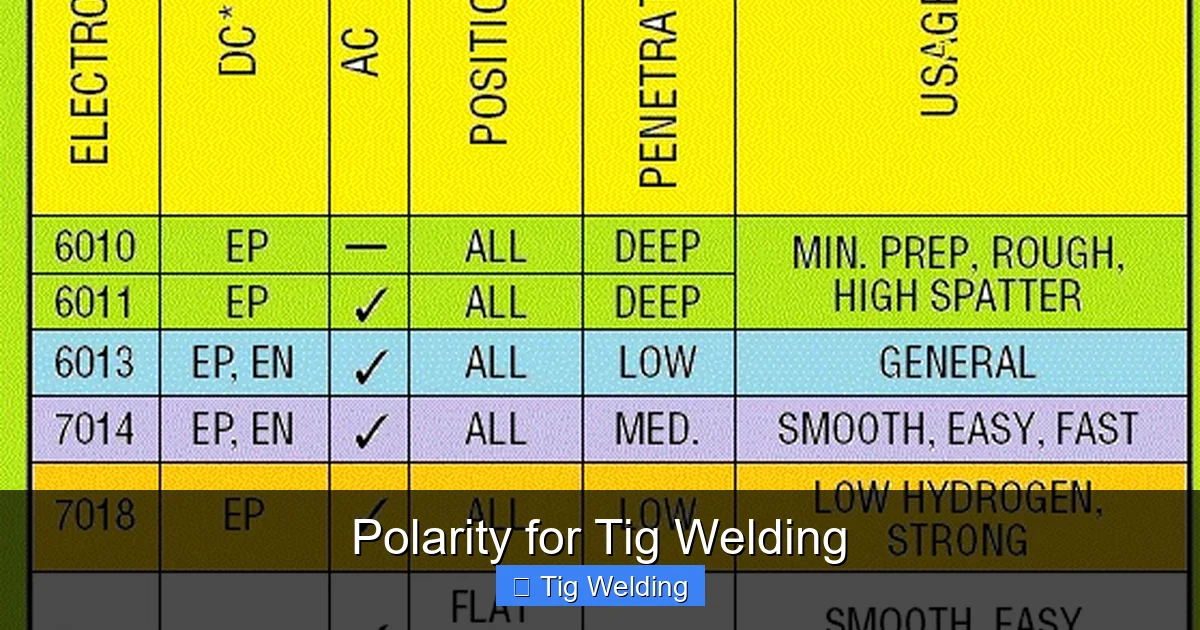
Understanding TIG welding polarity is crucial for achieving strong, clean welds. This guide explains the three main types: DCEN, DCEP, and AC, detailing their applications, advantages, and how to set them up correctly. By mastering TIG polarity, you’ll gain better control over heat, penetration, and bead appearance on a wide range of metals, from steel to aluminum.
Polarity for Tig Welding
Welcome to your comprehensive guide on polarity for TIG welding! If you’re looking to elevate your TIG welding skills and achieve those perfect, clean welds you’ve been dreaming of, understanding polarity is your next crucial step. It might sound technical, but we’re going to break it down in a way that’s easy to grasp.
In TIG welding, polarity refers to the direction of electrical current flow between your tungsten electrode and the workpiece. This seemingly simple choice has a profound impact on your weld. It dictates how heat is distributed, how deeply the arc penetrates the metal, and even how clean your weld will be. Getting polarity right means better control, stronger welds, and less post-weld cleanup.
In this guide, we’ll explore the three main types of TIG welding polarity: DCEN (Direct Current Electrode Negative), DCEP (Direct Current Electrode Positive), and AC (Alternating Current). We’ll delve into what each one does, when to use it, and how to set it up on your TIG welder. By the end, you’ll have the confidence to select the right polarity for virtually any TIG welding task.
Key Takeaways
- DCEN (Direct Current Electrode Negative) is the most common TIG polarity, offering deep penetration and a narrow, focused arc, ideal for welding steel and stainless steel.
- DCEP (Direct Current Electrode Positive) is less common in TIG welding due to shallow penetration and excessive heat at the electrode, but it has specific uses for certain materials.
- AC (Alternating Current) is essential for welding aluminum and magnesium, providing cleaning action to break through oxide layers and good penetration.
- The choice of polarity significantly impacts weld penetration, bead width, arc stability, and cleaning action.
- Always consult your TIG welding machine’s manual for specific polarity settings and recommendations.
- Proper tungsten selection and setup are critical and often depend on the chosen polarity.
Understanding the Basics of Electrical Current
Before we dive into specific polarities, let’s quickly refresh what direct current (DC) and alternating current (AC) mean in the context of electricity.
Direct Current (DC): With DC, the electrical current flows in only one direction. Think of it like water flowing down a river; it always goes the same way. In TIG welding, DC can be configured in two ways, depending on which component (electrode or workpiece) is positive and which is negative.
Alternating Current (AC): AC is different. The electrical current periodically reverses its direction. It flows one way for a moment, then reverses and flows the other way. This back-and-forth motion is what makes AC useful for certain materials.
DCEN: The Workhorse of TIG Welding
DCEN, often referred to as straight polarity, is the most common and widely used polarity for TIG welding. In this setup, the electrode (your tungsten) is connected to the negative terminal of the power source, and the workpiece is connected to the positive terminal.

Visual guide about Polarity for Tig Welding
Image source: image.slideserve.com
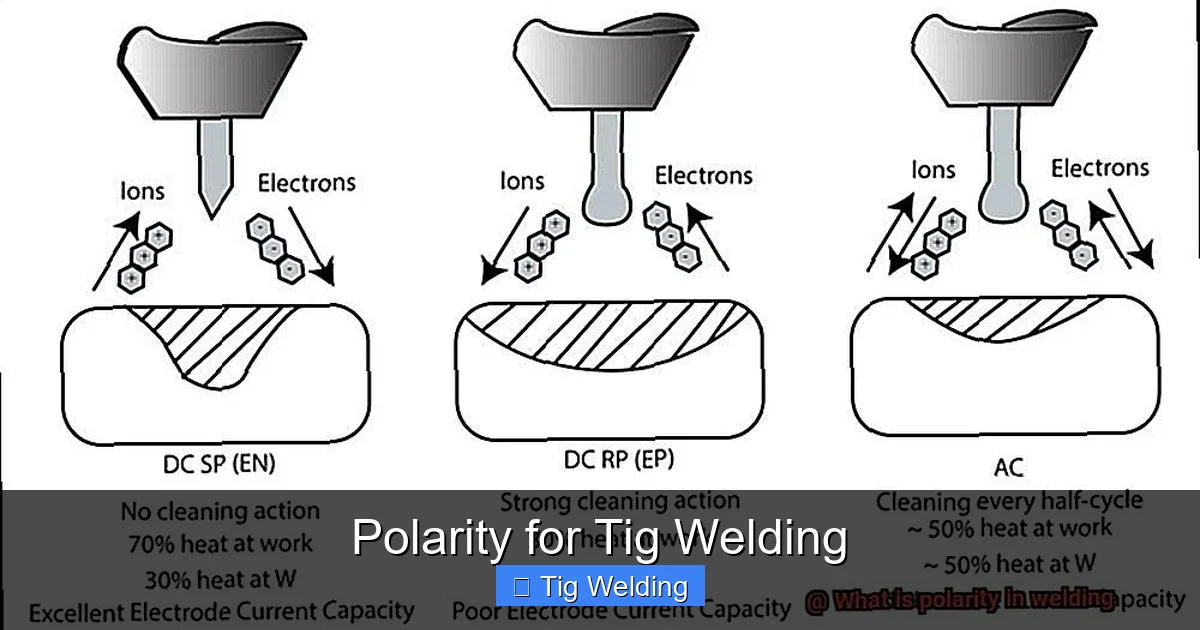
How it Works: When you strike an arc, electrons flow from the negative tungsten to the positive workpiece. This direction of electron flow concentrates about two-thirds of the heat at the workpiece and one-third at the tungsten electrode. This is a very desirable characteristic for many welding applications.
Why Use DCEN?
DCEN offers several key advantages:
- Deep Penetration: The concentrated heat on the workpiece allows for deeper penetration into the base metal. This is crucial for creating strong, fusion-sound welds, especially on thicker materials.
- Narrow, Focused Arc: DCEN produces a very tight, focused arc. This gives you excellent control over the weld puddle, allowing for precise welding and the creation of aesthetically pleasing, clean beads.
- Efficient Metal Deposition: You can efficiently melt filler metal and deposit it into the weld joint.
- Less Tungsten Contamination: Because most of the heat is on the workpiece, the tungsten electrode stays cooler, reducing the risk of it melting and contaminating your weld.
When to Use DCEN:
DCEN is your go-to polarity for welding most ferrous metals, including:
- Mild Steel: For structural steel, automotive parts, and general fabrication.
- Stainless Steel: For kitchen equipment, industrial piping, and automotive exhaust systems.
- Chromoly Steel: Commonly used in aerospace and bicycle frames.
- Nickel Alloys: For specialized applications requiring high-temperature resistance.
Setting Up for DCEN:
Setting up your TIG welder for DCEN is straightforward:
- Connect the Ground Clamp: Ensure the ground clamp is securely attached to the workpiece or welding table. This is your positive connection.
- Connect the Electrode Holder/Torch: The electrode holder or torch assembly will be connected to the negative terminal of your TIG welder.
- Select DC Mode: On your TIG welder’s control panel, choose the “DC” or “DCEN” setting. Some machines might simply say “DC,” and you’ll assume it’s DCEN as it’s the default for DC.
- Tungsten Selection: For DCEN, pure tungsten electrodes or lanthanated (gold or blue band) tungsten electrodes are commonly used. A sharpened, pointed tungsten is ideal for a focused arc.
Practical Tip: For steel, starting with a sharpened tungsten of about 2% lanthanated is a great all-around choice. Ensure it’s ground to a fine point to maintain a stable, focused arc.
DCEP: The Less Common TIG Polarity
DCEP, also known as reverse polarity, is the opposite of DCEN. Here, the tungsten electrode is connected to the positive terminal, and the workpiece is connected to the negative terminal.
Visual guide about Polarity for Tig Welding
Image source: theweldguru.com
How it Works: In DCEP, electrons flow from the workpiece to the electrode. This configuration directs about two-thirds of the heat to the tungsten electrode and only one-third to the workpiece. This creates a wider, less focused arc with shallower penetration.
Why (and When) to Use DCEP?
DCEP is rarely the primary choice for TIG welding due to its inherent disadvantages for most common TIG applications. However, it does have some niche uses:
- Shallow Penetration: Because less heat goes into the workpiece, it’s suitable for welding very thin materials where deep penetration could burn through.
- Certain Exotic Metals: In some very specific applications with certain exotic metals, DCEP might be recommended by the manufacturer for particular weld characteristics.
- Carbide Deposition: It’s sometimes used in specialized hardfacing applications where a wider, hotter arc is needed to deposit carbide material onto a surface.
The Downsides of DCEP for General TIG Welding:
- Shallow Penetration: This is the biggest drawback. Most structural welds require good penetration for strength, which DCEP doesn’t provide.
- Electrode Burn-off: The tungsten electrode gets significantly hotter, leading to rapid consumption and increased risk of contamination from melting tungsten.
- Wider, Less Stable Arc: The arc is less focused and can be more difficult to control, leading to wider beads and potential porosity.
Setting Up for DCEP:
Setting up for DCEP is a mirror image of DCEN:
- Connect the Ground Clamp: Attach the ground clamp to the tungsten electrode holder or torch. This is your positive connection.
- Connect the Electrode Holder/Torch: Connect the workpiece lead (often called the “ground lead” in other welding processes) to the workpiece. This is your negative connection.
- Select DC Mode (if applicable): Your TIG welder will likely have a setting to switch between DCEN and DCEP within its DC mode. Look for a “Reverse” or “DCEP” option.
- Tungsten Selection: If you find yourself using DCEP, you’ll likely need a thicker tungsten electrode to withstand the increased heat.
Important Note: For the vast majority of TIG welding, you will spend almost all your time with DCEN. DCEP is an exception, not the rule.
AC: The Key to Aluminum and Magnesium
AC (Alternating Current) is the third fundamental polarity and is absolutely essential for welding aluminum and magnesium. It offers a unique combination of cleaning action and penetration that these metals require.

Visual guide about Polarity for Tig Welding
Image source: i.ytimg.com
How it Works: With AC, the current cycles between positive and negative. This means the tungsten electrode and the workpiece alternate being positive and negative. A typical AC waveform for TIG welding is not a perfect sine wave; it’s often modified to allow for better control.
The AC cycle typically has two parts:
- Electrode Negative (EN) phase: This part of the cycle works like DCEN, providing good penetration into the base metal.
- Electrode Positive (EP) phase: This part of the cycle works like DCEP, but it also provides a crucial “cleaning action” on the surface of aluminum.
Why Use AC for Aluminum?
Aluminum has a thin but very tenacious oxide layer that forms instantly when exposed to air. This oxide has a much higher melting point than the aluminum itself, and if not removed, it can lead to a weak, porous weld. AC welding tackles this in two ways:
- Cleaning Action: The Electrode Positive (EP) phase of the AC cycle helps to blast away this oxide layer. It creates a “scrubbing” effect on the surface of the aluminum, breaking up the oxide and allowing for good fusion.
- Penetration: The Electrode Negative (EN) phase provides the necessary penetration to melt the base metal and fuse it together.
Key AC Settings on Your TIG Welder:
When welding with AC, your TIG machine offers additional controls to fine-tune the arc. These are critical for achieving good results:
- AC Balance (or Electrode Positive/Negative Ratio): This is arguably the most important AC control. It adjusts the ratio of time the current spends in the EN phase versus the EP phase.
- More EN (closer to DCEN): Increases penetration and reduces cleaning action. Good for thicker aluminum or when you need to drive the puddle.
- More EP (closer to DCEP): Decreases penetration and increases cleaning action. Good for thinner aluminum or when dealing with heavy oxidation.
- AC Frequency: This setting controls how fast the current alternates between positive and negative.
- Higher Frequency (e.g., 100-200 Hz): Creates a more focused, tighter arc, leading to better directional control and a narrower bead. This is often preferred for intricate work or thinner materials.
- Lower Frequency (e.g., 50-60 Hz): Produces a wider, softer arc, which can be beneficial for filling larger gaps or when working on thicker sections where a broader puddle is desired.
- High-Frequency (HF) Start: This is standard on most TIG welders and allows you to start the arc without touching the workpiece, which is essential for AC welding aluminum.
When to Use AC:
- Aluminum: From thin sheet metal to thicker castings.
- Magnesium: Similar to aluminum, magnesium requires AC for its oxide layer.
- Some Exotic Alloys: Certain less common alloys may also benefit from AC welding.
Setting Up for AC:
- Connect the Ground Clamp: Attach the ground clamp to the workpiece. This connection alternates between positive and negative.
- Connect the Electrode Holder/Torch: The electrode holder or torch is connected to the terminal that also alternates.
- Select AC Mode: Choose “AC” on your TIG welder’s control panel.
- Adjust AC Balance and Frequency: Start with a balanced setting (e.g., 50% balance, 60 Hz frequency) and adjust based on the material thickness and your welding needs.
- Tungsten Selection: For AC welding aluminum, pure tungsten (green band) or zirconiated (brown band) tungsten electrodes are traditionally used. However, many modern welders and operators prefer 2% lanthanated (blue band) tungsten for AC welding due to its arc stability. For AC, the tungsten is usually balled or rounded at the tip, not sharpened to a fine point.
Practical Tip: When welding aluminum, pre-cleaning the material thoroughly with a stainless steel wire brush dedicated only to aluminum is crucial. This removes gross contaminants before welding.
Troubleshooting Polarity Issues
Incorrect polarity settings can lead to a variety of welding problems. Here’s how to identify and fix them:
Problem: Lack of Penetration
- Cause: Incorrect polarity (e.g., using DCEP instead of DCEN for steel).
- Solution: Ensure you are using DCEN for steel and stainless steel.
- Cause: AC balance is too far towards Electrode Positive (EP) when welding aluminum.
- Solution: Adjust AC balance to favor the Electrode Negative (EN) side.
Problem: Excessive Electrode Melting/Tungsten Contamination
- Cause: Using DCEP for steel or stainless steel.
- Solution: Switch to DCEN.
- Cause: AC balance is too far towards EP for too long.
- Solution: Adjust AC balance to favor EN more.
- Cause: Tungsten is too thin or not properly prepared for the amperage.
- Solution: Use a thicker tungsten or adjust amperage.
Problem: Poor Cleaning Action on Aluminum
- Cause: AC balance is too far towards Electrode Negative (EN).
- Solution: Increase the EP percentage in your AC balance setting.
- Cause: Material is not properly cleaned before welding.
- Solution: Thoroughly clean the aluminum with a dedicated brush.
Problem: Unstable Arc
- Cause: Incorrect tungsten type or preparation (e.g., sharpened tungsten on AC).
- Solution: Use a balled or rounded tungsten for AC. Use appropriate thoriated or lanthanated tungsten for DC.
- Cause: Low amperage for the material thickness.
- Solution: Increase amperage.
Conclusion: Master Your Polarity, Master Your Welds
Understanding polarity for TIG welding is not just a technical detail; it’s a fundamental skill that separates good welders from great ones. By grasping the principles of DCEN, DCEP, and AC, you unlock the ability to tailor your TIG welder’s output for optimal results on a vast range of metals.
Remember:
- DCEN is your best friend for steel and stainless steel, providing deep penetration and a focused arc.
- DCEP is rarely used in general TIG welding but has specific, limited applications.
- AC is indispensable for aluminum and magnesium, offering the crucial cleaning action needed to overcome oxide layers.
Experiment with your welder, practice these settings on scrap pieces, and pay close attention to how each polarity affects your weld puddle, penetration, and bead appearance. With this knowledge, you’re well on your way to achieving cleaner, stronger, and more professional TIG welds.
