

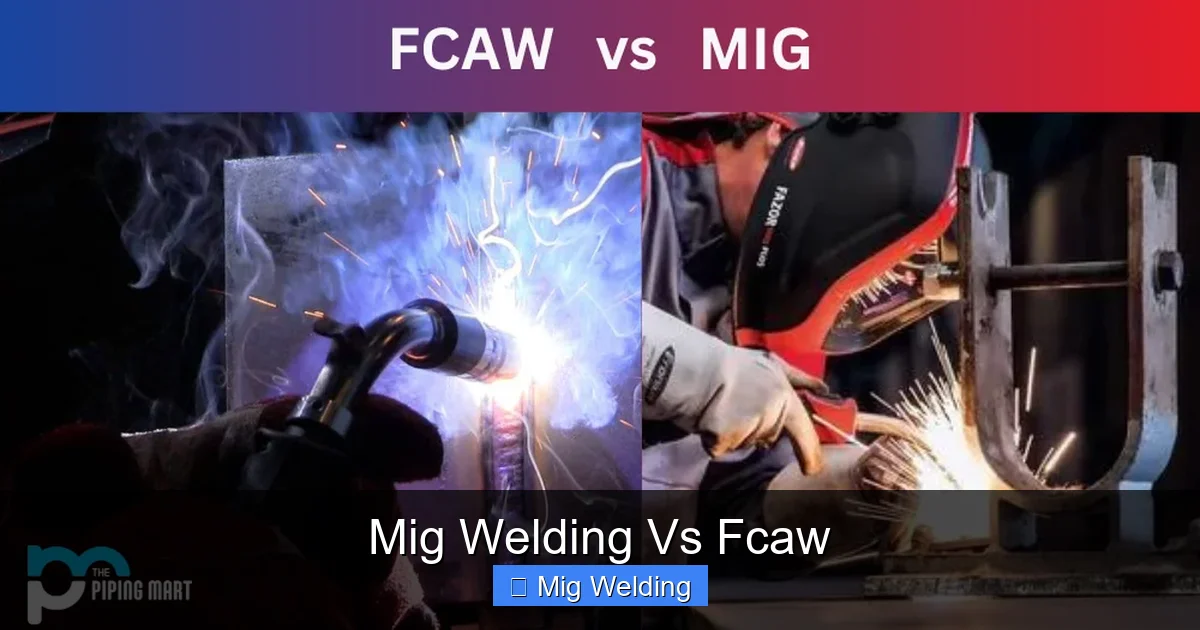
This guide breaks down MIG welding vs FCAW, comparing their setup, performance, and ideal uses. Whether you’re a beginner or a pro, you’ll learn how to choose the right method for your welding needs.
Key Takeaways
- MIG welding uses a solid wire and external shielding gas, making it clean and beginner-friendly but less effective in windy conditions.
- FCAW (Flux-Cored Arc Welding) uses a hollow wire filled with flux, producing its own shielding gas, ideal for outdoor and heavy-duty work.
- MIG is better for thin materials and indoor projects, offering smoother finishes and easier cleanup.
- FCAW excels in welding thick metals and rusty surfaces, with deeper penetration and higher deposition rates.
- FCAW doesn’t require external gas in self-shielded form, reducing setup complexity and cost in some cases.
- MIG requires more equipment (gas tank, regulator), increasing initial investment and maintenance.
- Choose MIG for precision and appearance, FCAW for strength and speed in industrial or outdoor settings.
Introduction: MIG Welding vs FCAW – Which One Is Right for You?
If you’re new to welding or looking to expand your skills, you’ve probably heard of MIG and FCAW. Both are popular arc welding techniques, but they work differently and suit different jobs. In this guide, we’ll compare MIG welding vs FCAW in detail, helping you understand how each process works, where they shine, and how to pick the best one for your project.
Whether you’re fixing a car, building a fence, or working on a construction site, knowing the strengths and weaknesses of each method can save you time, money, and frustration. We’ll walk you through the basics, step-by-step setup, practical tips, and troubleshooting advice—all in simple, easy-to-follow language.
What Is MIG Welding?
Visual guide about Mig Welding Vs Fcaw
Image source: wermac.org
MIG stands for Metal Inert Gas welding, though it’s more accurately called GMAW (Gas Metal Arc Welding). It uses a continuous solid wire electrode fed through a welding gun. At the same time, an external shielding gas—usually a mix of argon and CO₂—protects the weld pool from contamination.
How MIG Welding Works
When you pull the trigger on a MIG welder, the wire feeds automatically into the joint. An electric arc forms between the wire and the metal, melting both to create a strong bond. The shielding gas flows around the arc, preventing oxygen and nitrogen from ruining the weld.
Best Uses for MIG Welding
MIG is great for:
- Thin to medium-thickness metals (like sheet metal or auto body panels)
- Indoor projects where wind won’t blow away the gas
- Clean, precise welds with minimal spatter
- Beginners learning the basics of arc welding
It’s commonly used in automotive repair, HVAC work, and home DIY projects.
What Is FCAW (Flux-Cored Arc Welding)?
Visual guide about Mig Welding Vs Fcaw
Image source: weldguru.com
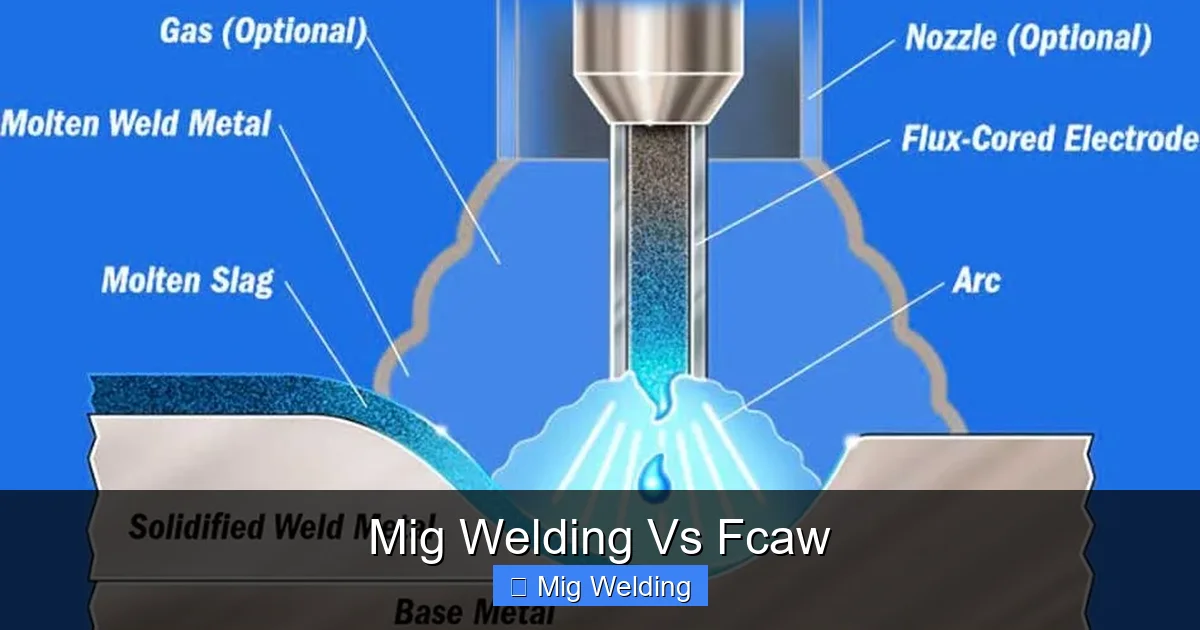
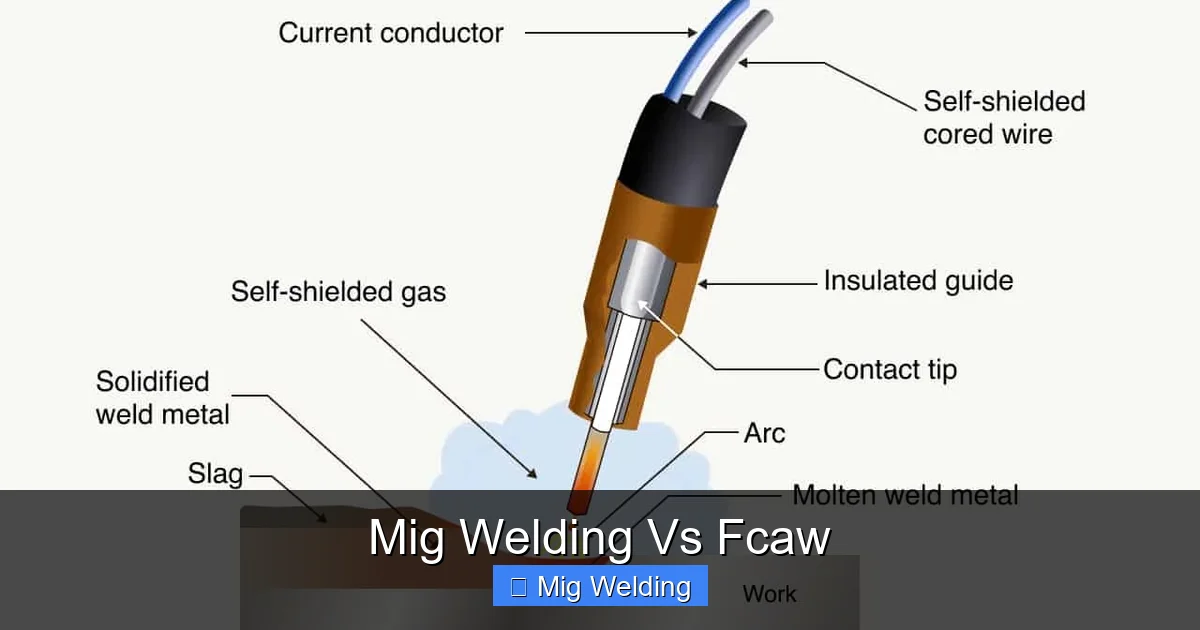
FCAW uses a hollow wire filled with flux—similar to the core of a stick electrode. When heated, the flux creates a gas shield and forms a protective slag over the weld. There are two types: gas-shielded (requires external gas) and self-shielded (no gas needed).
How FCAW Works
The wire feeds through the gun just like in MIG welding. But instead of relying on external gas, the flux inside the wire burns and produces its own shielding. This makes FCAW more versatile, especially outdoors.
Best Uses for FCAW
FCAW is ideal for:
- Thick, heavy materials (like structural steel or shipbuilding)
- Rusty, dirty, or painted surfaces
- Outdoor welding where wind disrupts gas shielding
- High-speed welding with deep penetration
It’s widely used in construction, pipeline welding, and heavy fabrication.
Step-by-Step: Setting Up MIG Welding
Follow these steps to get started with MIG welding:
1. Gather Your Equipment
You’ll need:
- MIG welder
- Solid welding wire (usually ER70S-6 for steel)
- Shielding gas (75% argon / 25% CO₂ is common)
- Gas regulator and hose
- Welding helmet, gloves, and protective clothing
2. Prepare the Metal
Clean the surface with a wire brush or grinder. Remove rust, paint, or oil—contaminants can cause weak welds.
3. Set the Welder
Adjust voltage and wire feed speed based on material thickness. Most machines have a chart inside the door. For 1/8-inch steel, start around 18–20 volts and 200–250 inches per minute (IPM).
4. Connect the Gas
Attach the gas cylinder, open the valve slowly, and set the flow rate to 20–25 cubic feet per hour (CFH).
5. Test and Weld
Do a test weld on scrap metal. Hold the gun at a 10–15 degree angle, keep a short arc, and move steadily. Listen for a smooth “frying” sound—that’s a good sign.
Step-by-Step: Setting Up FCAW
FCAW setup is similar but has key differences:
1. Choose the Right Wire
Use E71T-1 for gas-shielded or E71T-8 for self-shielded. Self-shielded is easier for beginners and outdoor use.
2. Prepare the Metal
FCAW tolerates dirt and rust better than MIG, but cleaning still helps. Remove heavy scale or grease.
3. Set the Welder
FCAW typically runs at higher voltages. For 1/4-inch steel, try 22–26 volts and 250–350 IPM. Check your wire manufacturer’s recommendations.
4. Gas Setup (If Using Gas-Shielded)
If using gas-shielded FCAW, connect CO₂ or a mixed gas like 75/25. Flow rate: 25–35 CFH. Skip this step for self-shielded.
5. Weld with Proper Technique
Hold the gun at 5–15 degrees, use a drag (pull) technique, and maintain a consistent travel speed. Expect more spatter than MIG—have a chipping hammer ready.
MIG vs FCAW: Head-to-Head Comparison
Let’s break down the key differences:
Shielding Method
- MIG: Needs external gas. Sensitive to wind.
- FCAW: Self-shielded versions work without gas. Better for outdoors.
Weld Quality and Appearance
- MIG: Clean, smooth, minimal spatter. Great for visible welds.
- FCAW: Rougher finish, more spatter, slag to remove. Stronger but less pretty.
Penetration and Strength
- MIG: Good penetration on thin metals. May lack depth on thick sections.
- FCAW: Deep penetration, ideal for heavy structural work.
Speed and Efficiency
- MIG: Fast on thin materials, but slower on thick ones.
- FCAW: Higher deposition rate—more weld metal per hour.
Cost and Equipment
- MIG: Higher startup cost (gas tank, regulator). Ongoing gas expense.
- FCAW: Lower gas cost (if self-shielded). Wire may be slightly more expensive.
Practical Tips for Better Results
No matter which method you choose, these tips will help:
For MIG Welding
- Keep the gas flowing a second after welding to protect the hot metal.
- Use a push technique for thinner metals to avoid burn-through.
- Store gas cylinders upright and secure them to prevent tipping.
For FCAW
- Always chip away slag after welding—it can trap impurities.
- Use a drag angle, not a push, for better penetration.
- Preheat thick metals to reduce cracking risk.
Troubleshooting Common Issues
Even experts run into problems. Here’s how to fix them:
MIG Welding Problems
- Porosity: Caused by dirty metal or low gas flow. Clean the metal and check gas connections.
- Burn-through: Too much heat on thin metal. Reduce voltage or use a lower wire speed.
- Wire feeding issues: Check for kinks in the liner or worn drive rolls.
FCAW Problems
- Excessive spatter: Often due to high voltage or wrong technique. Lower voltage and use a steady drag.
- Incomplete fusion: Caused by fast travel speed or wrong angle. Slow down and maintain proper gun angle.
- Slag inclusion: Not chipping slag between passes. Always clean thoroughly.
Which Should You Choose? MIG or FCAW?
The answer depends on your project:
- Choose MIG if: You’re welding indoors, working with thin metals, or want a clean, professional finish. Great for beginners and automotive work.
- Choose FCAW if: You’re outdoors, welding thick or dirty metal, or need deep penetration and speed. Ideal for construction and industrial use.
Many welders own both machines—or a multi-process welder that does both. That way, you’re ready for any job.
Conclusion: Making the Right Choice
Understanding MIG welding vs FCAW helps you pick the best tool for the task. MIG offers clean, easy-to-learn welding perfect for light-duty and indoor projects. FCAW delivers power, penetration, and outdoor reliability for heavy-duty jobs.
Both have their place in a welder’s toolbox. Start with MIG if you’re new, then add FCAW as you take on bigger challenges. With the right setup, technique, and safety habits, you’ll get strong, lasting welds every time.
Whether you’re fixing a trailer or building a steel frame, knowing when to use each method will make you a more confident and capable welder.
