

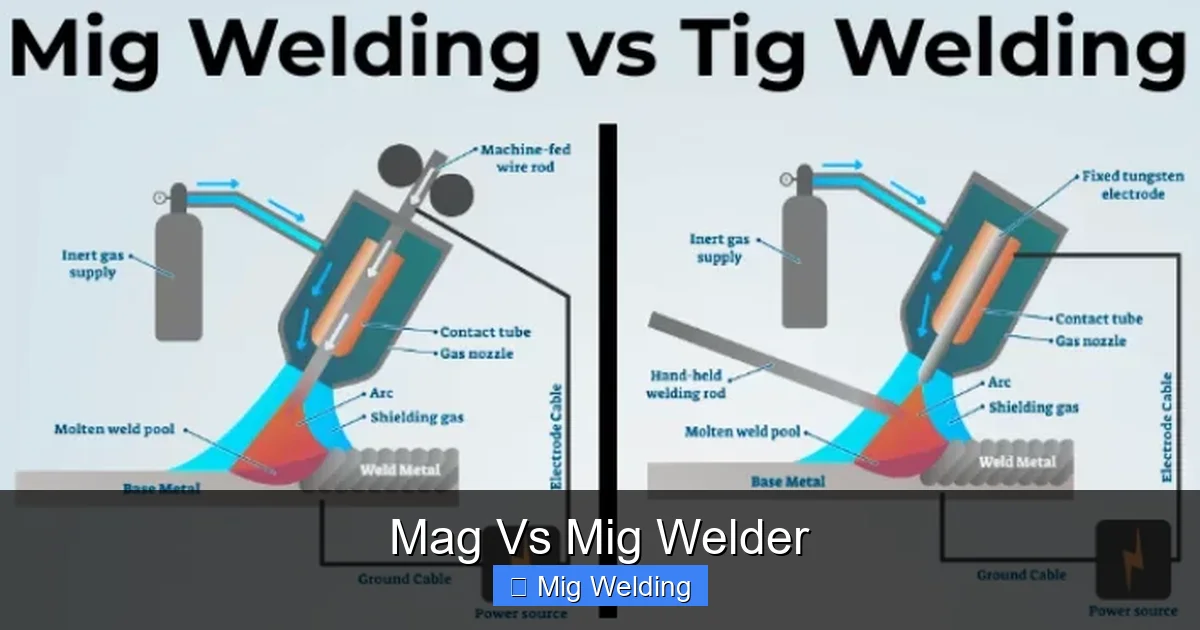
Choosing between a MAG and MIG welder can be confusing, but understanding their differences makes the decision easier. This guide breaks down both types, their uses, and how to pick the right one for your welding needs.
Key Takeaways
- MIG and MAG welding are both gas metal arc welding (GMAW) processes but differ in the type of shielding gas used—MIG uses inert gases like argon, while MAG uses active gases like CO2 or mixes.
- MAG welders are better for outdoor use and thicker materials because active gases provide deeper penetration and handle wind better than inert gases.
- MIG welding produces cleaner, smoother welds with less spatter, making it ideal for thin metals, automotive work, and detailed projects.
- MAG welding is generally more cost-effective due to cheaper shielding gases like pure CO2, while MIG often requires more expensive gas blends.
- Most modern welders are dual-purpose and can handle both MIG and MAG processes, giving you flexibility across different materials and conditions.
- Beginners may prefer MIG welding for its ease of use and cleaner results, while industrial users often choose MAG for strength and efficiency.
- Always match your welder, gas, and wire to the material you’re working on—using the wrong combo can lead to weak welds or equipment damage.
Mag Vs Mig Welder: A Complete How-To Guide
If you’re new to welding or upgrading your tools, you’ve probably come across the terms MIG and MAG—and wondered, “What’s the difference?” Don’t worry, you’re not alone. While both are types of gas metal arc welding (GMAW), they serve different purposes depending on the material, environment, and desired weld quality.
In this guide, you’ll learn exactly what MIG and MAG welding are, how they differ, and how to choose the right one for your projects. We’ll walk you through setup, operation, tips for success, and even troubleshooting common issues. By the end, you’ll know whether a MIG or MAG welder—or a dual-purpose machine—is best for your needs.
What Is MIG Welding?
Visual guide about Mag Vs Mig Welder
Image source: weldguru.com
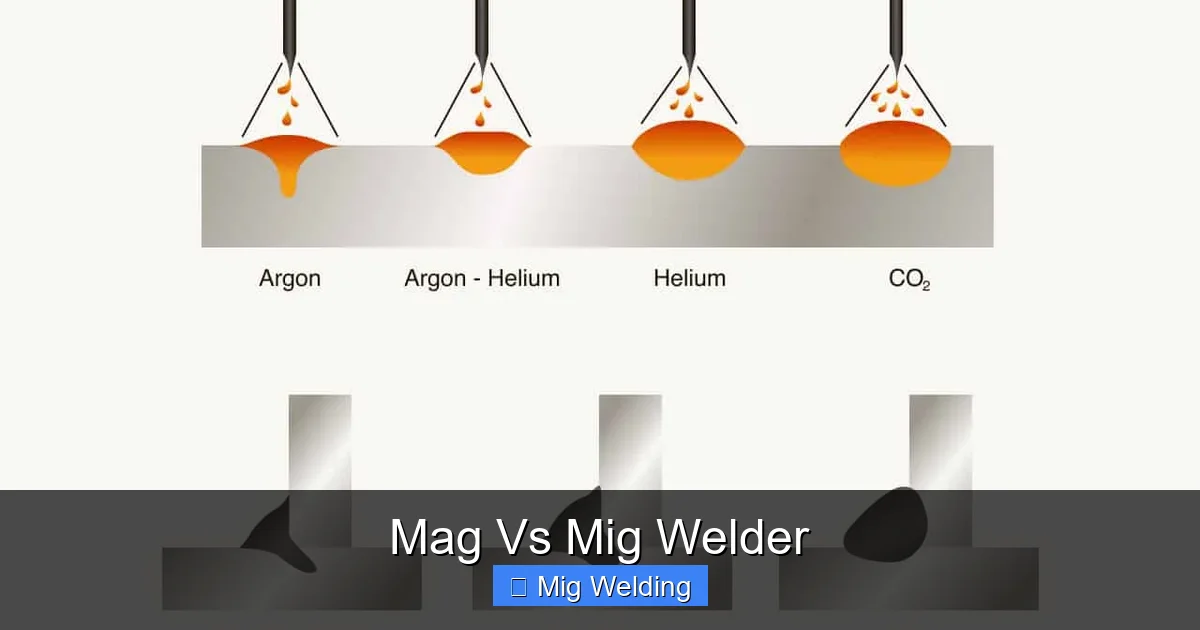
MIG stands for Metal Inert Gas welding. It uses a continuous wire electrode fed through a welding gun, along with an inert shielding gas—typically argon or a mix of argon and helium. This gas doesn’t react chemically with the weld pool, which helps prevent contamination.
How MIG Welding Works
- The welding machine feeds a solid wire electrode into the weld area.
- An electric arc forms between the wire and the metal, melting both to create a strong joint.
- Inert gas flows around the arc, shielding it from oxygen and nitrogen in the air.
- The result is a clean, spatter-free weld with minimal cleanup.
MIG welding is great for thin to medium-thickness metals like aluminum, stainless steel, and mild steel. It’s commonly used in automotive repair, fabrication, and DIY projects because it’s relatively easy to learn and produces professional-looking results.
What Is MAG Welding?
Visual guide about Mag Vs Mig Welder
Image source: cdn.thepipingmart.com
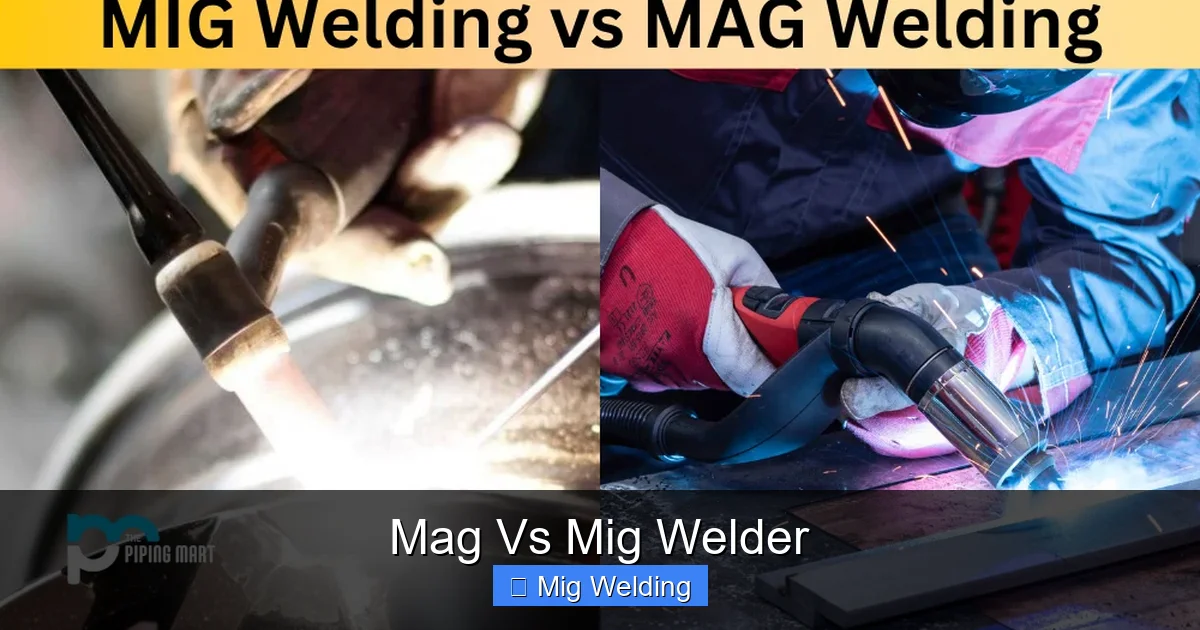
MAG stands for Metal Active Gas welding. Like MIG, it uses a wire electrode and a shielding gas—but here’s the key difference: MAG uses active gases such as carbon dioxide (CO2) or mixes of CO2 and argon.
How MAG Welding Works
- The process is nearly identical to MIG—wire feeds, arc forms, metal melts.
- But the active gas reacts slightly with the weld pool, increasing penetration.
- This deeper penetration makes MAG ideal for thicker, heavier materials.
- It’s more tolerant of wind and drafts, so it’s better for outdoor use.
MAG welding is widely used in construction, shipbuilding, and heavy fabrication. It’s powerful, efficient, and cost-effective—especially when using pure CO2, which is much cheaper than argon blends.
Mag Vs Mig Welder: Key Differences
Now that you know the basics, let’s compare MIG and MAG side by side.
1. Shielding Gas
- MIG: Uses inert gases like argon or helium. These don’t react with the weld, keeping it clean.
- MAG: Uses active gases like CO2 or argon-CO2 mixes. These react slightly, boosting penetration.
2. Weld Quality and Appearance
- MIG: Produces smoother, cleaner welds with less spatter. Great for visible or precision work.
- MAG: Can produce more spatter and a rougher finish, but the welds are stronger and deeper.
3. Material Thickness
- MIG: Best for thin to medium materials (up to about 1/4 inch).
- MAG: Handles thick materials (1/4 inch and up) with ease due to deeper penetration.
4. Cost
- MIG: More expensive due to cost of inert gases and specialized wire (like aluminum).
- MAG: More affordable—CO2 is cheap, and steel wire is widely available.
5. Environment
- MIG: Best used indoors. Wind can blow away inert gas, causing porosity.
- MAG: More wind-resistant. CO2 is heavier and stays in place better outdoors.
How to Choose Between Mag and Mig
So, which one should you pick? It depends on your project.
Choose MIG If:
- You’re working on thin metals like aluminum or stainless steel.
- You want clean, professional-looking welds with minimal cleanup.
- You’re doing automotive work, art projects, or detailed fabrication.
- You’re a beginner looking for an easier learning curve.
Choose MAG If:
- You’re welding thick steel or structural materials.
- You need deep penetration and strong, durable joints.
- You’re working outdoors or in drafty environments.
- You want to save money on gas and consumables.
Best of Both Worlds: Dual-Purpose Welders
Many modern MIG welders are actually MIG/MAG capable. These machines let you switch between inert and active gases, giving you flexibility. For example, you can use argon for aluminum (MIG) and CO2 for steel (MAG)—all on the same welder.
If you plan to work on a variety of materials, a dual-purpose welder is a smart investment.
Setting Up Your Welder: Step-by-Step
Whether you’re using MIG or MAG, proper setup is key to success.
Step 1: Choose the Right Wire
- For steel: Use ER70S-6 solid wire.
- For aluminum: Use 4043 or 5356 aluminum wire (MIG only).
- Make sure the wire diameter matches your machine and material thickness.
Step 2: Select the Shielding Gas
- For MIG on steel: Use 75% argon / 25% CO2 mix.
- For MIG on aluminum: Use 100% argon.
- For MAG on steel: Use 100% CO2 or 80/20 argon/CO2.
- Never use CO2 for aluminum—it will ruin the weld.
Step 3: Set the Voltage and Wire Speed
- Refer to your welder’s chart for recommended settings based on material thickness.
- Start low and increase gradually. Too much voltage causes spatter; too little causes poor penetration.
- Use a practice piece to test your settings before welding your actual project.
Step 4: Prepare the Metal
- Clean the surface with a wire brush or grinder. Remove rust, paint, and oil.
- Dirty metal leads to weak, porous welds.
- Clamp pieces securely to prevent movement during welding.
Step 5: Wear Safety Gear
- Always wear a welding helmet with auto-darkening lens.
- Use flame-resistant gloves, jacket, and pants.
- Work in a well-ventilated area or use a fume extractor.
Tips for Better Welding Results
Even with the right machine, technique matters.
Keep a Steady Hand
Move the welding gun at a consistent speed. Too fast = weak weld. Too slow = burn-through.
Use the Right Angle
Hold the gun at a 10–15 degree angle, pointing in the direction of travel. This helps gas coverage and penetration.
Maintain Proper Distance
Keep the nozzle 1/2 to 3/4 inch from the workpiece. Too close = spatter. Too far = poor gas shielding.
Watch for Common Issues
- Porosity: Caused by dirty metal or wind blowing away gas. Clean metal and use windbreaks.
- Spatter: Often due to high voltage or wrong gas. Adjust settings and use anti-spatter spray.
- Lack of Fusion: Usually from low heat or wrong angle. Increase voltage and check technique.
Troubleshooting Common Problems
Even experienced welders run into issues. Here’s how to fix them.
Wire Won’t Feed
- Check for kinks in the liner or worn drive rolls.
- Make sure the spool spins freely and the tension is correct.
- Clean the contact tip if it’s clogged with spatter.
Weak or Inconsistent Welds
- Verify gas flow (usually 20–25 CFH).
- Check for leaks in the gas line or loose connections.
- Ensure the ground clamp is attached to clean metal.
Excessive Spatter
- Reduce voltage or increase wire speed.
- Switch to a gas with more argon (e.g., 80/20 instead of 100% CO2).
- Use a shorter stick-out (distance from tip to workpiece).
Conclusion
So, Mag vs Mig welder—which wins? The truth is, neither is universally better. It all comes down to your project.
MIG welding shines when you need clean, precise welds on thin or non-ferrous metals. It’s user-friendly and great for beginners. MAG welding, on the other hand, delivers power and penetration for thick steel and outdoor work—plus it’s more budget-friendly.
The best choice? A dual-purpose MIG/MAG welder. It gives you the flexibility to handle almost any job, from repairing a car bumper to building a steel frame.
No matter which path you choose, remember: practice makes perfect. Start with scrap metal, fine-tune your settings, and always prioritize safety. With the right knowledge and tools, you’ll be welding like a pro in no time.
